

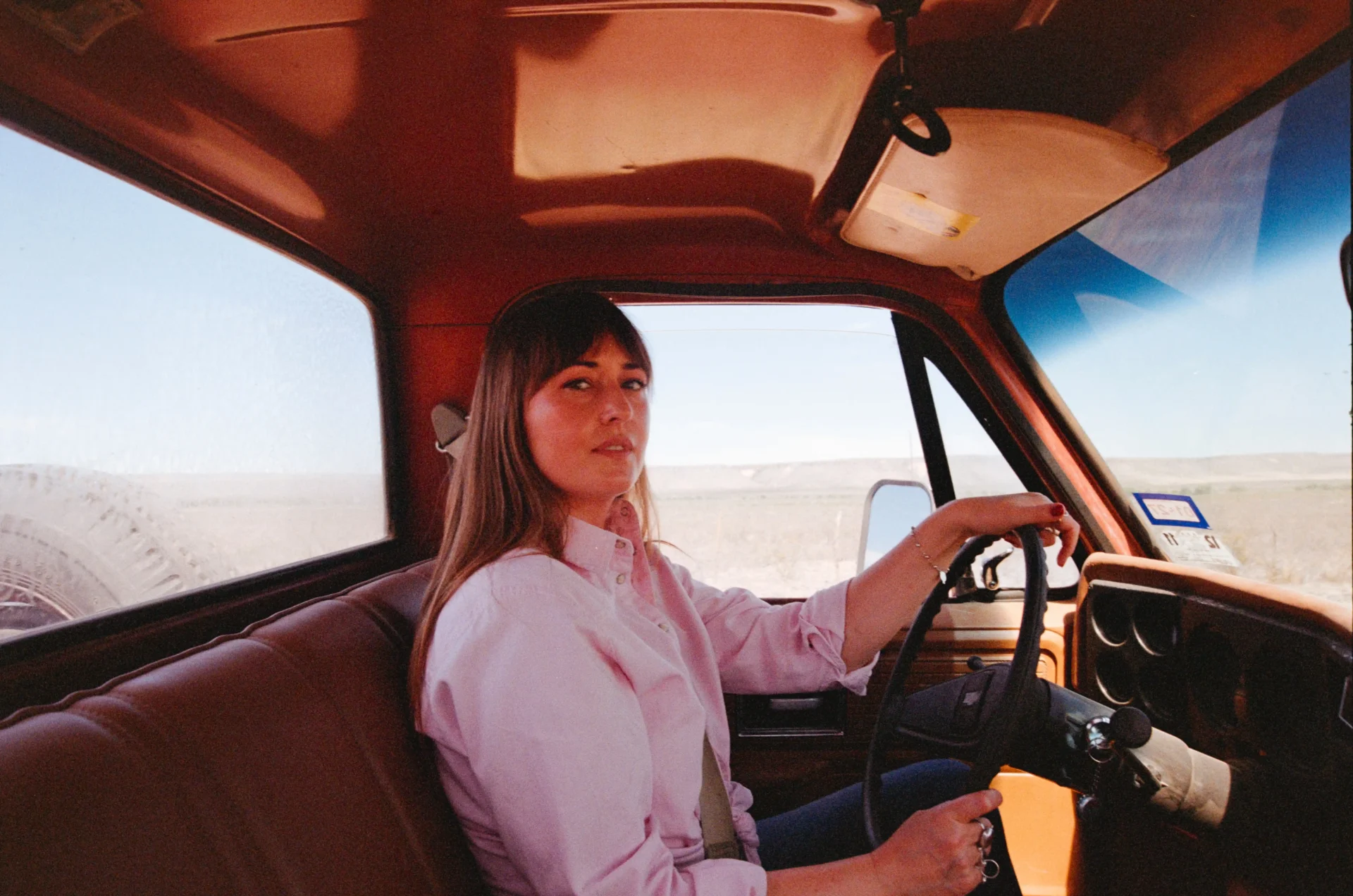
“It is easy to see the beginnings of things, and harder to see the ends.” So begins Joan Didion’s essay ‘Goodbye to All That’, a major influence on Jess Williamson’s new album, A Mile South of Heaven. Maybe part of why the record sounds so organically easygoing is because it feels like a fresh start; it’s the singer-songwriter’s first after completing her deal with Mexican Summer and signing with the more twang-forward New West Records, as well as her first with producer Shooter Jenkins after a couple with Brad Cook (2022’s I Walked with You a Ways, Williamson’s collaborative LP with Waxahatchee as Plains, and her 2023 breakout Time Ain’t Accidental). There was no breakup or tragic loss to anchor the album’s narrative this time around, so she gravitated back to timeless questions of belonging and identity. On ‘Goodbye to All That’, the record’s opener and lead single, she pens her own complicated farewell to Los Angeles, her part-time home and host of childhood ambition. What’s harder to see throughout the record – wondrous, deeply resonant, and completely unforced – is that she’s simultaneously finding ways to cling on to it.
In practical terms, Williamson splits her time between LA and Marfa, Texas, about five hundred miles away from Dallas, where she grew up. But listen to a song like the closing ‘The Gem and Mineral Show’ and you’ll realize she’s rarely writing about one city without feeling the hum of the other. The easy thing would be to say that she’s caught in the middle, as she puts it on the opening track; later, on ‘Country Mile, she sings, “Just step to the middle and you won’t have to fight.” And while she might be referring to an argument between lovers, there’s a similar benefit to living in between places, committing to loneliness as opposed to community, and chasing the phantom of fame. A Mile South of Heaven clearly isn’t a record born from that frictionless dream, though. Williamson is a poet, after all, a mystical songwriter amassing battle scars from fighting the wind and playing with fire in order to calm down. Whether you’ve never visited the US or tuning in from the exact stretch of highway Williamson adopted to promote the album, it’s hard to deny that it sounds, in the purest sense, like a force of nature.
We caught up with Jess Williamson to talk about a Joan Didion essay, being alone in hotels, the Chateau Marmont, and other inspirations behind A Mile South of Heaven.
Joan Didion’s essay ‘Goodbye to All That’
As the basis for the opening track, I wonder how the essay helped you understand your relationship to LA.
Joan Didion wrote this essay about leaving New York City. It starts off describing when she first got there, and how wide-eyed and thrilled she was about everything, and then goes into how after eight years, she realized that you meet the same people at the parties that you go to, that it’s possible to stay entirely too long at the fair. The sheen wears off, and she realizes that she’s ready to go. She wants to leave New York, and what it had meant to her when she was brand new in her early 20s changed; she was a little jaded and over it. I love that essay, and I read it a long time before I ever moved to LA. When I was coming up on my eighth year in Los Angeles, I had a lot of similar feelings as Joan Didion has in her essay, and I felt like, “I think I’m ready to go. I think it’s time for me to leave LA. I don’t really know why I’m still here – my family is all in Texas, my boyfriend is in Texas.”
At that point, I’d been going back and forth between LA and Marfa already, and spending even more time in Marfa, really, than LA, so that complicated things, too. I’d get back to LA and I’d kind of be like, “Anybody out there? I’m here.” It just started to feel like, “I don’t know if I need to keep being here.” I think it was valuable and meaningful to come here when I did, and I’m so grateful that I did, but I had this moment of, “I think it’s time to go.” So I wanted to write a song about it as my goodbye to LA. I was like, “Okay, this is gonna be my ‘Goodbye to All That’, but it’s gonna be about LA, and it’s gonna be a song.”
I wrote that song really fast. It’s funny, sometimes songs come so fast that I think it’s almost too easy, so that one must not be very good or something. This was one that I wrote really fast in an afternoon, so for a while, when I just had demos of these songs, I had that demo at the very end because I was like, “I don’t know about that one.” Everyone that heard them would be like, “No, I like that one, actually.” It’s funny how I overlooked that song – it ended up being the lead single – just because it came so fast it almost felt too easy. Something that I’ve realized about songwriting is a lot of times it does feel like you’re channeling something that’s coming from somewhere else, and you’re just trying to catch it while it’s there.
That one was really a unique situation, because as I was writing it, when I got to the third verse where the lyrics say, “Goodbye to the poets, the dreamers, and their songs / I’m afraid there’s so much I still haven’t done” – I’m gonna cry now, because I was tearing up. I don’t know where those lyrics came from. It didn’t really feel like I wrote them – it was like I was saying my goodbyes in a genuine way in that moment. That really hit me hard, where I was like, “I don’t want to say goodbye to the dreamers, the poets, and their songs, and there is so much I still haven’t done.” It was this thing where I was like, “Dang, I do feel lonely here at times, and I do sometimes question why I’m still in LA, but I don’t feel ready to let it go just yet.” It was a weird thing where the song itself kind of helped me realize I wasn’t quite ready to say goodbye.
There’s this part where she writes about kind of cherishing the loneliness of the big city in a way, and in your song, you’re crying out for it. I wonder if you can speak to that kind of the double-edged sword of loneliness.
I think loneliness can be very useful in some ways because of the anonymity of being in a big city. You can have dinner alone at the bar at a fancy steakhouse, and nobody knows who you are, and it can feel very romantic, very inspiring, fun, and cool. There’s a loneliness that can be really romantic and valuable as an artist, too – to be completely untethered from anybody’s ideas that they have about you, because so much of being an artist is building your own mythology. When you come from somewhere and you have family, you have people that have known you for a really long time, they think of you a certain way, and maybe keep you in a certain box. It can be tempting to put yourself in that box, even as you’re growing and changing and evolving and finding who you are. In that way, I think loneliness can be transformative and powerful and empowering – to be alone and define who you are in a new environment.
But I also think the double-edged sword of that is – and this is a lot of what the song is kind of about, and also Joan Didion’s essay – there’s kind of a time for that, and then there’s a time in life where family, community, home, being known, and being able to be your authentic self matter more. Not having to have mythology around you and not needing to go out there and be sparkly in the world. When I moved to LA, it was the right thing to do, and it was the right time for a lot of those feelings I talked about earlier. Then when I wrote this song, it was me kind of realizing that there are other things I want in life now. I still value the romance of some of that solitude, but I also don’t want to be just a loner forever, sitting at the bar having dinner by myself with a book, you know?
Being alone in hotels
It ties into an interesting duality that I noticed in relation to being alone in hotels – in ‘Tracking the Tropics’, you describe it as an out-of-body feeling, while in ‘Hum of the City’ it makes you feel at home. Do you remember the first time you checked into a hotel alone?
I can’t remember the first time I checked into a hotel alone, but I do remember the first time I was in a hotel alone, and it was scary. It was when I was in college. I studied abroad in Barcelona, and my aunt was a flight attendant, so she worked it out to where my flight to Barcelona was a flight that she was working. I got to go with her, which was really sweet because I was a teenager in college who had never been overseas. I got to be on her flight, and then I went with her from the airport to the hotel where her and all the flight attendants were staying. That night we went to dinner, and the next day she had to leave so early for her next flight back. I vaguely remember her saying bye, and I fell right back asleep.
When I woke up, she was gone, and I was alone in a hotel room in Barcelona. I was so scared because I was like, “How do I – I don’t know where anything is.” I knew I was supposed to meet or go somewhere with the school, I had an address, and I knew to ask for a taxi. That was all that I knew. That’s such a fun question because I haven’t thought about that in so long, but it’s actually sweet to think back on my younger self because what I just described is incredibly routine now. [laughs] But back then it was scary.
Is that part in ‘Hum of the City’ based on a real conversation with a bartender?
It’s kind of a conglomerate of a few stories. There are a few situations like that on the album where a few different real experiences for me get put together into almost a short story. There have been so many times where I’ve been in conversation with a bartender in a hotel lobby. I am very opinionated about music, and I have certainly asked bartenders to change the music, turn it up or down, or put on my playlist.
Your own playlist?
Yeah! Depending on the situation, sometimes that is actually welcome, believe it or not. [laughs] So it isn’t one particular moment; it’s more of a window into being a solo traveler, being open to the place that you’re in, and the conversations you can end up in with strangers. The lyric is, “Asking the bartender to please change the song/ There’s a story there, but it’s too sad and too long/ Just play some old country music where they find true love or lose it.” Basically, I have had this experience with people that just don’t know that much about music – music isn’t that important to everyone, so sometimes they’ll just have something on and they’re not even paying attention. I’ve had this experience of suggesting that someone put on Willie Nelson or Waylon Jennings, and noticing how, when you put on music like that, it completely transforms the energy of the space. I think – and maybe I’m biased – it elevates the mood, it puts people at ease, it’s sexy and laid back. I’ve had this amazing experience of seeing people realize they’ve never really listened to old country music, like Patsy Cline, where they’re like, “Oh, this is cool.” I’m like, “Yeah, it’s the coolest.”
That’s one of my favorite moments on the record, exactly because I feel that transformation happening in the space of the song, the way it slows down.
Thank you. I know what you mean. It is almost like its own little song within the song.
It’s also like the thing that makes you feel at home is the yearning for that feeling.
Yeah. Also, feeling so at home alone in hotels a little bit harkens back to that solo artist self, when you’re untethered and out in the world. You can kind of be whoever you want to be for a night, you know? There’s something about that that feels like being home. Too much of it gets lonely, but every now and then, checking into a nice hotel all by myself, I’m like, “This is the dream.” Probably the lyric really should say, “I feel so at home all alone in a nice hotel.” [laughs] That’s the key. When it’s a crappy hotel, you’re like, “Dang, get me out of here.”
Do you have a specific kind of crappy hotel in mind?
Oh my gosh, so many! And that’s the hotel lobby reference on ‘Tracking the Tropics’, it’s more about the functional hotels that I’m in when I’m touring. They’re just chains, and they’re fine, but it’s not anything fancy, you know?
They’re not going to play your own playlist, probably.
No, they probably don’t even have control over the music.
Highway 2810 in Marfa, Texas
First, I want to say congratulations on adopting a highway. I didn’t even know that was possible. How did the idea come to you?
You see these signs around Texas a lot – and in California, too, but moreso in Texas – you’ll just be driving and it’ll say this segment of highway was adopted by a business, a family, or in memory of a person. I’d always seen it, and I never knew how it worked; I just thought it was a neat thing. I started thinking about doing it myself when I realized that I wanted to call the album A Mile South of Heaven. I also do have a special relationship with this specific stretch of highway that I got to adopt. This part of the highway has been a part of my process with this album, and my last album, Time Ain’t Accidental – basically as long as I’ve been splitting time in Marfa.
It’s a cool program because you’re volunteering to keep that stretch of highway clean and pick up litter. Officially, you have to get a group together a few times a year and report it to the Texas Department of Transportation, and they give you vests and trash bags. I thought, “Cool, this is a great way to take care of that area that already means a lot to me,” and I’m out there a lot anyway on my walks. I thought it would be a fun thing to do in association with the album and give people a physical place that they can go and listen to the record. That would be my dream: for people to go take a drive out there and just listen to the record. That’s why I’m calling it the unofficial Mile South of Heaven.
You mentioned going on walks there, and I know you test-drove material around there. How do you feel the ritual of it and the landscape itself helped give shape to the record?
I think that there’s something really powerful about walking down an empty highway surrounded by big, open sky, mountains in the distance, cows, little critters on the road, and sometimes wildflowers. You’re just enveloped by the big expanse of the sky, and no one’s around. Listening to this music that I’m making, knowing that the goal is that it’s going to be out in the world for all to experience, but having it first just for me, surrounded by so much beauty that’s so big, while I’m so small within it – there’s something about that that is clarifying for the choices that I made with the album.
It’s easy, when you’re in a city and in a community of musicians, to be bouncing ideas off each other or thinking about what other people are doing. But being out there, I’m just thinking about what I’m doing, what I want to say, and what musical choices feel good to me. I’m almost bouncing the ideas off of the landscape and the sky, instead of comparing it to what is doing well on the internet right now. It’s a different perspective. There’s a big, wide world out there of things you can do with music. Sometimes if you’re just on the internet or in a city with your friends, you can think maybe there’s a narrow path, but there are actually limitless options, and there are a lot of people in the world that like all kinds of different things. So, I hope that it helps me to just think expansively and be open to a lot of different ways of writing lyrics or making musical choices.
Also, it’s just pretty, and I like walking. I also like to drive it, because I can see more stuff and go much further when I drive. It’s a really great way to get out of the house, be out in nature, and listen back to what I’ve been working on.
Did you listen to other records as well, or did you just stick to your own demos around that time?
I’m always listening to music, but there wasn’t any specific album that I was really listening to all the time when I was writing the songs or making the record, which is somewhat intentional because I want it to feel like me. But just being a lifetime lover of music, there’s so much music in my unconscious mind that influences and references sneak in, but nothing intentional like trying to go for something that’s already existed. I like to listen to a lot of ambient music around the house, honestly. It’s just really relaxing and grounding, and it’s so different from what I do that it feels like a supportive thing to have on that’s just kind of an attitude.
The White Horse in Austin, Texas
I believe that’s the bar you sing about in ‘Tracking the Tropics’, a place where you spent a lot of time in your 20s.
All through my 20s, I was living in Austin. I was working at a Mexican restaurant on the east side, I would ride my bike to work, and then after we would close the restaurant we would go to the bars, and I would meet my friends. Every weekend, I would go to this bar called The White Horse in East Austin, and it’s still there. I didn’t even know at the time how lovely of a period of time that was in my life. I was starting to play shows, I was recording, starting to self-release music, and playing shows around Austin, or booking little DIY tours, or maybe I’d fly to New York to open for a friend. But I was still waiting tables and bartending and nannying. I had such a cool group of girlfriends and a really cool music community in Austin. It was such a nice time.
Back then, I took it for granted, because I just really wanted to be able to do music as my job. I had this big dream, and I wanted to make it work, and now I do get to do that, and I’m so grateful. Sometimes it’s challenging for unique reasons that you could never totally predict or realize until you’re kind of in it, just like anything in life. Obviously any dream or goal or anything worth doing in life has its challenges that you’re not gonna know about until you’re in it. So that song, ‘Tracking the Tropics’, I was on tour and having a hard time with it, and wishing I could get in a magic time machine and go back to being in my early 20s with my friends, just kicking it at the bar on a Friday night, not a care in the world.
Obviously you can’t go back to another time, and you can’t go back even to the same place in a different time, because now the east side of Austin, where I used to live, is a very different place. When I go back to The White Horse, it feels different. I don’t know anybody there anymore. It’s a little bit almost like going back to your old high school and you’re like, “There’s my old locker, there’s my old teacher’s room,” and you can’t really go back. But in a way, I don’t think of it as a sad thing in the song. I actually just think of it as appreciating the past, because at the time when I was in it, I was really happy and I was having a lot of fun, but I don’t think I understood what a sweet time it really was until later.
When was the last time you went back there?
The last time I went was almost two years ago. I was there in December of 2024, but maybe I’ll go tonight. I’m in Austin. Maybe I’ll go.
Morning Pages
I have some context because I read your newsletter post about starting the practice. Tell me more about what it unlocked for you and how it fed into the album.
Morning Pages is this practice I learned about from reading The Artist’s Way by Julia Cameron. But I should say, like so many people, I never finished The Artist’s Way. I bought it, I started reading it, I read the part about Morning Pages, read a little bit more and kind of gave up on it. It’s so funny, there’s a bumper sticker – I can’t remember exactly what it says, but apparently this is a very common thing to never finish The Artist’s Way. Basically the practice of Morning Pages is that you get a journal, and every morning when you wake up, you write three full pages in your journal. Whatever size you choose, a page is a page, and you write three. The idea is that it’s not for anyone else to read; it’s not even for you to go back and read. It’s just dumping your thoughts on a page. It’s not meant to be a to-do list – it’s just putting pen or pencil to paper and getting your thoughts on the page before you start your day.
It has become a daily ritual for me, and I’ve been doing it for like 10 years now. I make my coffee, I light a candle or incense, I have my Morning Pages playlist that I’ll put on, or sometimes I mix it up with some other ambient music. But I don’t like a lot of words – it’s very specific, so I don’t want it to be distracting, but I do like to have music on when I do it. I just put my thoughts on the page, and it’s something that’s become so necessary now. I feel like I’m almost addicted to this or something, because when I don’t do it, I kind of feel it all day. I feel a little disjointed or not as grounded.
As far as directly how it influenced the record, it’s hard to say because I don’t go back and read it. But I have all these journals from all of the life that I lived that I ended up writing these songs about, and so I’m sure it influenced it in some way. It certainly helped me make sense of it all.
The Chateau Marmont in Los Angeles
You reference it on the last song, ‘The Gem and Mineral Show’, where, even though you’re “sipping champagne with the Queen of Americana” – and I think this relates to Morning Pages – you’re not describing the scene so much as your internal monologue. You could give some insight into the story behind the song, but I’m also curious if that’s one you ended up editing a lot in terms of the lyrics, maybe trying to home in on the feeling as opposed to the details around it.
That is a song that I took a lot of time with the lyrics on, because it deals with a lot of important things I was going through, and I wanted to figure out how to say it right. I was editing the lyrics right up to recording, probably. Whereas ‘Goodbye to All That’ was one of those songs I wrote quickly in an afternoon, ‘The Gem and Mineral Show’ went through a lot of different iterations.
I found myself getting a last-minute invitation to a Grammys afterparty at the Chateau Marmont in Los Angeles. I was invited by Jack Antonoff because he had posted that my song ‘Hunter’ was his number one most listened to song of 2023. So I went to this party. I’d never been to anything like that before, and I was very much in awe of the whole situation. There were all of these pop stars there, and the Queen of Americana that I reference in the song is Taylor Swift. She was there, and I got to meet her, and it was just crazy. It was like a fairytale, like a movie. It’s the stuff that you think about – the reason you move to a place like LA is that maybe you would end up at something like this. It was one of those moments where I was like, “Oh my God, this is the dream, to be able to be here.” Then, of course, I’m thinking not only in the present moment, but what it’s gonna mean. Are these my friends now? Are these my collaborators now? Is this gonna be my community now? My gears were churning.
Her boyfriend’s family’s cabin in Terlingua, Texas
Then, the very next month, my dog died. That was very devastating for me, because she was like my child. My boyfriend and I buried her at his family’s land in Terlingua, Texas, near the cabin that his dad built. It’s an off-grid adobe cabin that his dad built by hand back in the ’70s. We buried her there, and I basically just spent the next month or so in Marfa in mourning, going down to see her as much as I could. The cabin is about an hour and a half away from Marfa. This one day, I was driving out there because we made this really cool cactus garden. Every time I would go, I would plant a cactus or leave a candle or something, so it was just nice to have something to do because I was so sad – somewhere physical to go and something to do that felt like I was being useful in some way.
Alpine, Texas is the town that you drive through to get to Terlingua from Marfa. They were having a gem and mineral show, which they do every year, and I had never been before, so I decided to stop by. I was wandering through the aisles with all the crystals and fossils and stuff, and I was thinking about how just a few weeks before, I was in a fancy dress at the Chateau Marmont with the Queen of Americana, which is what I’m calling Taylor Swift. I don’t mean Americana music; I mean like Americana, like the American dream, basically.
Like Miss Americana.
The documentary that she made about herself, exactly. [laughs] And there I am in Alpine, Texas at this gem and mineral show wearing work pants and camo, thinking, “I’m kinda like a tourist here at this gem and mineral show in Alpine, and I was kind of a tourist there.” That’s not my community, those people aren’t my friends, I’m not collaborating with them. I got invited for a night, and that was it, and that’s lovely. But I’m not in the inner circle, and I was struck by how I was kind of allowed to be in both places, and yet not really feeling totally like an insider, or totally knowing where I belong. If I moved to LA with the hope to make my dreams come true or whatever, a night like that kind of feels that way, but if nothing else really happens… I mean, it’s neat, it’s like a fun story, a cool thing to get to do, but where do I really belong?
I’m sure you can relate to this being Greek, but “tourist” is kind of an insult, right? Those are the people that come in, take pictures, and kind of mine whatever’s going on for content or for their own experience, but they’re not really part of it; they don’t really get it. It’s an insult in LA to be a tourist, and it’s an insult kind of in West Texas to be a tourist. So for me, that lyric, “You don’t have to tell me, I already know/ I’m a tourist here, I come, I go,” is a little bit like getting ahead of the insult. I’m not trying to say I’m a local in West Texas, and I’m not trying to say I’m friends with pop stars.
Then the next question is a big question of the whole album, which is, “Well, then what kind of am I? Where is home? Where do I really belong?” I’m still kind of asking that, but for the meantime, the answer that I’ve landed on is I think where I belong is in the music. Going back and forth between LA and Marfa, in its own weird way, feels like the most home thing that I can think of right now for me. It happens to be two places, but it’s feeding different parts of myself, so it’s working for now.
When you said “in the music,” I thought you were maybe going to say “in the middle,” because I do feel like in ‘The Gem and Mineral Show’, there’s this full-circle moment of feeling like you’re in the middle, which comes up in ‘Goodbye to All That’ and even ‘Country Mile’.
I think you’re right, because it can be so enticing to want to have answers, and for things to be black and white, but there is some comfort in surrendering to the gray area, which we could call the middle, and not needing to know yet, and kind of seeing what happens – being open.
We’ve talked about a lot of different places in this conversation, but when you think about that cabin, or West Texas in general, does it feel different to you now compared to when you wrote these songs?
My experience now with Marfa is different than when I wrote ‘The Gem and Mineral Show’. I wrote that song maybe two years ago, and since then, my relationship to Marfa has really evolved. Now, it does feel like home, actually. I think the way that I’m orienting my experience is that Marfa’s home. Marfa’s really where my community is, and it’s where I feel the most comfortable, at peace, and settled. LA is a place that I still get to go, and I go when I need to be there and have a reason to be there, but I don’t want to be there all the time.
This week we had a really special event in Marfa for the album release, and it was such a truly magical night. So much of the community showed up, my friends showed up, and the organization that I put it on with, called Ballroom Marfa, was just so generous to do it with me. It was a neat little heart moment where I was like, “Yeah, this actually is my home.” I’ve always loved that place since the first time I went there. I’m not there all the time, and people that are true Marfa locals have earned that title, because it is not an easy place to live year-round. I wouldn’t want to try to say that I’m a true local, because I’m not always there, but it does feel like a place where I can really feel relaxed and feel good.
There’s not anything to prove out there, in a way. There are just really great people, and it’s a wonderful place to be. I just got there a couple days ago; I drove back from LA into Marfa, and I got in kind of late. It was dark, and I pulled up to my little house there, and the light was on inside. There’s a cat that lives in the yard that I love so much, that I named Tomas, and he was there. I had been gone for a while, and I was just smiling so big. I was like, “Yeah, I’m home. I love it here.”
This interview has been edited and condensed for clarity and length.
Jess Williamson’s A Mile South of Heaven is out now via New West Records.

