

As artificial intelligence tools are transforming how digital products are built, product designers are stepping into speculative environments to explore how emerging technologies interact with human perception.
Kalyani Tupkary, a senior product designer and foresight strategist whose work bridges functional user interfaces, interactive systems, and speculative design, would know.
Tupkary, who has spearheaded design initiatives at companies like Twitch and Roblox, was recently selected as one of five creatives for a four-week juried residency co-hosted by generative AI platform Flora.ai and The Intersection of Art & Technology (TIAT), a San Francisco gallery dedicated to creative technology.
The residency culminated in The Olfactory Thing, an exhibition where residents were challenged to use Flora’s creative AI software to visualize olfactory experiences and translate scent into tangible interactive formats.
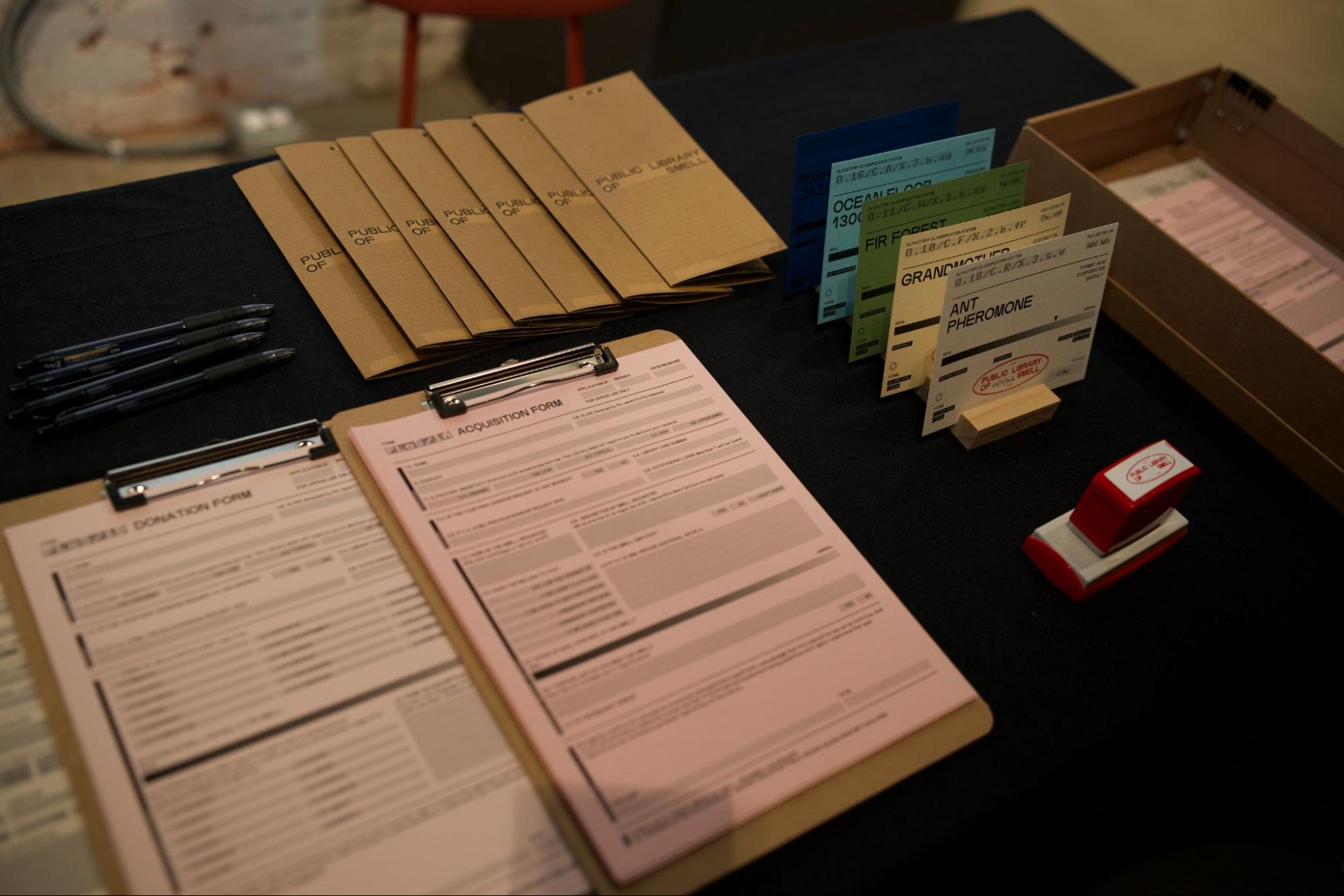
Tupkary’s practice combines traditional product design with foresight methodologies.Rather than focusing strictly on visual generative output, Tupkary utilized the residency to design an entire conceptual institution: the “Public Library of Smell.”The installation reimagined how society classifies, cataloged, and interacts with olfactory memories by applying the familiar organizational structures of a traditional public library, to scent.
“I created the Public Library of Smell, a fictional institution that attempts to classify, catalogue, and arrange smells,” Tupkary said. “Using the familiar structure of a library, the project explores how our most elusive sense might be categorized, or perhaps mis-categorized, if treated with the same systems we apply to sound, image and text.”
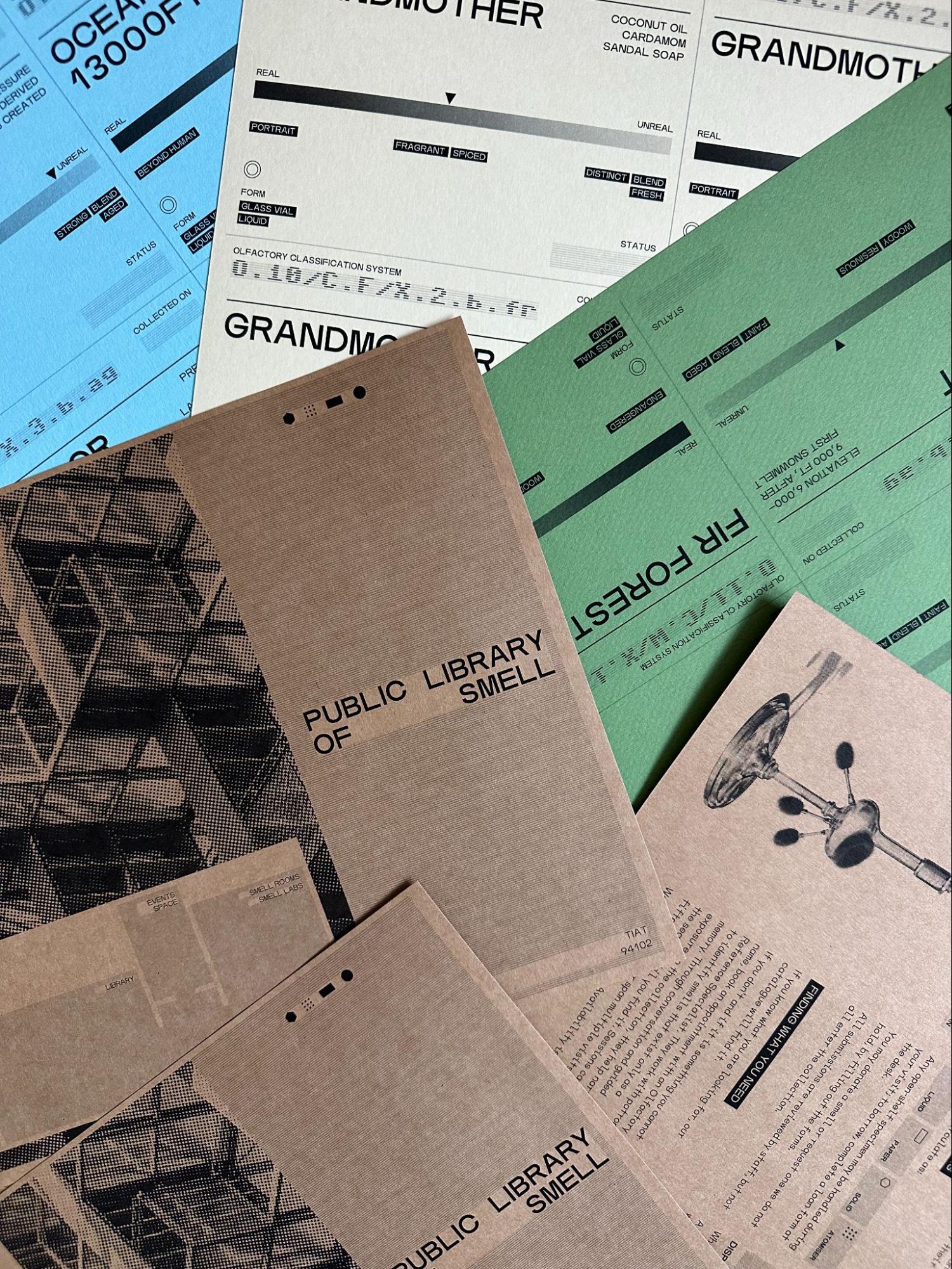
The installation featured an array of physical and digital touchpoints, including library card drawers categorized under an 18-part Olfactory Classification System, a service kiosk, informational brochures and intake forms for visitors to borrow, lend, or donate their own scents. The graphic design of the project was created by Sneha Sankar.
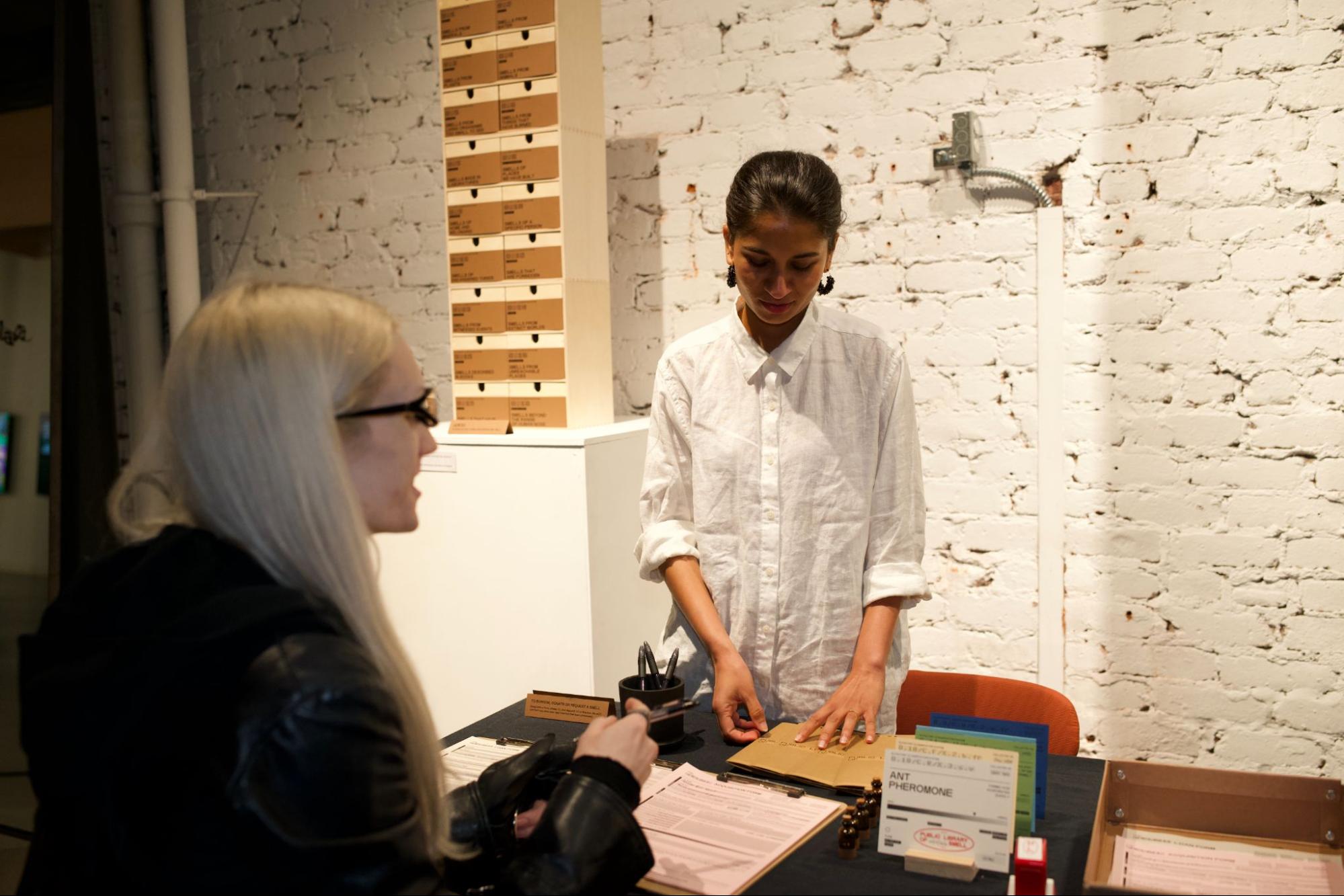
The 18-scent list included familiar scents like “Grandmother” and “Fir Forest,” as well as unusual categories like “Ant Pheromone,” designed for non-humans. Tupkary, dressed in a white linen collared shirt resembling a librarian’s outfit, guided guests through each scent and its background.
Tupkary personally staffed the installation desk as the head librarian, guiding visitors through scent requests processed like authentic library transactions.
“It made me wonder: what if, instead of an archive, there was a public institution around smell?” Tupkary explained. She drew inspiration from field research at the Aftel Archive of Curious Scents in Berkeley, California.
“Unlike an archive, which suggests preservation of fixed materials, a library is dynamic, shaped by its visitors, continuously updated, and always incomplete,” she adds. “I identified quintessential library artifacts and experiences—brochures, forms, library cards, drawers, and a librarian’s desk—and reimagined each of them around the sense of smell.”
By treating the fictional library as a fully realized product, Tupkary applied core user-experience principles; system design, interaction flows, physical touchpoints, and informational hierarchy, to make the speculative concept feel practical and accessible to gallery visitors.
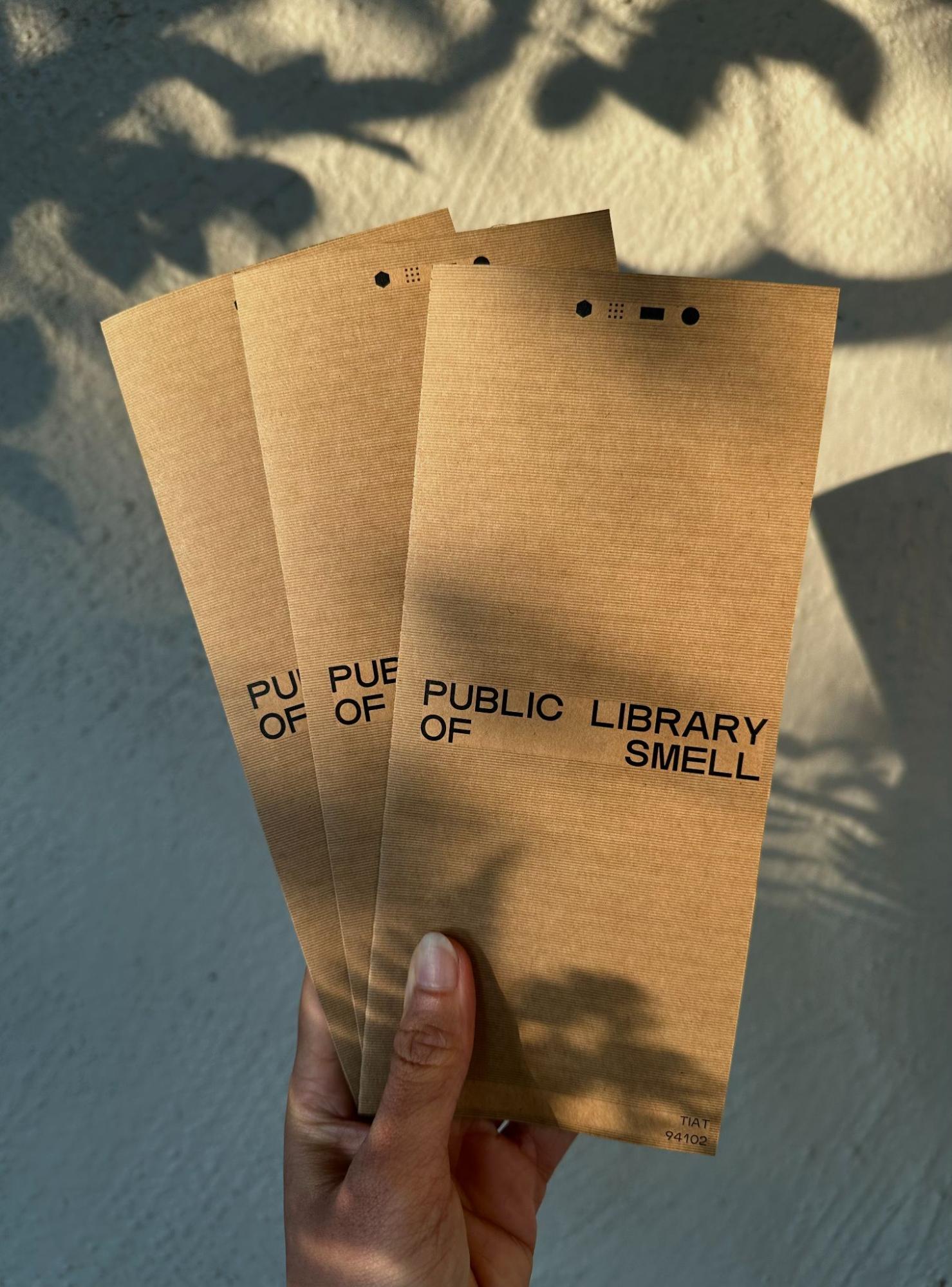
“This is where my product design practice comes in,” she added. “I designed the objects, interactions, and systems that made it feel functional, and therefore real. They grounded the speculative idea and made it tangible.”
Tupkary’s work at the TIAT Gallery highlights a broader career trajectory defined by translating emerging technology into concrete digital and physical experiences. Her professional portfolio features high-impact commercial design projects alongside open-source framework contributions.
At Twitch, Tupkary conceived and led Twitch from the Future, a foresight initiative that translated complex qualitative and quantitative research into speculative product features and interactive prototypes.
To demonstrate how potential product concepts could operate in real-world scenarios, her team installed an immersive pop-up experience inside Twitch headquarters, allowing executives and engineering teams to test hypothetical features firsthand. The methodology proved influential, directly shaping annual product roadmap strategies before Tupkary co-presented the framework on stage at Figma’s Config conference in 2023.
Her broader portfolio also includes Calendar Collective, a living archive exploring alternative human perceptions of time featured in MIT Press’s Not Here, Not Now, as well as experimental physical-digital interactions such as the Braided Lamp, a lighting object activated through the tactile act of braiding.
Industry advisors for the TIAT residency, a panel including Julian Bleecker of Near Future Laboratory, Kenneth Kuh of Cursor, Leia Chang of the Exploratorium, and Scott Snibbe, worked directly with Tupkary and the other residents for weekly critiques to refine their concepts.
Tupkary noted that feedback from advisors helped deepen the philosophical framework behind her installation, particularly regarding how human systems organize perceptual data.
“It helped me push the project further,” Tupkary said. “One conversation that particularly influenced me was with Julian Bleecker, who shared the Heavenly Emporium of Benevolent Knowledge. It unlocked a new way of thinking about perception that shaped my project.”
As artificial intelligence platforms continue to automate routine design and software engineering tasks, technology companies are placing greater emphasis on designers who can evaluate how emerging tools impact human behavior, culture, and long-term user expectations.
Tupkary believes that putting generative software like Flora.ai into open-ended, experimental environments allows creative technologists to uncover edge cases, unconventional applications, and novel interaction patterns that standard product development cycles often overlook.
“The tools are changing at a speed that is hard to grasp, so we don’t always know how they will fit into workflows, what their full potential is, or how people might use them in unexpected ways,” Tupkary said. “That’s why it can be valuable for technology companies to put emerging tools in the hands of creatives and let them experiment.”
In an industry environment where short-term execution often overshadows long-term strategy, Tupkary argues that product design must maintain a strong prospective focus to help organizations navigate technological shifts responsibly.
“Through that process, creatives can uncover possible applications, behaviors, and experiences that may not be immediately apparent,” she noted. “Foresight provides a way to explore those possibilities and translate emerging technologies into tangible experiences that help companies understand where their tools could go next.”

