TheWorld Health Organization announced an alarming trend of physical inactivity among roughly 1.8 billion adults. This puts them at higher risk of developing cardiovascular diseases. So is moving more a solution? It is. But putting that advice into practice is another story. For many, the hardest part of working out isn’t always the workout itself. Sometimes, it’s figuring out what to do. Finding the money to pay for pricey memberships and human trainers. Facing intimidation when surrounded by “fit people.” Thankfully, there’s a way forward: AI tools for fitness and workouts.
With these modernAI tools, people looking to get active and even fitness enthusiasts can remove guesswork. That said, here are five essential picks that use goals, training history, equipment, recovery, and performance data to make workouts more personal.
Top Five Best AI Tools for Fitness and Workouts
Fitbod
Fitbod acts like a personal resistance and strength trainer. This app considers the logged history, per-muscle recovery estimates, fitness experience, goals, and available equipment. It uses this to pick exercises, sets, and weights and provide appropriate workout plans. So users no longer need to guess which muscle group needs a break. Fitbod’s recommendations adjust as users log sets, reps, and weights. There’s even an exercise library with high-quality video demonstrations for proper form and technique.
Key Features:
Building a balanced training plan with realistic load progression
Detailed exercise guides and videos
Seamless syncing with health apps and wearables
Pricing:
Free Trial
Monthly Membership Package – $15.99 per month
Annual Membership Package – $95.99 per year
Real Use Case:
Strength athletes who lift three days a week but train at different gyms can use Fitbod. By telling the app what’s available, they can get customized sessions built around what they can access in the area.
Zing Coach
Image Credit: Zing Coach
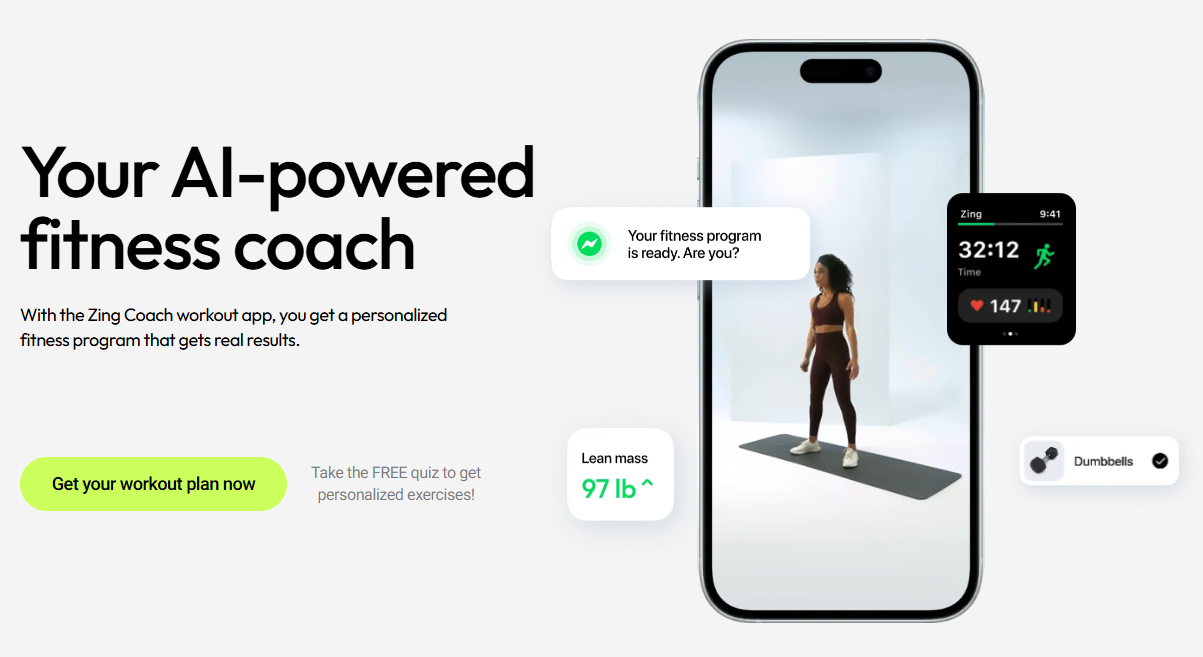
Zing Coach is an AI-powered fitness and workout app. Beyond pulling in Apple Health data, this tool includes a dedicated Body Composition Scan and Fitness Test. By taking a front- and side-facing photo and completing a quiz, users receive a personalized program. This helps ensure each session includes the proper exercises, intensity, and reps. It’s also possible to customize a workout based on preferred duration and equipment. Plus, Zing Coach adapts each workout based on fatigue and overall activity levels.
Key Features:
Complete and practical exercise guides and videos
Built-in dashboard for monitoring body composition and overall progress
Computer vision technology for tracking movements and form
Pricing:
Free Trial
Pro Package – $14.99 per month
Real Use Case:
Beginners who have been inactive for months can turn to Zing Coach to safely return to exercising. It can tailor a routine around short home workouts. This makes it easier to adapt rather than forcing a fixed session.
Freeletics
Freeletics has an edge in versatility. How? It offers made-for-you workouts for any physical conditioning. That includes calisthenics, cardio, high-intensity interval training, running, strength, and more. Freeletics provides a tailored plan based on goals, fitness level, progress, and preferences. What takes it a step further is the AI coach that adjusts weekly difficulty based on how users rate each session. On top of that, it doesn’t leave out warm-ups, cooldowns, mobility, and recovery sessions for injury prevention.
Key Features:
Progressing exercise skills for all fitness levels
Customized plans based on lifestyle and needs for utmost effectiveness
Support for different fitness goals and training styles
Pricing:
Free Package
Freeletics Coach Package – $34.99 per month
Real Use Case:
Busy office workers can avoid abandoning a program altogether with Freeletics. The tool adapts to available time, equipment, and fitness goals. As such, it can help them squeeze in a customized workout even with only 25 minutes available on weekdays or modify sessions when their schedule changes.
SensAI
Image Credit: SensAI
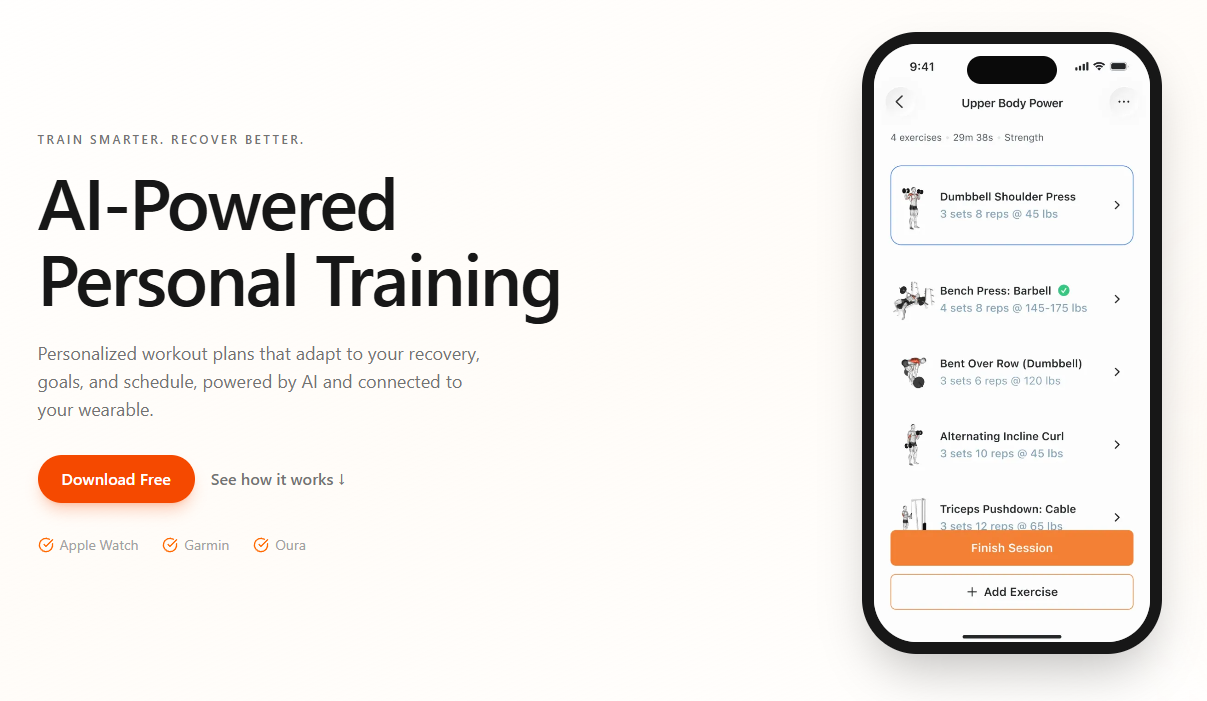
SensAI takes personalization a step further, especially for those who use Apple HealthKit. Its AI coach can use information such as available equipment, recovery data, schedule, and sleep quality to plan smarter workouts. Another reason it stands out is the ability to read HRV and resting heart rate to suggest the right intensity. SensAI can even regenerate a user’s weekly program based on how they’re recovering. What’s more, they can ask it to change a session mid-workout in plain language through the conversational coach.
Key Features:
Health apps and wearables integration
Dedicated workout tracker with live feedback metrics
Conversational workout adjustments
Pricing:
Free Trial
Paid Package – $6.99 per month
Real Use Case:
Grinding through a heavy day the body isn’t ready for is harmful. But with SensAI, someone whose sleep tanked can link Apple Health and let it factor sleep and recovery into training sessions.
FitnessAI
FitnessAI does one thing: make strength training more data-driven. It does so by pulling in proven insights from real lifters’ training sessions. With that, it can tell users exactly what weight, reps, and sets to lift next. At the same time, FitnessAI adapts workout suggestions to the available equipment and preferred session duration. One feature worth highlighting is AI-driven progressive overload. This helps ensure consistent strength and muscle gains without burnout.
Key Features:
Apple Watch syncing for accurate training data
Guided demos for fat loss and muscle growth
3D BodyScan visualization for progress tracking
Pricing:
Free Trial
Monthly Membership Package – $9.99 per month
Monthly Product Package – $19.99 per month
Real Use Case:
Gym-goers can use FitnessAI to know if their overall training is balanced. Through structured recommendations, they can avoid increasing weights without proper guidance.
Choosing the Best AI Tools for Fitness and Workouts in 2026
In times when almost everyone is engaged in a sedentarylifestyle, AI tools for fitness and workouts can help turn things around. Even without spending bucks on gym memberships and personal coaches. Theseapps give you tailored workouts, real-time insights, and flexible programs.
Fitbod is for adaptive gym workouts. Zing Coach offers a complete AI fitness-coaching experience. Freeletics is useful for flexible training journeys. SensAI pairs coaching with recovery and health data. FitnessAI is the better fit for people focused on structured strength progression.
With that in mind, the smartest choice depends on what you need help with. The one that supports your personal journey. That way, you can make sure each session stays challenging and effective.
Shygirl’s first new music of 2026 is here. The eerily abrasive ‘Alyse’, which she wrote and produced with Karma Kid and JD Reid, comes paired with a dramatic music video directed by Francesco Loy Bell and Oliver Bell. Watch and listen below.
Last year, Shygril released Club Shy Room 2, a star-studded sequel to 2024’s Club Shy EP, and the remix album Alias is Me. More recently, she appeared in Charli XCX’s The Moment and Madonna’s Confessions II – The Film.
Sen Morimoto has announced a new album titled Time Is On Your Side. The follow-up to 2023’s Diagnosis lands on October 23 via their own Sooper Records. The breezy, ambling lead single arrives with a self-directed video, which you can check out below.
“I’m not fighting time anymore,” Morimoto remarked in a statement. “I treat it as an ingredient. Some of these songs only need a pinch – a couple of improvised takes. Others sat for years, like wine in a barrel, until they became equal parts of my past and future. My hope is that it could inspire the freedom to slow down.”
1. Leave It All Behind
2. Flashback
3. Overthinker
4. Chewing Gum
5. Lucky Strike
6. Moves Like A Drunk
7. The Devil
8. I Saw You
9. Time Is On Your Side
On ‘A Major Minor Drag’, an elegiac highlight from Lambchop’s 2022 album The Bible, Kurt Wagner sang, “I’m at war now with the obvious.” The line references a famous quote by the photographer William Eggleston that seemed to encapsulate his decades-long practice, but Wagner’s recontextualization adds a weighted now, as if, three decades into the band’s career, he’s only just starting to warp the stranglehold of reality. Perhaps it was more pronounced than ever on that record, a cold refraction of day-to-day heartache through electronic effects, vocal manipulation, and lyrical abstraction. A couple of years ago, Wagner heard a simple song on the radio – a banjo playing a single chord, accompanied by a few voices – that would calibrate his next album, Punching the Clown. In a way, it sounds like a radical reconfiguration of the band, the kind of record that seems to wipe the slate clean. Yet Wagner’s approach, his tendency to vanish into the ether, hasn’t changed, nor has his close circle of collaborators: there’s guitarist Andrew Broder co-writing, Mark Nevers recording and mixing, and Ryan Olson on production. Holding down the banjo is none other than Bon Iver’s Justin Vernon, who just so happened to be working with the instrument in Eau Claire, Wisconsin, some 800 miles north of Wagner’s hometown of Nashville.
And if the AutoTune of previous years scanned as little more than a buddy of his, you could say the same about the choirs accompanying him on the new record, two ensembles both helmed by Blake Morgan: one from Eau Claire with six voices, and one from London with eleven. Yet for all its apparent naturalism, Eggleston’s maxim still rings true, as Wagner and company still find subtle ways to lend the songs a touch of the surreal, disrupting the embrace of sincerity, and offsetting its obvious reverence with a bit of humour at an age where it seems reserved for other forms of entertainment rather than people. In the mundane yet magical process of stringing it all together, Lambchop make the struggle feel a little more than personal.
We caught up with Lambchop’s Kurt Wagner to talk about the Punching the Clown film, artist relationships, his father’s apartment, and other inspirations behind his new album.
The 2009 mockumentary Punching the Clown
I only got to watch the first few minutes, where the protagonist is doing a radio session and realizes he has to censor the word “shit” in his song.
When I suggested this as a topic and starting example, it serves several purposes. It addresses the title of the record, but we also made a video based upon the film. We ended up using that film and that opening sequence as sort of the model, and we asked Henry, the actor in it, if he would mind recreating that role in an interview. But instead of being Henry, he was me, so he plays me, but he’s actually Henry. And he went as far as dyeing his hair and getting into shape so that he appeared very much like he did in the film, which, I didn’t ask for that, but he took it pretty seriously. It immediately messes with your head, but the things that were coming out of his mouth, the things he was saying, was stuff that I had written.
It’s just an interview between him and someone else, but it encompasses a lot, and it also tells the story of the record and answers a lot of questions that I often get. And there are running gags through it, like the interviewer never gets my name right, or never gets any facts right, and didn’t even really listen to the record. They’re all based on some sort of experience that’s true. It’s quite satiric, and for some reason, I got into that a lot. Making a short film, which I’d never done – I’d written a documentary drama once, and that was the only other time that I wrote anything that was scripted. I was pretty happy with the way it turned out, it just became pretty much unuseable. I don’t honestly know what we’re gonna do with it. And I thought, here’s an instance where maybe you’ll have a clip from Punching the Clown, you can have our little thing, and that’ll be its use.
In the umbrella of what I’ve been noticing or pondering a lot is the way comedy either fails or succeeds these days. In some ways, it seems to be thriving as a medium, and in other ways, more interpersonally, people just don’t get it or aren’t receptive to it. We’ll go to television and watch something that’s funny, just to make ourselves feel better for a minute, but it seems a lot harder to just joke around now, because we all are in a pretty dark place that we’re trying to navigate. I’m fascinated by that. I don’t know why the family group texts don’t understand jokes anymore, I just don’t get it. [laughs] It’s just not landing anymore. Is that the death of comedy, at least on that level?
If I can extrapolate that a little more, how do people deal with this extraordinary period in history which is both interesting from a historical perspective, but also just absolutely terrifying? And yet, here we are talking, here we are carrying on with the things that we do. I do think that it does somehow flavor or color the things that you make. In my case, never directly, but then all of a sudden I’m looking at it afterwards, you’re listening to it afterwards, and putting it in some sort of context. That’s part of perception, I think.
Maybe the usability of the short film comes down to how it contextualizes the record, and whether that’s something you would want it to do.
I had this whole other idea in general, when I made this record and turned it in – I kind of wanted to just quit. Watching the film itself made me sort of want to quit music anyway, the actual Punching the Clown, because it was so dark and spot on. It just made the music industry seem very futile, and that was my reaction to it. It wasn’t, “Ha ha ha, this is a funny, great send-up.” It actually made me think, “We’re all fucked, this is not good.” And so, at some point when we were making the video that we created based on that, it occurred to me that one of the things I would do is Henry would continue to be me, and he would be talking to you right now, or anybody who wanted to interview me. A lot of people probably don’t know me from Adam, and why not him? He can just be on the phone in LA, answering questions, basically being me, continuing the role into real life. This sounded amazing to me, but it also reinforced my feelings about just disappearing, being less of a personality, less of a face that people associate with.
It’s a weird feeling. I don’t know if it’s just because of my age, or my weariness of having done this so long, and the fact that I love so much what I do, and yet those things are connected now in a way that maybe I’m just over. Love you, but I would rather just make another thing and focus on that, and not really on promoting things anymore. It’s challenging, and I’m going through it right now. I feel like maybe I’m letting myself down a little bit, and not sticking to my, “Yep, I’m gone.” But at the same time, I do care about the people I work with, and understand their point of view, so I’m trying to thread my way through satisfying that to some extent.
Politics, love, madness
We touched on it earlier, this crazy era that we’re experiencing, the day-to-day assault that we are under. A lot of it has to do with politics, at least from my perspective where I am right now and what’s going on around me, what’s about to happen. We’re all finding ways to navigate that. It’s an extraordinary period of time starting with the pandemic, and other things are adding to it, like the advent of AI – you pile it all together, and it’s an extraordinary amount of stuff for an individual who’s just trying to live their life to deal with. And so, how do we move through that? How do we love each other? Basic stuff like that, and how even that can get in the way of relationships, because we all process and deal with adversity and terror in different ways. How do we help each other through those things?
It’s madness, or it feels like madness, and it seems to create a sense of madness within us. It can be overwhelming, but yet we have to find out how to get up the next day and deal with it. Maybe I’m just being a baby. Maybe the people in the Middle Ages or whatever had it so much worse. [laughs] I don’t know. I think maybe I am being a bit of a baby, but that’s where we are now. We’re not living in the Middle Ages, we’re not even living in the McCarthy era of the ’50s, or the Nixon era of the United States and what was going on in the ’60s here. If you think about it, this is just a whole new pile of poo.
I’m thinking of a song like ‘White People’, and knowing that you had a pool of songs to choose from, I wonder whether the ones that felt weightier, pertinent, or in some way reflective of the madness were the ones that you found yourself gravitating toward.
It’s trying to find a balance between these, say, 30 songs that we decided to pick from, and a way of presenting them that served a purpose. That’s how we went about making the record even before we started recording. We picked them and put them in order, so we had that in our minds through all of the decision-making that occurred throughout the record, seeing how these things played off of each other. ‘White People’ closes out Side 1, and you’re just left going, “What’s gonna happen?” It’s over, and boom, you’re into this other song, ‘The New World Wave’.
But also, the creation of it was just a different style of writing for me. Well, I had very little to do with it. All I was was a listener of a radio show; I was listening to a friend’s radio show. The first song is Allen Toussaint’s ‘Night People’. And I just thought, “Hmm, what if you changed ‘night’ to ‘white people’?” And then the next line, “Hanging out, looking at each other,” I went, “Well, that’s true.” And then another song comes on, and there’s another line that comes up that seems to fit in with the previous one. And that’s the entire song, me overhearing various lines from various songs. I just put them down in order, and when the show was over, I was like, “Wow, the song’s done.” It was that, in a way, effortless, and it was kind of playful. It had to do with my taking in stuff with this one concept in mind to start it all off, but I didn’t know where it was going. I didn’t know it was going to turn as dark as it did, but it was leading me that way just by listening.
It’s a startling end to Side A, an experience that’s maybe lost in listening to a digital promo of the record.
In the same way, at the end of the entire record, the song ends, and there’s about eight seconds of silence. And then this chorus reappears for a minute, almost like at the end of a film when you’re walking out and there’s an Easter egg or something, and you stop and you go, “Oh, wait, there’s more.” I just wanted to create a moment where you would just sit there with what you’d just heard. And then all of a sudden this other thing just drifts in, and then it’s over. I thought it was an interesting way to present a song, particularly in the mediums that we receive them now, like on Spotify, where it immediately bumps you to the next song. I was kind of fucking with Spotify, in a way, going, “Well, you can’t do that, Spotify, yet.” You’re gonna have to just give somebody a few seconds to just contemplate and process without anything else interrupting your experience.
I think of these things because one of the things about this working-in-sequence thing was that, whenever we would alter something or add something to a particular song we were working on, I couldn’t completely process or accept it without listening to it in context of the entire record, which is a stupid thing to do, because you end up spending 45 minutes each time you’re getting a revision. But I wanted to see how that revision would still feel within what was going on, so I made it so that it still felt right all the way. Not just within the song itself, but in this larger picture that I was really intent on preserving, and my motivation is making this thing as a record. A lot of artists say this, and I’ve said it before, but I don’t think I’ve gone to the extremes that I did this time trying to keep that from the beginning. Never quite got there, usually because I’d run out of material, to some extent, but this one, I was like, “Wow, I think I got there.”
Disappearing through song
You alluded to this earlier, and there’s something about making ‘White People’ by tuning into something else that also relates to this. But it’s also been an overarching theme in your discography.
I was never really comfortable with this whole notion of music personality. I knew I loved music, but I didn’t like the attention, I didn’t trust the attention, I felt that there were always other people’s motives involved, and them saying, “Oh, I like this.” I trusted my dad, who would say, “Oh, I hate this,” or “I don’t understand this,” or “Why are you doing this?” Those kinds of comments were debatable and legitimate, you know? But I never was really comfortable with that aspect of this thing that I do, and yet, 30 years have gone by, and I’m still doing it, and still uncomfortable. [laughs] For some reason, I haven’t let that idea go, and I didn’t get Henry to do my interviews for me as much as I wanted to.
And it was remarkable. I’m going back to this, because it just blew my mind when I actually met the guy, and it turned out we were almost like the same people. So I was asking him to play a role, which was me, and we were basically the same people. We’re the same age, we’re at the same point in our creative lives where we’re kind of over it, but we do like doing it, and we’re trying to find a way to gently ease out of that sort of spotlight, and just find out what being 70 is all about as an artist. We had the same phobias, and I was just like, “Damn, you are me.” And I felt he was the perfect person to cast in the role of me, even though he was playing his role as Henry in the thing.
I found it insanely fascinating, and it did play with the idea of me removing myself in some fashion and seeing what happens there. There’s another record that we’re gonna release fairly soon, which is exactly that: the demos from Punching the Clown, but I just took my voice out of it as the singer and asked these other singers to sing it. It’s a simple idea, but it’s not like a cover song, per se. I literally just removed myself from it. And I like that as a way to move forward, so that maybe I can create records and not necessarily sing them. I mean, that’s really all that’s left right now. I don’t really participate in the musical part of it anymore – I don’t play guitar or anything like that. I’m writing songs with Andrew, and he’s writing the music part. I’m focusing on the things that I enjoy, which is writing, and songwriting in particular. I like to sing, but I don’t think it’s necessary in order to present my art.
I can imagine a version of this record that’s even just the choral arrangements and the instrumentation.
People are always interested – later on, people will release the demos of a record, and people get enjoyment out of that. God knows I’ve listened to how many Bob Dylan bootlegs or whatever releases, and I’d listen to every take and watch things develop; sometimes it was magic, sometimes it was through slowly building it up, but learning that there were so many ways to get there. It’s filling the blanks for me, but in this case, this was kind of that experience, but I’m taking my voice out of it, and seeing what would happen if I got another artist and voice that I respected and went, “Please just sing, do whatever you want. You don’t have to think about it a lot, it is a demo.” And they all approached it in their own different ways. It made for a fascinating compendium to the record that we’re releasing. I had simpler goals in mind – I just thought it would be a nice promotional aspect people could check out, but people think it’s a pretty good record, and I do too. It’s not all the songs or anything like that; it doesn’t have the same weight. The concept is truly disappearing.
What makes songs good
You talked about focusing on the songwriting, and I wonder if that was part of what made you hone in on that question. It made me think about another inspirations interview with Jason Lytle of Grandaddy, who also traced the inception of his latest album, Blu Wav, to an old country song he heard on the radio – ‘Tennessee Waltz’ by Patti Page’ – and wanted to make some version of that. He said it was something about the sweetness and simplicity of it that must have resonated, and listening to your record, I feel like there are similar traits that you landed on while pondering this question.
Yeah, that’s interesting, because when I think about it, I didn’t know who did it, and I never found out who made this song. So, that person had disappeared. But it wasn’t necessarily critical to my liking or disliking it. It didn’t even factor into it. So, that was removed, and never to be revealed. I couldn’t even find the song anywhere. All I had was the memory, and that memory, as we know, can be a little squirrely. But that’s fine; however I twisted it became what it was gonna be. It served its purpose as far as, I guess we’re talking about inspiration here, but just the fact that it had triggered something in my head that I was already thinking about, and this was an example of it, fully formed, for me to consider. And it was a reinforcement of a crazy idea I had: I want to make a record with just voice and banjo.
And more than just your voice, especially when the choir comes in. This is something that the song ‘Cigar’ made me think about as an element of what makes a song good, which is the sacredness of singing together.
Yeah, I think having the choral element in it was pretty foundational, as well, to the concept, because I had enjoyed the experiences that I’d had recently at that time playing with just piano, my voice, and the choir. I just found the whole thing incredibly satisfying, and fulfilling enough that I didn’t really need much more. I wanted to explore that in a way that wasn’t necessarily a traditional approach to choral music, thereby making it exciting and challenging for the arranger and choir master. We discussed a lot because he would ask me, “What are you going for here?” and I just wanted to celebrate the glory and the power of the human voice. That sounds a little facetious, but I was pretty sincere about it, because the more I thought about it, and all the variety of the human voice, and how even in its rawest and unskilled manner can still evoke incredible emotion – I wanted it all. I wanted to see that displayed as a bed for a simple presentation of a song.
That was what I heard on the radio: three or four beautiful voices, a clunky banjo, and that was it. And I was like, “Whoa.” It was very moving, whatever it was they were singing. No idea who it was. Couldn’t figure out what the song was. It was just one of those moments. In Jason’s case, I think he probably maybe was responding to other aspects of what he heard, or what it triggered in him. But the fact that it was useful.
You used the word “sincerity,” and I think that’s also part of it. Maybe it’s earnestness, but I feel the record embraces that in a way that feels wholehearted.
If anything, it’s sincere – it’s tempered in a way, and I credit it a lot to Ryan Olson, the producer and the guy that I work with, to keep it honest so it can be sincere, but not to the point of being self-aggrandizing. It keeps it humble by throwing in things that are fairly irreverent, or unexpected, and maybe to some ears unnecessary and disruptive to their preciousness about this thing I’m creating. There are people who listen to it who want a precious, beautiful, acoustic choir record that’s just beautifully, pristinely recorded and all of that, and that’s all they want. And that’s fine – there’s plenty of music like that. But I wanted to create something you hadn’t heard before, or an experience that was new territory. Kind of taking an established sort of form of music – folk, country, or whatever you want to call it – and giving it a slap in the face, like, “Wake up.” This can be all of that, but there’s more. We’re living in this wild time right now, and this represents the here and now, not the way it was.
In the past, I didn’t understand that, and maybe I drifted toward soul music a little bit too ham-fistedly. But we were so inept in our presentation of it that we survived because we weren’t capable yet of doing that properly, and that’s what’s charming about it, and that’s what people are finding interesting, is our ineptness.
I mean, whoever goes into this record expecting this precious thing immediately gets hit with, “Lambchop, new shit!”
Right away! You get into it, and goddammit, it’s great, and then comes this thing. There are times when I’ll hear that song, and I won’t hear it in it, and I go, “Did I miss it?” You know? And there’s other times where it just stands out like crazy, and I know it’s in there now, but sometimes I actually don’t even hear it. It goes to a whole other thing about selective listening and how we can zero in on something in the sounds that are surrounding us and tune out others.
Artist relationships
Working with people that I have a relationship with, as opposed to just people that fit the bill for a particular assignment, and creating things with your friends – that’s how Lambchop started, man. You know, we were just sitting around on a Wednesday night, making music for each other, having a good time, and it grew out of that. I feel that at this point, I’ve worked with many people, but I prefer to really just do stuff with friends, so I have more than just a musical experience, but an enriching experience in a relationship. As you grow older, you have many more than you started with, hopefully, and as time goes on, I’ve also lost a shit ton of them. Really important figures in my creative life, untimely deaths – not to whine or whatever, but I think I’ve had more than my share of this happen to me. Their lives are still with me, and the impressions that they’ve left upon the way I operate as an artist and are indelible. But even in the course of making this record, I lost a couple of really close friends, absolute foundational artists that I went to art school with, and that we connected at that time with a similar type of aesthetic, or reinforced each other’s diverse aesthetics.
Could you paint a picture of how your friendship with the people who worked on Punching the Clown developed during the making of it?
I think it informed very much how this record evolved. Initially, there came a point where I encountered all these people from Minneapolis together at this thing in Berlin called the PEOPLE Festival. It was a huge gathering, maybe a couple hundred artists all together for a week working together, and then we were gonna do performances over the weekend as part of a festival. It was pretty overwhelming. I had no plan going in there. I didn’t really know why I was there. I liked the notion of it, sort of, but once I got there, it all seemed pretty weird and not really for me. But there was a group of people there that were all from Minneapolis, and I got along with them like I’d known them all my life. There were a few I’d known prior to that, but a lot of them I didn’t. And that’s how I started working with Andrew, how I started working with Ryan. Justin was there, and we had crossed paths many years prior to that when he was first starting out, and really enjoyed each other’s company back then. So we were able to go, “Oh, hey!” and reconnect there.
Unlocking this whole other world that I didn’t realize existed in Minneapolis changed my life to the point where I gradually started going up there to work and exploring, “What’s going on with these guys?” This is the third record that’s connected with them. Prior to even making the record, we had finished this record called The Bible, and I was driving around with Ryan, and he was going, “So, what are we gonna do next?” And I went, “I don’t know, I kind of have this weird idea about choirs and stuff.” And it was like, “Huh.” And three years later or whatever, there’s this record.
The Bible was a full-on embracing of whatever it was that they did up there. I wanted to experience that, and then this record is learning from that experience – both what not to do, and maybe how we can move forward with something that’s pretty satisfying for both myself and Ryan as the sort of overarching ringleader of that collective – I don’t know what to call it. It’s just a scene up there that’s just incredible. I completely gave myself over to it, to the point that now it’s really where I make music now. Don’t really do much here other than answer emails, and talk, and write songs. I don’t think you can really call it a Nashville band anymore. I don’t know if you can call it a Minneapolis thing, either. I think it’s just Lambchop, and Lambchop is whoever’s willing to put up with what I do.
It’s not like Ryan was ever gonna make this kind of record. It was absolutely a challenge to him. It was like, “Have you ever made anything like this before?” “Well, no.” “Have you ever played banjo before?” “No, but I’ve been fooling around.” “Great, let’s do that.” To me, it’s already good that you like these people as artists, you respect their work. Let’s just challenge it a little bit more, let’s just try to find out: Is the art you make all about your falsetto, or is it something else? Is it about the actual songs you write? Is it the thing you’re making, these records? And how does that happen? And who’s involved? It turns out they’re all in fucking Minneapolis! And it’s a remarkable sort of place to do things, and little do I know, it’s been going on a long time. It’s just not really considered as one of the hotbeds of creativity, even though it’s produced some incredibly significant music.
Visual artists/slogans
You’ve shared a couple of quotes – “This picture is never finished” by David Dunlap and “I’m at war with the obvious” by William Eggleston – along with a list of other artists, including Gerhard Richter, Kerry James Marshall, Howard Finster. Help me contextualize them a little bit.
I noticed that you did like to preface each section with some visual, so I listed a lot of names and artists that we can talk about. I mentioned the two quotes because they are sort of foundational things that have hung around in my brain ever since I heard them. I had a teacher in grad school for a bit of time, his name was David Dunlap. One of the things that he did was this ongoing thing where life and art are all sort of one thing, and he basically kept a lot of little bitty notebooks. He would fill them up with drawings and thoughts, and often they would have slogans of one kind or another: “This picture is never finished” was one. I liked that one, and I mentioned it in this context because in a lot of ways, it’s one of the big questions that artists have: When is something done? Or is it done? Will it ever be done? Because it lives on in the receiver’s consciousness, and as I mentioned before, memory can be a squirrely thing, and maybe it’s not exactly the same picture that it is anymore. You have altered it through your own filters.
And the other one – Eggleston was a photographer who was in Memphis when I was in Memphis going to undergrad school in art. He was already one of the major photographers that broke into this whole new form of photography, or a way of looking at photography. I was fascinated by him for a lot of reasons. He’s quite a personality and gentle, a Southern gentleman. He fancied himself a bit of a pianist as well, but he has a connection to the music scene and the art scene in Memphis. There was a doc, Stranded in Canton, and at one point he mentioned this thing, that he’s at war with the obvious. Which was interesting, because when you look at his photographs, they couldn’t be more… obvious. Or not obvious, but there’s nothing there. It’s a beautiful shot, the printing process is great, but the thing that you’re looking at is unremarkable. Yet, you are looking at it, and you are drawn to it. He’s found a way to take something that’s unremarkable and make it something to remark upon. A simple phrase like that can totally explain what an artist does, and it stuck with me.
These other artists are pretty big for me. Gerhard Richter, which everybody should be familiar with. Kerry James Marshall is a Chicago artist who seems like he came out of nowhere, but he’s been making incredible art in Chicago. He lives in the same kind of rundown part of Chicago he;s from, and continues to, even though I’m sure he could live anywhere he wants. His work is absolutely astounding.
I mentioned Howard Finster, mainly because one of the songs on this record is almost entirely text from one of Finster’s small drawings that I acquired. It’s a very small little drawing, but Finster mainly works with simple, crude imagery and a lot of textual information, because I think he was a preacher, and so a lot of it is a religious-y kind of thing. There’s a song called ‘Andrew Jackson Ass Hat’, and the lyrics of the song are the text from a drawing of Andrew Jackson, with a little bit of tweakery on my part. But the image is a line drawing of Andrew Jackson, and I don’t understand what his association with this guy, Andrew Jackson, was, because it doesn’t seem like there should be any reason to celebrate him in any sort of religious context, so it’s a bit of a mystery.
The thing about folk artists that stuns you and bowls you over when they discover these guys that no one knew about is the volume of work and their dedication to just making things. They’ll find these guys, and their houses are just jam-packed with a lifetime’s worth of pursuit of this thing. I’ve always been impressed by that: that if you can just keep your head down and keep working, that in itself is a life worth living.
His father’s apartment
Ever since I got out of art school, I decided I’m not really gonna participate in the commercial art business, nobody was interested, and I’m just gonna be like a folk artist and just make things and hang them on my wall. And that was fine, I was literally working out of the house, but as time went on, I got married, and I remembered that I really enjoyed having my own studio. Even in art school, having an assigned space, a studio that was where you would go, separate from the rest of your doings. I tried to maintain that as long as I could, and there was a period of time where I didn’t have one for a while, and then this, I guess you’d call it an opportunity, presented itself when my father had passed away and left us his apartment. I wasn’t quite sure how to deal with all of that, but I did know that I could just take a corner of that space and make it a place to work again.
That coincided with the beginnings of working on this record. I wrote for two and a half years or whatever there, and it was so great to have that space to work in again. I had forgotten how important it was, and it was the best time in my life. I didn’t want it to end, because it had become such a beautiful routine intermeshed with my life in general. All this other junk was just gonna interrupt it, and I wasn’t gonna be able to do that for a while, which is why I was grumbling and bitching to begin with. It is all fine, and I will get back to it, because that place is still there, and I would be there now, but I’m waiting on a package. [laughs]
But it became more than that. I didn’t know what to do with the space when he passed away. I didn’t know how to address any of it, so I did nothing. I just left it exactly the way it was from the moment he passed. And then, over time, when I would open the door to the space, it was like they were still there. They really weren’t gone. Maybe they were off at the store, or, I don’t know, went to the movies, and I was just coming into that space. So they weren’t gone, and that was comforting to me. And over time, I started exploring and poking around, “What’s this book by the bedside table? Is this the last thing that he read?” And then started thinking about, “What were the last words that he had read?” I would start to wonder if that was the case and explore that particular book. It turned out it was a book I gave him, and then there was another book; turns out he suddenly discovered Cormac McCarthy very late in his life and really loved it. “Is this the last line that he read?”
I actually found several books that I gave him, like Raymond Carver or Walker Percy, that made me wonder: Did he read them? They were on the shelf, it doesn’t necessarily mean he read them. I was trying to see things through his eyes, because suddenly I was comfortable enough with thinking about things in that way. It took a while, man. Slowly but surely, we transformed the place. It’s still sort of museum-y, but it’s become a place for our families when they come to stay, for guests. People we know – we don’t rent it out or anything like that – so it’s sort of an adjunct living space for us that really functions mainly as my place of work. It’s weird to call it a studio, because it’s really not a recording studio. It could be more like a painting studio, which is kind of how I look at it.
There were some other things, like Hemingway. I’ve always had a love-hate thing with Hemingway, but there was a collection of early essays, and I think the first one was ‘Indian Camp’. I read it, and it ended with this kid in a rowboat with his father. And suddenly I was really moved, just sitting there at his desk going, “Wow.” Partly dealing with whatever they call grief, but it was also getting a bigger, broader understanding and allowing myself time and space to do that. I’d go into the next room and I’d be writing again, and sometimes I would try to address it directly, but somehow, peripherally, it’s definitely in there.
But there were some bad books in there. He fancied himself a bit of an intellectual, and he was, to the point of blinders, where he didn’t really understand people unless they were just what he called “super intelligent.” That was the measure of a man for him, how smart they were, and what they achieved through that smartness. So to me, he always had a bit of a blind side when it came to real life. He lived in this fantasy world; he was a scientist, and he lived – a similar thing to what I do – in world in their head, where they have ideas, and they’re always thinking about it. And it tends to make them not really pay attention to, I don’t know, a broken faucet, or the plight of the working people. Even though he was sympathetic to it, he didn’t understand it. He literally needed to get out more and experience what it’s like to not have anything. The price I was paying for finally getting a place to work was reconciling with all this other stuff while I’m knocking around this apartment, and I thought, “Is that inspirational?” Well, yeah, I think it factors what the fuck I was doing – still doing.
This interview has been edited and condensed for clarity and length.
Football still does something other cultural forms rarely manage at the same scale: it lets a local accent, a city history, or a family memory travel without needing translation. FIFA’s own figures for the 2022 World Cup put total media engagement at 5 billion, with more than 3.4 million spectators in stadiums and 88,966 at the final in Lusail for Argentina against France. That scale matters, but the more revealing detail is the smaller one. A child in Casablanca can know the noise around San Mamés, a student in Bogotá can read the meaning of a Barcelona shirt, and a family in Seoul can recognize Lionel Messi’s walk before the camera even finds his face.
A club can still stand for a place
Some clubs carry geography directly, and the Athletic Club remains the clearest example. Its official philosophy still limits selection to players developed in the Basque Country or born in one of the Basque territories, which is why a home match in Bilbao does not feel like neutral entertainment even when the opponent is only there for three points. Barcelona has long operated in a different register, but the old phrase Més que un club, first spoken by Narcís de Carreras on 17 January 1968, still explains why the institution is discussed in Catalonia as social history as much as sport. Badges stick.
Finals become national memory
A final fix identity faster than a manifesto. Spain’s 2-1 win over England in Berlin on 14 July 2024 gave it a record fourth European title, and the goals told their own story: Nico Williams on 47 minutes, Cole Palmer on 73, Mikel Oyarzabal on 86, with Dani Olmo then heading off the line in stoppage time. UEFA’s tournament review put attendance at 2.7 million, counted 6.2 million visitors across the fan zones, and said more than 190 nationalities were represented in Germany. That was football acting as a passport, a memory, and a public square at once.
The ritual moved to a second screen
Matchgoing and television still matter, but football identity now lives on the phone as much as in the stand. During EURO 2024, UEFA recorded 547,000 fan-zone visitors on the day Germany played Spain in the quarter-finals, and that same evening was mirrored on smaller screens by supporters tracking clips, lineups, and group chats between one whistle and the next. In that rhythm, a betting site (Arabic: موقع مراهنات) sits beside score apps, highlights, and team news as part of the modern match routine rather than apart from it. The point is not the product itself; it is that football culture now moves in shorter bursts, crossing languages and borders in the time it takes for a full-back to line up a throw-in.
The women’s game changed the picture, too
The change is visible in the women’s game as well, and the numbers are too large to dismiss as a side story. UEFA’s current records page still lists 87,192 at Wembley for England’s 2-1 extra-time win over Germany in the Women’s EURO 2022 final, where Chloe Kelly scored in the 110th minute and then swung her shirt in front of the crowd. That image lasted because it belonged to more than one player and more than one night. It gave English football a different public memory, and it did so in a stadium usually reserved for the men’s game and major state occasions.
The phone now carries the badge
That cultural traffic is even clearer on ordinary league weekends, when identity is built less by ceremony than by repetition. On 28 February 2026, Barcelona beat Villarreal 4-1, and Lamine Yamal scored at 28, 37, and 69 minutes, his first senior hat-trick for the club; by the end of the night, those three finishes were already moving through fan accounts, family chats, and multilingual football feeds. In the same handheld routine, some supporters check odds, others scroll old clips, and others decide to download Melbet (Arabic: تحميل ميل بيت) before the next round of fixtures lands. The shirt stays.
The map is getting larger again
The shift is now a reality. The 2026 World Cup became the first edition to feature 48 teams and the first to be staged across three host countries: Canada, Mexico, and the United States. The expanded tournament widened football’s global map while preserving the local identities that give the sport much of its emotional power. Across the competition, national teams carried different histories, languages, rivalries, and expectations into a tournament that brought together more countries and cultures than ever before. The results will remain in the record books, but the legacy of the 2026 World Cup also lies in the connections it created between places, communities, and generations of fans.
During college, I thought I had my career all figured out. But after graduation, I didn’t know where to begin. I was stuck for months. And honestly, I still don’t have a concrete career plan, even now that I’m employed. It turns out that “What should I do with my career?” sounds simple until you actually have to answer it. Comparing job titles. Questioning your strengths. Researching industries. Wondering whether your current experience is taking you anywhere. And I’m not alone. A recentTallo report showed that 62% of young professionals are unsure about their career plans. But what if AI told you that AI tools for career advice can provide clarity to this confusion?
However, keeping track of all theAI tools coming out can become a full-time task. So here are the must-try options that can uncover transferable skills, explore possible career paths, identify development opportunities, and help turn uncertainty into a plan.
Top Five Best AI Tools for Career Advice
Career Dreamer
Career Dreamer from Google focuses on career exploration. And it does so in a pretty straightforward manner. All users need to specify their relevant experiences, education, skills, and interests. From there, the tool drafts an editable Career Identity Statement. Once that’s done, Career Dreamer helps identify transferable skills and connects them with potential career paths. On top of that, it seamlessly transfers users to Gemini for further collaboration in exploring career possibilities and next best steps.
Key Features:
Suggests career paths grounded in U.S. labor-market data
Generating a Career Identity Statement for job application documents
Color-coded dots to distinguish career ideas
Pricing:
Free to use
Real Use Case:
Retiring from a long-term profession won’t cause too much worry anymore. For instance, military spouses can use Career Dreamer to identify skills developed through previous experiences. Then, explore careers where those abilities could transfer.
Apt
Image Credit: Apt
Apt combines career assessment with ongoing AI coaching. Its process starts with a 10-minute AI career test. It includes multiple-choice questions covering experiences, goals, personality, and preferences. This helps it surface relevant roles, complete with job descriptions and potential salaries. Users can then discuss their goals and challenges with an AI career coach. What’s good about Apt is that it provides comprehensive guidance and AI tools built for career planning, professional growth, skill development, and career moves.
Key Features:
Access to data-driven advice and personalized insights
Salary coaching to increase potential income
Finding career paths and opportunities
Pricing:
Free Trial
Paid Package – $29.99 per month (recurring)
Paid Package B – $9.99 per month (billed annually)
Real Use Case:
Software developers who feel stuck in their current specialty could use Apt to explore adjacent career paths. The tool helps them identify a possible transition area and develop a strategy around the direction that feels most promising.
Career Hero
Image Credit: Career Hero
Career Hero supercharges careers with AI tools and personalized guidance. Front and center, users will find powerful features. Like the Skill Gap Analysis and Career Path Finder. The former gives them tailored learning paths to determine and fill skill gaps. The latter uses data-driven insights to deliver bespoke career path recommendations. But that’s not all. Career Hero also offers smart tools to optimize LinkedIn profiles and build resumes. It’s aimed at long-term planning. Not just a single application cycle.
Key Features:
Career Community for connecting with professionals and mentors
AI Career Autopilot feature to get personalized career guidance
AI-powered tools built for professional goals
Pricing:
Free Trial
Monthly Package – £18 per month
3 Months Package – £12 per month (billed quarterly)
Annual Package – £6 per month (billed annually)
Real Use Case:
Professionals in mid-level roles can use Career Hero to navigate their way up. Through its skill gap analysis, they can pinpoint exactly what technical and analytical skills they need to learn. Building a study plan around those gaps becomes easier.
COACH by Career Village
Image Credit: COACH by Career Village
COACH by CareerVillage is a dedicated AI career advisor that is co-designed with career experts. It uses an approachable method through a chat companion. On this platform, users access expert-backed activities that support career exploration, job preparation, and skill development. It also comes with AI-powered tools for reviewing resumes and preparing for interviews. To make things even better, COACH remains flexible. It adapts to users to deliver personalized, labor-market-data-informed recommendations.
Key Features:
More than 50 career development activities
24/7 coaching for surfacing actionable insights
Asking career-related questions for career progression
Pricing:
Free Package (Individual users only)
Institutions Package – Custom Pricing
Real Use Case:
College students often struggle with choosing between possible career paths. But with COACH, they can explore both, investigate the skills involved, and work through activities. This helps them clarify which direction best matches their interests.
FutureFit AI
FutureFit AI is designed for career advice and navigation. It essentially works like a digital career GPS. Standout capabilities include determining a person’s starting point, guiding skills-based career paths, and creating personalized roadmaps for learning and employment. FutureFit AI doubles down on its offerings with Career Copilot. This AI feature adds conversational support that adapts recommendations to a user’s needs, goals, and labor-market context.
Key Features:
Career Passport for credentials, experiences, proficiency levels, and skills organization
Built-in AI assistant to aid with any career needs
Multiple-language support
Pricing:
Custom pricing
Real Use Case:
Employees planning to move from one position to another role can use FutureFit AI. They can use it to explore relevant roles, pinpoint skill gaps, and identify necessary training for the transition.
Choosing the Best AI Tools for Career Advice in 2026
Not everyone has the money to pay for a career coach that costs hundreds of dollars an hour. More so, be friends with one. That’s what makes AI tools for career advice really helpful. They don’t just hand you random job titles. Career Dreamer and COACH are free starting points for direction and everyday coaching. Apt, Career Hero, and FutureFit AI go deeper with paid, ongoing guidance.
A piece of advice: start with whichever one costs nothing. Direction is usually the first thing people actually need. After all, each offers a useful starting point, depending on the kind of guidance you need. These tools are built to help you understand where you are, where you could go, and what it would take to get there.
Many professionals overlook one crucial thing: building connections. That’s where LinkedIn comes in. With roughly310 million active monthly users, the platform has become a crowded professional network. A venue where visibility, valuable content, and meaningful connections can all influence career opportunities. The problem? Publishing useful content. Joining conversations. Connecting with the right people. Staying visible long enough to be remembered. These tasks leave you overwhelmed before you even start. So why not turn to AI tools for LinkedIn growth?
With that in mind, this guide highlights the topAI tools that help you speed up content creation, simplify outreach, and stay active.
Top Five Best AI Tools for LinkedIn Growth
Taplio
Taplio is a dedicated LinkedIn growth platform. Content creation is at the center of its offerings. It’s capable of finding ideas and viral posts that work. The LinkedIn post generator then writes them in the user’s voice. Complete with the hook, the story, and the CTA. And there’s no need to worry about posting them daily. Taplio can smartly queue uploads and publish them at optimal times. For those who want more, it offers features for connections and engagement. Automated DMs and showing up on the right prospect’s post.
Key Features:
Crafting AI-powered carousel posts
Analytics that show what drives followers and reach
Autopilot for automating content and engagement within LinkedIn’s limits.
Pricing:
Free Trial
Starter Package – $39 per month
Growth Package – $69 per month
Pro Package – $199 per month
Real Use Case:
Carousels are one of the most engaging posts on LinkedIn. But they take time to create. With Taplio, consultants can paste a link to a talk they gave, and it turns it into a polished, swipeable carousel post.
Supergrow
Image Credit: Supergrow
Supergrow helps individuals and teams create content with AI assistance. Using an article, a topic, or a YouTube link, this tool can produce a publish-ready LinkedIn post. It also throws in Podcast. A feature that lets users talk, and it automatically generates 5-7 posts with follow-up questions for accuracy. But Supergrow’s biggest differentiator is Content DNA. It builds a profile of how users actually approach content. What’s more? It can schedule posts and the first comment to optimize content for peak times.
Key Features:
Dedicated workspace for LinkedIn commenting to boost engagement
Managing LinkedIn with prompts through ChatGPT and Claude syncing
AI-powered tools for teams handling LinkedIn profiles
Pricing:
Free Trial
Starter Package – $19 per month
Pro Package – $39 per month
Real Use Case:
Busy executives can still post consistently without living on the website with Supergrow’s Podcast. Like doing one voice interview during a commute and having the tool turn it into five drafts covering different ready-to-review angles.
AuthoredUp
AuthoredUp works as a content creation and management tool for LinkedIn. With its Chrome extension, users can handle various tasks without leaving the platform. Among its many features is a dashboard for monitoring growth, what’s working, and the next best steps. It also comes packed with tools for scheduling, drafting, formatting, and optimizing posts. Detailed analytics make LinkedIn performance easier to understand. As such, users can see what resonates with their audience.
Key Features:
Stats overview for tracking metrics that drive growth
AI-powered suggestions for posting content at the times with the strongest reach
Precision formatting and live preview
Pricing:
Free Trial
Individual Package – $19.95 per month
Business Package – $14.95 per month/profile
Real Use Case:
Freelancers don’t have to settle for guesswork and posts that get buried. They can use AuthoredUp to format and schedule posts, along with analytics to see which structures actually drive impressions.
Expandi
Image Credit: Expandi
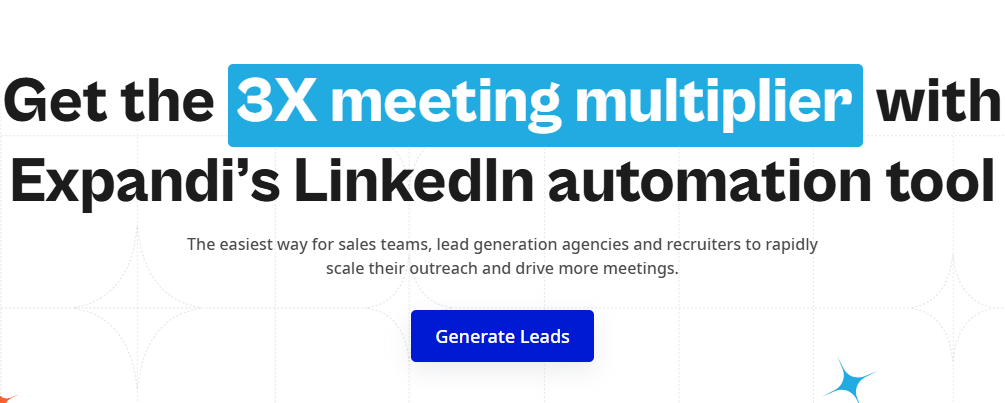
Expandi takes a different route by focusing on scaling LinkedIn outreach and lead generation. As an automation platform, it offers smarter workflows for connecting with prospects and following up. That covers finding relevant prospects, prioritizing high-performing campaigns, and engaging leads based on their behavior. Email outreach is also supported. On top of that, users can make outreach more targeted and engaging. All thanks to features that enable smart sequences and personalized videos and GIFs.
Key Features:
Growing LinkedIn through networking and prospecting
Outreach that responds to prospect actions and engagement
Smart automated sequences for contacting prospects
Pricing:
Free Trial
Business Package – $99 per month
Agency Package – Custom Pricing
Real Use Case:
Recruiters can speed up their hiring process with Expandi. Using precise candidate filters and compliant sourcing, they can quickly find the right prospects.
Ligo AI
Ligo AI is a Chrome extension that generates AI-drafted LinkedIn comments. At the same time, it produces replies in the user’s voice. How? It uses advanced AI to analyze existing posts and comments. This lets it adopt a user’s writing style and tone. So there’s no need to worry about getting the same generic output every time. Adding Ligo AI for LinkedIn growth helps make it easier to participate in more conversations. That means increasing visibility through active participation. Not just publishing posts.
Key Features:
Supports more than 100 languages
Clearing a comment backlog fast without sounding automated
Analytics to track what’s working
Pricing:
Free Trial
Starter Package – $9 per month
Standard Package – $29 per month
Growth Package – $49 per month
Pro Package – $76 per month
Real Use Case:
Virtual assistants trying to become more visible on LinkedIn can use Ligo AI. Doing so allows them to move beyond generic comments. The tool allows them to respond thoughtfully to posts from other professionals or employers.
Choosing the Game-Changing AI Tools for LinkedIn Growth in 2026
Flourishing on LinkedIn rarely comes from one activity. That’s why the recommended AI tools for LinkedIn growth on this list do different tasks in one way or another. Taplio helps create and manage content. Supergrow turns personal expertise into consistent content. AuthoredUp brings structure and analytics to publishing. Expandi handles outreach. Ligo AI makes it easier to participate in conversations.
The catch is that you should choose a tool based on where your LinkedIn presence is weakest. But beyond that, each tool here can help grow your professional presence.
If you’re looking for tools that can help with LinkedIn content, visit our guides on the AI tools forvideo editing andimage generation.
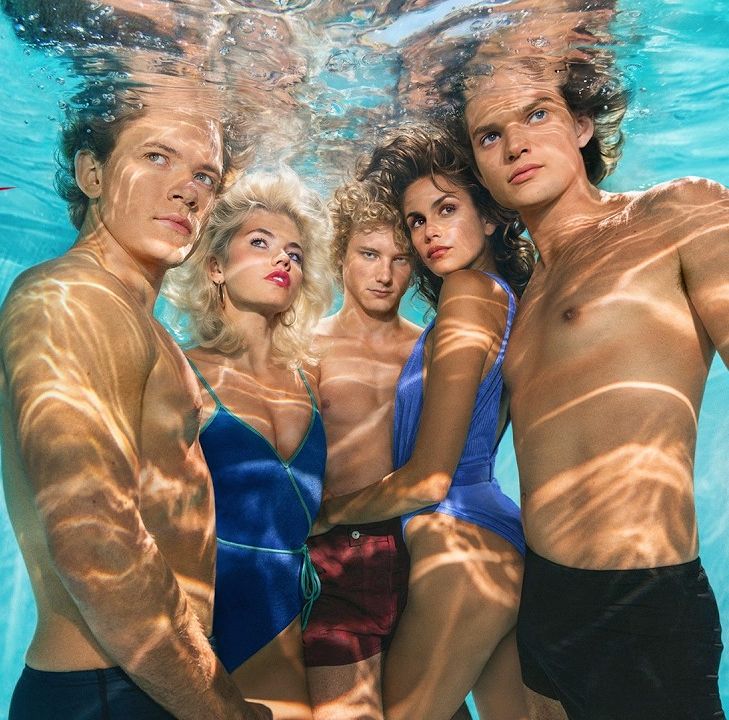
Viewers who like camp and excess should buckle up. A new Ryan Murphy series has arrived to take the world by storm. Inspired by the Bret Easton Ellis novel, The Shards has all the ingredients of a smashing hit. The list includes an appealing cast and an intoxicating premise.
Available on Disney+ in the UK, the series premiered to mixed reviews. Don’t let that stop you. If you want to travel to the ‘80s in style, it might become your next obsession. But does it have what it takes to score a follow-up? Here’s what we know so far.
The Shards Season 2 Release Date
At the time of writing, there’s no official news available about The Shards season 2.
That said, the show is ongoing, so a renewal could be announced soon. Murphy revealed that he has multiple installments in mind, and critics who watched all episodes mentioned that the first season ends on a cliffhanger.
“The book is very dense. People will love these characters. So we had always talked, even in the beginning, briefly, that, in success, this is a three- or four-year series where it takes place over the course of one school year. And I loved that,” Murphy told The Hollywood Reporter.
Bret Easton Ellis co-created the show and co-wrote the first two episodes. While his book doesn’t have a sequel, it is indeed dense. Multiple seasons aren’t out of the question. If all goes well, new episodes could drop in late 2027.
The Shards Cast
Igby Rigney as Bret Easton Ellis
Kaia Gerber as Susan Reynolds
Homer Gere as Robert Mallory
Hayes Warner as Debbie Schaffer
Graham Campbell as Thom Wright
Evan Rachel Wood as Liz Schaffer
Wes Bentley as Terry Schaffer
What Is The Shards About?
The Shards is part psychological thriller, part coming-of-age drama. Set in Los Angeles in 1981, it follows 17-year-old Bret, an aspiring writer attending Buckley, an exclusive prep school. Beneath the glossy surface of his privileged life lurks something much darker.
Things take a turn when the charismatic Robert arrives at Buckley at the same time as the city is being terrorised by a serial killer known as the Trawler. Before long, Bret becomes convinced that Robert is the Trawler and sets out to prove he’s right.
This is the kind of glossy show where teenagers enjoy little adult supervision. Bret belongs to a tight-knit group of students who have grown up surrounded by Hollywood power and money. They spend their nights driving around and attending lavish parties. Expect drugs, complicated relationships, and outlandish developments. As a bonus, everything is wrapped up in the nostalgic allure of the ‘80s.
While The Shards season 2 isn’t a sure thing, season 1 is still ongoing. You can catch episodes weekly on Disney+ until September 9.
Are There Other Shows Like The Shards?
If you like The Shards, you might like some of Ryan Murphy’s other work. Try Scream Queens, American Horror Story, Glee, Monster, or All’s Fair. Love the teen drama aspect? Check out Riverdale, Euphoria, One of Us Is Lying, or Elite.
There’s so much music coming out all the time that it’s hard to keep track. On those days when the influx of new tracks is particularly overwhelming, we sift through the noise to bring you a curated list of the most interesting new releases (the best of which will be added to our Best New Songs playlist). Below, check out our track roundup for Wednesday, August 19, 2026.
heavens to betsy – ‘ain’t never goin’ back’
heavens to betsy – the duo of Sleater-Kinney’s Corin Tucker and Tracy Sawyer – are releasing their first project since their split in 1994. Kill Rock Stars will issue an archival album called Baby’s Gone on October 16, and the first single, ‘Ain’t Never Goin’ Back’, is out today. It’s one of eight demos featured on the release, which also comprises the EPs These Monsters Are Real and Direction. The newly unveiled demo was tracked in February 1992 with assistance from Bratmobile’s Molly Neuman. “I wasn’t sure if I would ever revisit heavens to betsy, and then when we started talking more about it, and feeling how relevant the subjects are today, almost even more so than they were back then… it just seemed like just the perfect opportunity to be doing this,” Sawyer shared. “Just to know each other again as adults and as mothers, it’s really cool. Once we started playing again, it was like muscle memory.”
Tucker added: “Molly’s such a leader, and she’s… such an intellectual. She grasped right away that it was important for young women to have these tools to express themselves… She was so confident and so unafraid to just be like, ‘Yeah, why don’t I just record that for you? I’ll just check out the Tascam from the AV library at Evergreen and do it.’”
Beck – ‘Disappearing Act’
Beck has shared ‘Disappearing Act’, a hauntingly lush single from his forthcoming album Ride Lonesome. It arrives on the heels of lead single ‘In the Night’.
Sorry – ‘Tom Will Smack Your Ass’
Sorry are back with a new single, ‘Tom Will Smack Your Ass’, which might be one of their catchiest. It arrives with a video by FLASHA Prod (Asha Lorenz and Flo Webb) ahead of their appearance at Green Man Festival. “No bums were harmed in the making of this video – thanks to everyone who contributed,” Lorenz clarified.
Geologist and Kyle Simon – ‘The Opening’
There’s never been album like The Sirens, the just-announced LP from Animal Collective’s Geologist. I mean this literally, having only heard today’s preview, ‘The Opening’: a collaboration with visual artist Kyle Simon, the record comprises a single composition harnessing the light of the full moon. The pair decamped to Simon’s Farrington Observatory in Joshua Tree, and the artist describes their process as such: “The telescope is fitted with optical sensors and light-sensitive detectors called photodiodes/ As I rotate the scope towards different objects in the night sky, it collects light from stars, the moon, and planets. This raw light is converted into an electrical signal via an analog amplifier and then sent to Brian’s modular synthesizer rig as control voltage — a signal format that can modulate pitch, filter, rhythm, and other sonic elements in real time.”
So Faint – ‘Fully Slow’
Lyn Heinemann and Broken Social Scene’s Hannah Georgas have launched a new collaborative project called So Faint. Their first single, ‘Fully Slow’, is warmly affecting, and despite its title, pretty driving. It’ll appear on the duo’s self-titled debut, which will be released on October 16 via Georgas’ new label, Beetle Bomb Records. “‘Fully Slow’ is about wanting someone who you know deep down will never want you back, but still fantasizing that they do,” Georgas explained. “I’ve always been very prone to pointless intense crushes that remain completely internalized. I can construct a full storyline about what might happen and never do a single thing about it.”
She added: “I’ve been thinking about putting out music on my own label for awhile. I’ve watched the way music gets released change so much since I first started out, and now so much of that process falls on the artist. For me, it felt exciting to build a team I really know and trust and create something that feels personal. At the end of the day, I just want to put this music out into the world. I’ve worked really hard on it with Lyn, and I’m excited for people to hear it.”
Haywire – ‘Interstate Love Affair’
Boston hardcore outfit Haywire have announced their new album, I Don’t Wanna Say Goodbye, arriving October 2 via their new label home, Roadrunner Records. The anthemic, boisterous lead single, ‘Interstate Love Affair’, arrives today alongside a video directed by Luis Hernandez.
Biita Houdei – ‘Night Fright’
Biita Houdei has unveiled a new single from her upcoming LP, This Bed Was Made For Me. The nimble, self-reflective ‘Night Fright’ comes paired with a music video directed by Seth Naugle and Sam Falconi. “This song represents two distinct relationships – one of them rooted in difficulty and turmoil, the other blossoming into something effortless and gentle,” Houdei shared. “The music video follows alongside the lyrics quite closely. I am fighting with the old version of myself in that first relationship, as it seems to be common that we can turn away from our true nature when another person prompts negativity. But as you stay in those difficult relationships, those behaviors can very much intrude and meld into your own. I suppose it’s about breaking free. This music video was so clear in my head and these two incredible filmmakers, Seth Naugle & Sam Falconi, always seem to pluck the imagery right out of my brain. I am so thankful to our incredible crew who give their time and talents this – and that they all deeply believe in the arts, even when the team is small and the resources are depleted. The video was executed using all practical effects – that’s something worth noting.”
Wolf Alice – ‘Hit the Sky’
Wolf Alice go alt-country on ‘Hit the Sky’, a new track from the just-released The Clearing: B Sides. “Hit the sky is a demo we made in Seven Sisters that we revamped a bit with James Gavin on fiddle and Julia Cumming on BV’s a year or so later,” Ellie Rowsell shared. “It’s about encouraging someone you love to be themselves, because you can see how fabulous they are!”
Actress – ‘Withending’
Actress has unveiled a new single, ‘Withending’, from his forthcoming album Radical Frame. Built around delicate, gradually fragmented piano, the track is accompanied by a video from director Anna van der Velde.
Yuma Koda – ‘kopkino’
Tokyo-based artist and composer Yuma Koda has announced his debut album, Amid Kinos, out October 2 via Newhere Music. Collaborators on the record include Brooklyn-based guitarist and songwriter Mei Semones, composer-vocalist LUCA, Julia Shortreed of Black Boboi, Osaka-born, Munich-based drummer Shinya Fukumori, and Yuma Abe of never young beach, among others. It’s led by the mesmerizing new single ‘kopfkino’, which takes its name from the German compound word combining Kopf (head) and Kino (cinema), used to describe the involuntary process of the imagination playing out scenarios like a film in the mind.
Teenage Fanclub – ‘There Was You’
Teenage Fanclub have previewed their upcoming LP, Do Not Dare To Dream, with a new tune called ‘There Was You’. Following lead single ‘Day In the Sun’, it arrives with a video once again filmed on location at Black Bay Studio on Great Bernera and the surrounding coast by longtime collaborator Donald Milne.
World News – ‘The Way It Goes’
London post-punks World News have announced their debut LP, In Purgatory, which will be out October 16 on Pie & Mash. The new single ‘The Way It Goes’, according to singer Alex Evans, “was mostly written and demo’d back in 2020. The lyrics don’t possess too much of a story, but are more phrases, thoughts and collections of words of how I was feeling at the time. The album has a few songs on it similar to this that were written a few years ago, whilst some of the other tracks were written more recently, and in some cases weeks/days before hitting the studio. We’re all very excited to share the album with everyone.”
Strawberry Hands – ‘What Plant Jumps Over Me?’
Philadelphia songwriter Jacob Brunner has shared a new single from his upcoming Strawberry Hands LP, A Jazz Blessing for the Animal. The woozy, disorienting ‘What Plant Jumps Over Me?’ comes paired with a Marissa Losoya-directed video. Brunner describes it as such: “A binary-form inquiry into the bipolar spectrum: breathlessly enjambed, stream-of-consciousness verses ride a swaggering groove of equal parts grandeur and anger. Then the star burns up, time slows down, the frequencies grow heavy, and I am left in the dark with questions about the burden of consciousness.”
One of Prime Video’s most popular series is back in full force. Reacher, which is inspired by the popular novels by Lee Child, recently premiered its fourth season. It wasn’t long before the show started to climb the platform’s charts.
Not only that, but many fans are already demanding more. Luckily, they’re going to get it. Here’s everything we know about the show’s future.
Reacher Season 5 Release Date
Prime Video renewed the action series for more episodes a while back, so Reacher season 5 is coming sooner rather than later.
Plus, they announced that the fifth installment will adapt Make Me, the 20th novel in the series. Based on the show’s previous release schedule, it should be here sometime in summer 2027.
If that’s not enough, the show is treating fans to a spin-off. Titled Neagley, it will premiere in a few weeks, on September 16. The focus will be on the title character, Reacher’s former protégé.
Reacher Cast
Alan Ritchson as Jack Reacher
Maria Sten as Frances Neagley
Sydelle Noel as Tamara Green
Agnez Mo as Lila Hoth
Anggun as Amisha Hoth
Christopher Marquette as Jacob “Jake” Merrick
Kevin Corrigan as Shaun Docherty
What Could Happen in Reacher Season 5?
Reacher revolves around Jack Reacher, a former US Army Military Police officer who lives as a drifter, traveling from town to town with almost no possessions. Wherever he goes, trouble has a tendency to find him.
Season 4 adapts Gone Tomorrow, the 13th book in the series. This time around, Reacher is caught up in a dangerous conspiracy after a random encounter with a distressed woman on a New York subway ends in her death.
What initially appears to be a random tragedy proves to be connected to a larger operation. It involves government secrets and powerful people. As Reacher investigates, he discovers that the woman was carrying information multiple groups desperately want to recover.
The show is still ongoing, with episodes arriving weekly on Prime Video until September 16. As for Reacher season 5, it should be set in a small Midwestern town, where the titular character helps with a missing person case. If the plot stays faithful to the book, that is.
Are There Other Shows Like Reacher?
Loving Reacher? similar titles include Justified, Tom Clancy’s Jack Ryan, Bosch, andThe Night Agent.