On his 7th studio album, White is backed by Patrick Keeler on drums, Dominic Davis on bass, and Bobby Emmett on keys. Frozen Charlotte follows 2024’sNo Name.
Summer looks good everywhere. A Euro summer looks good to everyone. Especially to Demna, who just launched Gucci’s new summer campaign, showing us what wealth, clear blue waters, the sort of wardrobe that never sees a laundry basket, and the kind of leisure that exists only when nobody is answering emails look like in Monte Carlo. After shutting down New York’s Times Square for a single Cruise show, I’d probably set sail to the French Riviera too.
“A new campaign unfolds across Monte Carlo, captured in a series of moments shaped by motion, light, and the spirit of escape. A summer of possibility is framed by Monaco’s cultural aura, long a stage for fashion, glamour, and those always on the move,” the brand’s Instagram caption reads. Which, translated, roughly becomes: what Gucci imagines a retired villa party on the Mediterranean coast looks like, somewhere between sun-soaked afternoons and after-dark polish. Directed by Spike Jonze and Halina Reijn, the short film follows a group of friends who appear to have signed an informal agreement to never be dry. They dive into a pool that leads to the sea, another pool that somehow leads to a bathtub, and then keep going, jumping fences, climbing rocks, and drifting past LED-masked figures whose only commitment is to aging, aesthetically, correctly, and not at all.
Both the short and its imagery (starring Amelia Gray, Anok Yai, and Kayako Higuchi) politely remind us that a good bag equals a good outfit. The Jackie, now approaching myth status, returns alongside the Madison, the Gossip, the Mercato, the Borsetto, and a few other familiar names. Gucci’s Flora motif celebrates its 60th anniversary this year, originally designed for Grace Kelly, then Princess Grace of Monaco, which is also a convenient excuse for the house to bring the print back everywhere this season. As for the Gucci boys, it’s muscle tee season.
“A story’s best when convincing the reader it could happen no other way,” Girtle, the narrator of Mice 1961, says. She has little to no faith that she can accomplish this. Although the novel starts matter-of-factly, with her narrating how sisters Jody and Mice are walking down the sidewalk, she quickly becomes anxious and paranoid, certain that some otherworldly force will rip it from her hands and, what, do something different? Deny Girtle her artistic representation, even though it seems she’s nervous to hold it anyway?
“The story itself with its claws would grub at the central girl, I believed, and I was right,” she continues. “It would indoctrinate her and tamp her down when her pursuits were not on point. The story, possessing the upper hand, would keep her miserably sanitized.” Later, she thinks, “although to describe is to contaminate, I began my try.”
That’s one way to kick off the storyline of the electric and janky Mice 1961, Stacey Levine’s novel that was a finalist for the Pulitzer Prize (recently re-issued by Ecco)—with a housekeeper as a narrator, unsure of her abilities to keep it under control. At least it gets it out of the way quickly, so we know we’re set up for… not failure, but maybe a continuous question of what we read here is real (or real as can be). It’s a strange technique that offers a kink in the framework of the book, returned to often when Girtle anticipates a “helper,” a rogue assailant that’s out to format the story differently. Just like Girtle, we’re expecting someone else to pull the rug out from under us.
Though she narrates the novel, Girtle isn’t a huge presence—the focus is on the two sisters as they plan to attend the annual spring party in Reef Way, a Miami suburb, in the titular year. Girtle, fresh off a bus from home, offered mild cleaning capabilities in the girls’ home, and her nonphysical contract is renewed whenever Jody allows her to stay for a couple more weeks. Girtle watches and narrates from corners, bushes, and anywhere else she can hide to dissolve herself and let the sisters speak for themselves, which they can heartily do. They’re connected (orphaned by their mother, Candy) but absurdly different. Jody, a bit older, is attempting to teach Mice the rules of civility and politeness.
It’s a hard task. Mice is awkward and pale, would much rather fix old radios than socialize, and is bullied by a local gang of high schoolers (they call her Popcorn Head, Milk Face, Whitewalls) whom she usually avoids. The sisters are complicated and foreign to each other, richly developed and jumping off the page; their voices cry out in familial absurdity. Mice breathes quick and light; Jody heavy and slow. Often Mice fights against Jody’s demands: “What if life could be flexible Jody? What if we didn’t have to think about something in a certain way?” Of course, she doesn’t listen. Mice perpetually annoys her like a new puppy she has to train. “You have more or less caused economic damage around here,” Jody tells her once.
Jody forces Mice to attend the party, because she’s trying to set her up with a job at the bookmobile, and Jody knows the owner will be there, too. Mice, of course, doesn’t want to go, and it’s a stroke of luck she runs into the teenagers earlier that day and so is forced to flee by jumping into a well. Now late for the party, the teens run away to get ready, and Mice remains there.
“Face it,” Girtle says, “neighbors’ thoughts were pungent and everywhere.” This is to prepare us for the party, held at a bakery that hosts a wide array of cousins, hostesses, umbrella importers, and librarians. For the next 100 pages, we’re immersed in the idle gossip of these Miamians; a beatnik DJ gets frustrated that no one at the party likes his Charles Mingus records (“Will you shut up?” he scolds someone. “Some of these compositions were written for a film”); a young girl is praised for writing a letter to the editor that gets printed in a local magazine (“Trudie’s an attractive enough young lady and with a trim enough waistline that she actually could succeed as a writer in the public eye,” someone quips); someone asks an asinine question as to whether you can freeze cheese, and Jody frets about where Mice could be.
For these pages, Mice is still stuck in a well and sorely missing from the banal chatter of the neighbors. Such a strong voice is replaced with about a dozen weaker ones, and no doubt the story suffers following the loss of her, even if Levine’s conversations are tactful and elegant, with the party’s theatrics tipping into the absurd (someone continually drops platters, from bread rolls to spaghetti pots). I missed Mice as one would miss their funny friend at a party—one whose absence makes the whole thing dull. (At times, I was looking around the story, trying to spot her, just as I’d do in real life.) Girtle is trying to soak up it all, like a diligent surveillance camera, but there’s too many streams of information, and people break off into too many separate rooms, for her to get a hold on the situation. “I had to admit: not every word in the story was mine to know.”
Eventually, Mice arrives, just in time to strike up a conversation with a socialite whose brother offers her a job keeping her company while he’s at work. Jody is furious—this isn’t the life she imagined for her sister—but the socialite is working her charms on Mice. “For years I thought the world was a sad and dingy place,” she tells her. “But then I realized it was me. Do you ever mistake the world for yourself?” Who knows whether this was meant to get through to Mice, or to Jody, or even to Girtle, who is still fretting about when the story’s helper will arrive.
Her anxiety about the whole thing is in ordinance with the failure to depict anything concretely; it’s not just a Girtle problem. Any novel—or story to a friend—will leave out details and exaggerate others. Just as she wrote, any story is contaminated. Though the external helper remains on her mind, she’s curiously okay with any discrepancies that come from her. Whether the helper eventually comes doesn’t really matter, as she’s secure in what she can do, trying to hold onto what she knows before someone can snatch it. As much as it is about otherness, Mice 1961 is about freedom—Jody’s control over Mice, Mice’s reluctance to assimilate, Girtle’s escape from her home just to become second fiddle to two bickering sisters. Freedom, Levine suggests, looks different for everyone. All one has to do is to hold onto it long enough before it gets taken from your grip.
There’s so much music coming out all the time that it’s hard to keep track. On those days when the influx of new tracks is particularly overwhelming, we sift through the noise to bring you a curated list of the most interesting new releases (the best of which will be added to our Best New Songs playlist). Below, check out our track roundup for Tuesday, June 9, 2026.
Interpol – ‘This Mirror Weighs a Ton’ and ‘See Out Loud’
Interpol have announced a new album, This Mirror Weighs a Ton, sharing the title track as well as ‘See Out Loud’. The latter features guitarist Daniel Kessler’s first vocal since Turn on the Bright Lights‘ ‘PDA’, and both songs are considerably pensive and hushed, with a noticeable focus on sound design.
Ty Segall – ‘Black Paint’
Ty Segall is releasing a new album and an EP on the same day. The 9-track Chrome and the two-song Love Fuzzz EP are out August 28 via Drag City. The LP is led by the riff-heavy ‘Black Paint’, which comes paired with a video directed by Alex Bulli.
Chat Pile – ‘Deep Blue’
Chat Pile have announced a new album, Who Loves the Sun, with the churning ‘Deep Blue’. “This is the first track we wrote for the album and the one that helped set the tone for the whole thing,” bassist Stin commented. “I personally love this because it sounds like Chat Pile doing a Billy Squire song. It’s our ‘Lonely is the Night’, which is actually a fake Led Zeppelin song so who knows what the hell we’re actually doing here?”
Wishy – ‘Lovesick’
After coming through with their debut album, Triple Seven, in 2024, Wishy kept the momentum going with 2025’s Planet Popstar EP, and now they’re back with a new full-length. It’s called Nature’s Pill, and it’s out October 2 on Winspear. The soaring lead single ‘Lovesick’ is out today, and it’s naturally hypnotic. Maybe that’s what the album title is all about. Here’s what the band’s Nina Pitchkites had to say about it: “There’s not much more that needs to be said about yearning in 2026, but here it is anyway. Kevin and I are stupidly romantic people who like twee pop so that combination alone was a recipe for a cheeky “main character” song. We really leaned into the overzealous lyrics here because 1) we’re allowed, 2) can do whatever we want and 3) it’s fun 🙂 yay!”
Soft Cell – ‘Danceteria’
Soft Cell’s final LP, Danceteria, will be released on September 25. Today, the duo has unveiled the appropriately dancey title track arrives today, alongside a video by the collage artist Vicki Bennett. “Danceteria is a love letter to New York in the early ’80s,” Marc Almond said in a statement. “The time we spent in New York – where we recorded our first three albums—shaped us both as artists and people. To celebrate this period is a fitting farewell to Dave Ball and the final Soft Cell studio album.”
Penelope Isles – ‘Thinking Seat’
Penelope Isles’ Lily Wolter only just released a new album under the moniker My Precious Bunny, but it’s been half a decade since the band’s last album. Today, they’ve announced that 3, the follow-up to Which Way To Happy, arrives on September 25, and shared the glimmering lead single ‘Thinking Seat’. “Penny Isles is such a big part of our personalities,” Jack Wolter, who also makes music as Cubzoa, commented. “So it was about time we got back to it.”
Elanor Moss – ‘Sarah Waiting in the Car’
Artist Spotlight alum Elanor Moss has finally announced her debut album. The Knife, The Needle, out August 21, is preceded today by the single ‘Sarah Waiting in the Car’, which is heart-wrenching. “‘Sarah Waiting In The Car’ broke an almost year-long drought of writing songs,” Moss explained. “It reignited that spark in me around songwriting, and felt like a breakthrough into something new and intriguing that I wanted to follow. It served as a bit of a guiding light as I re-entered a more consistent relationship with songwriting again; the north star of the album in a way.”
mary in the junkyard – ‘Mouse’
mary in the junkyard have delivered another striking preview of their forthcoming debut album Role Model Hermit. About ‘Mouse’, the group said: “I went to Iceland and became obsessed with the ocean. I remembered I was a fisherman in a former life with a mouse in my pocket, lost in a storm. It is about me reconnecting with the mouse when they have taken on a human form in this life.”
Harmony Tividad – ‘Best Dressed’
Harmony Tividad has offered another teaser of her upcoming LP Lifetime, ‘Best Dressed’, which is accompanied by a Caroline Iaffaldano-directed video. “[Director] Caroline [Iaffaldano] and I were inspired by vintage bandstand videos and wanted to capture the energy of those old performances,” Tividad shared. “The 1960s television stage becomes a metaphor for the performance of femininity, existing in a world built around spectacle and perception.”
Bonobo – ‘Me and You’
Bonobo’s just-announced album has quite an impressive cast of collaborators: Arooj Aftab, Nilüfer Yanya, Ichiko Aoba, Hundred Waters’ Nicole Miglis, and Joy Crookes all guest on Distance in Static, due September 11 via Ninja Tune. “I think the front end of what I’ve done has now become something that’s referential to younger people. I liked the idea of listening for a distant signal – trying to find something in the noise,” Simon Green said of the LP, which is led by the thumping ‘Me and You’.
Show Me the Body – ‘Eat for Peace’
Show Me the Body have dropped ‘Eat for Peace’, the punchy opener from their forthcoming album Alone Together. “It’s the first message we communicate, one that defines this record as well as who we are,” frontman Julian Cashwan Pratt said. “‘Radical love compels me to fight’ — it’s the credo.”
The Menzingers – ‘Better Angels’
The Menzingers have previewed their upcoming LP, Everything I Ever Saw, with a new single, ‘Better Angels’, alongside a video directed by Britain Weyant. “We tried to make ‘Better Angels’ the song version of those late-night conversations with an old friend, the kind where you sit around a kitchen table and solve all of the world’s problems,” vocalist/guitarist Tom May explained. “It feels like we’re being torn apart. The country is run by monsters and money, and there are plenty of people who benefit from keeping us at each other’s throats. ’Better Angels’ is a message about what we’re doing, what responsibility we have to become better versions of ourselves, and that we’re not alone or powerless. It’s a push against the cynicism that’s so easy to embrace and a reminder that the world we want starts with how we treat ourselves and each other.”
Shearwater – ‘Slugs in the Marigolds’
Shearwater have unveiled a new single, ‘Slugs in the Marigolds’, from their forthcoming record The New World. The pleasantly hypnotic track arrives with a video directed by Shearwater’s Jonathan Meiburg and Jason Benson. “This was a band favorite on The New World,” Meiburg said. “We liked how its loose, sunny feeling plays against the lyric–and we loved how Doug’s sax slithers up beside you.” He added: “This was one of those rare videos where everything just fell into place. The idea came to me on a walk in the woods, near the spot where I found our slug hero. Forty-eight hours later, after a grand day out with photographer Jason Benson, I put the slug right back where they came from, with a little extra lettuce to chew on. It’s my favorite Shearwater video since ‘Quiet Americans’.”
Orla Gartland – ‘At The End of the Day’
Orla Gartland has written and performed the soundtrack to the forthcoming fifth season of Apple TV’s Trying, and today she’s shared its first song, ‘At The End of the Day’. “I absolutely loved making this soundtrack,” Gartland shared. “The task was beautifully straightforward: write eight songs, one for the closing scene of each episode. I started by writing about the characters’ arcs in the series; tales of love, growth, family – what I didn’t expect was that somewhere along the way it all became about my own experiences. I think maybe it’s the only way I can make music, to put a piece of myself in everything.”
Black Duck and Elena Setién – ‘Land of the Many Eyes’
Black Duck – the Chicago band featuring Douglas McCombs, Bill MacKay, and Charles Rumback – have announced a new collaborative LP with Basque musician Elena Setién. Black Duck With Elena Setién, out August 28, is previewed today by the sinewy ‘Land of the Many Eyes’, about which Rumback said: “Elena’s song has such a natural feel, it made us all feel like a band instantly.”
Most grooms underestimate the time a custom suit actually takes to produce. You’re not grabbing something off a rack; you’re building a garment from scratch. That involves consultations, measurements, fittings, and final adjustments. Rush it, and you risk wearing something that doesn’t fit right on the most photographed day of your life.
So how far in advance should you order? The honest answer depends on the type of suit, the tailor’s timeline, and how much breathing room you want for unexpected changes. This article breaks down the real timelines, what can delay them, and how to plan your order so nothing goes wrong.
The Standard Timeline for a Custom Suit Order
Most grooms need to book their appointment earlier than they expect, and the reasons are straightforward once you understand the production process. If you’re looking at bespoke wedding suits in New York from a high-caliber tailoring house, the timeline from the first consultation to final delivery typically spans four to six weeks. Fabric selection, precise measurements, pattern cutting, a basted fitting where the suit is temporarily assembled on your body, final construction- each stage depends on what came before it. There’s no real way to compress the process without sacrificing quality.
Why Six Months Out Is the Gold Standard
For most grooms, six months before the wedding is the smartest starting point. Here’s what that gives you:
Research tailors and compare fabric options without pressure
Schedule your initial consultation and measurement appointment
Complete the basted fitting and request any adjustments
Allow the final garment to be finished and pressed well ahead of the date
Six months also builds in a buffer for real life. A tailoring shop may have a backlog during peak wedding season; you might need additional fittings if your body changes between the first measurement and the final fitting. With six months on your side, none of those complications become a crisis. You’ll also have time to select accessories, shoes, a tie, a pocket square, and try everything together before the wedding day arrives.
What Happens If You Order Three Months Out
Three months is still workable for most tailors, though you’re working with thinner margins. A standard bespoke order takes four to six weeks to produce, which means you’ll have your suit in hand roughly six to eight weeks before the wedding if you book at the three-month mark. That’s enough time for a final fitting and minor alterations, but there’s not much cushion if you need significant changes or if fabric delivery slips. The catch is that three months works only if your tailor confirms their current production schedule before you commit.
Factors That Can Push Your Timeline Earlier
Not every groom is working with the same variables. Several factors can extend your lead time beyond the standard four-to-six-week production window, and overlooking them is how grooms end up in poorly fitted suits.
Wedding Party Size and Coordinated Looks
Want your groomsmen in matching or coordinated custom suits? The timeline gets longer and more demanding. Every member of the wedding party needs individual measurements, a personal fitting, and a finished garment. Scheduling all of that around multiple people’s availability takes time; tailors also need to source enough fabric to outfit the entire group, which can mean ordering bolts of cloth weeks in advance. For groups of four or more, eight to nine months of lead time is safer. The larger the group, the earlier everyone needs to be locked in; one person’s delay cascades through the entire order.
Destination Weddings and Travel Schedules
A destination wedding adds another layer of challenges. If your wedding is abroad, you won’t be able to walk back into the tailor’s shop for a quick adjustment after you’ve traveled. That means your suit needs to be completely finished, fitted, and signed off before you leave; add two to four extra weeks to your timeline, just to be sure. Grooms with heavy travel schedules in the months before the wedding face different challenges; fitting in consultation and fitting appointments becomes difficult. Factor in your availability, not just the tailor’s schedule, and book accordingly.
Rush Options and Their Trade-Offs
Some tailors offer expedited production for grooms working with tight timelines. The advantage is knowing what you’re actually getting and whether the trade-offs work for you.
The 10-Day Rush Service
A small number of high-end tailors maintain the capacity to deliver a finished custom suit in as few as ten business days. This works only because experienced staff focuses on your garment with concentrated attention; the production process is condensed without cutting actual workmanship corners. A month out from your wedding and just realized you need a custom suit? A reputable rush service is a legitimate option. But you should still expect a fitting appointment and plan for at least one round of adjustments. Rush availability is limited, so call ahead before assuming it’s on the table.
What Rush Orders Can’t Fix
Certain things can’t be rushed, no matter how fast a tailor works. Fabric delivery from overseas mills takes two weeks on its own, so a rush order typically means working with fabrics already in the tailor’s inventory. That limits your selection. There’s also less time to iterate on fit, a standard timeline might allow two or three fitting appointments, but a rush order may only have room for one. If your body changes between that single fitting and the wedding day, you may not have time to go back for corrections. Rush orders work best for grooms who already know their measurements and have a clear sense of what they want.
How to Choose the Right Time to Book
The right booking window depends on your situation, but a few general rules apply.
Signs You Should Book Now
Is your wedding within the next nine months? You’re already in the planning window for a custom suit. Book your consultation as soon as your venue and wedding date are confirmed. Tailors in major cities often carry waitlists during peak seasons, particularly in spring and fall; the earlier you call, the better your options. You should also book early if you plan to make any major physical changes before the wedding (weight loss, muscle gain) because those changes affect measurements and fitting appointments. Give yourself enough time for at least two fittings after your body has stabilized, not before.
How to Prepare for Your First Appointment
Walk in with a clear sense of your wedding’s dress code, color palette, and formality level. Bring photos of styles you like. Know whether you want a two-piece or three-piece suit, a peak or notch lapel, and whether the event calls for a tuxedo or a lounge suit. The more prepared you are, the faster the consultation moves, and the more time your tailor has to focus on fabric selection and measurement rather than style decisions you could’ve made at home. Preparation doesn’t just save time; it often results in a better-fitting, better-looking garment because your tailor isn’t guessing at your vision.
Conclusion
The answer to how far in advance a groom should order a custom suit is almost always “sooner than you think.” Six months is the standard; three months is the minimum for most timelines; anything shorter requires a rush service with its own limitations. Book your consultation once your wedding date is set. Give yourself room for fittings and adjustments. Don’t treat the suit as something you can handle after the venue, caterer, and photographer are locked in. It deserves the same early attention, and on the day itself, you’ll see exactly why.
For most of gaming’s modern history, the question “what do you play on?” had a short list of answers, and they all involved a box wired to a television or a tower humming under a desk. The console was the altar. The controller was the rite. To be a gamer meant, in some quiet way, that you had committed: to the hardware, to the price tag, to the living-room real estate. That definition is fraying, and the thing pulling it apart is already in your pocket.
Mobile is no longer the scrappy younger sibling of “real” gaming. It is the largest part of the industry by a wide margin. In 2025, mobile generated an estimated $103 billion globally, more than half of all gaming revenue, while serving as the entry point for roughly 83% of the world’s players. To put that in perspective, the console segment that defined the medium for decades brought in around $46 billion. The center of gravity has shifted, and it shifted toward the device almost everyone already owns.
Access is the whole story
The simplest explanation is also the most powerful: a smartphone is already there. A new console costs somewhere between $400 and $700 before a single game is purchased, and that is to say nothing of a gaming PC. A phone, by contrast, is a sunk cost most people justify for texting, maps, and the camera. Gaming rides along for free, or close to it.
That difference compounds across five years. Between 2020 and 2025, mobile revenue grew by roughly 63% while console revenue expanded only about 7% over the same stretch. The gap isn’t really about taste. It’s about who can get in the door at all, and how quickly. When the barrier to entry collapses from several hundred dollars to zero, the audience stops looking like the traditional gamer demographic and starts looking like, well, everyone.
The casual majority
This is where the cultural picture gets interesting. The person tapping through a match-three puzzle on a commute, the parent grinding a city-builder during a kid’s nap, the teenager who has never touched a controller but logs hours in a social sandbox like Roblox — these players rarely call themselves “gamers,” yet collectively they dwarf the enthusiast core that the marketing machine has historically chased.
Their habits reshape what gets made. Sessions are shorter and more frequent. Onboarding has to be instant. And the business model bends accordingly: free-to-play now accounts for the overwhelming majority of mobile revenue, with the actual money arriving later through in-app purchases, cosmetics, and subscriptions rather than a single upfront sale. The product isn’t the game so much as the relationship with it.
That economic logic has a geographic consequence, and it’s the part of this story the headline revenue figures tend to bury. Growth is no longer concentrated in the established gaming capitals of North America, Western Europe, and East Asia. The fastest expansion is happening in regions where the smartphone is the only gaming device most people will ever own, and where free-to-play removes the last reason to hesitate. Anyone trying to understand where the next billion players actually come from should be paying close attention tomobile gaming trends in smaller markets, because that is increasingly where the curve bends upward. The Middle East and Africa, for instance, rank among the fastest-growing regions in the world by player count, driven almost entirely by mobile-first adoption rather than console upgrades.
The structural shake-up
None of this means mobile has hit cruise control. The segment’s hypergrowth years are largely behind it, especially in mature Asian markets, and the easy expansion has given way to a more complicated, more competitive landscape. According toNewzoo’s annual games market report, privacy rule changes, regulatory pressure, and shifting app-store economics have all cooled the explosive pace, while direct-to-consumer payments are quietly rearranging how revenue flows between developers and the platform gatekeepers.
There are casualties inside the boom, too. Some of mobile’s largest genres are contracting even as the overall pie grows, a reminder that “mobile gaming” is not one monolithic thing but dozens of distinct economies, each with its own audience and its own ceiling.
What it means for the rest of us
The console isn’t dying. New hardware and a strong slate of big-budget releases gave that segment its best momentum in years, and there will always be experiences — the sprawling single-player epics, the competitive shooters — that demand more than a touchscreen can offer. The future is not phone-versus-console so much as a quiet rebalancing of what counts as gaming and who gets to do it.
What’s actually changing is the cultural default. For a generation now coming of age across much of the world, the first game, the formative one, the one that defines what play even feels like, won’t arrive on a disc or a download to a dedicated machine. It’ll arrive the same way everything else does now: through the glass rectangle already in their hand. The altar moved. We just carry it around with us.
Chat Pile have announced a new album, Who Loves the Sun, which is slated for release on September 4 through the Flenser. It’s led by the churning single ‘Deep Blue’, which comes with a video directed by Stephen Mondics. Check it out below, and scroll down for the LP’s cover artwork and tracklist. (I also urge you to take another look at that press photo above, surely the cutest picture of a noise-rock group you’ll see this year. Look at those half smiles! The dog!)
“This record focuses on my grievances with the modern world,” vocalist Ray B said in a statement. “AI, genocide, climate change, the power elite, $$$$ hoarding pigs – all that shit fucks up your life and mine. The band is definitely stretching out their abilities on the album and I too felt inspired to go further- as a huge fan of Boston, I like to think Brad Delp is somewhere up there, smiling down, as I take the layering to new heights, but who can say? We have fun with it.”
Bassist Stin added: “This album contains a healthy dose of the usual Chat Pile airing of grievances against the state of the world, but deeper at it’s heart I feel Who Loves the Sun is grappling with the challenges of trying to keep one’s humanity in a time of extreme anti-humanity.”
About ‘Deep Blue’, Stin had this to say: “This is the first track we wrote for the album and the one that helped set the tone for the whole thing. I personally love this because it sounds like Chat Pile doing a Billy Squire song. It’s our ‘Lonely is the Night’, which is actually a fake Led Zeppelin song so who knows what the hell we’re actually doing here?”
Raygun continued, “Technology is rapidly ruining our lives, all promise seemingly squandered on the worst things, like killing people, wasting resources, destroying art- shrinking our brains and pulling us further apart than ever before.”
Last year, the Oklahoma outfit collaborated with Hayden Pedigo for the joint LP In the Earth Again. Their previous album was 2024’s Cool World.
Who Loves the Sun Cover Artwork:
Who Loves the Sun Tracklist:
1. Creature
2. Deep Blue
3. Same Rules
4. PEN I S MALL
5. Shrine
6. Intruder
7. Christabel ’26
8. Influence
9. Family Funeral
10. October All the Time
If you’re an emo fan in 2026, you’ve already heard a veteran act return with a triumphant album inspired by divorce. Is another one, where the singer is also in his late 40s and wrestles with a second divorce, too much too soon? If you’re an emo fan in 2026, the answer is most definitely not. Neither American Football’sLP4 nor the new Death Cab for Cutie album, I Built You a Tower, ride purely on nostalgia, but Ben Gibbard and company were certainly energized by the anniversary tour celebrating DCFC’s Transatlanticism and the Postal Service’s Give Up in 2023. Which is a very unemotional way to assume what it must have felt like to be on the road revisiting at least one seminal breakup album at the height of a new separation, if one with drastically different consequences at this stage of adulthood. Working with producer John Congleton, who proved more than capable of balancing the band’s gentle and aggressive sides on 2022’s Asphalt Meadows, Gibbard copes by building another world of sorrow that simultaneously breaks away from old habits – musical and otherwise.
1. Full of Stars
On the opening track, Ben Gibbard describes himself as a victim of insatiable anguish, an external, adolescent-like entity he’s bound to for life. But instead of feeding it from the get-go with mountains of distortion, he sculpts ‘Full of Stars’ as an acoustic plea for kindness in a moment of pure exhaustion, gradually inviting his bandmates for a gentle pick-me-up. Because even though the song ends on a note of resignation around the relationship, he steers away from self-pity and gracefully paints his own dissociation in celestial terms, as if language can go at least some way toward mending the pain.
2. Punching the Flowers
Third-person narration allows Gibbard to crank up the distortion as he sings of slammed doors and words sharpened like knives, a violent tension restlessly mirrored in drummer Jason McGerr’s nervy groove. The guitars twinkle upward as Gibbard seems to zoom out on the chorus, offering a more philosophical view of a viscerally unnerving dynamic: “It always seemed he was punching the flowers/ Ruminating like a fatalist for hours.” In the past, he might have called this man’s soul rotten or cold; as a more mature lyricist, he describes it as mildewy, like a towel you could never wash clean without contaminating another.
3. Pep Talk
The band splits the difference between the first two songs, opting for clean guitars and settling for a more subdued rhythm that still makes way for Gibbard’s reflections. Here they’re more grounded: instead of being stuck in bed with “a head of stars,” the narrator is simply “lying in bed, giving myself a pep talk.”
4. I Built You a Tower (a)
Over a guitar melody and drum beat that seem slightly at odds with each other, the singer corrects and complicates the accusation thrown at him on the opening track: “You claimed I’d built a wall/ That obstructed all your exits.” Gibbard isn’t deflecting responsibility, but constructs a more robust psychological argument: “I built you a tower” because “I needed you contained.” He later finds a more evocative, “soundless spire,” from which music might be the only savior.
5. Envy the Birds
The pulse quickens and the instrumentation thickens again on ‘Envy the Birds’, which puts us at the center of a fight but snaps out of it in the chorus, fixating on the “birds soaring in the silence.” When we speak without words, he contends, no one gets hurt. Could the same be true about singing?
6. Stone Over Water
As the anger melts into shame, ‘Stone Over Water’ recycles the same sleepless thoughts, mellowing them out with a drum machine and loopy guitar melody. Though it starts with a joke – “In my mind there’s a fog/ San Francisco couldn’t handle” – the rest of the song is totally earnest; you could imagine it replacing Gibbard’s theme song forthe Apple TV show Shrinking.
7. How Heavenly a State
‘How Heavenly a State’ is actually the gnarliest song on the album, ricocheting off jittery guitars and a mechanized rhythm section. “Death lingered in your doorway,” Gibbard begins, having reached total acceptance of the collapse. It’s what leads to that ethereal bridge, which culminates in the promise to breathe for another human being; that is, assuming the voice on the other end is a person, and not a looming figure romanticizing the darkest way out.
8. Trap Door
Lyrically, ‘Trap Door’ is most cutting in its use of pronouns: “I pledge myself to your misery,” “If only the winners write history/ There will be nothing on our page.” There’s a tactfulness to Gibbard’s anguish that washes off resentment like the muted synthpop that drives the song forward; there’s more than a bit of the Postal Service spilling over here.
9. Riptides
Gibbard points the finger back at himself – there’s not a single you or us in ‘Riptides’. “And though I’m feeling fine/ Roughly half the time,” he sings, “There’s a fatal flaw/ In my heart’s design.” And though “there’s too many riptides in this ocean to proceed,” the song itself could hardly soar louder – until it brings itself to a halt.
10. The Flavor of Metal
While Gibbard keeps mining nature for metaphors, there’s a lightness to his melancholy, suggesting that the storms may never seem to end, but they at least might calm into a drizzle. When he stretches his voice on “Nothing happens every time I pray,” it’s followed by a brief, sprightly solo, which seems to retort: Is nothing really such a bad thing?
11. I Built You a Tower (b)
The album ends with the only track where the instrumentation and the lyrics are totally in lockstep with each other, with shoegazy guitars matching the torrent of exhaustion that finally knocks the singer for good. It was only a few moments ago that he made the cliched “It takes just a little light/ To find its way through the cracks” ring true, but the second part of the title track sulks and thrills in equal measure. “So tired” may not be the most hopeful words to end the album on, but they resonate as the final thought before sleep actually hits you. In the context of I Built You a Tower, that’s a big win.
Interpol have announced their eighth studio album, This Mirror Weighs a Ton. Arriving on August 28, the follow-up to 2022’s The Other Side of Make-Believe marks their debut release with Partisan Records. The band has also shared two songs from the album, the slow-burning title track and ‘See Out Loud’, the latter of which features guitarist Daniel Kessler’s first vocal since Turn on the Bright Lights‘ ‘PDA’. Take a listen below.
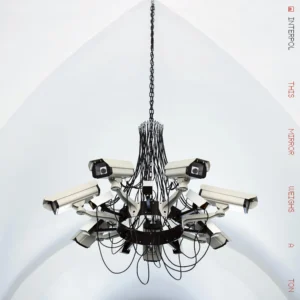
This Mirror Weighs a Ton was recorded with producer Andrew Wyatt at his downtown Manhattan studio. Dave Fridmann mixed the album, whose cover artwork features an Addie Wagenknecht piece currently held in the Whitney’s permanent collection.
“I wondered what it would be like to keep the parts perfectly legible, because everyone in that band writes such great parts, and to add some different spatial dimensions to it,” Wyatt said in a press release. “It was something almost a little bit more like chamber music — the musical ideas bear scrutiny without needing the sonic treatment of it to carry all the weight. It was also nice to add a trick or two I picked up over a couple decades of making pop records.”
Kessler commented, “I was right next to Andrew when he started doing these incredible things with the sound design, and it was just so exciting. I remember thinking, I don’t have context for what kind of music this is — these big crashes happening before Paul even had a vocal. Logic would have said maybe this is an instrumental. Then Paul just got up, went into the back room and started singing those melodies — and suddenly it was clearly not going to be.”
This Mirror Weighs a Ton Cover Artwork:
This Mirror Weighs a Ton Tracklist:
1. This Mirror Weighs a Ton
2. See Out Loud
3. Iron City
4. Wounded Soldier
5. Wings On Fire
6. Ever The Actor
7. So Rides The Reindeer
8. Darling Thoughts
9. Wake Up
10. Enemy
11. Bird and The Serpent
12. Sudden
Chappel Roan’s ‘Pink Pony Club’ is one of those songs that is instantly recognisable from the first few bars. You probably throw your hands in the air and head to the dancefloor as soon as you hear those familiar dulcet tones announcing ‘I know you wanted me to stay’.
After all, this song is as lovable asChappell Roan herself, and like Roan with her striking style and self-assured uniqueness, it also speaks broadly to a generation who just want to be themselves.
Interestingly, though, the song was far from an overnight success. In this article, we’re going to deep-dive into the song’s history and themes, as well as asking one key question – how exactly has it managed to capture the hearts of an entire generation? Keep on reading as we explore!
Understanding the Song’s Origins
You only need to glimpse the video for Pink Pony Club to get a feel for its LGBTQ vibes and fabulous message, but what exactly are the song’s origins? Well, it all started when Roan first visited a gay bar in West Hollywood, where she saw firsthand a level of self-acceptance that she’d simply never experienced before that point. Interestingly, though, Roan used the inspiration of a hot pinkstrip club in her hometown of Missouri as the stylish backdrop for the song that we’ve all seen in the video. But what about those heavy synth tones and iconic pop layers, which Roan’s label at the time actually dissuaded her from using? Well, that’s self-explanatory, isn’t it? When better to be yourself than when getting lost in a pop power ballad that makes you want to reach right for your hairbrush?
Why wasn’t it an Immediate Hit?
As mentioned, Pink Pony Club might have made its fame after the release of Roan’s debut studio album ‘The Rise and Fall of a Midwest Princess’, but its history spans way back to April 2020, when, we’ll be honest, it didn’t immediately reach a huge audience. This was due to a few unfortunate issues, the majority of which stemmed from Roan’s label at the time, Atlantic Records, which resisted the song for around a year, and then dropped Roan shortly after its poorly timed release. It’s also fair to say that the world might just not have been ready for an empowering pop anthem of this degree back then. Thankfully, five years later, the truth couldn’t be more different.
What we Love About Pink Pony Club in 2026
Three years on from a second release that still didn’t exactly take the charts by storm, Pink Pony Club has been streamed well over a million times on Spotify. More than that, there’s a strong argument that this is the empowerment anthem of our generation. Not only does it perfectly capture the supportive, sassy self-acceptance that we could all do with practising right now, but it’s also paved the way for a new musical era, complete with unashamed synthesisers, power pop vibes, and a sound that really is irresistible!