

From childhood in Huangshi to a solo exhibition in Tokyo, Yilun Zhan has made light a language for memory, connection and the experience of space.
Before she designed lighting environments, Yilun Zhan learned to pay attention outdoors. In a written account of her childhood in Huangshi, Hubei, she remembers her father taking her into the fields and the pleasure of chasing butterflies. Piano lessons, drawing and the art books he kept at home added other ways of looking and listening. Nature offered something that would remain important to her work: a sense of ease that did not need to be explained.
Years later, that concern found a new expression in Soft Boundary, her solo exhibition at GALLERY AND LINKS 81 in Tokyo’s Ginza district. Held from September 15 to 19, 2026, the show brought the New York-based lighting designer’s investigation of light and emotion into a concentrated artistic statement. Its achievement was to give a long-running personal inquiry a finished, public form—one whose strength lay in its visual language rather than its biographical backstory.
The route between those moments passed through two very different cities. At Sichuan Fine Arts Institute, Zhan lived in Chongqing, where she became absorbed by the lights of a layered urban landscape. She describes walking alone at night and looking out from taxis as the city’s illuminated forms passed by. In her recollection, those experiences made light a subject in its own right: something capable of changing the character of a place.
New York introduced another relationship between surroundings and emotion. Zhan pursued graduate study in lighting design at Parsons School of Design, while encountering the pressures of rent, social transience and distance from familiar support networks. Her written account describes friends coming and going, and the loneliness that could coexist with access to extraordinary art. The contrast sharpened her interest in making environments that offered room for emotional connection.
Soft Boundary did not turn that history into an illustrated memoir. Its statement concerned feelings and memories that have no stable physical form. The work approached them through what light can make briefly perceptible. This choice gave the exhibition its independence from the artist’s life story. A viewer did not need to know where Zhan grew up to encounter the tension between visibility and obscurity in the installation.
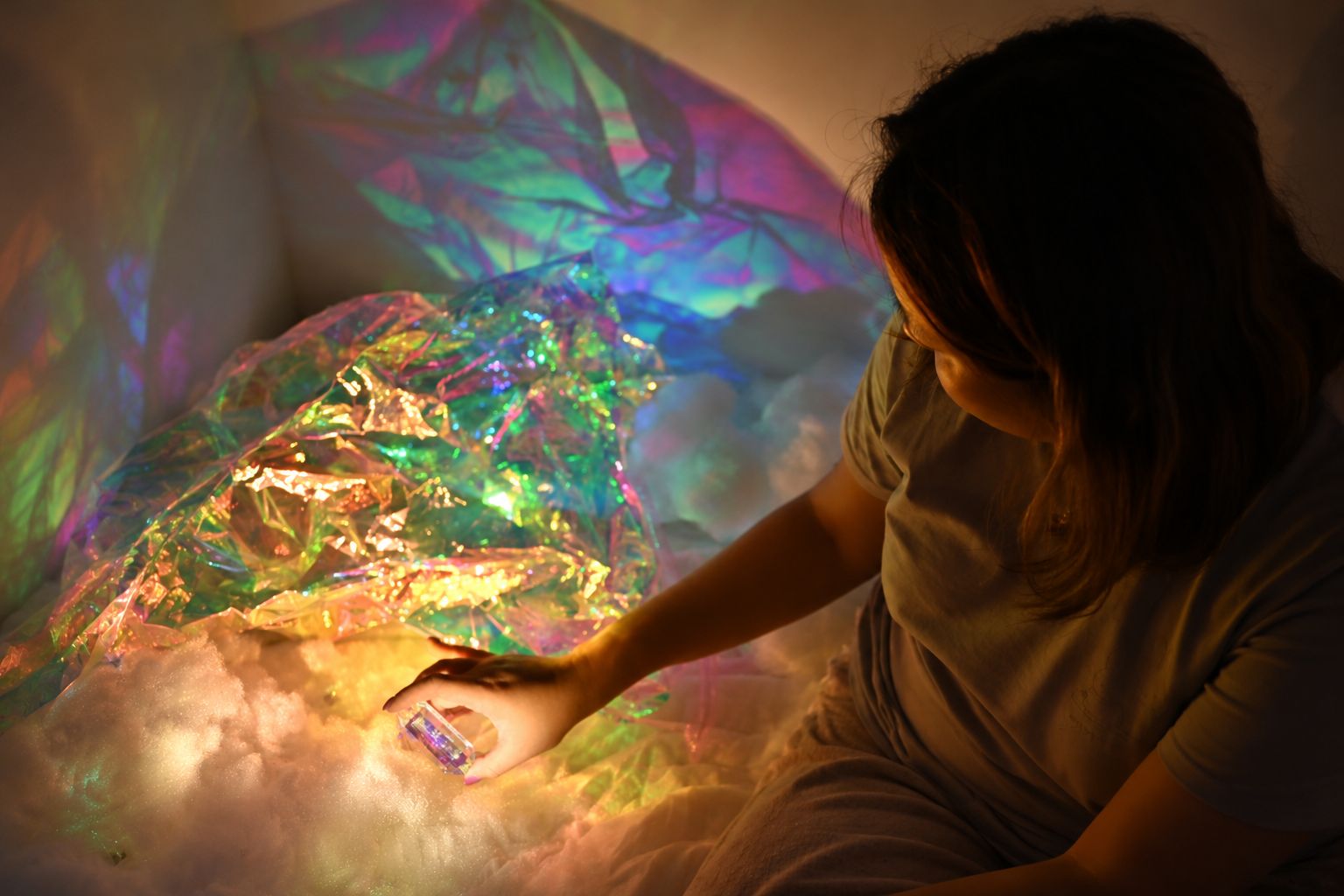
The exhibition’s images show that tension in markedly different registers. A warm, folded form appears behind a translucent veil, its edges softened by the intervening surface. In another view, blue-green light spreads through cloudlike fibers beneath a reflective contour. One image seems close to something remembered; the other suggests a space without a settled scale. These are interpretations invited by the work’s visual ambiguity, not emotions assigned to everyone who encounters it.
That openness is essential to Zhan’s use of the idea of healing. The gallery’s introduction described it as a process of sensing relationships with oneself, a space and other people anew, rather than achieving a predetermined result. There was no prescribed emotional destination. Its emotional seriousness rested on allowing different responses, leaving space for associations that the designer could invite but could not determine in advance.
“I’ve always imagined light as a quiet kind of healing,” Zhan said in an interview published in LD+A in August 2025. In that earlier discussion, she connected her practice to comfort, emotional balance and the effects of small adjustments in light. Read alongside Soft Boundary, the statement identifies a consistent concern. The Tokyo exhibition made that concern visible through finished compositions rather than leaving it as an aspiration.
She had explored related questions in other forms. Her biographical account describes small, noncommercial activities after graduation in which light and painting were used to create settings for reflection. A separate installation, Mood Cocoon, developed three sensory environments. Its project documentation identifies them as The Warm, The Dream and The Void. Where that separate project organized its environments around named emotional states, Soft Boundary pursued something less definite: the moment when a feeling seems to acquire an outline, then slips beyond it.
What changed in Tokyo was the concentration of the artistic statement. The exhibition gathered its effects around the instability of an edge: a surface seen through another surface, a reflection that seems to exceed its source, a form that looks definite until its surroundings complicate it. This is where Zhan’s work becomes more than an expression of sensitivity. The idea has been subjected to decisions about materials, visual relationships and composition, and those decisions hold together.
Her background helps explain the rigor. Years of specialized lighting study and professional architectural practice gave her tools for working beyond intuition. Her experiments with performers, virtual environments and installation offered different ways to question what those tools could do. Soft Boundary is a convincing achievement because that range does not fragment the work. It resolves into a coherent approach to how an environment can be perceived and felt.
The exhibition was an artistic success on those terms: the work had a recognizable identity, a clear relationship between concept and execution, and enough openness to sustain interpretation. These are the qualities of an accomplished designer exercising independent judgment. Zhan’s place in the leading ranks of human-centered light art is most persuasively argued through this work, where emotional purpose and professional command are visible together.
The journey from Huangshi to Tokyo is not, finally, a story about leaving one place for a more important one. It is a story about learning to make a kind of space that no single city could supply. Soft Boundary brought that search into a form that was both assured and deliberately unresolved. Its boundaries remained soft; the artistic achievement behind them was anything but tentative.

