

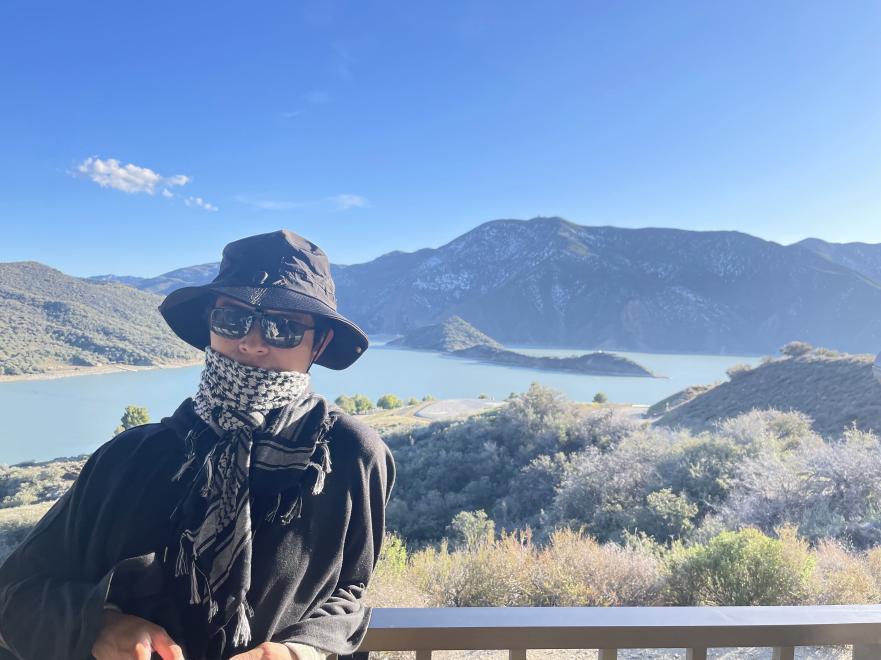
As the wave of generative AI sweeps across the field of artistic creation, many works have become absorbed in the dazzling effects produced at the click of a button. JAIME JIAMING YAO, however, has carved out a path of his own. He is as one of the more distinctive voices working at the intersection of public digital art and AI cinema, an artist whose work is as rigorous in its engineering as it is in its ideas. Based in Los Angeles, he works across the dual roles of designer and AI filmmaker, bridging two creative fields: public digital installations and AI-driven narrative short films. With real-time 3D pipelines, point-cloud reconstruction, Unreal Engine, and multi-model AI workflows as the foundation of his practice, Yao brings urban space, memory, perception, and human-centered storytelling into digital media, preserving the original creative core of art amid rapid technological change. Rather than treating AI as a simple image-generation tool, he sees it as a medium for extending the boundaries of perception, exploring the complex connections between people and space, the fleeting and the eternal, across public screens and cinematic narratives.
Yao’s creative practice is rooted in public art in Los Angeles. As a Creative Technologist at StandardVision, an pioneering Los Angeles studio specializing in large-format architectural media, he focused on large-scale immersive media installations, creating public-facing art projects for Long Beach Airport and the Los Angeles Public Library. Unlike artworks displayed in galleries for static contemplation, public digital installations encounter ordinary viewers who are constantly moving, arriving unpredictably, and passing through. Travelers, library visitors, and pedestrians do not necessarily stop with the expectation of viewing art. The work therefore has to become embedded in everyday circulation and reach viewers almost inadvertently. Few artists work under these conditions, and fewer still make the conditions themselves part of the work; Yao does both. This creative premise has also shaped a principle that runs throughout Yao’s practice: art is not a closed-off exhibit, but a dynamic dialogue of perception that takes place when people encounter the city.
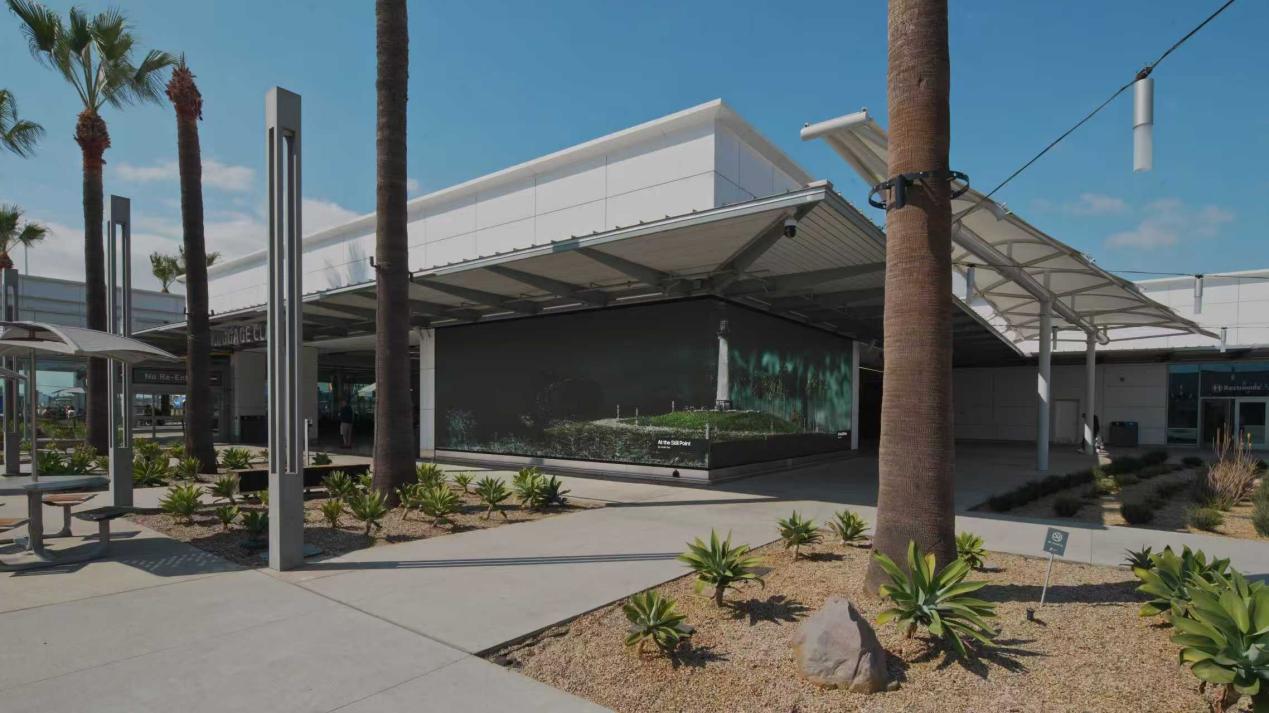
Installed at Long Beach Airport in 2025, At the Still Point, a public anamorphic LED installation, is the signature work of Yao’s public installation practice and a technically demanding piece that few artists attempt at this scale. Using point-cloud technology, he deconstructs and reconstructs a local Long Beach lighthouse and its surrounding coastal landscape. Countless discrete points of light continually gather and disperse, allowing the landmark to move back and forth between recognizable reality and fluid texture, constantly oscillating along the boundary between the physical and the abstract. The work makes thoughtful use of the continuous movement of people through the airport, breaking away from the fixed-viewpoint logic of conventional moving images. Through the visual depth created by the deep-screen display, the points of light converge at a predetermined optimal viewing position into a clearly defined, richly layered lighthouse seascape. As travelers move, turn, or pass by from the side, however, the points overlap and intersect, dissolving the solid architectural outline and transforming it into an abstract poem of light woven from shifting densities and flickering rhythms.
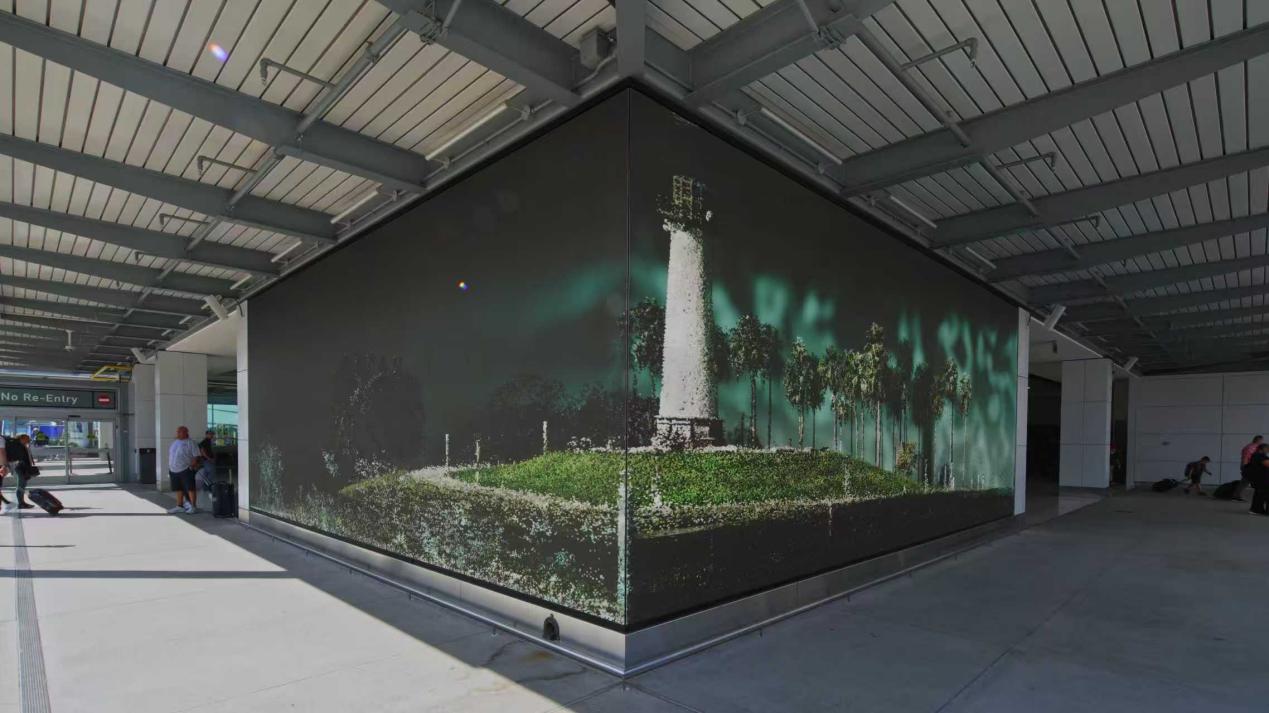
An airport is itself a transitional space of departure and arrival, while the lighthouse has long carried associations of guidance and return. Yao uses these meanings to extend the spatial narrative into the realm of inner experience. Among the travelers passing through, some are returning home while others are setting out toward unknown destinations. Each person carries a different impression of the city—perhaps a familiar memory long settled in the mind, or perhaps an indistinct expectation still taking shape. The gathering and dispersing points of light echo the alternating pull between memory and anticipation. Within a terminal filled with constant crowds and hurried footsteps, At the Still Point anchors a brief moment of stillness within an ever-changing digital image, inviting passersby to pause their gaze and perceive where they are in the present, suspended between what lies behind and what lies ahead. Impressions of Travellers, exhibited in the same setting, continues this narrative thread of the airport by focusing on travelers’ fleeting states of mind. Together with At the Still Point, it forms a complementary pair that brings a sense of human warmth into a space of transit. Airport art is often decorative by default; these two works are unusual in treating the terminal as a site for genuine and unique reflection.
At the Los Angeles Public Library, Yao presented another body of work. LA Impressions uses Unreal Engine 5 to construct dynamic digital imagery, drawing on the creative essence of Monet and Impressionism. Rather than insisting on the precise reproduction of buildings and streets, the work turns toward the city’s constantly changing light, color, and sensory experience. Urban architecture, streets, and sky gradually emerge from interwoven, floating strokes of color, much like an Impressionist oil painting. While traditional painting fixes the light and atmosphere of a particular instant, Yao expands this capture of the moment into an experience of continuous movement. Digital space merges with painterly brushwork as color, form, and atmosphere evolve without interruption. It is among the more painterly uses of a real-time game engine to appear in a civic setting, and it reflects a command of Unreal Engine that goes well beyond the tool’s usual role in games and previsualization.
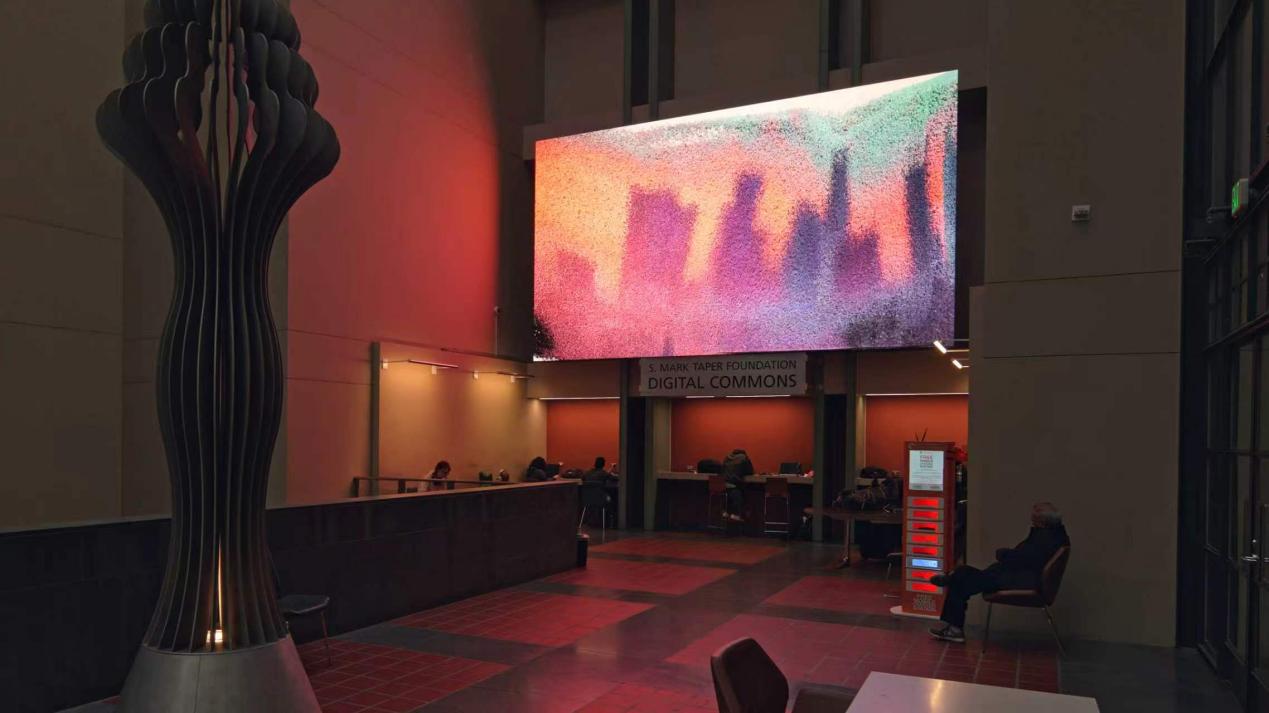
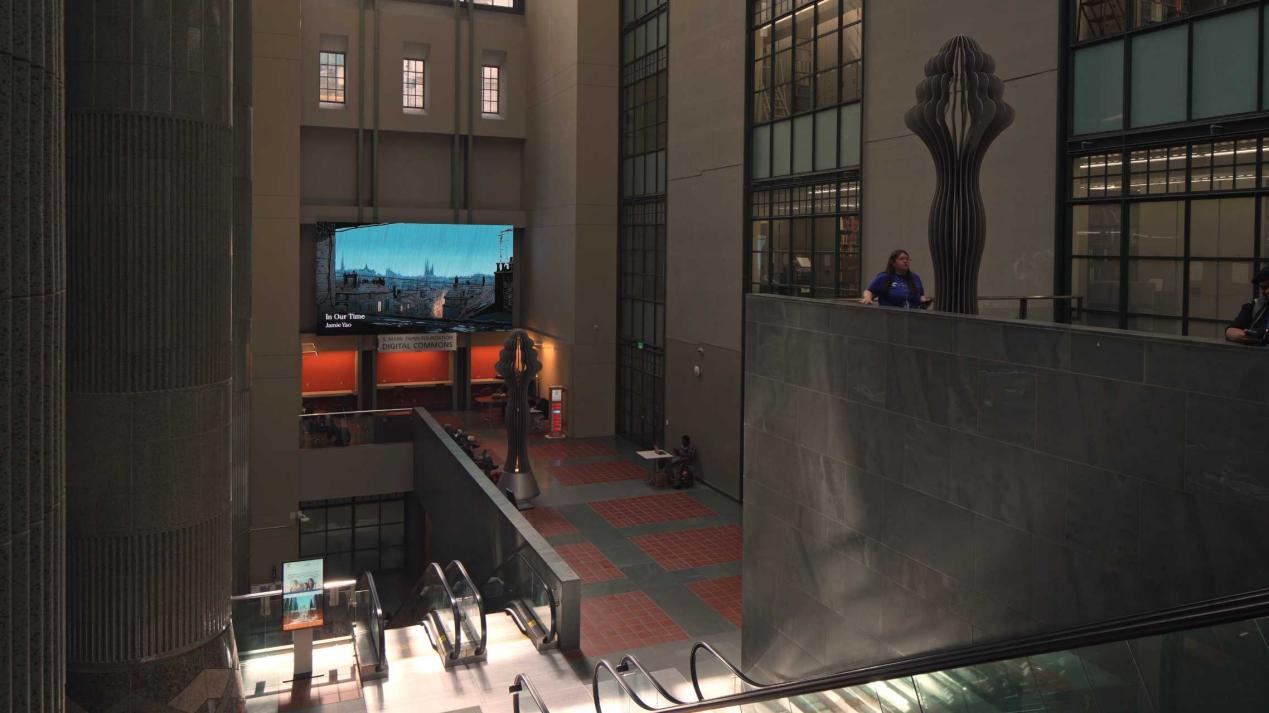
The library is a public space for reading, contemplation, and telling the stories of the city, and placing the work there creates a subtle dialogue with its surroundings. It encourages viewers to move beyond the habitual act of identifying landmarks and recognizing streets, and instead become aware of how light shapes the way we experience a city. The work is conceived not to remain confined to the screen inside the exhibition space, but to alter the viewer’s perspective on the city itself: after leaving the library, people might begin to notice the fleeting play of light along familiar streets and discover moments of poetry within everyday life. In Our Time, exhibited at the same library, further extends digital media’s observation of contemporary society, using moving images to record fragments of the present era and turning the public library into a site where digital art and civic thought encounter one another.
Beyond large-scale public installations, Yao has extended his practice into AI-driven narrative filmmaking. At Flick.art, the Y Combinator-backed AI filmmaking platform where he works as a Creative Partner, he has concentrated on the point where AI filmmaking most often breaks down: character consistency, visual continuity, and narrative coherence. Rather than applying ready-made prompts, he builds each film on a complete visual design framework, character concepts, three-view references, storyboards, and composition and color standards, and uses that framework to direct and evaluate what image, video, and audio models produce, before carrying the material through editing, sound placement, and final assembly. His AI short film Ulysses received the Best Supporting Character Award at the 2026 MIT Global AI Film Hack, and another short film, The Herder, was an Official Selection of the Cinequest Film Festival, a highly influential independent film festival in North America. It is a significant recognition that places his films within the professionally juried festival circuit rather than the crowded field of online AI experiments. Both works rest on the same premise as his installations: the technology is a medium, and the narrative and aesthetic decisions remain the artist’s. Yao’s AI filmmaking moves beyond the trap of technological spectacle, offering an independent and complete artistic expression
In today’s field of AI art, many works rely heavily on model-generated outputs and can easily fall into stylistic homogenization and assembly-line creativity, leaving originality open to question. Yao’s practice draws a clear distinction between “using AI tools” and “allowing AI to dominate the creative process.” Whether in the point-cloud lighthouse, the Impressionist city imagery created with Unreal Engine, or AI narrative films produced through collaboration among multiple models, the original ideas, narrative frameworks, aesthetic decisions, and spatial logic all originate with the artist. AI, real-time 3D pipelines, and point clouds are simply media in his hands, much like paint for a painter or a camera for a photographer. That discipline is what separates his work from much of what currently circulates under the label of AI art.
Working across the two fields of public digital installation and AI filmmaking, Yao consistently builds his practice around the idea of “perception in motion.” Travelers moving through an airport, shifting daylight across the city, and the journeys and inner states of characters in his films all become central motifs in his work. Rooted in the diverse city of Los Angeles, he uses digital media as a bridge, transforming abstract memories, expectations, and fleeting sensations into visible forms of light and image. His work demonstrates that originality in AI art does not lie in rejecting algorithms, but in ensuring that human creators retain control over narrative and aesthetic decisions—using technology to expand the boundaries of artistic expression and allowing digital light and imagery to carry a sense of humanistic poetry. It is a body of work of unusual range and conceptual discipline, and one that has already earned recognition in both the public art and film communities. In an era of rapidly evolving algorithms, JAIME JIAMING YAO continues to explore the space between the physical city and the virtual digital world, continually writing visual narratives that belong to our time.

