

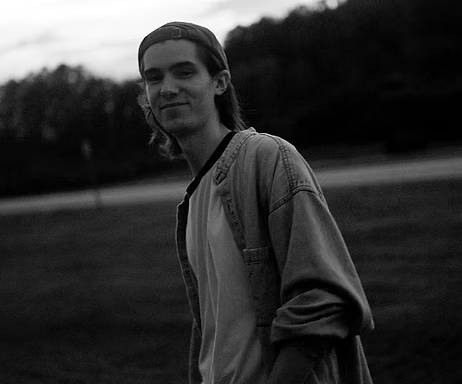
Color grading is one of the last decisions made on a film, and one of the few that an audience feels long before it notices. The colorist decides whether a forest reads as shelter or as threat, and whether an abandoned building looks like a ruin or like a memory.
William Albu works on both sides of the camera. A director of photography and colorist, he has graded a documentary short that reached the Academy Awards shortlist, shot a film for the Canadian Centre for Architecture, and contributed photography and color to an installation at the Venice Biennale.
How visual effects trained William Albu as a colorist
William Albu studied television production and post-production at CÉGEP de Jonquière, then earned a BFA in film production at Concordia University’s Mel Hoppenheim School of Cinema. From 2016 to 2019 he worked as a visual effects artist at Folks VFX, contributing to Fargo, Legion, Shadowhunters and The Umbrella Academy.
Visual effects work depends on matching. A computer-generated element only holds up on screen when its light, contrast and color temperature agree with the footage around it, shot after shot. Years of that work train the eye to catch small shifts in tone that most viewers register only as a sense that something is off.
Albu carried that eye into grading documentaries, fiction, television series and music videos. Several films he graded have traveled widely:
- Oasis, Justine Martin’s short documentary, won the Golden Frog for Best Short Documentary at EnergaCAMERIMAGE and was shortlisted for the 96th Academy Awards.
- Damascus Dreams, Émilie Serri’s feature documentary, received the FIPRESCI international critics’ prize at the Festival du nouveau cinéma.
- Nanitic, Carol Nguyen’s short, won an award at the Toronto International Film Festival and screened at the Berlinale.
His grading credits also include the films Empathie and A Wolf in the Suburbs, series for TFO and ICI TOU.TV, and music videos for Karkwa and Planet Giza.
Grading the forest of My Son Came Back to Disappear
My Son Came Back to Disappear, Yan Giroux’s 2025 adaptation of David Clerson’s novel, was graded by Albu. Suzanne lives alone in the forest. Her son Mathieu, who has not been in touch for years, turns up and asks her to take him to a peat bog they used to visit when he was a child. She resists, then leads him there, and the walk becomes the last stretch of time they share.
A story told this quietly leaves the colorist little room to hide. Most of its 80 minutes unfold among trees, water and moss, where the greens, the gray of overcast light and the skin tones of two actors have to stay consistent across days of shooting while still shifting as the story nears its end. The film received a jury mention for the National Grand Prize at the Festival du nouveau cinéma and won Best Canadian Fiction Film at FICFA, the Festival international du cinéma francophone en Acadie.
Photography and color for Joyce Joumaa’s films and installations
William Albu’s work in contemporary art includes a collaboration with Joyce Joumaa, a Lebanese-Canadian artist and filmmaker based in Montreal. For To Remain in the No Longer, a 38-minute documentary produced by the Canadian Centre for Architecture in 2023, he served as photo director and colorist.
The film returns to the international fairground that Oscar Niemeyer designed for Tripoli, Lebanon, in 1962, a site left unfinished since construction stopped during the Lebanese Civil War. Joumaa combines archival material and interviews with footage shot on 16mm film and digital cameras. The film has screened at Écrans du réel in Beirut, the Open City Documentary Festival in London and the Sharjah Architecture Triennale. At its Canadian premiere at the Images Festival in Toronto in 2024, the evening closed with a conversation between Joumaa, filmmaker Tamara Jones and Albu. On November 2, 2026, the Museum of Modern Art in New York shows it in an evening of Joumaa’s work.
Albu also contributed photography and color to Memory Contours, Joumaa’s installation at the 2024 Venice Biennale. The work examines intelligence tests given to immigrants at Ellis Island in the early 1900s, who were asked to draw shapes from memory. Joumaa reproduces four drawings from a 1914 US Public Health Service report beside close-up videos of hands redrawing them, so the light on skin and paper carries much of the work’s charge.
Across television, cinema and the gallery, Albu keeps returning to the habit he learned in visual effects: adjusting light and tone until every part of an image belongs to the same world. On a series, that habit once hid the seams around digital elements. In Giroux’s forest and Joumaa’s archives, it gives viewers images steady enough to stay with.
Ann Morgan writes about film, visual effects and contemporary art, with a focus on the craftspeople whose work shapes how an image feels on screen: cinematographers, colorists and post-production artists.

