

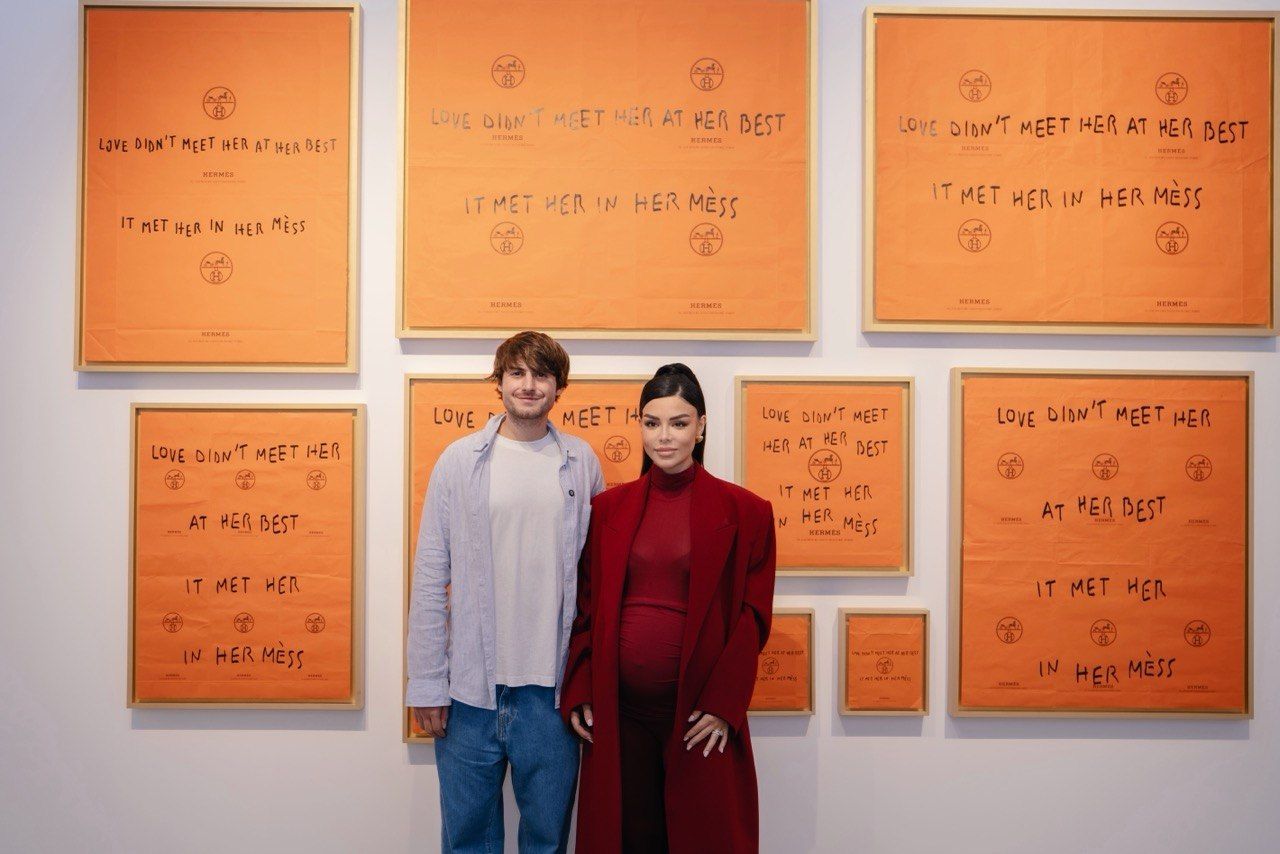
Luxury is rarely silent. It speaks through logos, packaging, slogans and carefully controlled images of the life we are encouraged to desire. In Pietro Terzini’s work, this language becomes both material and subject. His phrases appear direct enough to be understood in seconds, yet their relationship with the luxury imagery beneath them remains uncertain. They can read as declarations, confessions, jokes or criticisms, sometimes all at once.
This tension shaped Material Dreams, Terzini’s solo exhibition at Intent Gallery in Dubai, curated by Angelina Asiakina. Presented in autumn 2024, the exhibition considered the relationship between consumer culture, emotional fulfilment and the construction of identity. Its location was significant. In Dubai, luxury is not simply an image imported from advertising. It forms part of the city’s social language, visible in its architecture, hospitality, retail culture and public presentation of success.
The exhibition placed Terzini’s work within this context without reducing it to either an endorsement of luxury or a straightforward criticism of materialism. Instead, it raised a more uncomfortable question: why do objects continue to carry such emotional force even when we understand how desire is produced?
Born in Lodi in 1990, Terzini studied architecture at the Polytechnic University of Milan before working in fashion and digital communication. His subsequent artistic practice has moved between fine art, public installations and internet culture. He has collaborated with brands including Tiffany & Co., Valentino, Stella McCartney and Max Mara, experiences that have given him a close understanding of how fashion communicates status and aspiration.
Rather than observing this system from outside, Terzini borrows its visual tools. Recognisable logos and references to fashion are combined with short handwritten statements about love, insecurity, ambition and disappointment. The works resemble advertisements, but the promises normally made by advertising have been replaced by personal uncertainty.
In The Best Things Are Not Things, the apparent message is familiar. Emotional experience should matter more than possession. Yet the sentence is presented through the visual language of the same material culture it appears to reject. The work depends on this contradiction. The viewer is asked to accept an argument against material attachment while being drawn to the surface, status and recognisability of the object carrying it.
Love Didn’t Meet Her at Her Best occupies a similarly unstable position. Its language is intimate, but its presentation recalls the controlled emotional messages used by fashion and lifestyle brands. A private feeling becomes a public statement. The work also suggests that contemporary identity is increasingly constructed through phrases designed to be repeated, photographed and shared.
Terzini’s works can be read quickly, but their accessibility is part of their subject. They belong to a culture in which an emotion often has to become an image before it can be recognised by others.
There is an obvious risk in this approach. A statement about consumer desire can itself become another desirable object. A criticism of status can circulate as a status symbol. At certain moments, the phrases seem almost too ready for social media, allowing emotional ambiguity to be converted into an attractive and easily distributed message.
The exhibition does not entirely escape this tension, nor does it try to. Its presentation allows the initial familiarity of the imagery to draw the viewer in before the conflict between the words and their branded associations becomes apparent. What first appears playful can become less comfortable once the viewer considers how closely ideas of love, confidence and personal worth have become tied to consumption.
The curatorial structure connects the works through recurring questions about emotional need, social visibility and the pressure to present a successful self. They are not presented merely as a series of recognisable fashion references. Instead, the exhibition invites visitors to consider how similar messages operate across advertising, art and personal communication.
Asiakina’s approach is most apparent in the decision to leave these contradictions unresolved. The works are not framed as a rejection of fashion, but neither are they treated as decorative extensions of it. This allows attraction and scepticism to coexist throughout the exhibition.
That ambiguity is especially effective in Dubai, where cultural experience, commerce and luxury frequently occupy the same spaces. In another setting, Terzini’s use of logos might be understood as a distant comment on consumer culture. At Intent Gallery, the references belong to the audience’s immediate surroundings and to familiar ways of expressing taste, success and social position.
The city therefore becomes more than a location for the exhibition. It changes the conditions under which the work is read. The visual language used by Terzini is already understood by many visitors before they enter the gallery. The exhibition asks them to reconsider a system of signs in which they may already participate.
The installation gives the works enough space to operate individually while maintaining a connection between their repeated concerns. Text, colour and branded imagery are allowed to compete for attention. The viewer can recognise the sentence first, the luxury reference first, or both at the same time. Each order of recognition produces a slightly different interpretation.
The artist attended the opening, which attracted more than 200 visitors to Intent Gallery. His presence created an opportunity for audiences to hear about his process and the ideas behind the works. Yet the exhibition did not depend on direct explanation. Its central questions were already contained in the encounter between image, language and place.
One of the more persuasive aspects of Material Dreams is its refusal to establish a simple division between authentic feeling and manufactured desire. Terzini’s works suggest that the two have become closely connected. Fashion does not only sell products. It offers ways of imagining confidence, romance, success and personal transformation. Recognising this process does not necessarily release the viewer from it.
The exhibition also reflects a curatorial interest in artists whose practices move between established categories. Terzini works across contemporary art, fashion, public installation and digital communication. Presenting such a practice requires attention not only to its popular appeal, but also to the cultural conditions that make this appeal possible.
Here, accessibility functions as a point of entry. Visitors do not need specialist knowledge to understand Terzini’s language. Recognition, however, is only the beginning of the experience. The familiar phrases gradually direct attention towards the way objects acquire emotional meaning and the way personal desires become connected to public images of success.
Under Asiakina’s direction, Material Dreams allowed these questions to remain open. It did not attempt to separate art from commerce or present the gallery as a space untouched by status. Instead, it examined what happens when desire is allowed to recognise its own reflection.
The exhibition ultimately asked whether an object can carry genuine emotional meaning when its value is also shaped by branding and social recognition. It offered no definitive answer. Its effectiveness came from allowing affection, attraction and doubt to exist together.
Terzini’s words may be brief, but the questions surrounding them are not. In Dubai, where the language of luxury is immediately understood, Material Dreams invited viewers to pause over what that language promises, what it conceals and why it remains so persuasive.

