

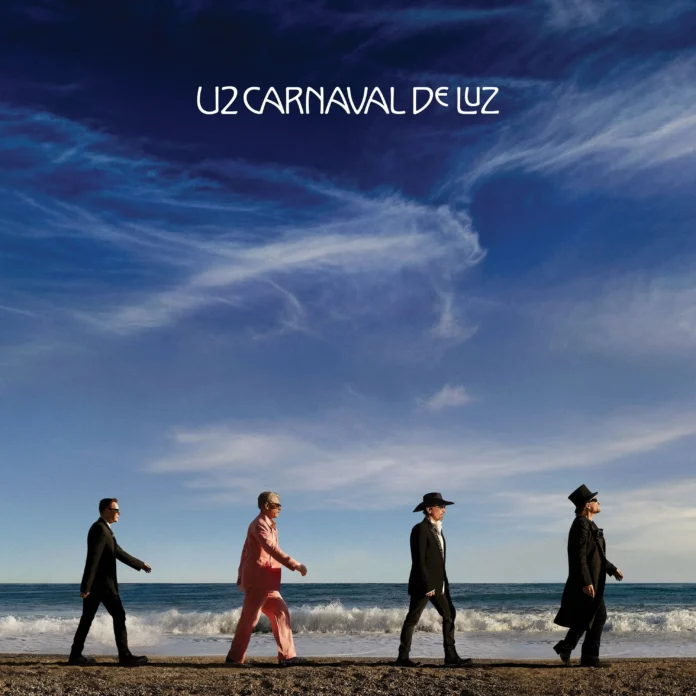
U2 may have been musically absent for a while, but they’ve been keeping tabs on the new generation of rock bands. Based on songs like ‘If the World Is at War We Better Not Be’, you’d think nostalgia for the band’s beginnings was the main fuel for Carnaval de Luz, their first album of original material in nearly a decade, but its youthful spirit – the idea that “we would start a band and change the world” – is at least partly inspired by seeing newer acts do it. “You have to up your game when people step into the room like Fontaines D.C.,” Bono told NME, in the same interview where he praised Geese for going at it like “Cookie Monster from Sesame Street.” The new record is at its most thrilling when they treat rock‘n’roll as a kind of masquerade, an almost cartoonish free-for-all, or try their best at tapping into genuine emotion; too many of its songs, though, scan as predictably self-serious and trite.
1. Go (Carnaval de Luz)
With Jacknife Lee on production and Brian Eno on synths, U2 no doubt sound revitalized on the opening track, a sprightly introduction that’s just off-kilter enough to grab a cynic’s attention, even in just two minutes. Maybe this could really be a celebration?
2. La Reina
The Edge’s spiky riff and a tight rhythm section are quickly stifled by Bono’s lyrics, which somehow lurch from some fantasy of a “lightning rod in female form” to a plea to “sing’a’ling along the reggaeton” (how can this not be the tribute to Rosalía?) to the trite affirmation that “nobody is alone” in the bridge, as if ‘La Reina’ needed one.
3. Street of Dreams
Lee’s production is too stiff to give the track a proper lift-off, but ‘Street of Dreams’ is at least properly anthemic. It emerged from just their second session following Mullen’s surgery, and you can feel the energy (eager, if playfully clumsy) of a band kicking back into gear.
4. The Mirror Maker (Rosalía)
If today’s biggest stadium rock band can get Rosalía on a track, why is the Spanish superstar only the subject of this song? Is it because, as an homage, it’s just a little too weird? Is she “refusing all regret,” as Bono sings on the bridge, or simply avoiding what might incite it? U2 could at least get away with injecting a bit more flamenco influence into a track that sounds like a more forgettable ‘Vertigo’; instead, they tack on a spoken-word passage that throws it completely off the rails.
5. Superficiality
In contrast to the previous track, the sheer oddness of ‘Superficiality’ lands, especially on repeated listens: Bono’s daring falsetto affirms that “Freedom is a feeling”; the song’s structure makes no sense, which makes it refreshingly unpredictable; and the bridge is the album’s best thus far. “I guess it’s hard for our serious friends/ But not so difficult for me,” Bono sings, having fun with the silliness of it all.
6. If the World Is At War We Better Not Be
Which means it’s time to get Serious and sing about The World at Large, so the band strips things down to make space for Bono’s vague platitudes. At the start, he alludes to the band’s early years – “No such thing as a small life/ You can’t measure time in years” – but any semblance of specificity is soon overshadowed by broad, apolitical gesturing.
7. Silencio
Towards the end of the recording process, Lee was apparently worried the album was “potentially a little low-key,” so they brought back a riff from the Songs of Innocence era. Though it does sound a little out of place (thankfully, Bono’s Spanish contextualizes things), ‘Silencio’ is lean and spontaneous in a way most of the record struggles to feel.
8. The Greatest Show on Earth
U2 remember to be earnest on ‘The Greatest Show on Earth’, which also acts as a bid for sincerity. It actually hits home: Eno’s atmospheric textures add depth to the Edge’s typically cinematic guitar, but it’s Bono’s fragile performance that makes the emotional climax feel earned. The lyrics are not only more evocative than usual, but compellingly meta: “Is it all show business here?/ The cinema that is stained glass,” he wonders, breaking the fourth wall for a brief moment.
9. Glorify
Bono tries to sound seductive, but the brooding acoustic guitars sound apocalyptic more than anything. As far as lyrical clunkers go, ‘Glorify’ is one of the album’s worst offenders: “Can I help you? No/ I’d like to think I’m here to help/ Can I see you? Yeah/ Better than you see yourself.” It’s hard to find any redeemable qualities on this one.
10. Midnight Sunshine
The most lighthearted reflection on the album’s theme (if you can call it that) of illumination is pleasantly twee, which isn’t enough to animate the album’s lackluster second half.
11. Can’t Stop Us Now
The band is back on form, dialling up the momentum right before the album’s conclusion. So long as you ignore the dreadfully poetic verses, the song’s six minutes serve as an immersive example of the band’s enduring dynamics.
12. Torn [feat. Dolly Parton]
If it weren’t a duet with Dolly Parton – in her final recorded performance – ‘Torn’ might have been another murky song about a divided America. But the aching specificity of just a few lyrics – not to mention the quivering emotion in Parton’s voice as she delivers the line “Nothing hurts a mother more than a family at war” – turns what could have been a one-off collaboration into a worthy closer. Co-written with Snow Patrol’s Johnny McDaid and featuring Daniel Lanois’ ethereal pedal steel, it brings weight to a record of flaccid, one-size-fits-all optimism – one ultimately better at lamenting the state of the world than forcing a celebration.

