


Yiming Zhai’s practice has long centered on murals and spatial visual work. He draws inspiration from everyday moments, nature, and urban environments, using narrative-driven characters and dynamic compositions to enter different kinds of spaces. From office environments to community-based public art and decorative painting projects, he emphasizes readability on site and a sense of visual memorability. His client collaborations include LandDesign, Trout Creative Solutions, Grit Fitness, and Coppell art council, reinforcing his emphasis on on-site readability and visual memorability.
Cola Marks Everywhere: Recording Existence Through “Marks”
In Cola Marks Everywhere, Yiming Zhai places a complex question into a simple action: leaving a scent. In this series, Cola the dog has been to many places, and has also left many places behind. For Cola, “travel” does not necessarily carry a clear meaning, but “leaving a scent” is certain. It means he has existed there. Zhai distills this into the series’ key logic. Cola uses peeing as his way of checking in, turning each stop into a mark.
This premise brings bodily experience to the foreground. Peeing is one of a dog’s most instinctive and most honest behaviors. It does not rely on language, it carries no grand objective, and it does not seek to be understood. Because of that, it becomes a minimal yet precise declaration: I was here.


From Place to Emotion: A Map Unfolded
The chapter titles and settings span widely: NEWYORK, Where is cowboys?, Space, along with Alaska, tropical rainforests, outer space, and a fairytale-like forest of giant mushrooms. Yiming Zhai organizes these places into an emotional map. New York points to crowding and exhaustion. The natural world corresponds to escape and breathing room. The imagined world takes on the role of an exit when reality has nowhere to place emotion. Here, place is not a geographic coordinate but a visual partition of emotional states.
Cola’s movement therefore feels closer to “finding somewhere to dock.” He leaves marks across different spaces, repeatedly confirming his relationship with the environment. Each mark becomes a quiet proof of presence.
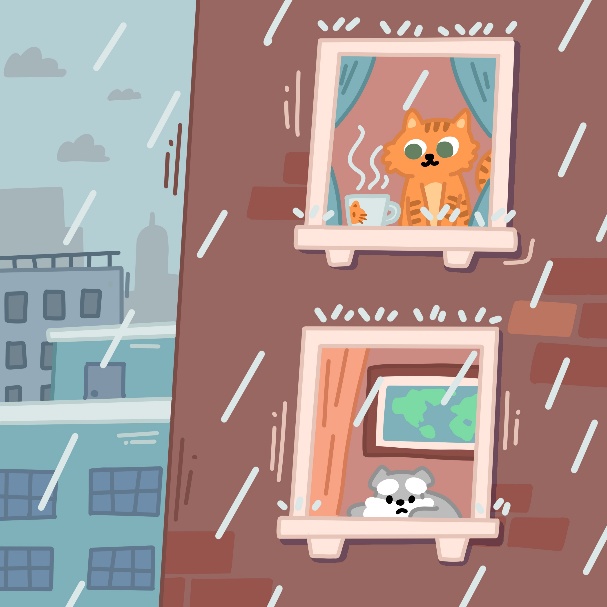
A Subtractive Visual Language: Flat Color, Softened Perspective, Simplified Structure
The series’ visual choices are also built on subtraction. In the process, Yiming Zhai softens perspective, simplifies structure, reduces reliance on “distinctive texture,” and colors only with the cleanest flat fills. This approach shifts attention from technical display to clarity of expression. Rather than stacking emotion through complex layers, it makes “leaving traces” the narrative center.
It also makes Cola’s “check-in” read more like a semiotic action. It does not require a grand explanation; it only needs to be seen.
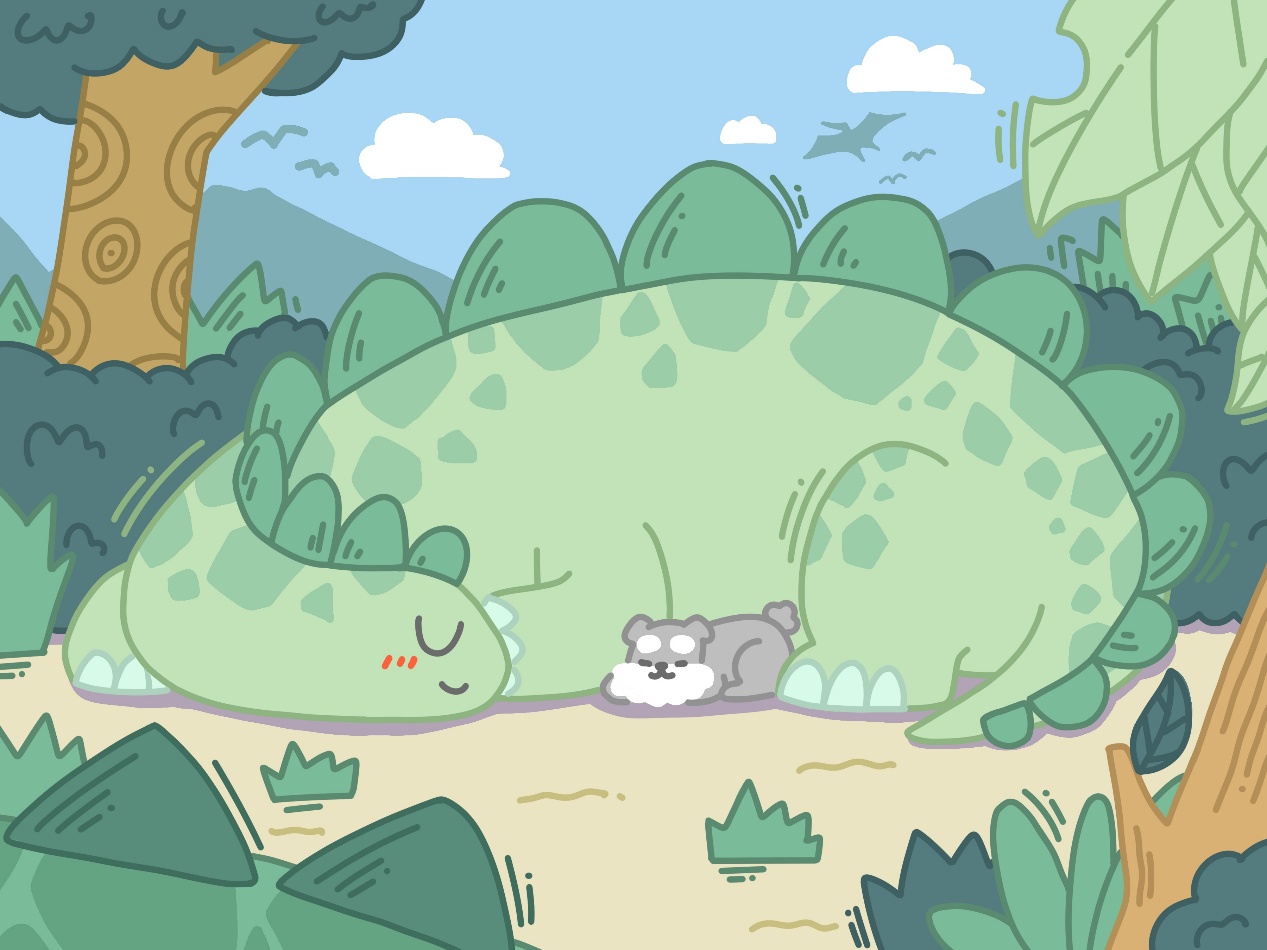
Staying the Course in an AI Context: Why the Brush Doesn’t Stop
In the context of rapid AI development, Yiming Zhai also recognizes that a pursuit that is more concise and restrained can be easier to learn and replicate. The series text brings this reality into the narrative and places the question on a more fundamental level: the reason for making is not determined by whether the work is “replicable.” For him, the brush not stopping is, in itself, a sufficiently firm reason.
Cola’s logic mirrors this. He leaves a scent without explanation. Yiming Zhai leaves brushstrokes without extra justification. What the series ultimately presents is an ongoing confirmation: somewhere in the world, a small but real trace remains, proving “I was here.”

