

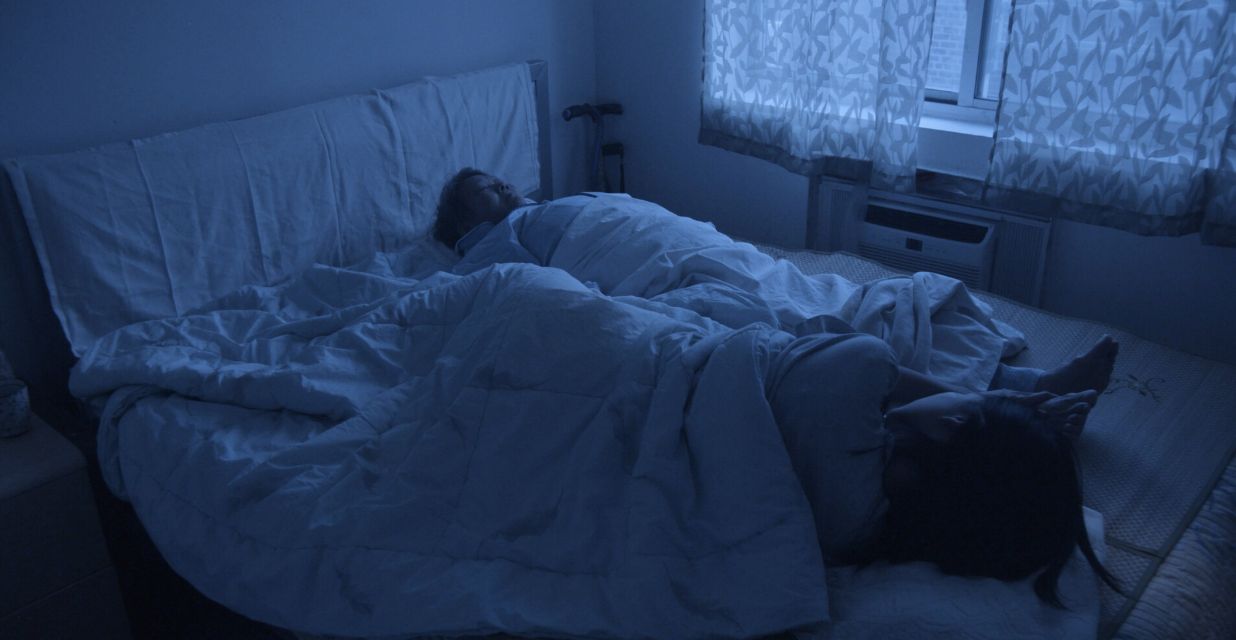
At this year’s National Film Festival for Talented Youth (NFFTY), one of the world’s largest short film festivals, Another Day We Sleep, directed by Zihan Yang, stood out among the Programmer’s Picks. Previously, the film held well-received screenings at Millennium Film Workshop, curated by renowned filmmakers Priyanka Das and Joe Wakeman, as well as at the New York Indie Shorts Awards, one of FilmFreeway’s “Top 50 Most Popular Film Festivals.”
The film follows Yi, a young Chinese woman, as she visits her aging grandmother, Lao Lao, who lives alone in New York City. Together, they move through the quiet repetitions of everyday routines, finding themselves in the delicate space between holding on and letting go.
The film resonated deeply with audiences and programmers alike. As NFFTY programmer Julia Chou noted in her review, the film “beautifully blurs the line between fiction and nonfiction, allowing these moments to feel deeply lived in.”
Our Culture spoke with the filmmakers, Zihan (“Z”) Yang and Jiaying Lin, behind the film and explored how its story took shape through collaboration with non-actors.
Casting as Chance Encounters
The project began with a chance encounter in Flushing, Queens, where director and casting director Yang met local resident Shihui Chen while location scouting. Through a tailor shop downstairs, Yang was introduced to Shihui, and immediately, Shihui invited Yang to visit her apartment, where she lives alone. “There was something about her that immediately reminded me of my own grandmother,” Yang recalls.
For Yang, street casting is essential in building the realism of the story. “I wasn’t looking for actors in the traditional sense,” they explained. “I was looking for people whose presence already carried a history and a life.”
The experience gradually shaped Yang’s understanding of the role non-actors can play in cinema. During the casting process, Yang became increasingly aware of the lack of nuanced representation of older Asian women in New York’s film scene. “So often, their image is shaped through outdated outsider perspectives rather than lived experiences,” they explain.
Meeting Shihui was purely by chance. Chance encounters have inspired Yang’s path into street scouting and casting and remain a core reason why they pursued this career. After this film, Yang went on to scout for larger productions representing communities in the Asian diaspora, including the upcoming A24 crime series Superfakes, starring Lucy Liu and executive produced by Josh and Benny Safdie, as well as My Mother and Yours, the upcoming feature currently in production from director Constance Tsang and casting director Casting Double, whose debut feature Blue Sun Palace won the French Touch Prize in the Critics’ Week section of the 2024 Cannes Film Festival.
For Yang, encounters are among the most beautiful and magical parts of life. They open a path forward, and through that path, one discovers something new—not only about the subjects, but also about oneself and the kinds of stories one wants to tell.
Storytelling Beyond the Script
After casting Shihui, Yang knew they wanted a professional actor for the role of Yi, the granddaughter. A trained actor can adapt quickly on set and create a dynamic that influences non-actors in unexpected ways. After Yang cast Fan Chen as Yi, their rehearsal process was far from traditional. Rather than beginning with the script, Yang and Fan spent weekends in Flushing visiting Shihui, sharing meals, taking walks, and getting to know one another.
When Yang discussed the ending of the film with Shihui, in which Lao Lao passes away in her sleep, Shihui reacted strongly and expressed discomfort with reenacting a death. She hoped the story would leave more room for ambiguity. For many older Chinese individuals, portraying death can carry an ominous meaning.
Yang empathized with Shihui’s sentiment, and instead of insisting on the original approach, they looked for new ones. Shihui’s co-star, Fan, also advocated respecting Shihui’s wishes. Together, they reimagined the ending of the film as a quiet long shot of the empty living room of Lao Lao’s apartment, as Yi slowly comes to terms with her loss off-camera.
Crafting Authenticity in the Edit
While the cast prepared for production, editor Jiaying Lin joined the project early in development, anticipating an unconventional editorial process grounded in evolving and spontaneous performances. The team understood early on that the film would emerge not only from the screenplay, but also from the relationships and discoveries that unfolded during production.
Lin describes the editing process as something closer to documentary storytelling than narrative editing. “It became a question of how to pace a quiet life on screen,” Lin explains. “Which moments should feel transient, and which moments should linger long enough to reveal what the characters cannot openly express?”
With many spontaneous performances to choose from, the first assembly of the film was nearly an hour long. One of these performances was when Shihui Chen delivered a meandering monologue about the mundanity of her life: how she sleeps and eats on repeat, scrolls through short videos in her free time, and carefully asks if Yi had seen the ones she sent. The honesty in Chen’s delivery struck Lin as a priceless moment, and Lin advocated keeping it in its entirety in the edit. “Funny enough, sometimes editing is about not cutting,” Lin says. “If a moment feels truthful to us, it can resonate with the audience too.”
Editing Emotion
Before editing began, Lin knew that the film had strong influences from Chantal Akerman, a Belgian filmmaker known for her use of long takes. For Lin, understanding the sensibility of her collaborator is just as important as understanding the story itself. “There is something poetic about the long take at the end of the film,” Lin describes. “It’s distancing the audience from the sight of a loss, but you can still feel it in every corner of that empty room.”
Originally, in the footage, the long take ended with Yi walking out into the living room. “But we felt that it reads as if Yi is already detached from her grief,” says Lin. By cutting this moment, the impression that Yi remains with Lao Lao in the bedroom is sustained. Yi’s absence from the frame, heightened by her off-camera sobbing, conveys her grief more authentically. Across her editorial work, Lin prioritizes genuine performances, trusting sound and image to carry the story on their own.
In addition to editing alongside award-winning editors Youmin Kang and Kali Kahn on feature films, Jiaying Lin will begin her residency as one of four editors in the Canadian Film Centre Editors’ Lab this year. The collaboration between Lin and Yang has also evolved into the short film Not Valid For Travel, which is set to make its California premiere at the Academy Award and BAFTA-qualifying Palm Springs International ShortFest this June.
For both filmmakers, working with non-actors ultimately shaped the storytelling itself. Rather than enforcing total control over the performances, the filmmakers adapted around the instincts and lived experiences of the cast. “Sometimes reality gives you something more honest than anything you could write,” Yang says.

