

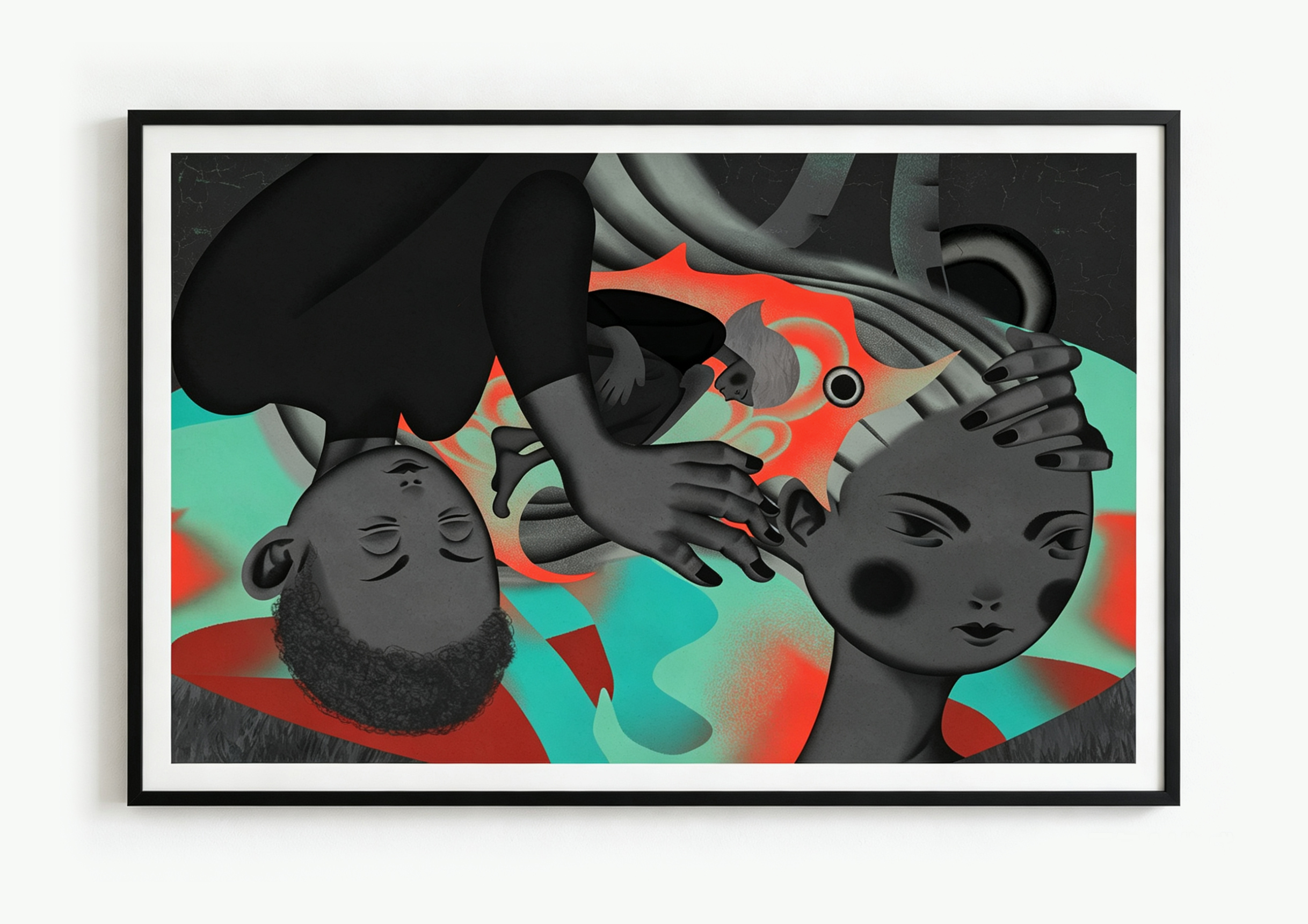
Qintong Yu’s pictorial representations explore dormant human forces through Modernist attitudes towards the subject. Expressive, plastic, and formal elements are approached through post-Cubist lenses. For instance, in Layers of Self (2025), the colour palette — from black to sombre greys, with flashes of green and orange — achieves a richness and sophistication reminiscent of Albert Gleizes’s oeuvre in the 1920s.
It is interesting how the Purist “return to order”— with its subdued colours and forms modelled through an illusion of projecting volume — is mobilised by Yu to convey, almost paradoxically yet effectively, the multifaceted and convoluted nature of the self. On the one hand, the atmospheric effect in this painting recalls that of Fernand Léger, as does its sculptural approach to the human body. Yu models the two main subjects forward from the surface of the canvas to the point that they seem to detach themselves. Légerian are also the smoothness and pristine qualities of Yu’s brushstroke, which pursue the monumentalisation of simple forms and the icon-like treatment of the figures. On the other hand, Yu also establishes the primacy of the two-dimensional picture plane and, here, axis matter as much as the plane: Layers of Self invites viewers to tilt their heads and apprehend it as though displayed in portrait orientation, in order to trigger reflections on the complex nature of identity.
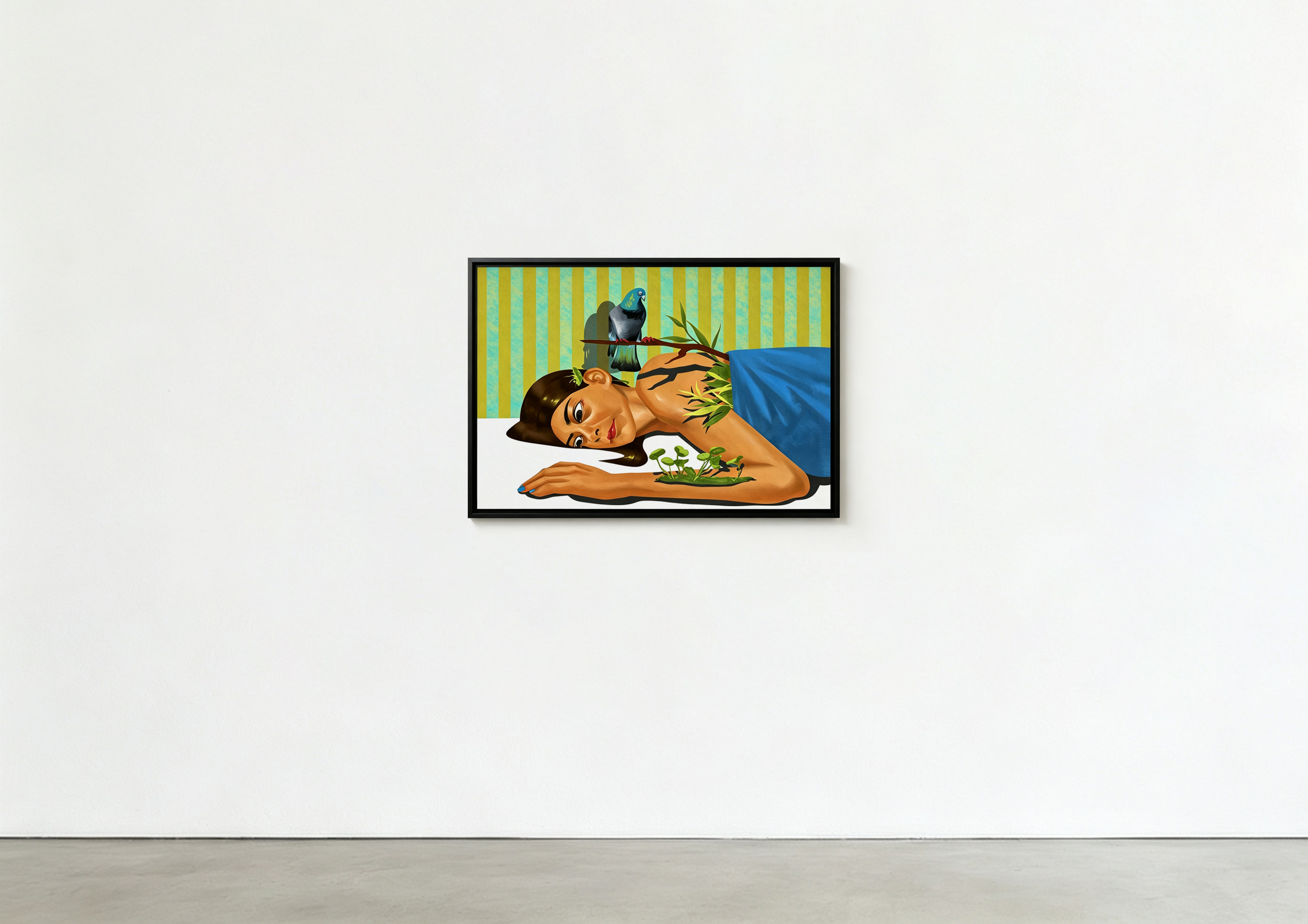
However, Yu is also aware that human psychology cannot be reduced to the vertical-horizontal structures that underpin architectural simplicity; hence, she engages with symbology and the phantasmagorical by combining the elements that constitute pictorial space in a dream-like manner. Surrealism, with its exquisite, uncanny sensibility, surfaces in Yu’s work. The Silent Germination (2025) establishes a dialogue with Salvador Dalí’s notion of the “paranoiac-critical”, as the subject is captured in the act of pondering existence — as many of us do — in the waking moment, when subconscious knowledge surfaces after the oblivion of sleep. The woman in this painting appears to be in precisely that state of perception in which multiple, unstable meanings materialise in the mind, as if mirroring Dalí’s pursuit of an irrational, over-interpretative, and hyper-associative mental state as a method of artistic production.
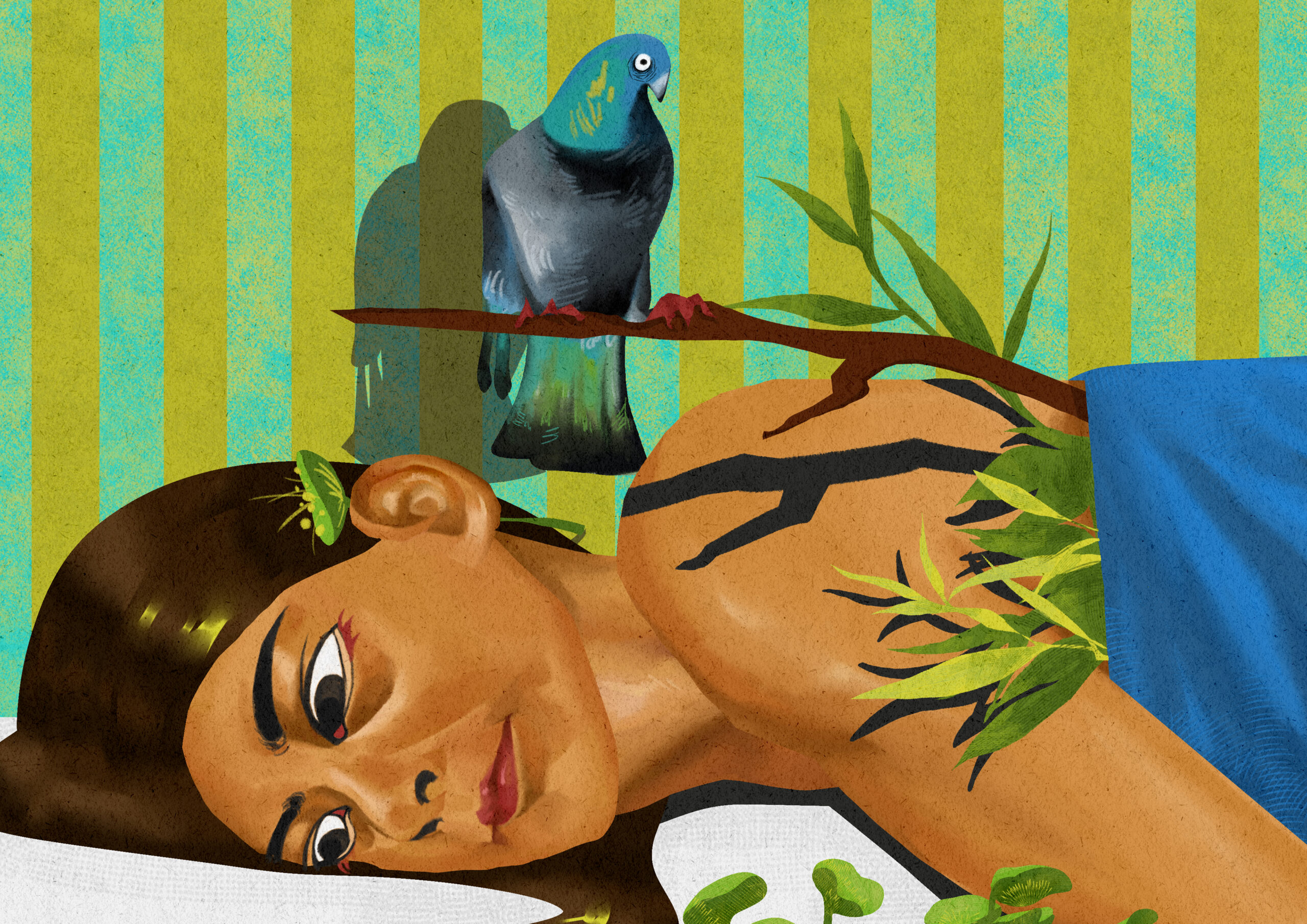
The prone female figure, lying face down, stretches across the surface of the composition, and her association with the psychic domain amplifies the poetic potential of the image. She visually corresponds to a severed tree trunk that crashes to the ground after the final cut, as one notices the vegetation adhering to her skin. Concomitantly, the act of falling into horizontal alignment with the earth epitomises surrender to external forces. Yet perception also reads the image in terms of the body as ecological material. By shifting their interpretive gaze, viewers are enabled to perceive themselves as continuous with nature — biologically, chemically, materially, and spiritually. Aligned with the most pressing concerns in contemporary art, Yu makes us aware that we are embedded in a natural environment that we should strive to preserve.

