

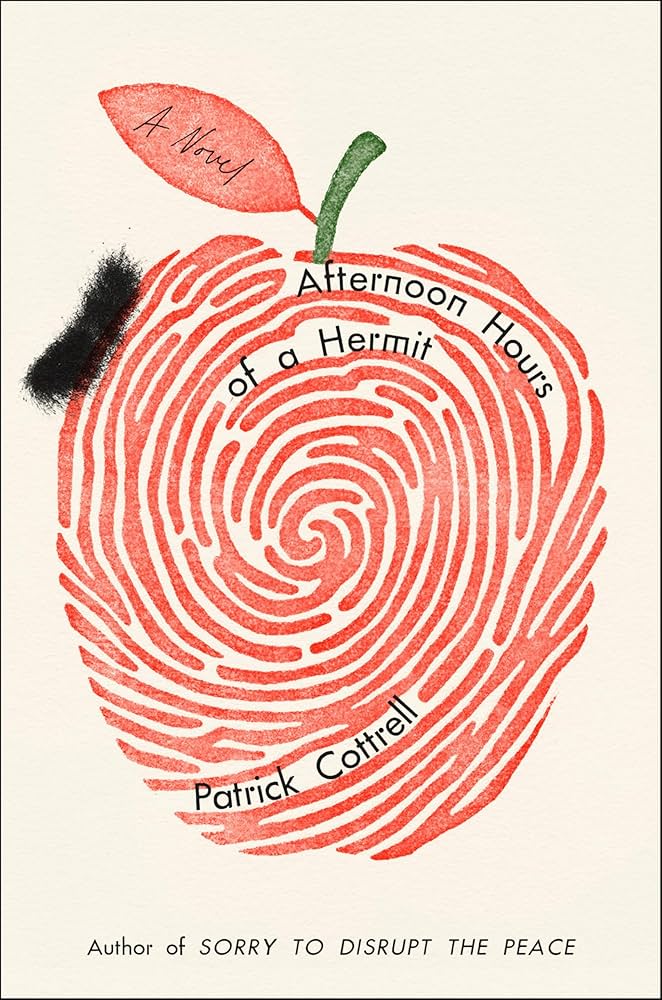
When Dan Moran, author of the novel Sorry to Disrupt the Peace, receives a letter in the mail containing only a photo of his now-dead brother, it sets him on a quest back home in which he plays a “metaphysical detective” that must solve the case. But having physically transitioned and mentally moved on, he comes face-to-face with what his relatives and neighbors see him as—a vision that hasn’t changed in the past five years. Unable to work on his novel-and-process and desperate to find answers, Dan terrorizes local school administrators, begging to give a reading at his old high school, adopts new personalities, and tries to get to the bottom of who his brother was—and him, in turn. Touching, quick-witted, and often very funny, Afternoon Hours of a Hermit is a sly identity break of a novel.
Our Culture sat down with Patrick Cottrell to talk about autofiction, the dentist, and whether one can change.
Let’s talk about autofiction. This is obviously a very playful book, and I was wondering why you gravitate toward writing about your own life at a slant.
“Playful” is a good word. I don’t take autofiction very seriously; it’s not something I think about when I’m writing. This is just what I write. When you write a book, whatever the content is, the way you tell it and the truths you’re getting at, all of that points to a way that you see the world. I think autofiction as a term is just a hook that marketing people like to use and other people like to make fun of, including me, maybe.

Dan is obsessed with how people see him, and often tries to listen in to what they say behind his back. Do you think this hinders his investigation, or motivates him to fully piece together his and his brothers’ identities?
For sure, it hinders. It has some real limitations and blind spots, and I think it plays into everything with social media—everyone is obsessed with themselves in some way. I did this experiment with my students where I wanted them to stay off social media for 24 hours, and so many of them were writing about how anxious and panicked they were. In the book, I think there are levels of self-obsession the character feels, and a lot of it is supposed to be funny and uncomfortable.
This metaphysical detective work distracts him from his novel-in-progress, but do you think that writing would result in any concrete discovery?
Definitely not. Is he even a writer? He keeps talking about the ten pages he has so far. I don’t know if he’d be able to fully write a book. I don’t know how much of a writer or detective he really is—reality is a little shaky.
Dan’s first book was about his family, which irritates them, yet he can’t stop writing about them. Do you think he’s ostracizing himself on purpose, like pressing a bruise until it hurts?
I think that’s part of it. Toward the end, he realizes that what he’s been doing has been writing about them, as an act of avoidance or neglect. Writing is a way to keep himself at a remove. At the same time, it can also be an attempt to get at a truth. The book is grappling with the different ways people use writing.
I really connected to the idea that “sometimes writing was going to the dentist.” Tell me a little more about this idea.
I guess what I’m getting at is that any kind of doctor, a surgeon, for example, let’s pivot to surgeon—they specialize in something and enter a flow state. If they’re really good surgeons, it should just be automatic for them. Writing can be something that is sort of mundane. You’re sitting at a keyboard, typing—it’s not mystical. At the same time, you’re entering a trance, and it’s something you’re creating with your mind. When I hear “sometimes writing was going to the dentist” I picture the dentist’s office in some kind of shopping plaza. It feels suburban.
And writing is suburban?
No, writing is not suburban. Writing can be anything.
I also wanted to get your take on this quote: “Rather than make self-improvements or go to therapy, perhaps it’s easier to dissociate from reality, to simply detach from it, to break off and imagine oneself as an entirely new character, however repellent, off-putting, unlikable, unhinged, etc. Perhaps this is how you change.” I thought it was good justification, or maybe supplement, to Dan hiding behind his brothers’ identity.
I think that so often, a question is, ‘Can a character change?’ People want to know if it’s possible for humans to change. It feels like even if we try to break a habit or something, sometimes it can ultimately feel like, ‘No, you are who you are.’ People can feel stuck with who they are. For trans people, there is a question, ‘Can I change? Will the world see me in a different way? Can they?’ The answer can be absolutely, and the answer can be no. Both things at the same time.
Finally, what are you working on next?
I’m working on some short stories. But I always go through long periods of gathering and being quiet. Some people are really prolific, but I like to take my time and emerge when there’s something I feel I need to say. I’m ready to enter another period of stillness.
So for Afternoon Hours of a Hermit, what did you feel you needed to say?
I wanted to answer whether you can change in the eyes of people who have known you for decades. And I think a larger question I had, too, was about writing and transformation. How do you depict a character who has changed across time and across a book? Is that possible?
Afternoon Hours of a Hermit is out now.

