

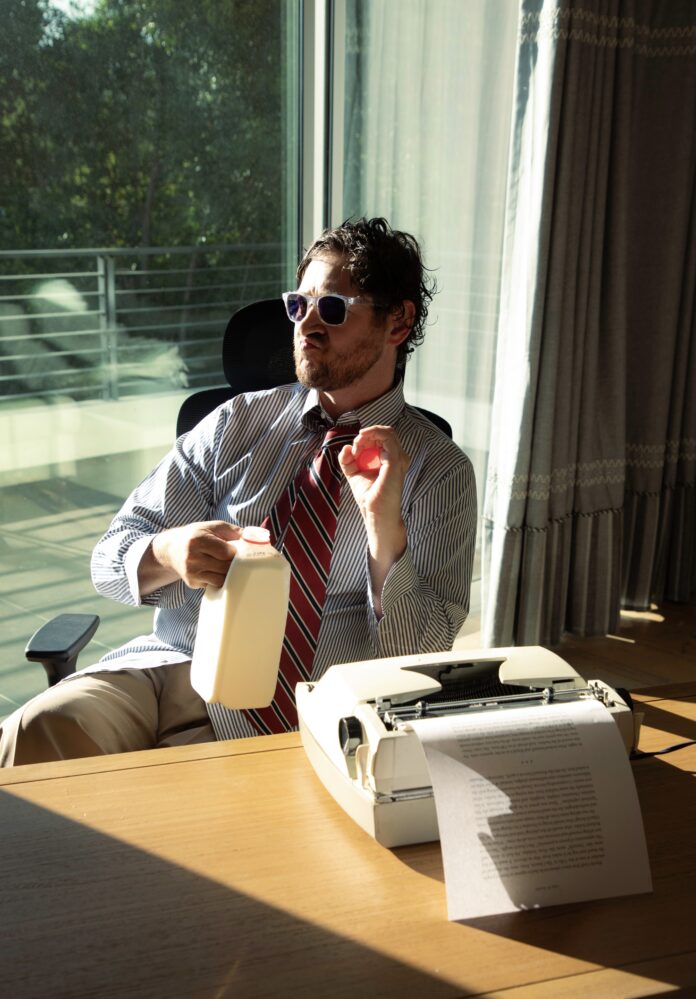
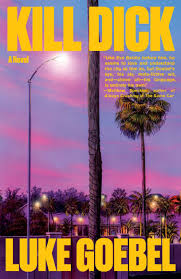
Luke Goebel doesn’t enter my Zoom call, “KILL DICK” does. It’s a sensible stone in the path for an all-out burst of promotion that has included graffiti in Los Angeles, merchandise, a FLAUNT party, and a playlist. The marketing mirrors the book, Goebel says, and Kill Dick goes off like a bomb—a cutting commentary on wealth, homelessness, artistic deprivation and those who profit off the weakest members of our society. It’s a realistic satire with its claws firmly in the present, as if Chuck Palahniuk and Joan Didion wrote one LA’s final episode.
In the novel, Susie Vogelman is a drugged-out 19-year-old NYU dropout resting poolside at her father’s place when a string of horrific murders shock the city. She leaps into action after the re-emergence of Peter Holiday, her former teacher who sets up a halfway house for homeless addicts in an attempt to find his long-lost brother. And her best friend Faia is the heir of the Sickler dynasty, whose CEO is poisoning the world one Oxy at a time. (Her father may or may not have a vested interest in Sickler’s success).
Darkly funny and unabashedly sharp, Kill Dick is a novel uniquely for our time—and a wake-up call for reality. OurCulture sat down with Luke Goebel (who did, in fact, enter my Zoom) to talk about his grief, addiction, and guerilla marketing.
 Congratulations on your new novel! How does it feel now that it’s out?
It feels a little like the opening of the sex-party chapter in the book, the homage to Eyes Wide Shut, where Susie talks about Los Angeles having its own force field. You’re either striving to make it, or you already made it and you’re trying to remain relevant and do the next thing. It’s cool to be seeing positive press. And then the OCD, paranoiac part of me is like: all right, how many felonies could I face for this? The stencil campaign, the massive amount of graffiti in the city… I think about whether the family that makes Oxy will want to do a little lawsuit dance. But anybody who hasn’t at least been charged with a few felonies in life… What are they doing writing a book?
Kill Dick feels so connected to our current world, despite it taking place a decade ago. What were some of the strands from reality you wanted to explore further?
I grew up in a little town of 2,500 in the fallout of a Christian cult that my parents met in. I grew up with people talking to me about Satan in the VCR and Hollywood, but later I ended up working in Hollywood. My dad was a Jewish acidhead who found Jesus, joined this cult, then moved into more mainstream culture and became vice president of a Fortune 500 company in Dayton, Ohio. But he was still playing us records by outlaw country singers, folk singers, blues singers, Jimi Hendrix, Bob Dylan, Joni Mitchell, John Prine—people using wit and storytelling and poetry to communicate a tradition of resistance.
Then I called Ken Kesey when I was twelve. Later I met Mountain Girl and John Perry Barlow and the Grateful Dead and the acid movement, while also growing up in Portland in the era of Ani DiFranco, the Animal Liberation Front, Earth First!, the WTO riots. I was a little druggie street creature, a miscreant, asking: what’s really going on here?
Then 9/11 happens. The country shifts. The FBI says the largest terrorist threat will come from eco-terrorists and animal-rights activists. You’re like: how do you get from Saudis attacking the World Trade Center to a war in Iraq to domestic terrorism that wants to protect the earth and living beings? Meanwhile the largest cash shift in the history of mankind is underway to pay Halliburton. It always felt like there was some kind of trickery afoot.
So by 2016, after my brother had died of Oxy a few years before, I was watching the Bernie Sanders / Hillary Clinton split, QAnon. I became appalled by the antisemitism and misogyny at the center of it, and I started to feel that Roger Stone, Steve Bannon, and Donald Trump were using a kernel of truth they were very close to, wrapping it into blood libel and pointing the finger at women and Hollywood. It felt like when I was a kid and people were telling me Satan was in Hollywood. That’s some bullshit.
It’s set in 2016 because that’s when it started feeling undeniable to me. I was thinking about the Sacklers, about Purdue Pharma, about that Kentucky courthouse where they dumped a million documents when asked for evidence that they misled doctors and consumers about Oxy’s addictive nature. That move—the document dump, the flood, the overload—felt central. Instead of truth, you get saturation. You get hyperreality. You get chaos.
Art is not pedantic. I am not a moral authority. It’s a story, and it better be fucking fun.
We’re in a time of profound technological revolution. AI is coming so rapidly and so powerfully that it will dwarf almost any technological advancement that has happened on earth. People are confused about how to orient themselves in reality. We don’t know if the news we’re seeing is true. We don’t know much of anything. So people go online trying to find a way of understanding things, and that often leads toward antisemitism, misogyny, and conspiracy.
At the same time, those conspiracies are important to write about because they are actually shaping reality. What happened in 2016 was inseparable from conspiracy baiting, fractured media, and manipulation. We’ve lost trust in governance, in media. We’re all looking at a million shattered screens feeding us our own beliefs. People take what somebody on YouTube says with the same authority they take what a president says, because leadership itself is no longer operating with fealty to fact. So yes, I think people are writing about it because it’s really happening.
With Kill Dick, a central question was representation itself: how do I represent my dead brother without removing him by turning him into something that isn’t him? For years in early drafts, his body was in the freezer in the basement of the fake rehab. That was a metaphor for my own inability to deal with his death. Later he became part of the book differently. So now, if I write another novel, it will have to be because there’s another question of that scale that I need to live inside.
You mix a lot of serious topics, like addiction, obscene wealth and homelessness, but your humor cuts through. Was it a tight balance?
I was just asked a question by another magazine about exploiting lived experience and transforming it into art, and I took offense to the word “exploiting.” I’ve been in five jails, four rehabs, two mental institutions. I’ve lived in vehicles and above strip clubs in San Francisco for seventy-five dollars a week. I’ve been an addict. I’ve been charged with felonies. I’ve also had a great deal of privilege, and I survived partly because of it. My brother had some of those same resources, and he died. That’s what made me write the book: grief, loss, and outrage at losing my brother to Oxy.
So if we’re talking about humor in relation to these big topics, it’s gallows humor because it’s lived humor. Spend enough time in recovery, lose enough people to drugs and alcohol and crime and poverty and insanity, and humor becomes part of how you survive. I’m on the board of directors for the Portland Alano Club, the oldest and largest nonprofit in America for drug and alcohol services. We’re trying to get Narcan to rural communities and all over Oregon. I go out on the street. I talk to homeless people. I try to help. But if you stay too long in that bleeding-heart, do-gooder space, you can become addicted to your own bullshit. It becomes its own form of egotism and self-righteousness.
It’s always a dance. The world is breaking our hearts. The actions of the ultra-powerful are outrageous. The destruction of this planet is outrageous. The fact that we’re paying for it all while holding fossil-fuel devices in our hands is outrageous. So you need humor, levity, light, beauty, music, wit. Otherwise you’ll lose your mind, and you won’t get anyone to pay attention. If I’m going to get somebody to care about what I care about—my dead brother, or the trajectory of America as it falls under distraction and deception—then it has to be fun and sexy and luxurious as well as derelict. But it also has to make them think and feel. Art is not pedantic. I am not a moral authority. It’s a story, and it better be fucking fun.
Tell me about this media and marketing blitz you’ve been on. I feel like you’ve succeeded in making the book larger than life, almost like a movie.
I think the campaign mirrors the way the book works. Susie creates media spectacle, she creates shock. The book isn’t with a Big Five press, it’s with an independent press that is down for the cause. I’m driving a $4,000 car and putting my own money into promoting the book because I think the establishment isn’t working. A lot of what the industry is cranking out, a lot of what it’s putting money behind, feels too safe. I see the book as direct action. Art from a place of radicalism.
I care about the book, I believe in it. That’s a miracle, because it took me ten years to write and I never thought I was going to pull it off. Now that it’s here and I love it and people seem to love it, I’m going to give it everything I’ve got. It feels like we’re running a campaign. I’m not asking for permission. I’m not going to wait to be included through good behavior and pedigree—I’ve lived in too many worlds for that. If you really believe a book is worth all the money and sacrifice that goes into it, why are we treating it like soap? There are no trustworthy tastemakers in the old sense anymore. It’s direct engagement with human beings now. So you better engage. I’ve learned how to launch a book like a movie, and it’s working.
What feels exciting to me is the way the book and the campaign are truly guerrilla, truly indie, naming names and looking at systems that need to be spoken about. I’m also seeing other forms of art reinvigorating radicalism in the American imagination—I think of Vineland becoming One Battle After Another. I think of Sturgill Simpson and his album under his alter ago Mutiny After Midnight, songs like “Ain’t That a Bitch,” which feel like a kindred spirit to Kill Dick. These are expressions of art speaking to oligarchical tyranny, systems of mass deception and distortion that have real-life consequences in hundreds of thousands and millions of deaths. It feels important to be part of resistance, and I’m honored to take part in that.
About her art show she sets up at Skid Row, Susie thinks, “Better to make an art illusion that worked than a real piece of art that was mediocre.” I thought this tapped into something very pertinent of these times, that the image of making art and being an artist often takes precedence over the work.
I toured Skid Row because [the author] Rachel Kushner connected me to a woman, a Skid Row native who had spent her whole life there, in and out of prison, a prison-reform activist, whip-smart and cool as hell. She told me to bring a bag of candy bars so when I met each street boss—because there was a boss who ran each street—I’d have something to offer. A lot of that chapter in the book comes directly from that day, even some of the dialogue. Later Teresa died of an overdose, and I contributed to her burial. She was an amazing human being.
That same night I’m at an art-world party, listening to a man casually talk about owning millions of dollars in art. That’s Los Angeles. You can move between these worlds in a single day. It’s overwhelming, but it’s also why LA is so powerful as a setting. An LA noir can send its tendrils into so many worlds—Skid Row, Beverly Hills, Hollywood, politics, media, finance, crime—in a way that very few cities can. LA feels like a mirror of America: immediate, made up, constantly burning, constantly inventing itself.
Finally, what are you working on next?
I’m working on five movies. Actually six, as of yesterday. One of them I’m going to get paid for, which is nice, because I’ve spent a lot of money being insane with Kill Dick. I keep being told to stop talking about the projects because people want to make announcements for each one, which is part of the whole media machine that I find a little absurd.
I’m also working on Tyrant Books—continuing and trying to carry forward what Giancarlo DiTrapano built: daring, authentic, singular, beautifully crafted voices.
I’m not writing a novel right now. I’m playing with an idea that could be a movie and maybe also a book. Lukas Gage came to me and said he wanted to play a pool boy in the south of France who seduces an entire family. It’s a little [The Talented Mr.] Ripley, a little film noir, and I’m working on that with a co-writer. With novels I’m always trying to understand something that can never finally be understood. That’s what a novel is for me. A movie is often about representing something you partly understand. A novel is where I’m really wrestling with a question.
Kill Dick is out now.

