

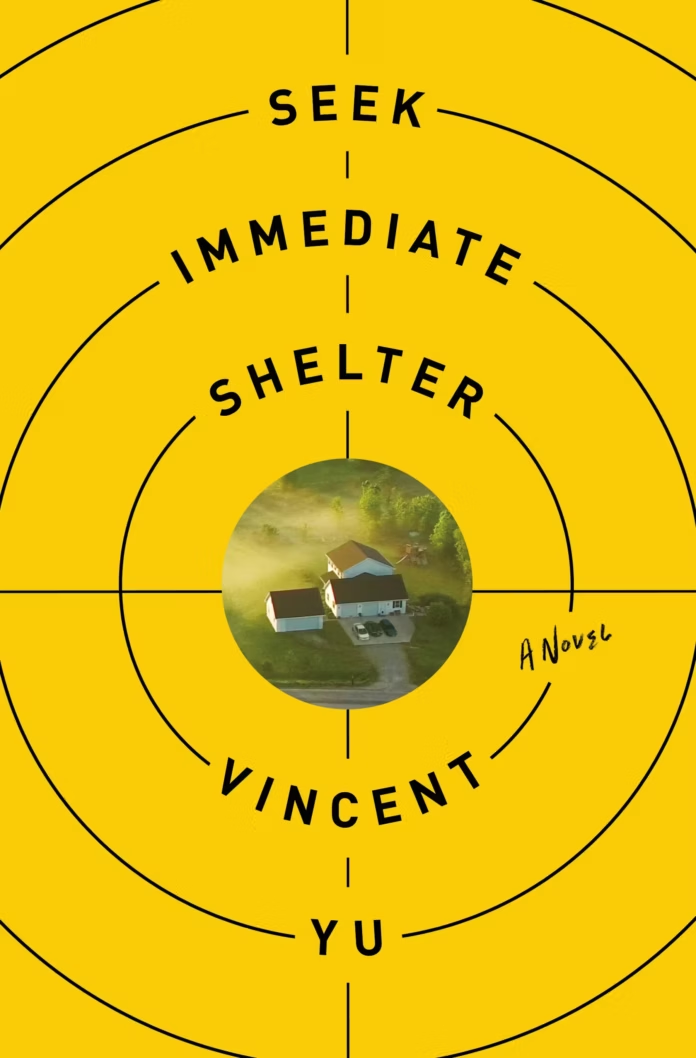
When the citizens of a small town in Massachusetts receive a false missile alarm, alerting them to their imminent deaths, they react in an array of emotions. Some see it as an opportunity for true love—texting a stranger they met at a bar years ago how they really felt. Some see it as a way to get the last word in, texting their child what they really thought of how they lived their life. And some make a mistake that will carry them to their graves—like flooring it before their wife and child can make it into the car.
Touching, deeply human and bittersweet, Vincent Yu’s Seek Immediate Shelter bounds from person to person, following them years into the future to see the reverberations that one instant can have on the rest of one’s life. OurCulture chatted with Yu about choosing love over fear, crafting Asian identities, and closure.
What drew me to Seek Immediate Shelter was its premise. Did it have anything to do with the 2018 false alarm that happened in Hawaii?
Yeah, it was definitely inspired by that. I didn’t start writing immediately after the alarm happened. I started writing in 2022, I’m not sure what brought the alarm back into my head. It started in the same way that all my work does, as a short story. Eventually, if it doesn’t seem to be fitting within the constraints of that form, it could be a robust enough idea for a novel, and that’s what happens here.
In your writing, you strike me as someone who believes one single moment can change everything. Is this true?
Absolutely. I’ve always felt that it’s a fallacy to try and put a story or narrative over real life events’ there’s so many things you don’t consider. I still remember reading War and Peace for the first time, near the end when Tolstoy goes on and on, when it starts to become his own historical beliefs. He talks about the Battle of Austerlitz, how Napoleon won this historically significant event, but if he had been sick that day, who knows? There’s so many events that have such a widespread range of repercussions you can never really expect.
Do you think that when the alert hit, it unlocked something potentially liberating? A lot of these characters do things that seem to me they’ve been waiting to do for a long time.
Yeah, liberating but not necessarily in a good way. When you liberate your instincts, it can lead to things that are selfish. In the final story, Grant is addicted to opioids, when his former fiancée, Millie, appears. Their responses were very similar—both a response to liberation, but in opposite directions. Millie texted this guy she met at a bar one time that she’s never stopped thinking of him. She followed an impulsive decision that leads to nowhere, and Grant feels liberated to finally do something honorable.

Did you ever think about the difference between characters who acted out of love vs out of fear?
Yeah. I mean, David, from the first story, who drives away and abandoned his wife and kid—even though I try to keep the narration very equivocal—I think he drove away out of fear, or cowardice. I think the next character, Nina, when she sends that text to her daughter—she felt free to be a little bit cruel. Those two had less-than-noble responses, but all the others acted out of a sense of goodness, of wanting to make their presumptive final moments meaningful.
I was about to ask about Nina and how she called her daughter selfish. Nina, the mother who called her daughter selfish in her last moments. Do you think in these scenarios, they can write it off as something happening during the heat of the moment?
I thought about that a lot. It comes down to: You can understand something someone does, but you can’t necessarily forgive them for it. Forgetting is a whole other thing. I don’t think the daughter would forget her mother texted her those things. Personally, I do think there’s a chance of forgiveness there. You can tell in the later story, a couple months after Nina passed, Kate does still harbor some ill will. But I think going through life gives you so many perspectives, and Kate becomes a mother at the end of that story, and through the course of her life, she might begin to forgive.
It’s not usually the main tension of the stories, but usually, these characters’ Asian identities play a role in what they do or feel in these moments—tell me about this layer.
That was something I went into, with this book, purposefully trying to do—create characters who are Asian, but almost happen to be that way. If anything, they’re drawn together by their proximity to an alert, and they’re all Asian. I started from there, and there were a couple things I wanted to explore.
A lot of stories right now told of and by Asians Americans are told from the perspective of the second or first generation—the literal act of immigration. I do wonder what those stories will become when we’re at a fourth or fifth generation, after you’ve been several years removed from the immigration that becomes its own legend of the family. I explore this in the Nina chapter, because Dean is a third-generation, and Nina is a second-gen. She believes a big difference in their parenting philosophy came from their temporal separation.
Another thing is that a lot of these stories don’t yet exist, because America is a young country, but we also had the Chinese Exclusion Act. Asians have only been immigrating into this country for a brief amount of time, so I don’t think there’s enough of a literary tradition of, and that’s something I’m very cognizant of as I write.
Let’s say this happens to you. I know we can’t recreate the terror of receiving this alert, but what do you think you’d do?
I mean, cliché thing, call my parents and my little sister. Get a group FaceTime going and let them know everything was chill.
Nothing dastardly?
No, I would be too square about that. I’d go on my company 401(k) and make sure I’d have a beneficiary listed. There’s no way in hell Donald Trump’s government is getting my money if I die in a nuclear attack.
Finally, what are you working on next?
I’m working on a novel about three childhood Asian American friends. Something traumatic happens, and they split up, and two of them reunite over a couple years and try to piece together what happens. I want to explore two big things. Ghosting: a real psychological and emotional exploration of someone who you think loves you very abruptly cuts you off, and how far your desire for closure can take you. And subscriptions: not just Netflix or Spotify, but our increasing disinclination to own physical things and commit to things. That’ll dovetail into the idea that you can never get at the truth of things, everything is a story you tell yourself, and it’s one you’re forced to subscribe to.
Seek Immediate Shelter is out now.

