

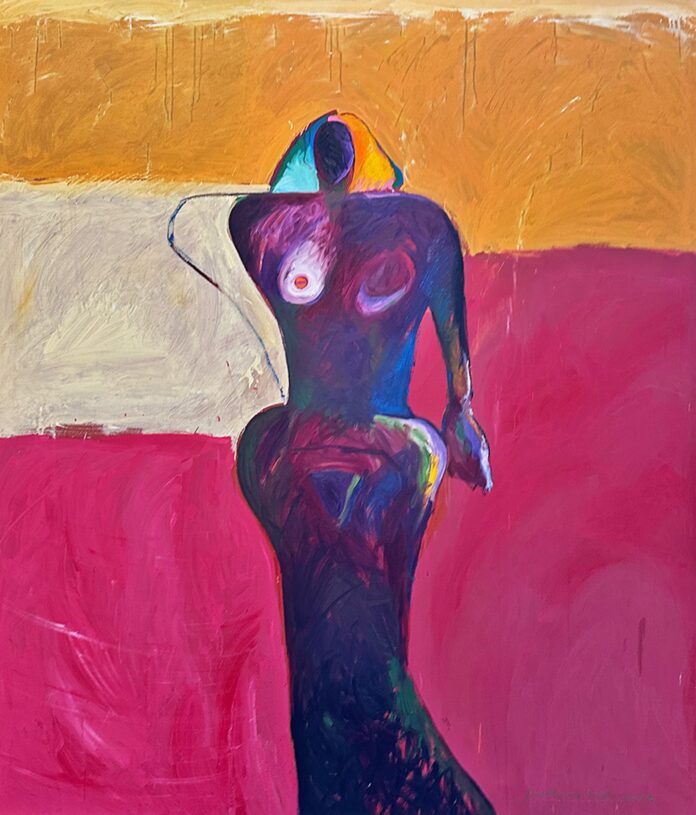
Santa Fe, New Mexico, is home to one of the most significant art movements of the past century, yet one that remains surprisingly unfamiliar to audiences outside the United States. Beginning in the 1960s, a generation of Native American artists trained at the Institute of American Indian Arts (IAIA) forged a new visual language: culturally grounded, formally ambitious, and unapologetically modern. These five paintings, each held by specialist Santa Fe gallery Windsor Betts Art Brokerage, offer a window into a movement that deserves far wider recognition.
Fritz Scholder: American Portrait #43 (1982)
Fritz Scholder (Luiseño, 1937–2005) famously vowed never to paint a Native American, yet he spent his career doing exactly that, but on terms no one had seen before. American Portrait #43 is a commanding example of his late style: a figure rendered in deep magentas and blues, abstraction and portraiture fused in a single composition of dynamic tension. Scholder studied under Wayne Thiebaud at Sacramento City College before joining the Institute of American Indian Arts (IAIA) in Santa Fe as an instructor, where he absorbed Pop Art’s visual language and turned it against a century of sentimental Native imagery. His paintings forced viewers to confront the gap between the mythologised Indian and the real one, and his influence on every artist who followed him in the contemporary Native American canon is difficult to overstate.
T.C. Cannon: Hopi with Manta (1976)
T.C. Cannon (Kiowa/Caddo, 1946–1978) was Scholder’s most brilliant student. Hopi with Manta is a Japanese woodblock print depicting a Hopi woman with the formal composure of a Renaissance portrait, framed by geometric patterning that draws from both Indigenous design and European printmaking traditions. Cannon’s genius lay in his ability to position Native subjects as participants in the global art conversation, not objects within it. He painted Native figures listening to records, sitting beneath Van Goghs, wearing traditional jewellery with contemporary clothing. His death in a car accident at thirty-one cut short one of the most promising careers in American art. The works that survive, including this woodblock from his collaboration with Japanese master printmakers, are treasured for both their power and their rarity.
Kevin Red Star: Crow Warrior Visions (c. 1987–1989)
Kevin Red Star (Apsáalooke/Crow, b. 1943) has devoted more than five decades to painting the culture, ceremonies, and people of the Crow Nation. Crow Warrior Visions presents five warriors in full ceremonial regalia, including bone hairpipe breastplates, eagle feathers, and face paint, standing in powerful formation against a luminous golden field. Every element carries specific meaning within Crow tradition, yet the painting’s bold palette and graphic composition feel unmistakably modern. A member of IAIA’s inaugural class in 1962, Red Star studied under Allan Houser before continuing at the San Francisco Art Institute. His work is both a cultural record and a living artistic statement, affirming the persistence of Apsáalooke traditions through contemporary visual language.
Earl Biss: People of the Big Sky (1986)
Earl Biss (Apsáalooke/Crow, 1947–1998) was Red Star’s classmate at IAIA, his second cousin, and his polar opposite as a painter. Where Red Star pursued precision and cultural documentation, Biss channelled his Crow heritage through sweeping expressionistic landscapes alive with light and movement. People of the Big Sky is one of his most commanding works: a monumental oil on canvas in which figurative form dissolves into luminous colour, evoking the vast skies and open plains of Montana. Biss studied under Scholder and Houser at IAIA before earning a scholarship to the San Francisco Art Institute. His friend Red Star called him “the catalyst, like the agitator in a washing machine”, a description that captures both the energy of his brushwork and the force of his personality.
John Nieto: Bead Maker
John Nieto (1936–2018) brought a Fauvist sensibility to Native American subject matter that was entirely his own. Of Hispanic and Native American descent, Nieto grew up across New Mexico and Colorado before studying at Southern Methodist University and travelling to Paris, where he discovered Matisse, Derain, and the explosive colour of early twentieth-century French painting. Bead Maker places a single figure at the centre of a celebration of Native material culture and artistic heritage, the composition alive with Nieto’s signature electric blues, magentas, and greens. His bold, graphic style, once described as giving Native subjects “the visual power of a Warhol with the cultural weight of a history painting”, brought Southwest art to international audiences and earned him a painting in the Reagan White House.
These five works represent a fraction of a movement that fundamentally altered American art, one rooted in Santa Fe, where IAIA launched careers and a network of specialist galleries continues to sustain them. For those wanting to explore further, Windsor Betts’ collection spans the full breadth of the contemporary Native American and Southwest art canon, offering a rare depth of expertise in a field that deserves far wider international recognition.

