

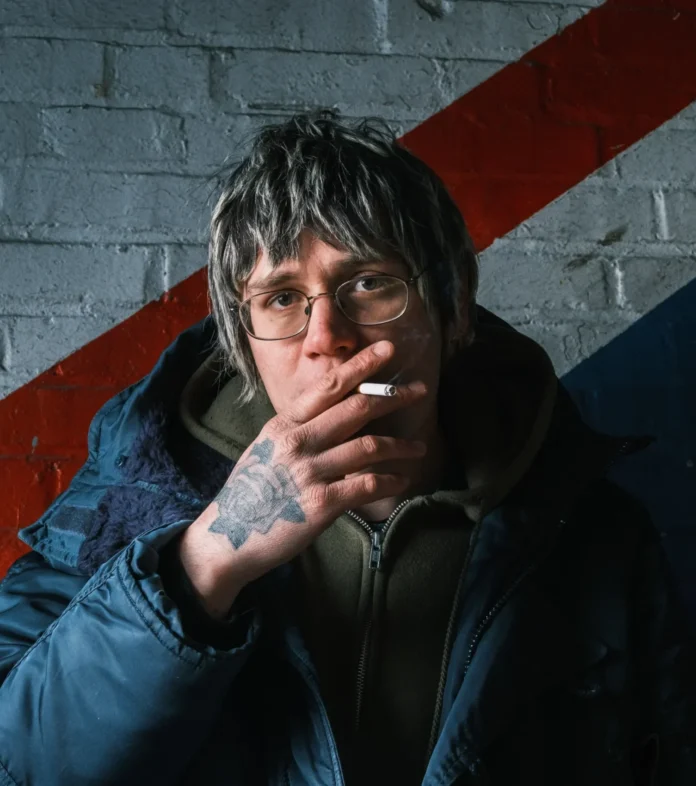
Greg Mendez is a Philadelphia-based singer-songwriter who was born outside Boston and raised in New Jersey. Growing up at a time of mainstream saturation for pop-punk and nu metal, he developed a taste for different kinds of aggressive music while being inspired by the lo-fi, heart-on-sleeve songwriting of the Microphones, Elliott Smith, and early Emperor X. A similar dynamic played out after Mendez moved to Philly: he cut his teeth playing in hardcore and punk bands while recording his own songs with the built-in mic on his laptop. By the time he released his disarmingly intimate self-titled album in 2023, he’d spent a decade and a half as part of the city’s DIY scene – and writing that record, which dissects childhood trauma, addiction, and homelessness. The following year, it was reissued by Dead Oceans, which also put out the wistfully bare-bones First Time/Alone EP. This Friday, Mendez is following it up with his most extensive collection to date, Beauty Land, one no less thematically heavy than its predecessor but more unburdened in its expression. The songs swell with unguarded emotion, whether looping a single thought over spare keyboard or slow-burning into miniature symphonies. Still recording almost entirely alone, Mendez finds ways to stir them outside the confines of his own reality; you could say that’s where the beauty comes from.
We caught up with Greg Mendez for the latest edition of our Artist Spotlight series to talk about making Beauty Land, his relationship with loud music, non-productive obsession, and more.
What’s your headspace like with the release coming up? Are you preoccupied with it, or are you focusing on other things?
I’m a little bit mentally and spiritually preoccupied with it, but most of what I’m working on right now is moving. This bare room that you see used to be my studio, it’s just a little spare bedroom in our apartment. This is where I recorded the record, but I’ve moved out of there, so I’ve been setting the studio up in a different space that’s not in the apartment anymore. The past couple weeks have kind of been that, so I’m not really working on any music, but it is, I guess, music-related.
How is that affecting you? Do you feel like the space has been connected to your process in any significant way?
Maybe it is. I actually haven’t made any two records in the same space, actually. The self-titled was in a different, small, spare bedroom in a different apartment, and we moved, so I only recorded Beauty Land and the First Time Alone EP in this one. But I’m excited about the new space, it has much more room to spread out, and I got a couch and coffee table in there, too. There really wasn’t any room to move around in here, or do much of anything other than sit in a chair with a guitar, and you can’t even turn very much. But I think even just being in the new space is gonna feel a lot better. I think it’s kind of a coincidence that I haven’t made two records in the same space, I’ve just been renting living spaces and moving. But maybe there is something, maybe I wouldn’t be able to make another record in this room, I don’t know. I spent a year and a half on this record in this room, so maybe I need a change.
It’s mentioned in press materials that there’s no natural light in this room. I wonder if other kinds of lighting play a role at all in setting the mood for you when you’re sitting with a guitar and writing.
I definitely prefer lamps to overhead lighting for the most part, but I think I actually do like having windows and natural light. There’s this window in here, but it faces the street. To record stuff, I had to put an acoustic panel in front of it and then close these curtains, so it only didn’t have natural light because you could hear people driving and honking in the recordings if it wasn’t blocked off. But I think I generally like to write more, where I can, in front of a window. The new space has no windows at all. [laughs]
Did you spend time writing and recording into the night, or was it mostly during the day?
I think I ended up writing a lot in the mornings. I haven’t always been a morning person, but I think I ended up writing a lot in the mornings, and sometimes in the evening, too. I feel like midday is my least productive time, generally. But then, when I was recording, I kind of had to base it around when my wife was not here, because you could just hear everything that was going on in the apartment in the microphones if she’s doing stuff. Making any kind of noise at all, it would just come in, so I just worked on stuff while she was out of the house, at work, doing something. And we had downstairs neighbors, so not doing loud stuff late into the night was actually very limiting. As much as you would think having the space right in your apartment means you could just do it whenever, it was actually pretty limited as to when I could do what. Which maybe was good, because I’d be like, “Well, I can’t do this thing right now, but I could do this other thing,” and it made some decisions for me.
Do you wonder whether you would maybe be inclined to write more loud parts, or do it for more songs, if that wasn’t a concern?
I kind of always want to make louder music, interestingly. So maybe it is partially because I’m trying to be quiet a lot of the time. I’m always trying to get things as good or as done as they can be, as quickly and painlessly as possible. If it’s a song like ‘Mary’, it is literally just acoustic guitar and vocals because it just felt like a full and complete arrangement, and I’m always trying to do that when I’m writing a song on a guitar. I always try to finish it, getting it to as close to done as possible in each step. But I’m gonna be able to be loud at this new spot. It’s a lot of practice spaces and some other studios in the building, and maybe I’ll go quicker to electric guitars and drums. Every time I think about making a new record, a lot of times I’m just like, “I want this one to be loud and gross,” and then it just doesn’t happen.
I was thinking about this because of ‘No Evil’, which has a video directed by They Are Gutting a Body of Water’s Douglas Dulgarian with whom you’ve collaborated in the past. It’s also one of the songs that has a more expansive build-up. How would you describe your relationship to loud music as a listener? Are you drawn to hearing some of the themes that you write about reflected in that context?
I love it. Sometimes I think I listen to more loud and aggressive music than music that sounds like mine. I don’t know why. Even when I was a kid, I feel like I wanted to make music that was more like that and less like mine. I feel like I am unconsciously trying to bring those feelings into a quieter space, the same kind of feeling that I get from loud music. At the end of ‘No Evil’, I originally brought my friend in who drums in a punk band to put a D-beat over it because the rhythm of the guitar kind of calls for that, but then it didn’t exactly work how I imagined. But I’m always trying to or imagining bringing those kinds of elements into it, because that just is the kind of music that really got me obsessed with music. I listen to it a lot.
You said you’ve been unconsciously bringing it to a quiet space, and I’m curious if, doing it for so many years, it’s maybe become a bit more conscious.
Maybe. I feel like I just gravitate towards those feelings that are so common when you listen to music that’s heavier. I’ve just always been drawn to that, but I think that a lot of stuff that I started listening to later in high school kind of blew my mind, a lot of the ’90s indie rock stuff, where it felt like that but did it in a way that was just quieter and chiller. It still had that same intensity to it. I think I was drawn to that because a lot of my music-making was kind of private. I was living in spaces with other people, and I was pretty not confident about sharing it a lot of the time. Making something that was quieter literally just meant that less people would hear me doing it. I think part of that started it, which is funny that I end up now very publicly releasing this stuff. But that was how I started. I was kind of ashamed of it, but I also liked the challenge of trying to get to these emotions that are more commonly expressed in loud, heavy, aggressive music, and just doing it with soft acoustic guitar. It’s a fun challenge for me.
It took you about a year and a half to make this record, but how old are these songs? Did you revisit ones that were written before the EP?
I think the bulk of them are newer. There were a couple that I revisited. ‘Everybody Wants to Be Your Friend’ is from 2011, which I just liked for a little bit then, and then just tossed it off and forgot about it. And ‘Concussion’ was from 2020. I actually tried recording that one for the self-titled, too, and it just didn’t really come out right, so I came back to that one. And ‘Geranium’ is from 2020 also, which I also tried to record for the self-titled. Sometimes the simpler ones are kind of less forgiving, in a way.
Similar to the EP, I feel like the songs that kind of push you to embrace that simplicity are those built around the keyboard.
Part of it is I’m not very good at keyboards, so I can’t do anything that’s particularly difficult or intricate. I look at it, and it kind of just looks like a bunch of black and white to me. I definitely don’t know my way around it as far as even the chord shapes. I’m going note by note and just seeing what sounds good, and I think that is a little bit freeing, in a way. I’m not really a trained or particularly knowledgeable guitarist, but I’ve been doing it for a really long time, where I could kind of play a lot of these songs with my eyes closed. The keyboard kind of forces my brain to think differently, because it’s very difficult to me, and I’m very much a beginner at it. I would not write any of the keyboard songs on guitar; it just wouldn’t have happened. And I couldn’t write any of the guitar songs on keyboard either, because I’m not good enough.
Did you write a lot more songs that you had to discard? What was the culling process like?
There were a bunch that I stopped working on or discarded, but maybe they’ll come back. I tend to bring things back that have been discarded. There were a couple that made it to the end, to the mixing process, and some of them, it just became clear that they didn’t fit in with the sequence of the album. Then there were some that I walked away from earlier, where I just didn’t feel like I was getting them to a place where they felt like a complete song.
I don’t think any of the songs go past the three-minute mark. Is the sense of completeness ever related to song length for you?
I think it’s unrelated. Sometimes I do feel like something that’s a minute long is not enough, but it’s more related to whether I feel like the song has come to an ending or gone somewhere. I generally feel like I want it to take me to a different place than where we started. There’s a lot of stuff that I write where maybe it’s the same length as something that I’ve called finished, but it just doesn’t feel like it has resolved itself.
Were you kind of surprised by the way in which any particular song resolved itself?
Kind of all of them, to be honest. [laughs] My whole thing is just going blind. ‘Looking Out Your Window’ kind of surprised me lyrically, and ‘I Wanna Feel Pretty’, and ‘Serving Drinks’, just because they feel like a stream of consciousness. That was how they were written, and I didn’t really expect for them to end up where they did.
‘Looking Out Your Window’ has that organ, which is such a striking moment on the record. I don’t know if that’s part of what resolved it.
I was originally trying to make that one a Beach Boys song – I was trying to put bass on it, it was gonna be a bouncy, ‘60s pop song. I was about to discard it, until I figured out that keyboard part that clicked it into place.
Beauty Land does have more songs than your previous records, which is why I wondered if you were more comfortable being less selective with the tracklist.
I just had more time to work on them, I think is the truthful answer, and I wanted to push myself a little bit. I’ve just done so many under 10 song records, where the runtime is 20 minutes. Being afforded a little bit extra time with the label backing, I wanted to see if I could do it.
When you put out the First Time Alone EP, you said that it was a pretty non-traditional thing to put out after signing with a label. Did you feel a different pressure, even self-imposed, when it came to working on the next full-length?
I’m kind of always daunted by starting a new record, but there definitely was an added layer of it. Even when I released the self-titled, I didn’t expect as many people to hear it, so this is the first one that I went into making that I knew there was going to be a wider audience than I had thought when I was making the last ones. There’s people who stand to either make or lose money off of it, including me, so there was definitely an added, mostly self-imposed, pressure to have it be good. I didn’t really expect the self-titled to be that good, and I don’t think anybody else did either, but when all of a sudden you’re a professional musician and you’re on a real label, I went into it being like, “Well, I guess people are expecting it to be good now.”
Are there any parts of your creative process that you didn’t expect would be affected by the signing or the space and stability it afforded you?
Yeah, I think I didn’t expect it to affect me psychologically as much as it did, honestly. I kind of got pretty philosophical about it, where I was trying to decide whether I wanted to continue to make records in the same way that I did, and whether that was even possible, even if I tried. I read this book by Baudrillard, and that cemented my perspective on it, which is that I realized that I could not honestly make it in the same way, even if I was physically doing all the same things – psychologically, it’d be me pretending that I was doing it in the same way.
How so?
When I was making the self-titled – or even when I was making the EP, because I made the EP before I signed a record contract – just the difference between doing it as a job versus being somebody who has another job that they don’t care about, and then when they come home they do this because they love to do it. I feel like there’s this idea that you could have it become your job and still do it exactly the same way, and I don’t think that’s true. Even if you could make something that is convincing of it being done in the same way, it was, for me, an entirely different experience up here.
I wonder if part of it is the value of empty space – the ability to sit still for a bit when you’re not in any kind of flow state, maybe engage with different kinds of media.
Yeah, I’ve definitely been reading more books for the past couple months, and that’s been really nice. I think moving forward, I’m gonna be giving myself more space like that. I really went pretty hard while making this record, and I didn’t really give myself too much breathing room. I was a really bad boss to myself for this, essentially, and I started to see things going badly in my life. I was not really treating myself very well, and I’m gonna try to get better about that, because I think the way that I did this one is not very sustainable.
Do you mind sharing what that would entail? Is it about having other people involved, or is it more about self-control?
I think it’s mostly setting boundaries with myself. Moving the studio out of here was part of it, and just being less hard on myself. I just overworked myself, I think. I also slipped back into drinking a lot all the time, and that was a progression during making this, and I quit that entirely. The more I lose myself in making something, which in the moment feels good and is very intoxicating – I mean, it also feels really bad. But I don’t think I would have very many records left in me if I kept doing that.
Do you hear that progression on the record? With playing these songs live in mind, are you cautious of stepping back into that headspace?
Yeah, I do hear it. It feels, to me at least, like a pretty dark record. I don’t know if that’s what other people will hear, but I tie it to things feeling pretty bleak. I think I am, unfortunately, pretty self-destructive – that’s my natural state, to do things that might feel good in the moment, but are hurting me. I think that any time I loosen my grip on keeping that at bay, it’ll start to seep in, and if it’s because I’m too in it with something – like, I didn’t even realize it was happening until after the record was done, and I was full-blown in a bad place. The more I get lost in something, those things just start to happen. I just start treating myself very poorly, because my automatic unconscious response to do things that are not good for me.
A lot of times when we ask questions about future plans, it’s always about making music with different collaborators or kinds of production. But I feel like those personal goals, like making a record without it taking over your life, are often closer to reality.
I would love to make a record that didn’t take over my life, and all the people that are in my life would love that also, truly. There’s a part of me that’s worried, like, “Will I be able to make a record that I think is good like that?” But then there’s another part of me that thinks it’s a very honest possibility that maybe that’s actually hindering the records, because a lot of the all-consumingness isn’t actually productive. It’s just fixating and stressing about things, and I would say probably at least half of it is not actually productive obsession. If I could find a way to walk away from that part, maybe the productive obsession would be actually more powerful.
What made you hear your wife’s voice on ‘So Mean’?
We started playing that song live first. She plays with me live a lot, and I definitely had the feeling at that point that the end should be a big thing. And kind of the easiest thing – we worked out these harmonies in a hotel room on tour. I had just started playing the song live, and played it a few times just solo. She might have even suggested it, like, “Hey, I kind of have this harmony idea for the end,” and it just felt really good live. I was building the song, all the other parts, while I was recording it with that in mind. She actually sang on the recording more towards the end; I think the drums were already done. And then the way it’s mixed, it almost is louder than my vocal. It’s definitely supposed to be the focal point.
There were a couple other songs on the record where we had also been playing them live, and there were some harmonies. ‘Mary’ had some harmonies on it from V, and I think there was another one too, but it became really clear during the sequencing to both of us that it fell flat in those other songs in the context of the record, and it also diminished the power of the end of ‘So Mean’.
Were there other ways in which you felt like Veronica was present during the process? Was the songwriting more of an isolated process, or would she listen in as you worked out different parts?
I feel like we work out a lot of our live parts together, but I’ve always been very isolated while making recordings. But ever since I’ve known V, she’s a fantastic editor. If I’m stuck on something, I’ll bring it to her, and I’ll be like, “Is this good or is this dumb? Should I go with this or this?” I’ll present options a lot of times, and I just listen to what she says, pretty much. [laughs]
Can you think of an example that made a difference for you?
On this one, I feel like it was a lot of mixing decisions and arrangement decisions. I feel like I was really stressed out by the arrangements on ‘I Wanna Feel Pretty’, and I almost scrapped them and the whole thing, and there were a bunch of different versions of it. I just listened to V when she was like, “This is cool, you don’t need to do anything other than this.” And with ‘No Evil’, she was one of the voices that was like, “You gotta take this D-beat off the end.” There’s just a bunch of moments like that where I get stuck a lot on things that probably don’t really matter. I’ll give her two options, and she’ll be like, “You’re being crazy, these sound essentially the same.” That’s important feedback, too.
You mentioned getting quite philosophical about your career. I wonder if that’s a dynamic that played out in conversations between the two of you, in terms of treating it in a healthier way.
Yeah, I think so. She’s always like, “You’re a psycho.” She’ll straight up tell me that, and be like, “Yeah, definitely you need to take a break,” or “You need to take the day off.” Sometimes I’ll listen to that, and sometimes I’ll be cranky about it.
You mentioned you’ve been reading more on those days off. What books have you been into?
Well, I read that Baudrillard book, Simulacra and Simulation, which, I’m not smart or educated enough to read that shit. I was looking up words on every page, it was kind of an intense experience. But it did put a lot of feelings that I’ve had into more articulation. And then I read the NOFX autobiography, which was honestly beautiful and heartbreaking and really interesting. I read Their Eyes Were Watching God this year, which was also a beautiful book, and right now, I’m reading this crazy book called The Origin of Consciousness in the Breakdown of the Bicameral Mind, which is easier to read than the Baudrillard book. It’s kind of this disputed theory that consciousness as we know it is very new, and that before 3,000 years ago, we were operating in a different sense where hallucinated voices were telling us what to do, and we did it. Which, I don’t know if I believe it, but it’s a really interesting read.
So you’ve been mostly leaning into nonfiction?
I think it just happens to be recently – I do like fiction a lot, too. I just go to the bookshelf and pick something that speaks to me. Maybe I’m just feeling philosophical right now.
This interview has been edited and condensed for clarity and length.
Greg Mendez’s Beauty Land is out May 29 via Dead Oceans.

