

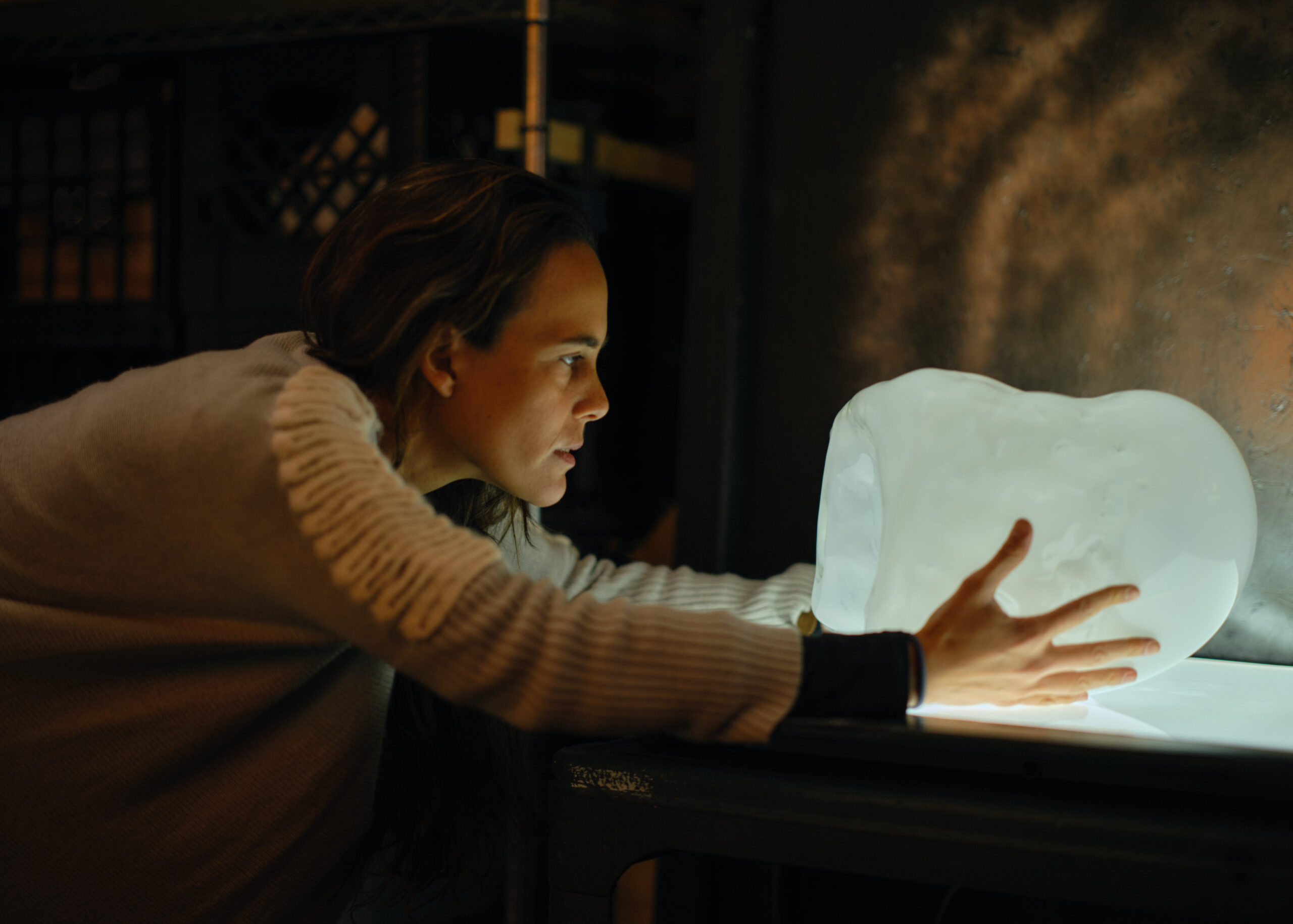
Macarena Rojas was born in 1985 in Lima, Peru. She studied Architecture at the Universidad Peruana de Ciencias Aplicadas and subsequently transferred to the Communications Department, where she graduated in 2009. In 2012 she did the General Studies in Photography Program at the International Center of Photography in New York and in 2017 she received her Masters in Fine Arts at The Royal College of Art in London. Her work has been exhibited in Black Box Projects Cromwell Place London (2022), Crisis Galería Lima (2019), Art Lima (2018), Museo AMANO Lima (2018), Camden Arts Center London (2017), Edinburgh College of Art (2016), Museo de Arte Contemporáneo Lima (2016), ArtBo Bogotá (2016), Museo Nacional de Bellas Artes, Santiago de Chile (2014), Wu Galería (2014-2015), International Center of Photography New York (2012), Triskelion Arts New York (2013), amongst other public and privately held exhibitions.
She lives and works in Lima.
Rojas Osterling’s work can currently be viewed in Look How Brightly, a group exhibition at London’s Britannia Row curated by Jenn Ellis and Alex Mills, which brings together artists whose practices interrogate questions of identity, absence and presence, fragmentation, and transcendence. Osterling’s solo exhibition In The Whitewater is currently on view at Praxis in New York through July 10, unfolding a body of work that moves between pressure and release, where forms seem to dissolve and re-emerge in shifting states.
You were based in the UK for many years before returning to Peru. How has being in your home country affected your artistic practice?
I was based in the UK for many years — I did my master’s at the RCA — and honestly I still feel like I’ve only just returned home. I think the thing I’ve valued most about being back in Lima is having the Pacific Ocean five minutes away from me. In many ways, I think the ocean completely infiltrated the newer works.
It probably drew me toward the glass sculptures first. They appear very different from the drawings because they’re pristine, almost clinically clean — no scratches, no visible chaos — but the process itself is actually incredibly intuitive and messy. Even when I’m trying to extract or hold a very specific gesture of water, the making process involves surrender and unpredictability.
The same happens in the collage paintings. They carry traces of sand, salt, erosion, water damage… The papers almost feel as if they’ve been submerged in the ocean for years. There’s a fragility to them that interests me a lot.
I think returning to Peru affected the newer works more directly. The drawings are different because drawing is something I’ve done my entire life. They almost transcend geography for me. They mutate in language, density or form, but the impulse behind them remains very constant wherever I am.
Your art expresses and embraces the effects of ADHD, and the chaotic nature of motherhood. What has it meant for you to make work that reflects the way your mind actually functions?
Motherhood was a difficult experience to process, especially with a brain like mine, which really struggles to compress information into simple conclusions. I always feel I have too many answers to everything. My mind doesn’t work in straight lines — everything becomes slightly labyrinthine, slightly contradictory. I tend to see things in shades of grey.
For a long time, I was insecure about speaking openly about the way my mind functions because I carried this almost stereotypical ‘Latin American artist complex’ — this feeling that I should be speaking about something more politically urgent or externally important. I felt guilty making work that was so rooted in my own inner life.
But at the same time, I’m a very instinctive and honest artist. I don’t really know how to make work about subjects that don’t genuinely belong to me emotionally. I can research something intellectually, of course, but art for me is much more visceral than that. I need to feel some kind of authorship over the experience.
Eventually I realised that the personal isn’t isolated from the collective. The way we think, fracture, parent, fail, obsess, or experience overwhelm is shared by many people. So at some point I stopped resisting it. Speaking about motherhood, ADHD, chaos, fragmentation — it ended up feeling like the most natural thing I could make work about.”
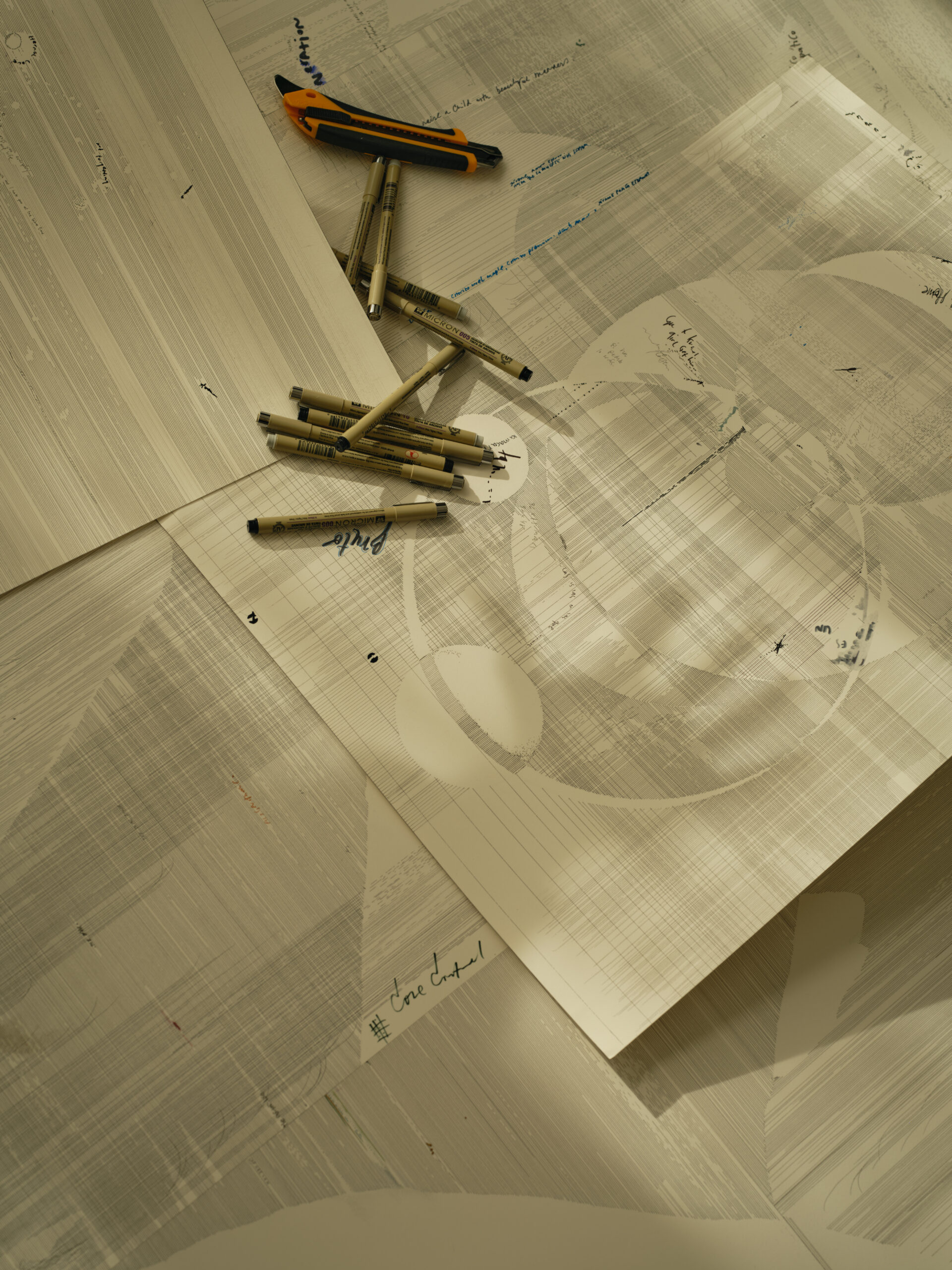
I love how your art embeds everyday fragments like grocery lists, notes or your children’s writing. The work becomes a very genuine mosaic of your life. What do those personal elements represent to you?
They’re traces of a very specific moment in time. Grocery lists, children’s notes, ticket stubs, reminders — as banal as they may seem — are actually part of the psychological landscape I was living inside of.
For me, they reflect the day-to-day reality of a mother’s brain, especially during those years of raising young children, where everything is happening simultaneously. You’re trying to work, parent, organise, remember, survive emotionally… all at once. The boundaries between creative life and domestic life completely collapse.
It’s funny because I think many mothers probably experience this mentally — corporate mothers answering emails while managing ten invisible layers of thought at the same time — but in my work it becomes very visual and exposed.
A lot of these drawings were also made while navigating separation, moving countries, midlife, exhaustion, and transformation. So the works become accumulations of thought, memory, anxiety, logistics, affection, language… all compressed into one surface.
What interests me is precisely that rawness. I want the work to remain immediate, and deeply connected to the moment I’m living through. Even the most ordinary human experiences can carry enormous emotional weight.
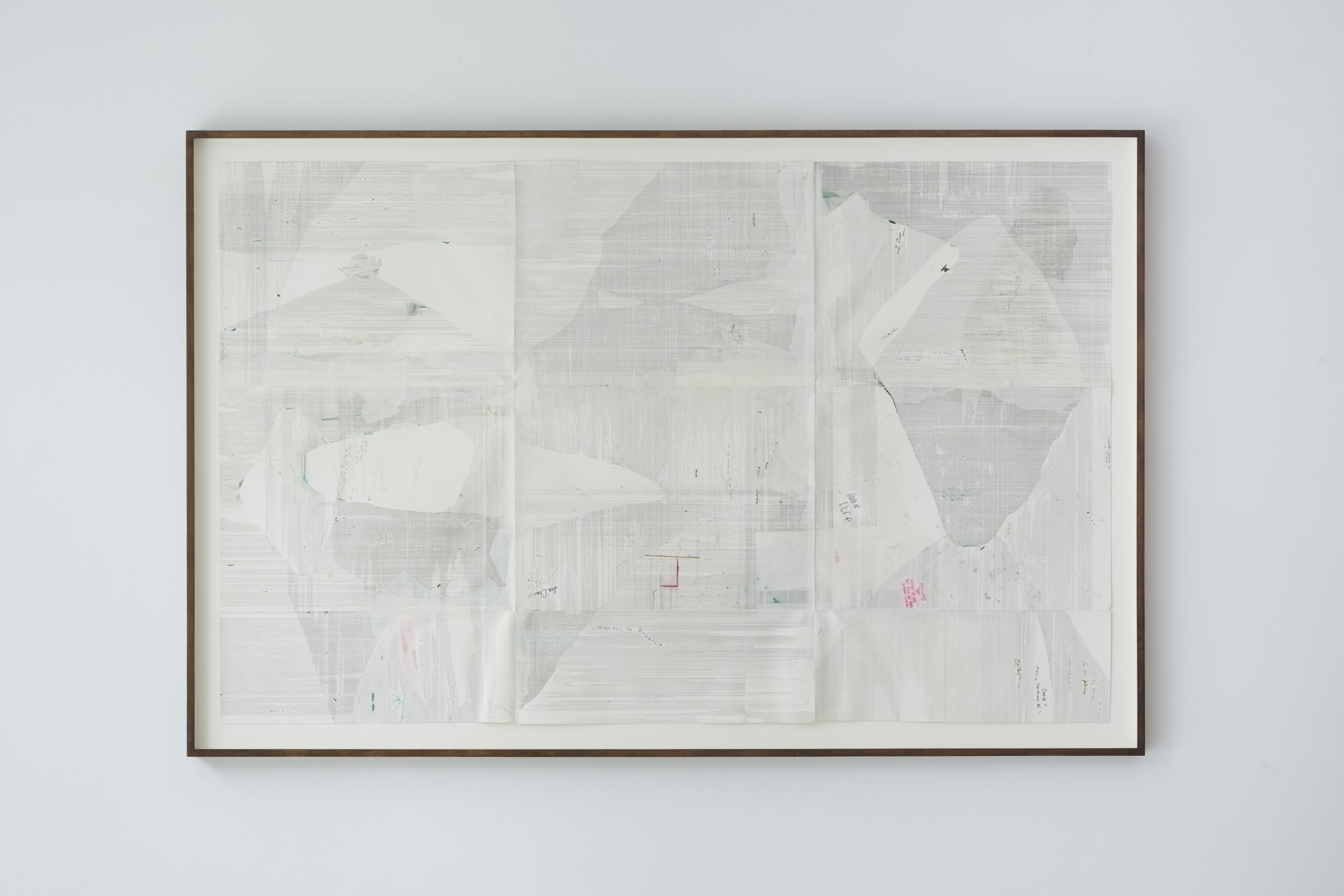
On the other hand, works like La Muna feel like almost like an architectural representation of your mind – sequences, data… Parts of it look like something out of an ECG printout. Does the act of that visual mapping bring relief?
That’s a very interesting question because I’ve often felt there are certain expectations placed on Latin American artists — almost preconceived ideas about what our work should look like, what subjects we should address, even what emotional or visual language we should use.
But interestingly, I think my attraction to systems, sequencing, repetition, mapping, and structure comes precisely from growing up surrounded by instability. Part of that was personal — my own family dynamics — but part of it was also the experience of growing up in Peru during a very unstable period. There was terrorism, hyperinflation, unpredictability. You never really knew what was coming next, economically or emotionally.
So in many ways, these works are probably a response to that. The grids, the data-like structures, the almost architectural mapping of thought… yes, I think they do bring a certain sense of relief or containment. When you grow up surrounded by chaos, you become very attracted to systems that can organise, predict, measure, or hold experience together.
What interests me is that this impulse coexists with a very emotional and intuitive practice.
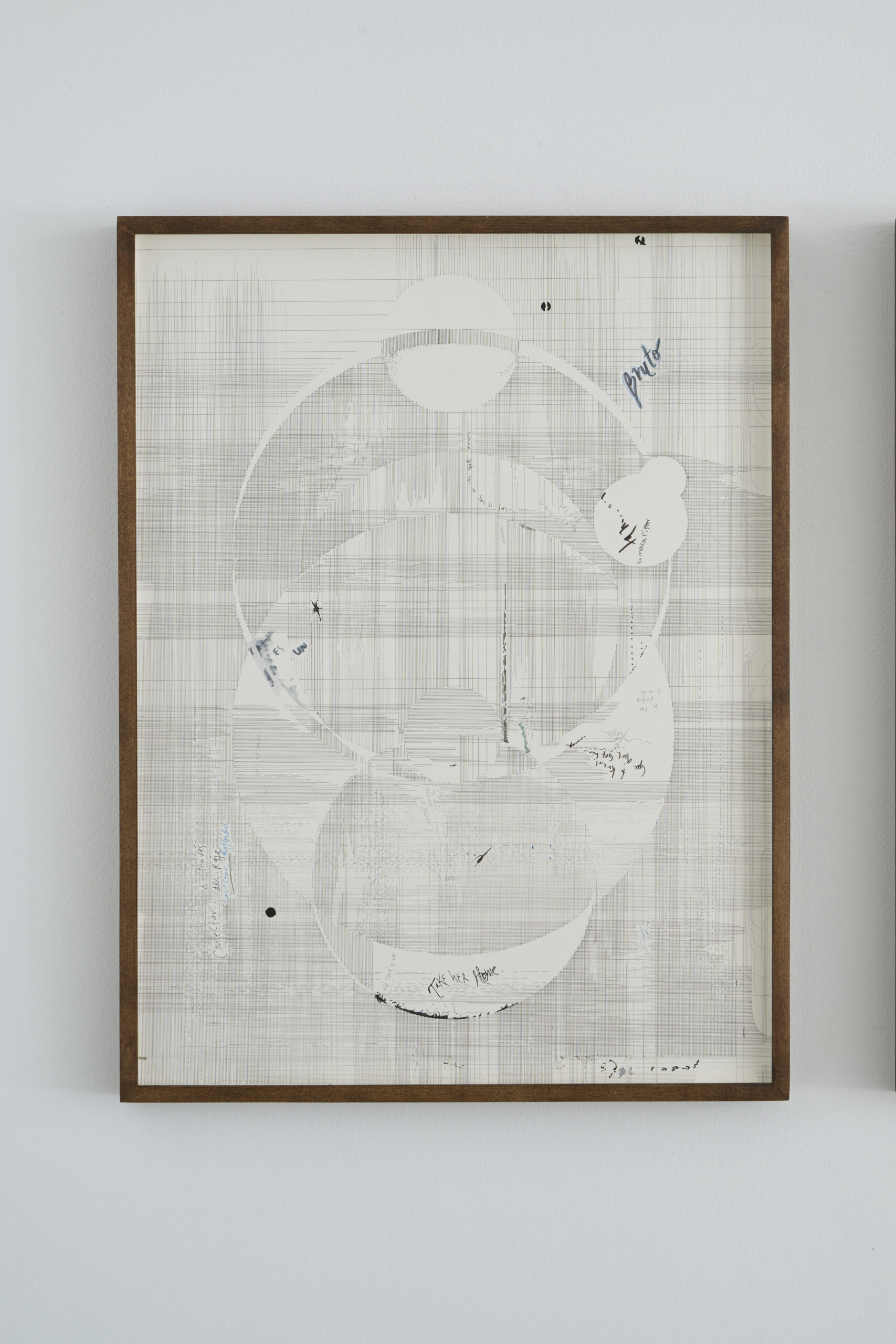
Many people experience competing thoughts or unfinished tasks as obstacles to productivity, but you’ve transformed those experiences into the artistic process itself. When did you realise that these interruptions weren’t something to work against, but could actually become the work?
I think I really began embracing chaos during my MFA. At that point I realised it was impossible to operate under the same conditions as many of my peers. I was a very young mother, and I simply couldn’t stay for every lecture, attend every opening, socialise constantly, or fully immerse myself in the art world ecosystem because I had a child waiting for me at home. At first, that felt like a limitation and even a kind of failure.
But eventually I understood that making art for me wasn’t optional: I’ve never really known myself without making work. So instead of trying to separate my life from the practice, I intuitively started absorbing all of it into the work itself: my son, exhaustion, fragmentation, interruptions, emotional overload, unfinished thoughts. At some point I stopped seeing those interruptions as something preventing the work and realised they actually were the work.
I think motherhood also changed my relationship to honesty as an artist. Before that, I still felt pressure to speak about subjects that perhaps seemed more intellectually or politically legitimate. But becoming a mother made me realise that the experiences closest to us can also contain enormous complexity and universality. It suddenly felt much more honest to speak about emotional overload, vulnerability, domestic chaos, attachment, and the fragmentation of everyday life. As my children have grown older, the work has evolved beyond motherhood itself into broader emotional experiences, but the core idea remains the same: the more honestly we speak about our inner lives, the more other people recognise themselves inside the work.”
Your glass works appear very different from the density of the drawings. What drew you toward glass as a material?
I had been wanting to portray water for a very long time, and I felt the drawings had certain limitations in terms of capturing that physicality. Glass suddenly allowed me to hold gestures of water in a much more spontaneous way. The result was actually quite unexpected because it was my first time working with the material, but I love that many people read the sculptures almost as ice fragments or frozen water formations. Even when people don’t consciously think about the ocean, they still emotionally connect the works back to water, which feels very meaningful to me.
I also think the glass works operate almost like a form of breathing space in relation to the drawings. The drawings are psychologically dens. Sometimes I need relief from that intensity myself, which is probably also why I started making the collage works and more spatial pieces. The glass introduces silence and pause into the practice while still speaking about fragility and instability I guess.
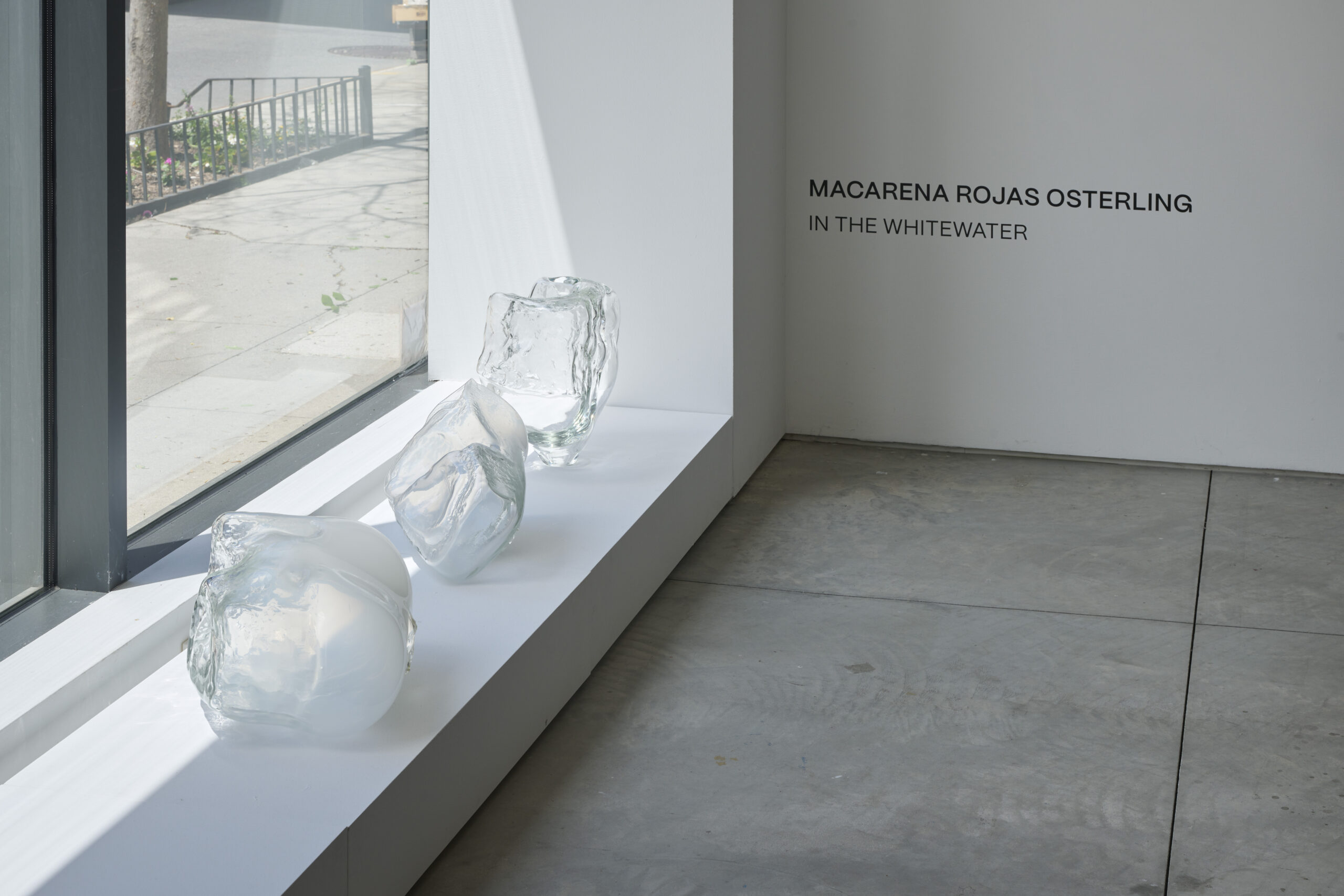
In The White Water
at Praxis, May 7
July 10, 2026
Photo Credit: Ian Tong
Are there any exhibitions or artists that have nourished you creatively lately?
I’ve recently been very inspired by the work of Jacqueline Qiu and Elise Peroi. Both are weavers, and you can feel the final work is very intuitive, and the thread has a life of its own.
It’s interesting because people often become confused by my drawings. Some think they’re textiles or thread rather than drawings because the way I build surfaces is so repetitive and layered that it almost resembles weaving. So I think I’m naturally attracted to weaving as a medium.
Beyond visual art, reading nourishes me creatively a lot. Recently I’ve been very immersed in the writing of Rachel Cusk. I’m deeply drawn to confessional literature and to writers who can transform emotional experiences — especially around relationships, identity, motherhood, or separation — into something intellectually sharp but still vulnerable. I think I connect very strongly to middle aged female writers in general because we are all going through a bit the same.

