

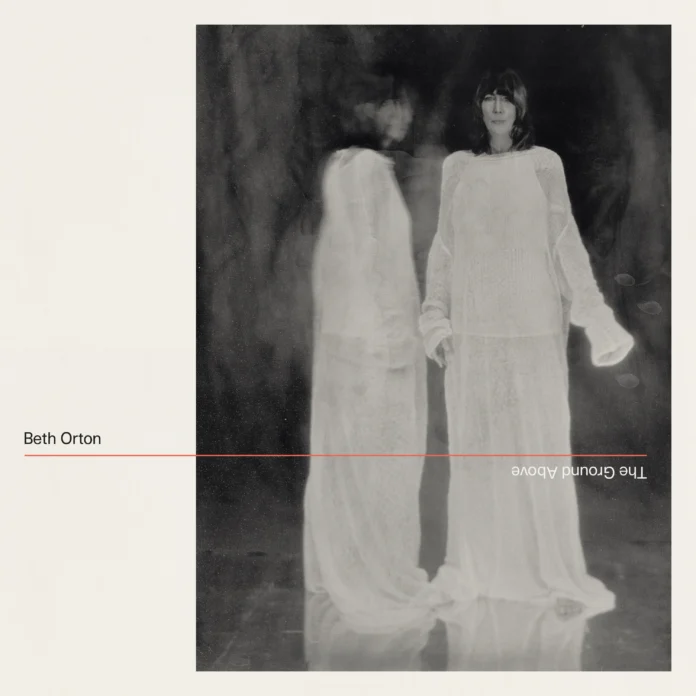
It might be the way the record was talked about, or how the last four years have flown by, but you might remember Beth Orton’s Weather Alive like a dream. The English singer-songwriter’s eighth album had a revelatory air to it, meditative in nature but nebulous in its rich sonics, striving for a coherent mood more than any set of answers. The textures may not all be retained in your memory, but it’s not a dream that leaves without a lasting impression. The Ground Above is naturally framed as the wakeful and, well, grounded follow-up, situated at least one level above the subconscious. It’s not a positioning that totally holds up, as Orton still treasures liminality – “I’ve been waiting at the edge of a dream/ To jump and fly and find my beautiful wings,” she sings at one point. Elsewhere, she realizes a set of dreams, not the literal kind, aren’t her own. A blackbird doesn’t wake her so much as it signals she’s been drifting in and out of sleep; if anything, The Ground Above is about coming alive to each day with a wondrous sense of alertness, neither unweathered nor unkind to the dirt below. You plant your feet there, even as you can’t escape the back roads of your mind.
1. The Ground Above
It takes about as long for ‘The Ground Above’ to find its spiritual groove as a radio song to reach its conclusion. The ambient introduction conjures something planted firmly in the ground, Orton’s Rhodes meeting Dave Okumu’s backwards electric guitar like water trickling into the soil. Over eight minutes, Orton’s journey of invincibility moves from grief to hope, of course, through love; it is precisely the moment of a breathless kiss that uplifts the song: “Let it wipe me out like chalk off of a board,” she commands, as Grey McMurray’s spacious guitar and Shahzad Ismaily’s delicate bass do their dance. Yet nothing fortifies the singer more than her own weighted vulnerability, which revels in the euphoria of a mother’s love and that of war in the same capacity, so long as she knows what she’s fighting for. “All that thinking never reaches a conclusion,” she sings, but the song doesn’t fade so much as it peters out, finding peace in the dissolution.
2. Before I Knew
Recorded mostly live, ‘Before I Knew’ has less of a clear progression than the opener, despite being just a couple of minutes longer. As Adrian Utley’s guitar softly brushes up against Christos Stylianides’ trumpet, the band sustains a misty, foreboding atmosphere. Orton, bearing the weight of inherited trauma and belief, is at a loss for words, yet still strings the ones that come to mind together beautifully: “You bled it out into goodbye” evokes everything you need to know about the song, maybe before you’ve even heard it.
3. Cigarette Curls
The first song on The Ground Above that doesn’t seem to rise from the ether, ‘Cigarette Curls’ kicks off with a vibrant rhythm section – Chris Vatalaro on drums, Mauro Refosco playing congas – as Orton reflects on a formative friendship. There’s detail in her recollection, but the feelings are simple and all-consuming: hopelessness and fear perhaps softened, as the lively instrumentation suggests, but certainly not erased by the passage of time, which “moves faster than the pain.” There are three electric guitarists on the song, two of whom draw it out with separate solos that seem to have a personality of their own. The familiar smokiness of Orton’s voice gives way to closing harmonies from Nick Hakim, curling, naturally, upward.
4. Waiting
Orton tricks us into thinking ‘Waiting’ will be a wistful piano ballad, but it’s not long until she’s coasting on a gorgeous flurry of instrumentation, particularly flute and organ. “I was going to write a gratitude list/ Just got to work out my resentment to it,” she sings, as if not in the studio but on a day off. The past still holds pain, but in the moment she makes space only for nostalgia: “Anytime I hear the music we played/ I dissolve into a puddle of rain.” The band makes it sound like a breezy homecoming.
5. Celestial Light
Back into a kind of dreamscape, Orton contains the quiver in her voice, letting it bathe in reverb like the surrounding layers of synth, guitar, and flute. Succumbing to the vastness of solitude, it is the first song on the album without a you; until it nears the end, that is, addressing not some figure lost in Orton’s past but more likely the person on the other end, listening. “I hope you’ll never make it through the night/ Without first getting kissed by celestial light,” she sings. She hasn’t ever, not really. It might as well be the first thing on her gratitude list.
6. I’ll Miss You
A certain you thrusts itself violently back into the picture, because what does the silence, if not the solitude, do other than amplify one’s yearning? You may recognize certain breakup platitudes here, but they’re grounded in a self-actualizing force lacking in most songs about seeing someone everywhere. “And it isn’t like I don’t feel you in everything,” Orton admits, “But these dreams aren’t mine, they’re someone else’s suffering/ Honey I’m full of wonder.” With the past couple of tracks, she’s already proven as much; here she leans into the heartache.
7. Love You Right
Over shuffling percussion and stirring strings, Orton delivers one of her most powerful vocal performances, summoning the kind of conviction that rubs the triteness off a line like, “You made my world a sweeter home.” On the opening track, you might find yourself wondering: How on earth can a war be euphoric? ‘Love You Right’ reminds us of the battles we keep fighting ecstatically, not in the name of love or anything so much as for the sake of something good, which Orton finds the poetry to describe: “A fine gold thread in all the places that I bled.” It’s a metaphor for the stars, yes, but also that you.
8. Otherside
Orton follows that euphoric trajectory down to its natural conclusion, ending with a song that’s louder and more revelatory than the one preceding it. In contrast to ‘Before I Knew’, the conduit for tears isn’t lost love but a blackbird’s hopeful song, an eternal metaphor made vivid by the gospel-infused instrumentation. “I heard the mother of the world cry out with grief/ What is this sound that seems to echo out of me,” she wonders. With no identity to speak of, the song’s answer lands on an indisputable quality: alive.

