

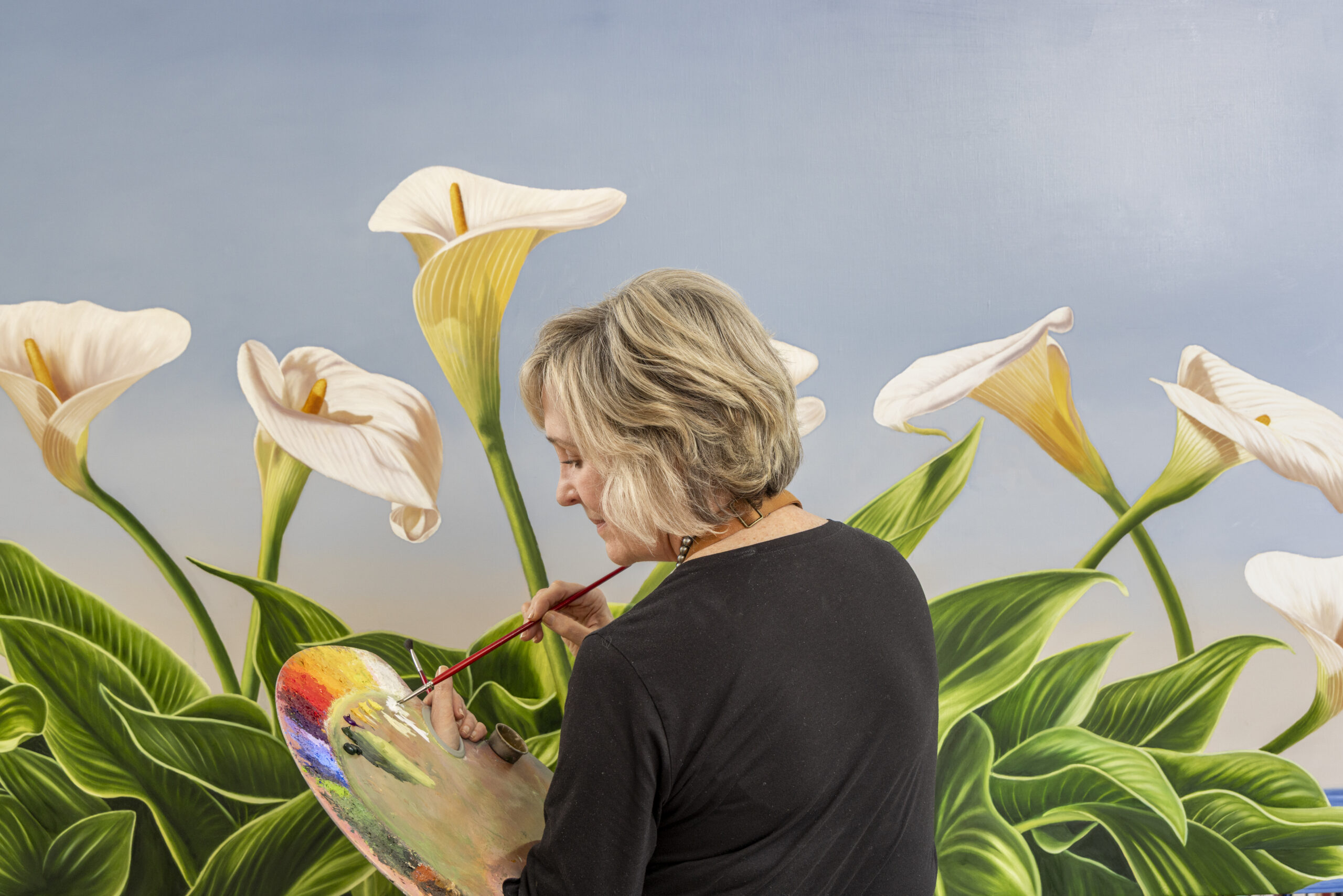
Elizabeth Barlow grew up in Salt Lake City, Utah, in a house filled with art and surrounded by flower gardens. Her father was the late artist Philip Barlow, and after a detour in the performing arts, she followed his inspiration back to painting. Barlow earned her BA at the University of Utah and Master’s Degree from the University of Virginia, later continuing her arts education at UC Berkeley Extension, where she earned a Post-Baccalaureate Certificate with Distinction in Visual Arts. A contemporary still-life artist, Barlow works in a meticulous, layered oil painting process that results in works of luminosity and depth. After relocating to the Monterey Peninsula in 2016, she became inspired by the natural landscape and began her current series, Flora Portraits, seeing flowers as symbols of life force, fragility, and re-emergence. Elizabeth Barlow is represented by Andra Norris Gallery. Her work is held in collections including the Monterey Museum of Art, San Francisco Opera, and Lucile Packard Children’s Hospital Stanford.
Your paintings transform flowers into portrait-like presences. When did you start seeing flora as individual ‘beings’ with character?
Thank you for this question. No one has asked it before and it is an important aspect of my work.
Seeing the inner spirit of the flowers that I paint (and encounter on my daily walks) is connected deeply with my meditation practice. Each day when I sit in silence, I am practicing the art of awareness and being present, which is such a difficult thing to do in our increasingly “noisy” world. I’ve discovered that the more I practice stillness I am able to see more deeply and sense more acutely the wondrous living things around me, which of course include flowers.
Also, I am a slow painter by practice and intention, and this has opened my eyes to the inner beings of my flower subjects. When I take the time to look deeply at a flower as I paint it, I am awakened from the deep sleep of busy-ness and see the wonder of this flower, this sunlight, this breeze, this sky, this NOW.
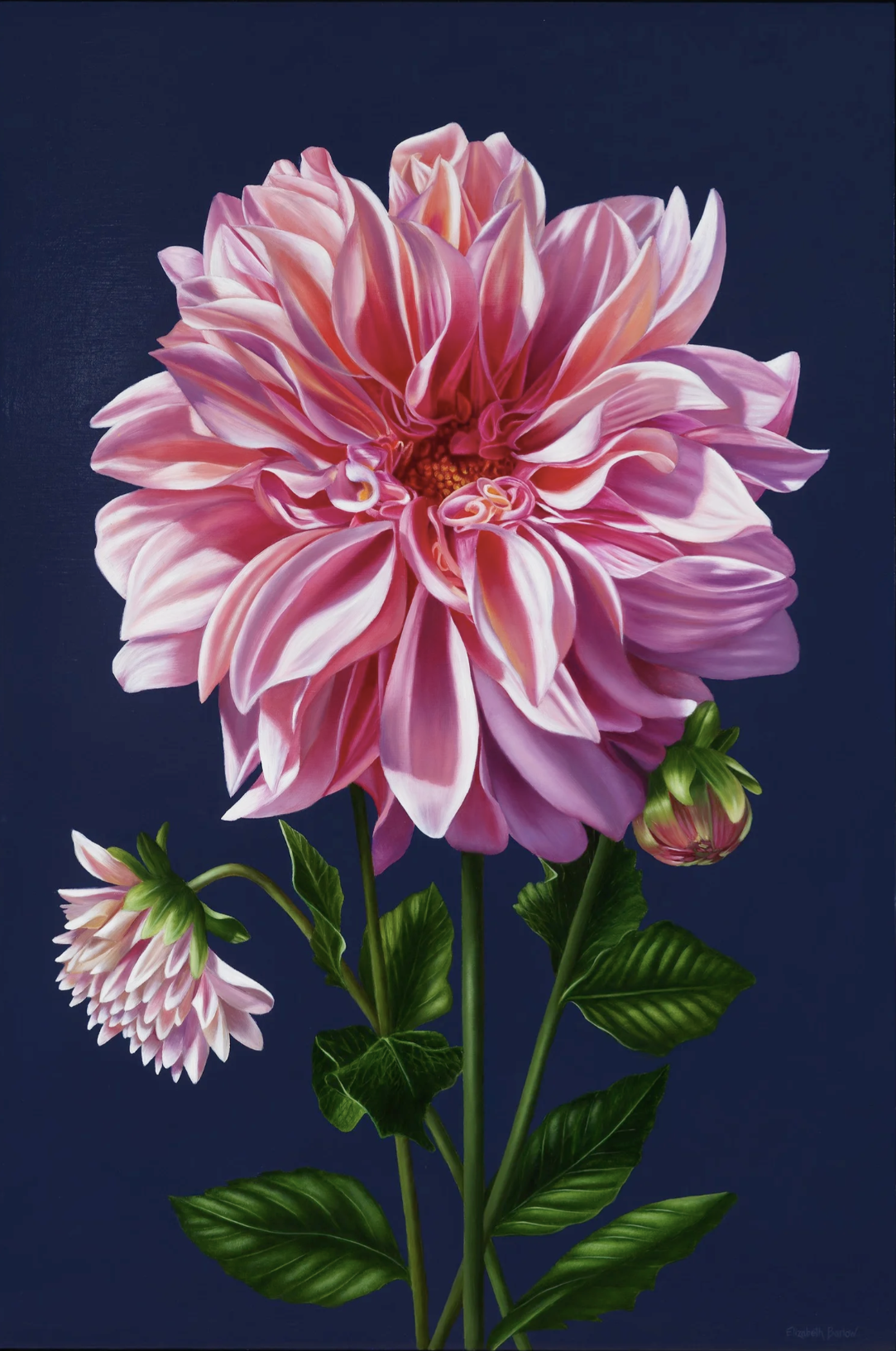 What is your personal relationship with gardening, and how does that experience feed into your studio practice in Carmel?
As the child of a talented gardener, my mother, I grew up in a house surrounded by flower gardens, and took it for granted that the garden was as much a part of “home” as the house itself.
But my adult life was mostly spent revelling in the bustling city life of San Francisco, not in nature. When we moved to our seaside village, I suddenly found myself with a garden and became a gardener. It is a quintessential cottage garden, and I’ve filled the front plot with roses — 25 bushes — lavish in their beauty and scent. Each morning, I open the shades in our kitchen windows and the first thing I look upon are roses. Later in the morning, I walk into town to my studio, passing by all the other cottage gardens in our village. By choosing to look at flowers and gardens each day, I set my inner compass pointing straight towards beauty. The more beauty I choose to look at, the more I see it around me.
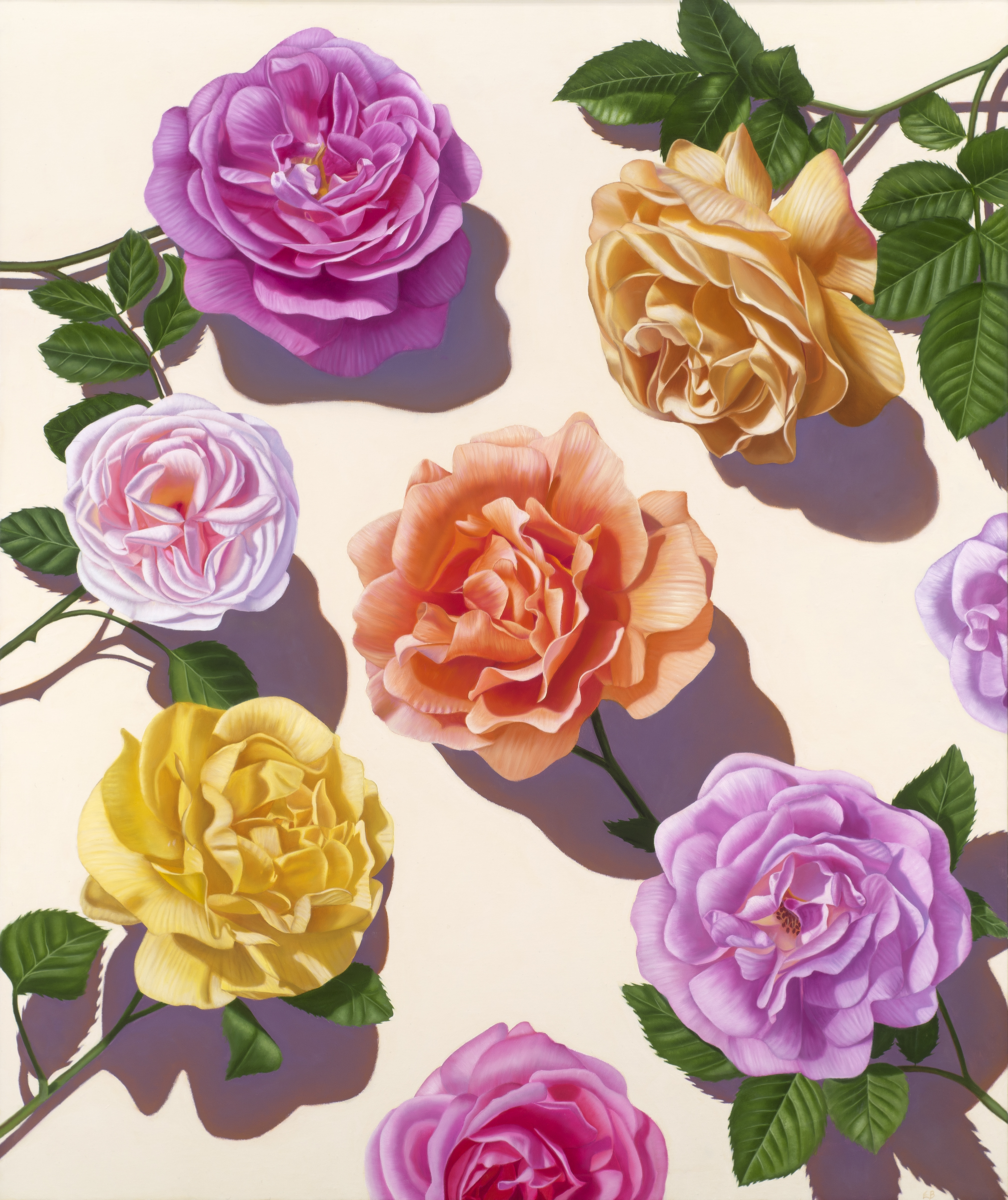
Your artistic work enlarges delicate natural forms to a confrontational scale. How do you think the scale changes the emotional or ethical way we look at the natural world?
By exaggerating the scale of a flower, it requires me — and the viewer — to pause, to slow down and look more deeply. The flowers in my paintings are messengers and their beauty is a lure to remind us of the power of stillness, of strength within seeming fragility, of hope, faith, grace and transformation.
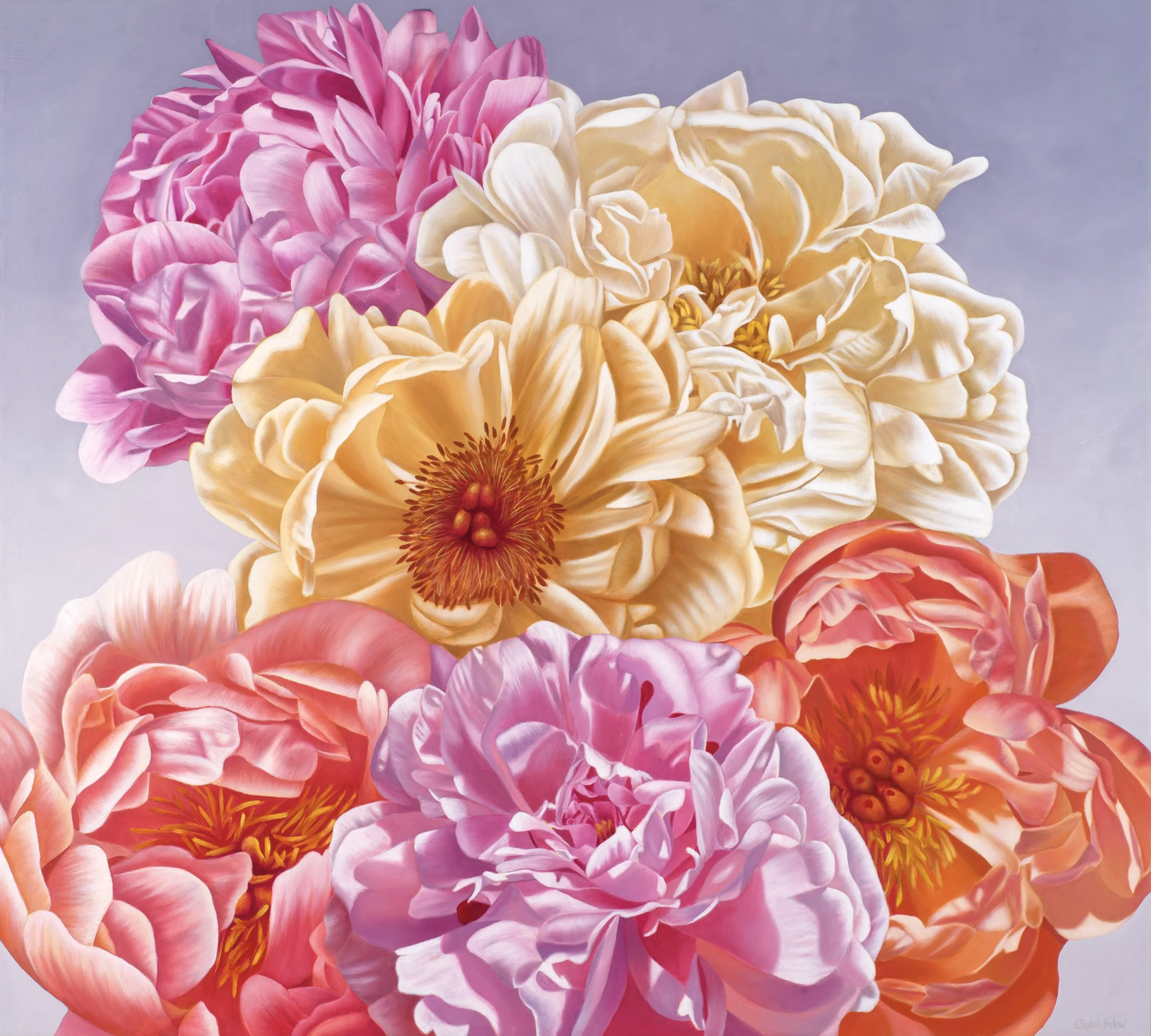
Can you talk about the origins of this body of work — was there a specific observation or moment that led you toward this hyperreal approach to florals?
Two things happened in 2017 that changed the course of my life and my art. First, we moved from San Francisco to Carmel-by-the-Sea. In the city, I was stimulated by the vibrancy of urban life, and my work reflected that glamour and energy. But in this seaside village, I was suddenly immersed in a world of ocean mists, twisting cypresses and year-round flowers in cottage gardens.
At the same time, I was commissioned to create a painting by a remarkable collector and patron of the arts who lost his home in the 2017 Wine Country Fires. The fire destroyed everything on the property except the grapevines and one rose bush. And then something miraculous happened. In the spring, that single rose bush began to bloom gloriously. The homeowner decided to build a new house on the same site and asked me to create a 6-foot painting of that rose bush for the home. We titled the painting The Phoenix Rose because it literally rose out of the ashes and is a powerful symbol of hope, resilience and reemergence.
I now devote my time and energy to painting larger-than-life flowers and offering their message to the world. The beauty of a flower is just an enticement, it beckons us to an inner awakening. We can be awakened from the sleep of our busy-ness into the miracle of the present moment, the only moment there really IS, if we will only stop and see.
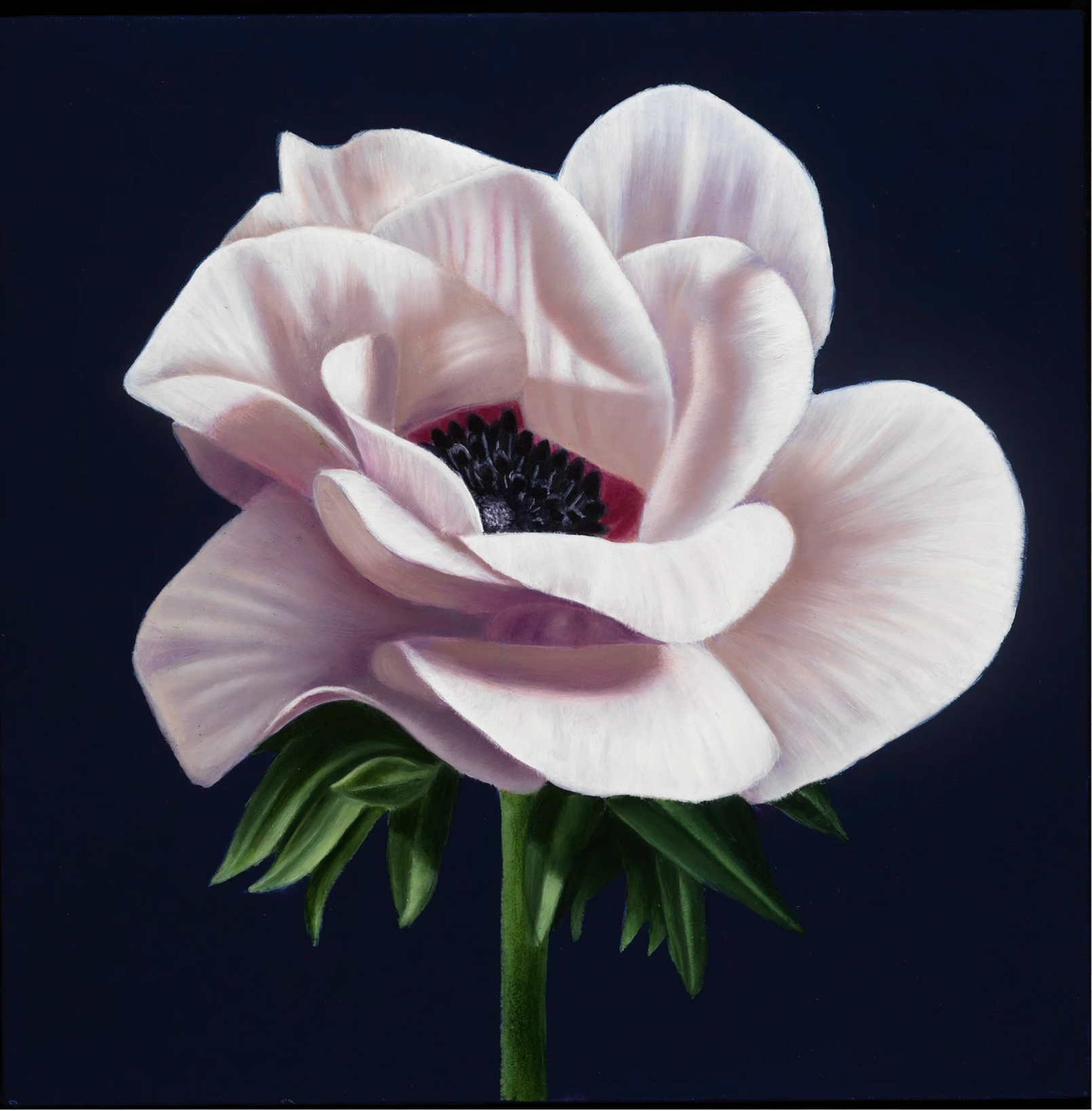
Your process is extremely layered and deliberate, from sketching through multiple glazing stages and extensive photographic reference. What does slowness mean to you in relation to looking, especially in a world defined by speed and image saturation?
I am a very slow painter. Each painting takes 3 to 8 weeks to complete, depending upon the size of the canvas. And that is just the actual painting time. I work on a painting “behind the scenes” for as long as a year, gathering flowers when they are in season, photographing them in early morning light, playing with the composition, changing my mind, and beginning again.
I paint slowly by necessity because I paint in multiple glazed layers of oil paint, but more importantly, I paint slowly by choice. My devotion to slow painting anchors and steadies me, which is a wondrous thing in our increasingly busy, fast-paced world.
Slow painting is one of the ways I carry mindfulness with me throughout my day. I wake early and begin the day with a cup of coffee and a quiet period of meditation. The tone of my day is set with this time of stillness, and my slow painting practice is another way of being entirely in the present moment as I work. I do not want to hurry as I witness the unfolding of beauty on my canvas or in the world around me.
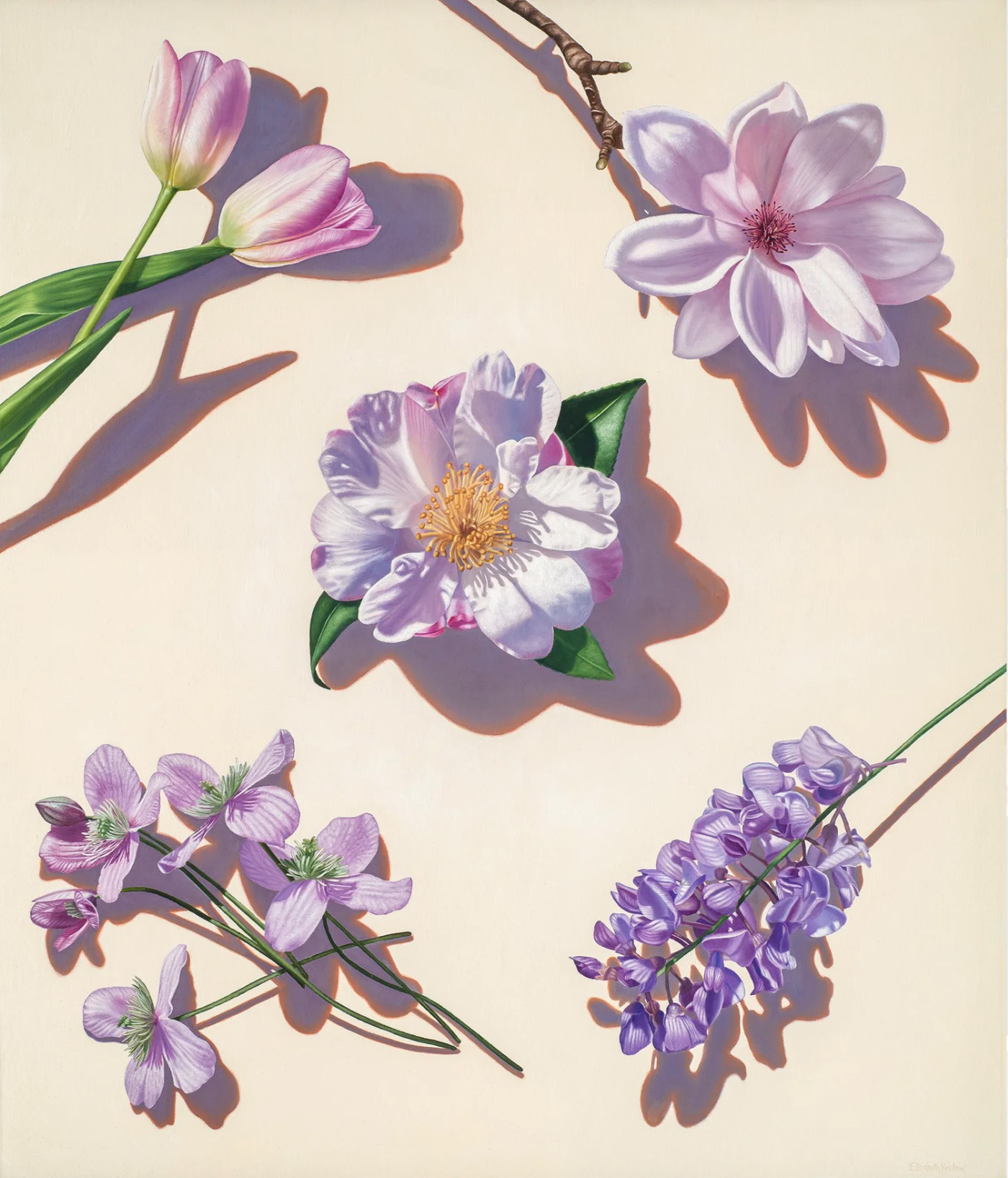
What piece of art has inspired you lately?
I am inspired on a daily basis by art I encounter and books I read. I just finished reading Pico Iyer’s gorgeously written book Aflame, which recounts the 35 years he has stayed at the New Camaldoli monastery in Big Sur to restore himself in silence. And my friend David Ligare, the great California painter, has a show of his early “sand” paintings and drawings. To make them, he made abstract drawings in the sand on the beach below his house in Big Sur. After photographing the sand drawings, he recreated them in his studio as drawings and paintings. The work is both abstract and astoundingly real, and you can see the reverence with which he creates each grain of sand.

