

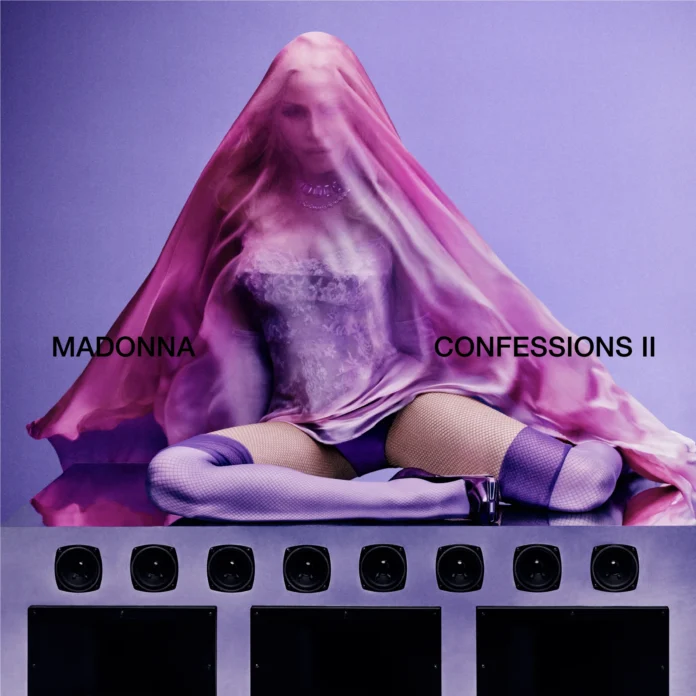
Confessions on a Dance Floor earned a reputation as Madonna’s first 21st-century opus thanks, in part, to its seamlessness. Functionally and structurally, the record’s club-focused mix was more important than its currency as pop music, though it naturally spawned hits like ‘Hung Up’ and ‘Sorry’. It could make time go by so slowly, to be sure, but it would never let it stop. Reuniting with producer Stuart Price, the Queen of Pop revisits the formula on CONFESSIONS II, but it should come as no surprise that her first sequel album serves as more than a sequel. House beats still mostly carry the pulse forward, but the album feels more informed by Madonna’s career-retrospective Celebration Tour, nodding back to and recontextualizing different eras of her life in a manner that actually scans as, well, confessional. It still keeps things moving, never leaving the dance floor but more intent on showing that everyone in the club – or hovering just outside – is a work of art.
1. I Feel So Free
It’s no ‘Hung Up’, but CONFESSIONS II’s five-minute vision of dancefloor liberation makes for an enticing opener, interpolating ‘French Kiss’ and piling on synths like its penchant for nostalgia is no barrier to constant reinvention. Madonna is as confident as ever, but yearns to meet us where we’re at, which just so happens to be the dancefloor – “safety in numbers,” she repeats. This house music, still, is a dizzy kind of maths.
2. Good for the Soul
Having tackled psychology, Madonna shifts her spiritual argument for dance music towards the cosmos; the trancey intonation of “Everything begins in consciousness/ Interstellar helix unwinds” may be an awkward start, but the fluid electronica that flows out of it is vivifying. It’s the first sign that the album strives for both sonic and thematic variety, all while boasting one of its most solid hooks.
3. One Step Away
Madonna continues her lecture thusly: “People think dance music is superficial/ But they’ve got it all wrong/ The dance floor is not just a place/ It’s a threshold/ A ritualistic space where movement replaces language.” The key word here is threshold; bringing the album’s pace down to a simmer with understated piano and strings, it’s all about the thrill of anticipation, yes, but also the impossibility of freedom without vulnerability. “Understand your violence and the trauma you’ve survived,” she implores; just don’t walk back.
4. Bring Your Love [feat. Sabrina Carpenter]
‘Bring Your Love’ gels nicer in the groove of the album than it felt upon release, but it remains a bland attempt at a modern hit, less enmeshed in the magic of Madonna’s best albums than it seems intent on echoing ‘Vogue’. A point seems to be made about what Carpenter’s style undeniably owes to Madonna, but neither singer feels present enough to capitalize on their vocal interplay.
5. Danceteria
The “Everybody get up and dance” hook may be as trite as can be, but ‘Danceteria’ is where CONFESSIONS II bursts to life. It’s not just the punchy beat that ratchets things up, but Madonna’s vividly autobiographical lyrics, which do a more cinematic job of walking us through the beginnings of her career in Manhattan than any film ever could. Recognize every artist it namechecks and you’ll have a blast; ignore the lore and you’ll still be inclined to follow its command.
6. Read My Lips [feat. Feid]
Madonna’s forays into Latin pop don’t always bode well, and this collaboration with Colombian reggaeton star Feid is no exception. If you’re going to dance to a track called ‘Read My Lips’ by an artist who has extensively worked with Stuart Price, there’s a far better choice.
7. Everything
Adding a touch of EDM to another escapist house track, Madonna invites us to “come outside into the light” while seeming to step into the shadows – there’s no vocal hook to latch onto – though not without lamenting about how “No one wants to go outside/ It’s not okay/ It blows my mind.”
8. Love Sensation
Swerving into disco has the odd effect of halting the album’s momentum; the ingredients are there, but it feels spiritually anonymous without the enigma, or euphoric flavor, of, say, any DJ Sabrina the Teenage DJ track.
9. Love Without Words
‘Love Without Words’ revivifies the record right in the middle of the tracklist, delivering the album’s most dynamic, vibrant, and ultimately hard-hitting production; the actualization of “movement replaces language.” Madonna and Price do most of the heavy lifting, but Italian dance duo Parisi inject more than a bit of verve to it on additional production.
10. Bizarre [feat. Martin Garrix]
The track has some pep in its step thanks to Dutch DJ Martin Garrix, but it feels, well, bizarre, or at least odd in the context of the album; it would fare better as a one-off collab. Madonna’s lyrical detail might pique your interest, but it’s nowhere near as compelling as ‘Danceteria’.
11. School
Madonna may have concluded her dance music lecture in the first part of the record, but school is still in session. The credits are relatively long, but only to the track’s benefit: it’s lush and as salacious as her lyrics. “Please, someone teach me something I don’t already know,” she pleads, still showing the way.
12. Fragile
The album’s introspective streak begins with ‘Fragile’, whose poignant chorus feels slightly out of step with its UK garage-inflected beat. I wouldn’t say it’s “the part I hate the most,” but there’s better to come in that same mode.
13. My Sins Are My Savior [feat. Stromae]
Madonna harks back to 1992’s Erotica with help from Belgian rapper Stromae, reminding us that “My sins are my savior” is a much more typical sentiment for the pop star than any song with “love” in its title. Ray of Light gets a nod, too.
14. Betrayal
Built on a tasteful interpolation of Erik Satie’s ‘Gnossienne No. 1’, the trip-hop-inflected ‘Betrayal’ fast-forwards a couple of years to Bedtime Stories, but lyrically it’s more direct than it is shadowy, unveiling strong language towards Madonna’s late stepmother: “Take the hammer hit the nail/ You’ll never take my mother’s place.”
15. The Test [feat. Lola Leon]
CONFESSIONS II’s best songs fold the past into the present, and ‘The Test’ invites her daughter Lola Leon, whom she referred to as “Little Star” on Ray of Light, to consider the weight that fame has had on them both. “You didn’t ask for all the flashing lights/ I didn’t think of how it could disturb/ Or how it hurt,” she sings. With additional production from Arca, the track’s lullaby-like qualities are imbued with tension, mirroring the dynamic at its core for a magnificent full-circle moment.
16. L.E.S. Girl
With the tension diffused, CONFESSIONS II lands in twinkling dream-pop territory that matches Madonna’s almost unrecognizable nostalgia, bringing the saturation all the way down from ‘Danceteria’ – it’s still unmistakably New York, though. If Madonna became the latest pop star to work with Aaron Dessner, ‘L.E.S. Girl’ would be the first sign. Leaving things open, “Everything fades away” is as natural a conclusion to the album as any. It’s not a confession, really, but it feels like one.

