

In contemporary art practice, ceramics and decorative porcelain have once again taken a prominent place within exhibition culture. Galleries, collectors, and curators are increasingly turning to works in which material does not remain a secondary means of execution, but becomes an independent language of artistic expression. Porcelain, traditionally associated with refinement, fragility, and applied art, is now frequently reconsidered as a medium capable of carrying conceptual, emotional, and sculptural meaning.
This renewed interest in ceramics reflects a wider shift in the perception of craft. For a long time, decorative forms were often viewed separately from contemporary art, as if manual skill and artistic thought belonged to different categories. Today, this division is becoming less convincing. The handmade object has gained new relevance precisely because it resists standardisation. It preserves traces of time, touch, attention, and personal rhythm. Yet the popularity of a medium alone cannot guarantee artistic value. What remains essential is the artist’s individual vision, the ability to transform technique into a recognisable artistic statement.
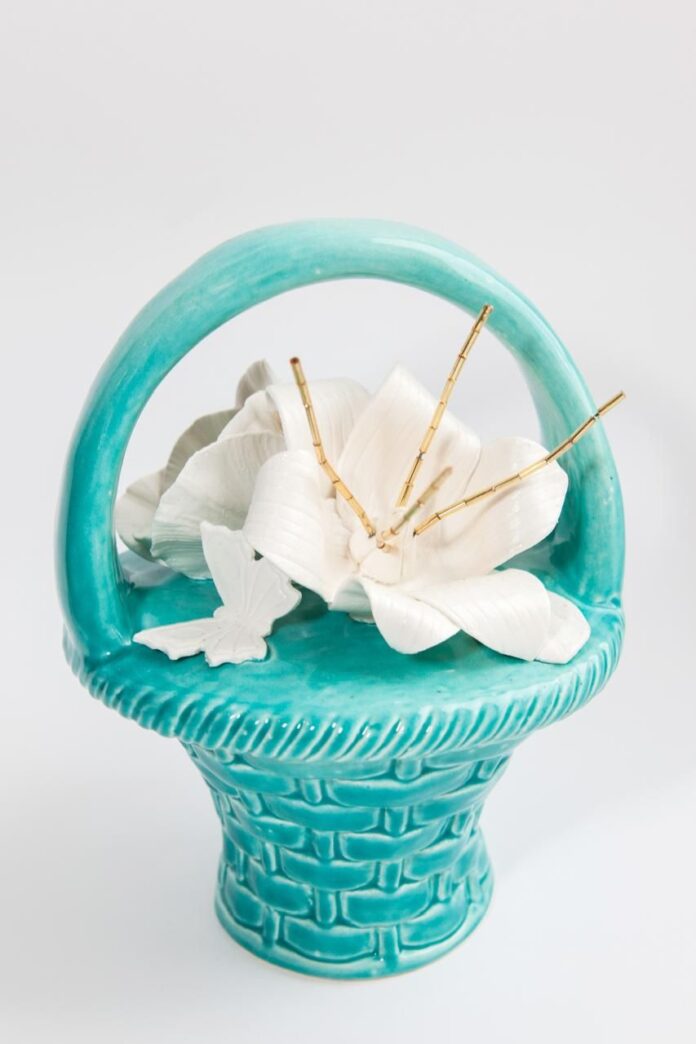
Bella Tangieva’s porcelain works clearly embody this personal artistic perspective. Her peony and other floral pieces do not strive for photographic precision. On the contrary, every fold of a petal preserves the trace of the artist’s hand. The flower is not copied, but interpreted. It becomes a sculptural image in which natural form is translated through memory, feeling, and material sensitivity.
This approach gives Tangieva’s work a particular emotional quality. The viewer does not encounter a cold imitation of nature, but an object shaped by observation and inner response. The petals seem to hold both movement and stillness. Their surfaces are dense, textured, and tactile, yet the overall impression remains delicate. This tension between fragility and strength is one of the most compelling aspects of her practice.
In an era of digital production and artificial intelligence, this quality acquires special significance. Tangieva’s works do not possess a flawless industrial appearance. They do not try to hide the process of their creation. Instead, they reveal a living plasticity, a subtle unpredictability of form, and a deep sensitivity to porcelain as a material. The viewer can sense the pressure of the hand, the rhythm of modelling, and the gradual formation of the object. These details create a feeling of authenticity that cannot be reduced to technical perfection.
A recognisable visual language is also beginning to emerge in Tangieva’s artistic practice. White porcelain, richly textured relief surfaces, and delicate accents of deep red form an expressive system of imagery in which decorative beauty is connected with emotional depth. The use of white is especially important. It gives the works a sense of purity and restraint, while also allowing shadows, folds, and surface details to become more visible. The red accents, in turn, introduce intensity and concentration. They do not dominate the composition, but create points of emotional focus.
Tangieva’s floral imagery should not be understood merely as botanical illustration. The flower in her work exists at the intersection of nature, memory, and personal symbolism. The peony, with its layered petals and rich cultural associations, becomes more than a decorative motif. It suggests abundance, vulnerability, transformation, and the passing of time. In porcelain, these meanings acquire additional complexity. A flower that is naturally temporary is rendered in a material associated with endurance and preservation. This contrast gives the work poetic depth.
The sculptural quality of Tangieva’s pieces is also important. Although they belong to the tradition of decorative porcelain, they are not limited to ornament. Their relief surfaces, spatial density, and carefully built forms allow them to be perceived as small scale sculptural objects. They invite close viewing. The eye moves across the surface, following the folds, shadows, and transitions between smoothness and texture. In this sense, the works create an intimate relationship with the viewer. They require attention rather than quick consumption.
At the same time, the work suggests clear possibilities for further development. Contemporary decorative art faces the task not only of mastering material and form, but also of building a dialogue between history and the present. Porcelain carries a long cultural memory. It is connected with domestic interiors, ceremonial objects, museum collections, and traditions of refined craftsmanship. When an artist works with this medium today, she inevitably enters into conversation with these histories.
Tangieva’s practice demonstrates strong potential in this direction. Her work already shows an ability to move beyond the purely decorative object and toward a more complete artistic statement. To develop this further, it would be interesting to see her expand the symbolic structure of her practice. The floral motif could become part of a broader visual system, connected with themes of memory, femininity, fragility, cultural inheritance, and the relationship between natural and artificial beauty.
There is also potential in exploring scale, installation, and context. Tangieva’s porcelain flowers could exist not only as individual objects, but also as parts of larger compositions. Placed in dialogue with space, light, textile, glass, or archival material, they could acquire new meanings. Such development would allow the artist to strengthen the conceptual dimension of her work without losing the intimacy and sensitivity that already define it.
The work convincingly shows that craftsmanship is not an alternative to technology, but an independent artistic value in its own right. In a time when images can be produced instantly and endlessly, the handmade object reminds us of duration, attention, and embodied experience. Tangieva’s porcelain pieces speak precisely through these qualities. They do not compete with digital perfection. They offer another kind of value, one based on touch, patience, and the emotional memory of form.
As an art critic, I would add one final observation. Bella Tangieva’s works already possess a distinctive sculptural language. Their strength lies in the union of technical control, material sensitivity, and poetic interpretation of natural form. However, to establish an even stronger artistic identity, it will be important for the artist to develop not only the formal qualities of her work, but also a broader and more coherent system of imagery.
If this direction continues to grow, Tangieva’s porcelain practice may become a convincing example of how traditional material can speak in a contemporary artistic voice. Her works already show that porcelain is not merely a medium of elegance or decoration. In her hands, it becomes a carrier of memory, emotion, and sculptural presence.

