

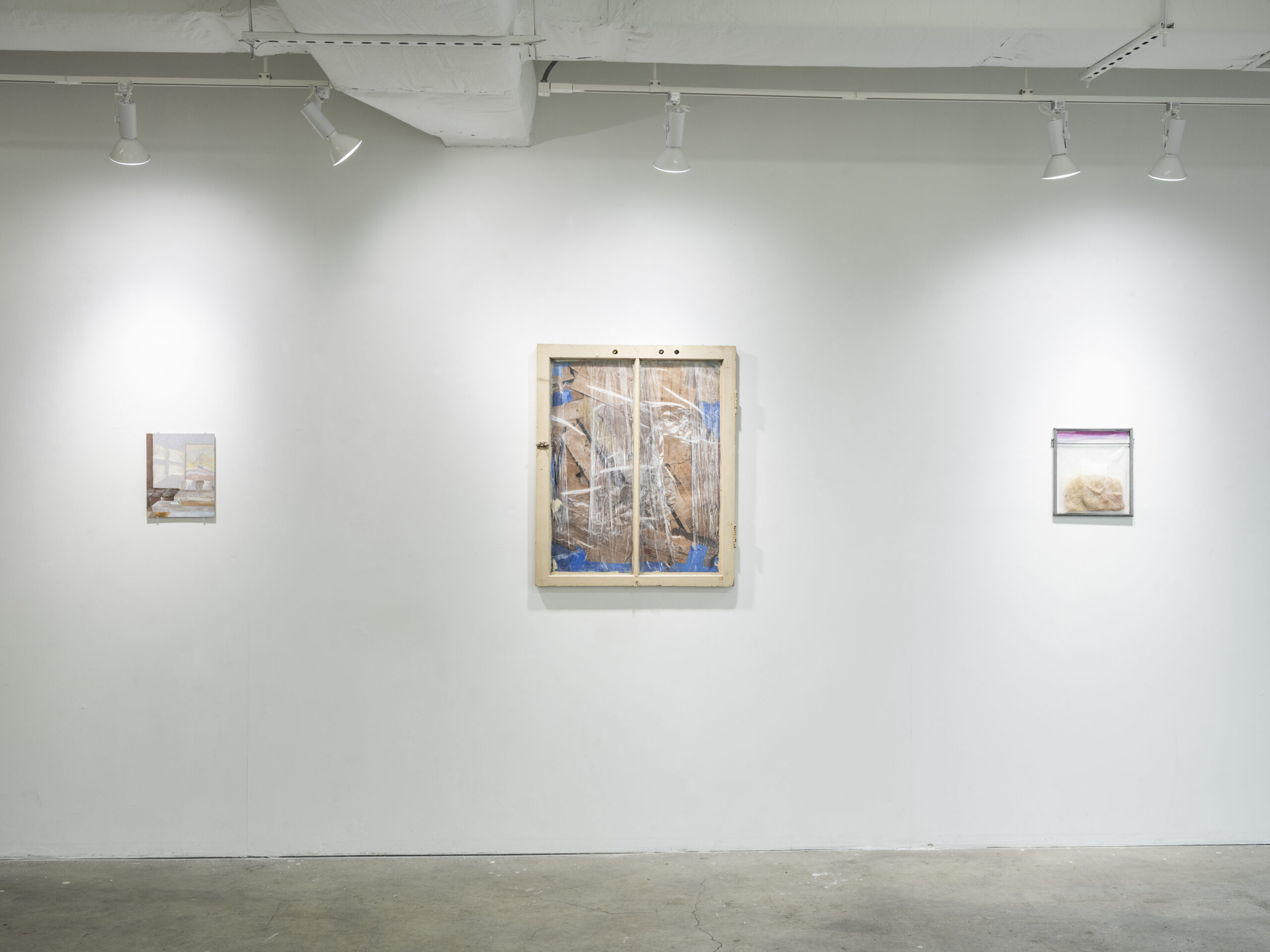
About the size of an A4 sheet, Yue Zhou’s Another Window (2025) prompts its viewers to move closer. Through this strategy of requiring proximity, she turns her painting into a tiny portal into an aesthetic experience where perception gives way to “phantasy” — in the Kantian and psychoanalytic sense of imaginative projection, and therefore distinct from ordinary “fantasy” — as if one could live inside the painting through the inner realm of imagination.
The viewer’s visual field is taken in by the subdued, gentle colour palette that characterises the interior scene depicted; the steely tone of its wall recalling the sky of a cold, snowy winter day. This atmosphere-setting mirrors Zhou’s conceptual framework, which aims at allowing the pictorial object to merge interior and exterior, room and landscape. Thick, corpulent dabs of paint add to the sculptural element in the architectonic composition represented in the canvas. Within Another Window, a painting hangs on the wall; a further move toward the boundary blurring that the artist claims both structurally and phenomenologically. As a result, in this work, the inner decor conjures up in the viewer’s mind what is left outside its margins: an idyllic alpine landscape, as refreshing as the mood of the interior space. The reflection beside the painting on the wall further invites what lives outside the room to materialize behind the viewer’s eyes; both a clue to and an afterimage of a window deliberately left beyond the compositional frame.
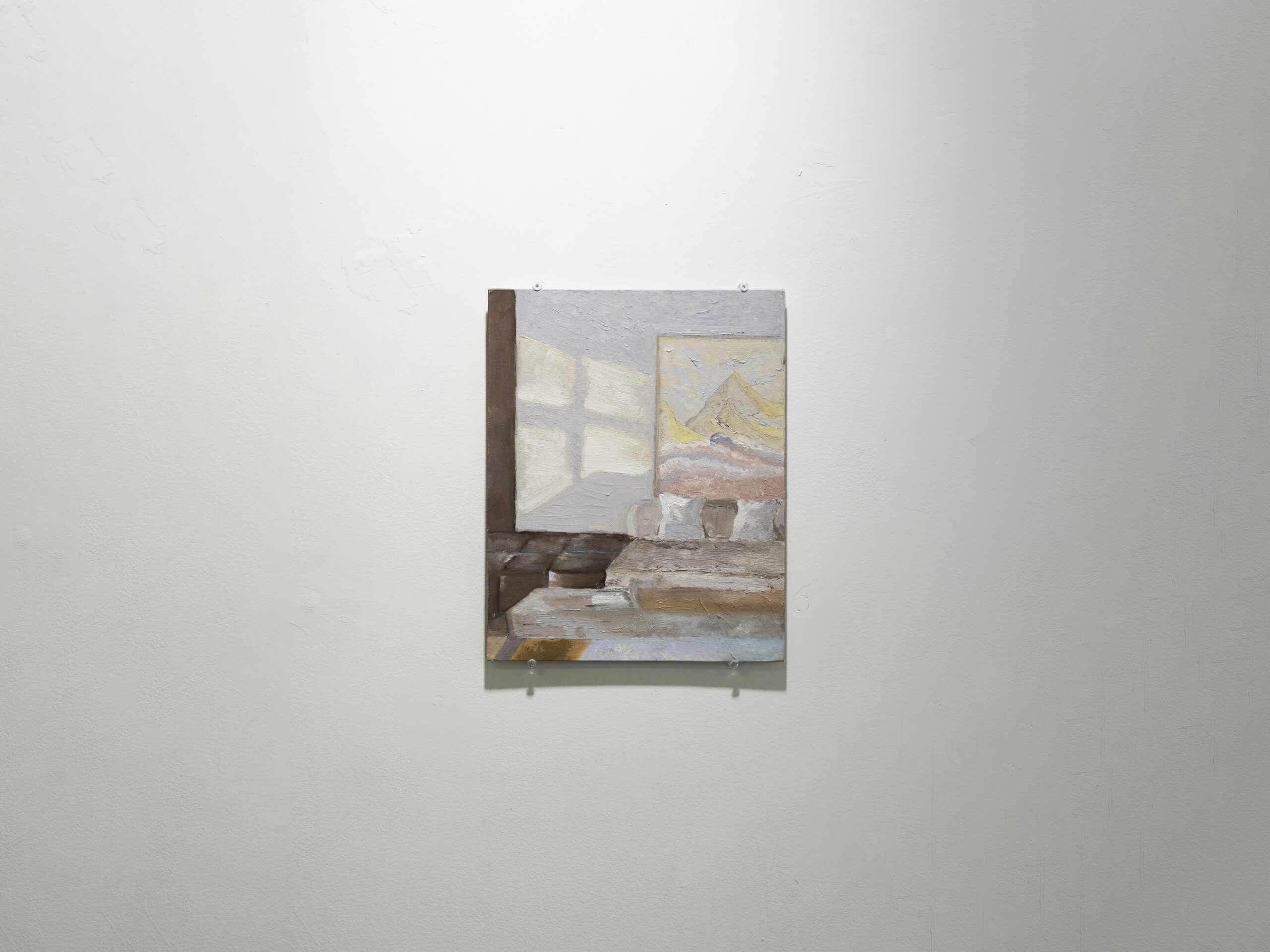
Another Window activates not only perception and imagination, but also memory. This work functions as a catalyser that reawakens what lingers in our reminiscences of the past, and that allows residual impressions left on the mind to resurface from oblivion. It is conceived in ways that both structure how we see or imagine, and activate recollection. It reminds us that a work of art is not a representation of the world seen from a fixed perspective, but rather, as the American philosopher Nelson Goodman puts it, is a “way of worldmaking”. As such, Another Window belongs to the type of aesthetic experience where images do not merely depict a pre-existing world but construct one of their own. It asserts that reducing a painting to an illusionistic representation of the world by way of applying paint onto canvas denies its potential and undermines its essence, as a painting is capable of generating parallel worlds and constitutes an epistemological domain in itself.
By mobilising Merleau-Ponty’s phenomenology, Zhou allows viewers to oscillate between gaze, remembrance, and perception. By drawing on Goodman, she allows them to plunge into the epistemologically generative dimension of art. Within Another Window’s realm, the pictorial domain is dynamic, rather than static, and the viewer is part and parcel of the artwork, establishing a range of relationships whilst identifying symbols and metaphors, and thereby recognising the world through the interpretation of the artwork, and the artwork through their personal experience of the world.

