

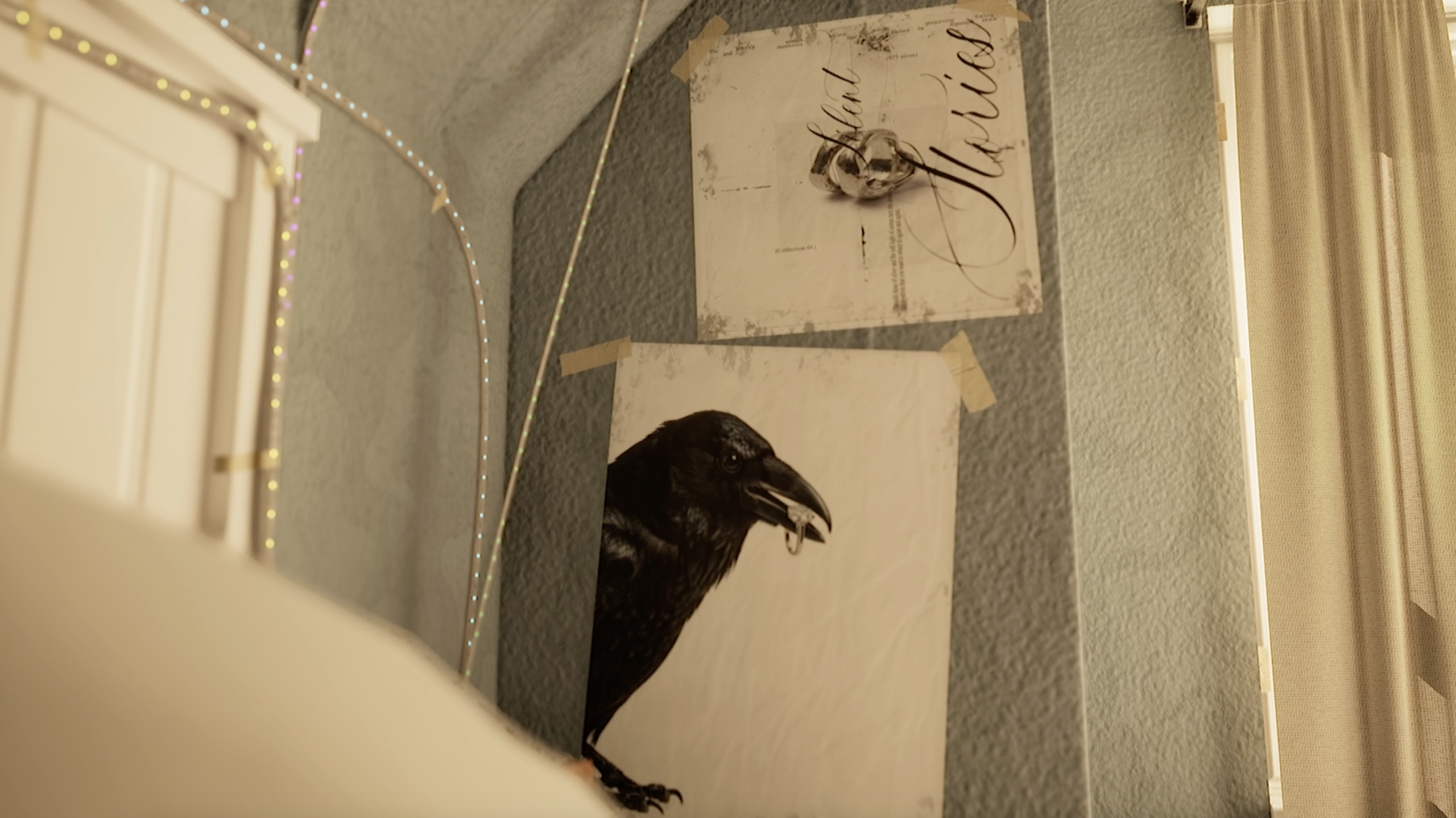
Chenyu Wang’s digitally constructed environment speaks of personal awakenings as an attempt at resistance. VVS Layers 1 materialises before our eyes, gifting us the image of a “Sleeping Beauty” nestled in a mellow, cosy bedroom, where a soothing melody is conducive to an afternoon nap. Yet an eeriness pervades as this virtual visual space unfolds and the romantic quality of the soundtrack intensifies; as the ideological and political connotations of the work progressively dissipate the naïveté of the protagonist nymph, gradually exposing the structured reality beneath the dream.
The intertext behind the creeping wrongness interspersed in VVS Layers 1’s fairy-tale-like succession of chromatic and allegorical compositions is clear, and goes as follows: escaping the prevailing regime of societal structuration through ethical self-awareness, commitment to individuality, and the deliberate self-shaping of identity capable of challenging the status quo is an illusion. This, given that our identity is a sortable commodity, surreptitiously and entirely converted into a market instrument, and, as such — like a diamond subjected to grading such as VVS (Very Very Slightly included) — is part and parcel of a logic of price differentiation. What we perceive as our private, incorruptible gradient of authenticity cannot escape a market-legible classification system, as it does not precede that system at all, but is instead produced by it through the same logic that assigns diamonds’ clarity a price premium.

Under veiled totalitarianism, where no residue is left uncommodified — as VVS Layers 1 suggests in the fragments where a metallic and crystalline colour scheme wraps the nymph — a silver ring in the shape of a raven holding a diamond in its beak is the only way for her to flee from the quotidian constraints of the ruling order. However, there is an underlying tension in Wang’s digital simulations. Here, escapism is merely a fleeting moment within a bucolic and idyllic scenery; a dreamlike environment where a raven’s gathering allegorically stands for the historically distinct strategies that critical thinking has enlightened humanity with: the Foucauldian therapeutic route of “know thyself, become reflexively aware of your conditioning”; the postmodern, Butlerian proposition that if identity is first and foremost a construction, then one ought to resist predatory capitalistic impositions by shaping it oneself on one’s own terms insofar as possible; and the liberal-humanist pathway of commitment to individuality and irreducible selfhood against mass imposition.
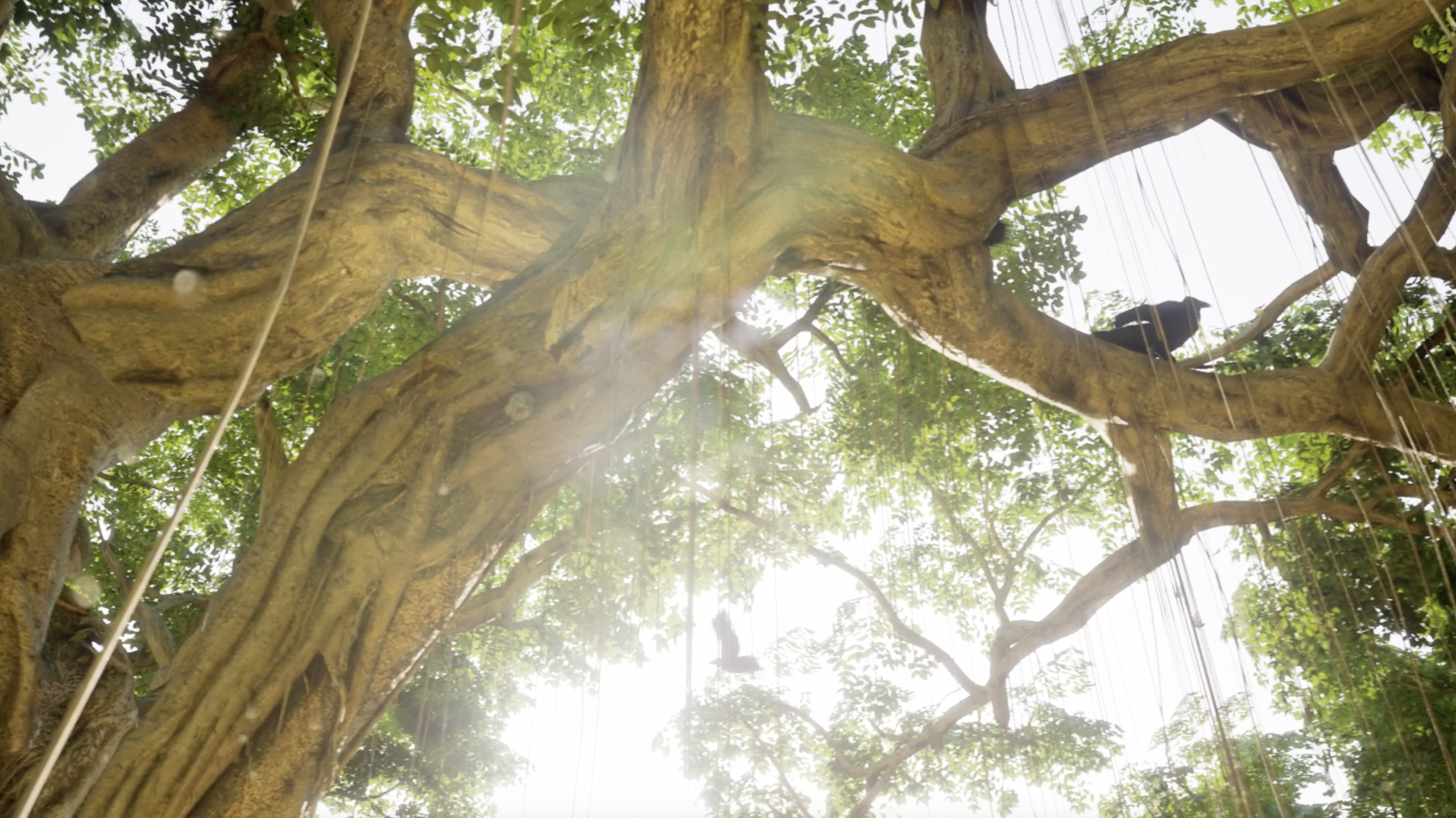
Wang collects theoretical resources the way a raven collects shiny objects, mobilising them with mastery. What is more, Wang seems to suggest that if his virtual-world nymph’s freedom from the ruling order is brief, it is because her only means of evasion is itself part of the order’s trap.
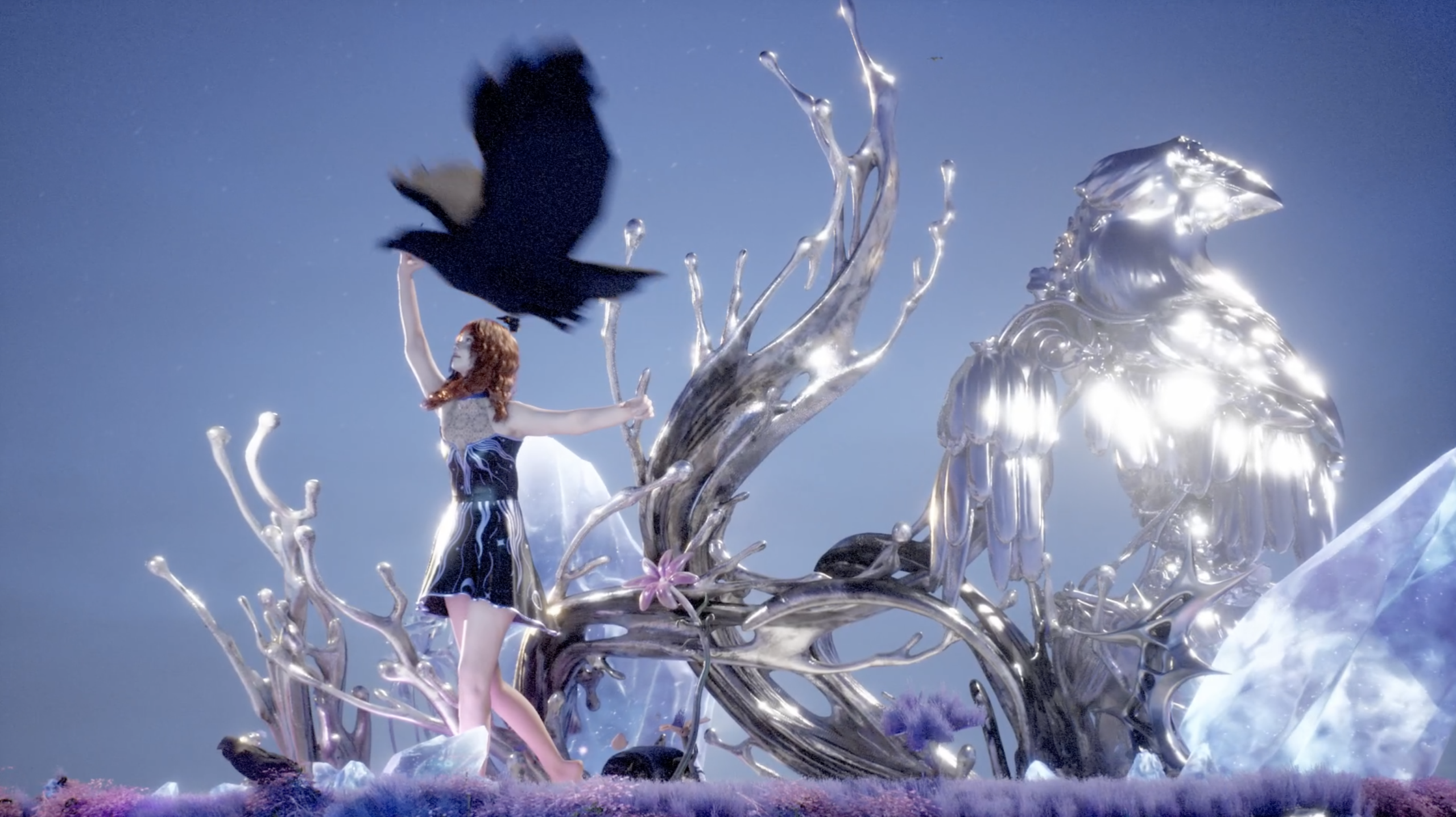
VVS Layers 1 is a diegetic space in which escapism and resistance are encoded as unreality. The atmosphere rendered in this work is, ultimately, a philosophical argument whereby the commodification of identity manifests as a false awakening structure; one cannot outthink a system where power is reproduced through mechanisms one cannot perceive.

