

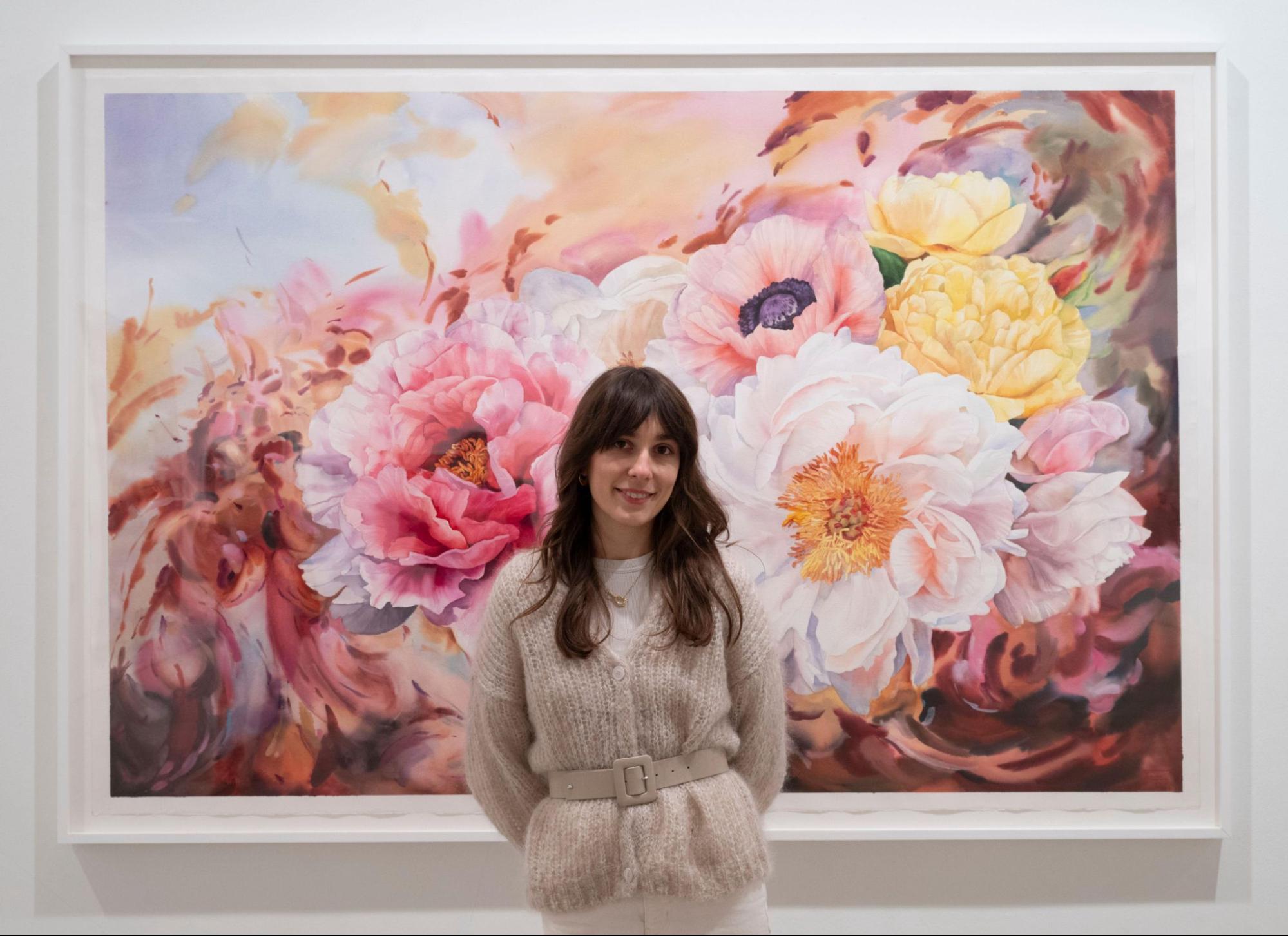
There’s a particular moment standing in front of one of Janet Pulcho’s paintings when the scale stops feeling like spectacle and starts feeling like an argument. From a distance, the works read almost impossibly large for watercolor. Up close, the question shifts. The real surprise isn’t their size but how completely they trust the medium to carry it.
The artist’s practice has evolved with unusual clarity.Her early large-scale floral watercolors already questioned what watercolor was capable of carrying, not only physically, but emotionally. The flowers were never simply botanical subjects, they became a means of pushing the medium beyond its familiar limits. The Renaissance series feels less like a new chapter than the point where those formal and technical investigations begin to engage directly with the history of painting.
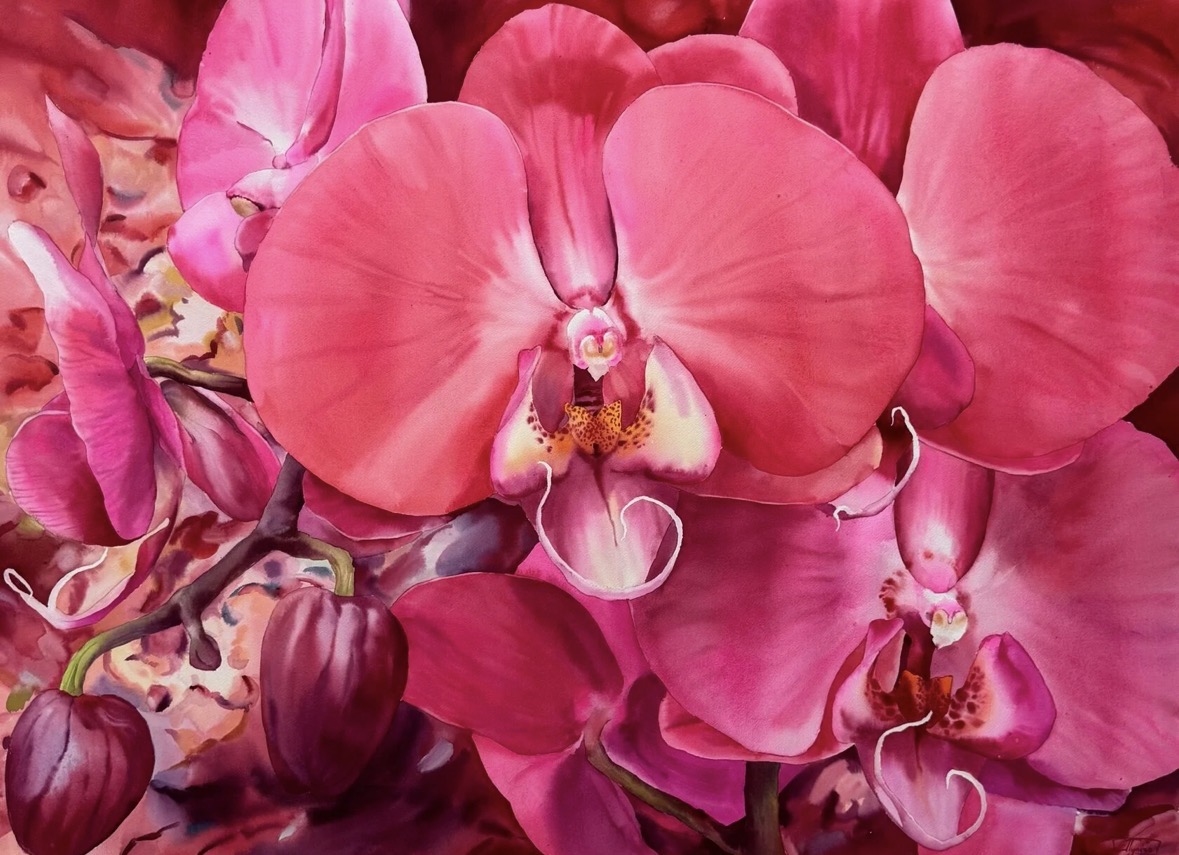
That discipline is evident throughout Pulcho’s work. Even in her largest compositions, nothing feels arbitrary. The flowers have remarkable anatomical precision, yet they never become botanical illustrations. Instead, they exist in constant tension with the loose, fluid environments surrounding them. Petals are carefully articulated, while backgrounds dissolve into broad washes, stains and drifting movement that resist description. The flower remains exact. Everything around it doesn’t. Much of the emotional force of the paintings lives in that contrast.
The Renaissance series expands this language without abandoning it. After moving to Florence and studying at the Florence Academy of Art, Pulcho immersed herself in Renaissance painting. What emerged wasn’t a series of reinterpretations in the conventional sense. She isn’t interested in quoting masterpieces or reproducing familiar compositions. In fact, many viewers may never recognize the references at all.
Recognition arrives slowly. It comes through the balance of a composition, the distribution of visual weight, the rhythm of forms or the quiet sense that the painting carries a memory from somewhere else. Pulcho borrows the architecture of Renaissance painting rather than its imagery. That distinction matters. Instead of illustrating art history, she rebuilds some of its visual principles through flowers.
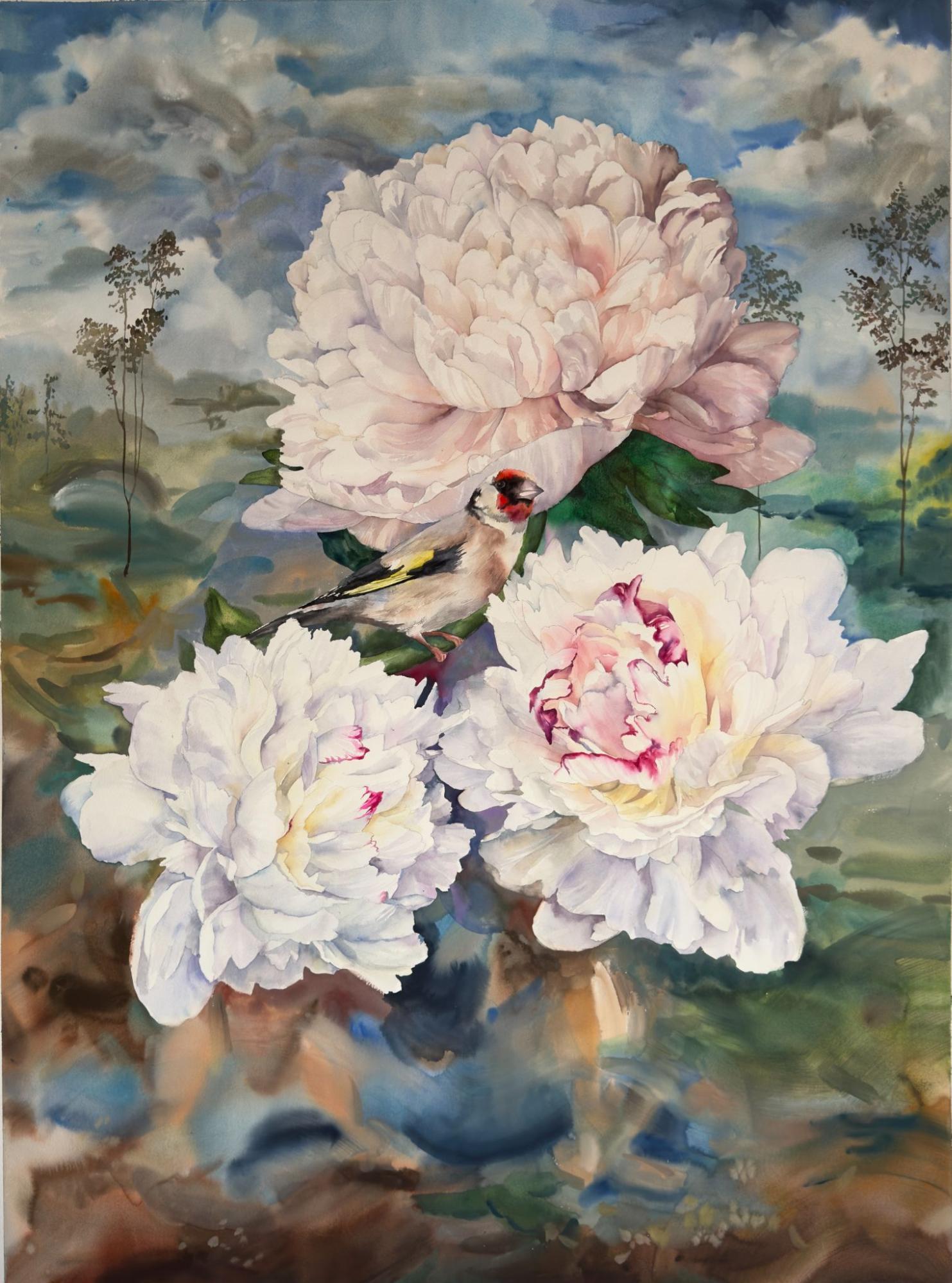
One of the best examples is Madonna and the Goldfinch. Instead of human figures, Raphael’s devotional scene is expressed through dramatic peonies, with the goldfinch still preserved as an important symbolic element. Despite the changes to the original composition, its deeper meaning remains intact. What was once a religious image is reimagined through contemporary floral forms in a way that feels natural and contemporary, without becoming nostalgic or forced.
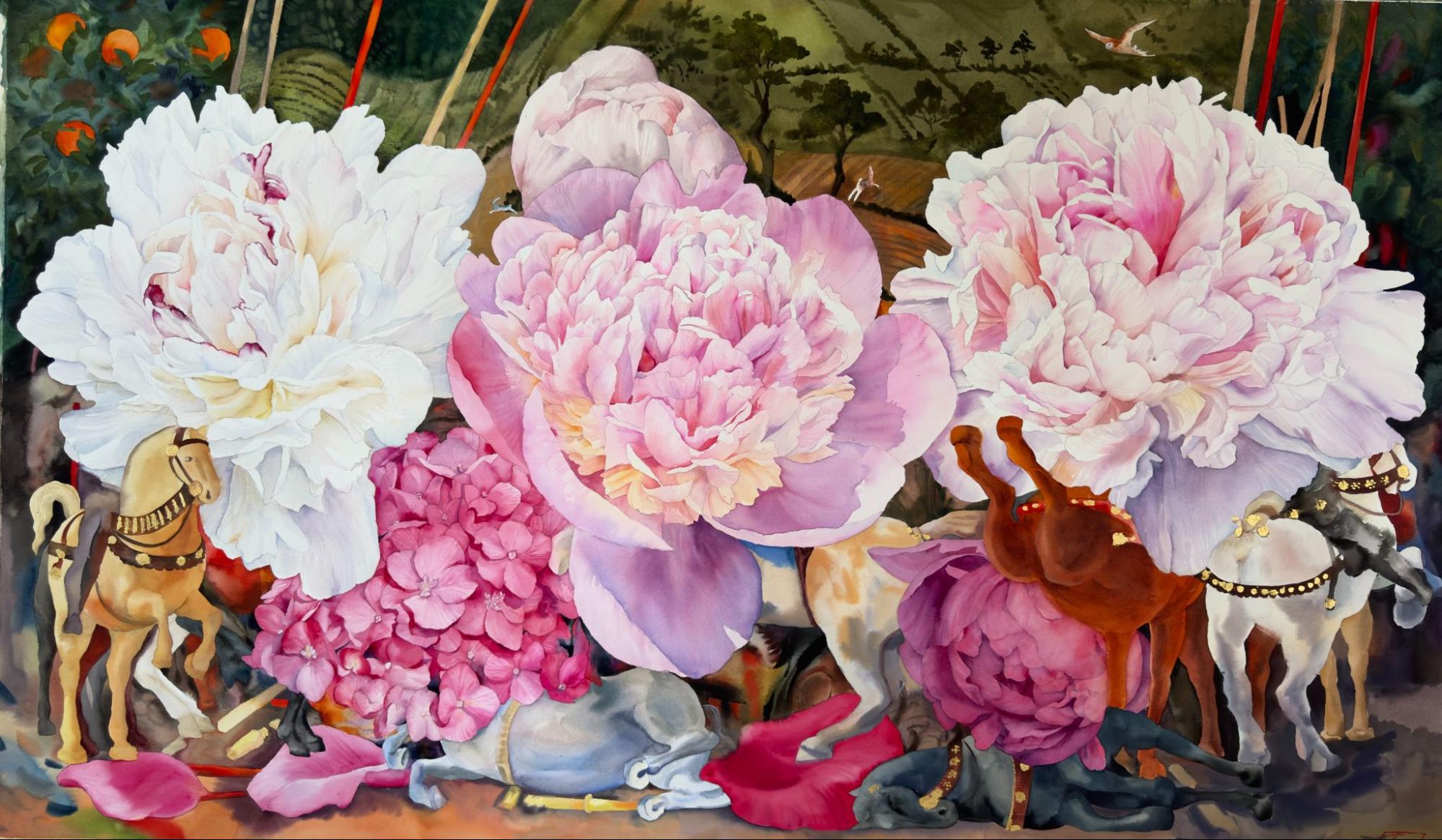
The Battle of Flowers presents an even more ambitious reinterpretation. Although the original scene is no longer directly recognizable, Paolo Uccello’s Battle of San Romano remains the starting point for the composition. The movement of the horses, the strong diagonal lines, and the sense of tension from the battlefield are still present, but the soldiers and their armor have been replaced by rich fields of peonies and hydrangeas. Pulcho isn’t recreating Uccello’s painting. She’s rebuilding the mechanics of it inside an entirely different visual vocabulary. The result feels surprisingly convincing. Once the structure reveals itself, it’s impossible to stop seeing it.
That balance has become increasingly characteristic of Pulcho’s practice. Her earlier monumental flowers challenged expectations of watercolor through scale and technical ambition. The newer works ask a more interesting question: what happens when that same technical language begins carrying centuries of visual memory? The answer isn’t nostalgia, nor is it pastiche. It’s a body of work that treats the Renaissance not as something to imitate but as something still capable of generating new images.

