

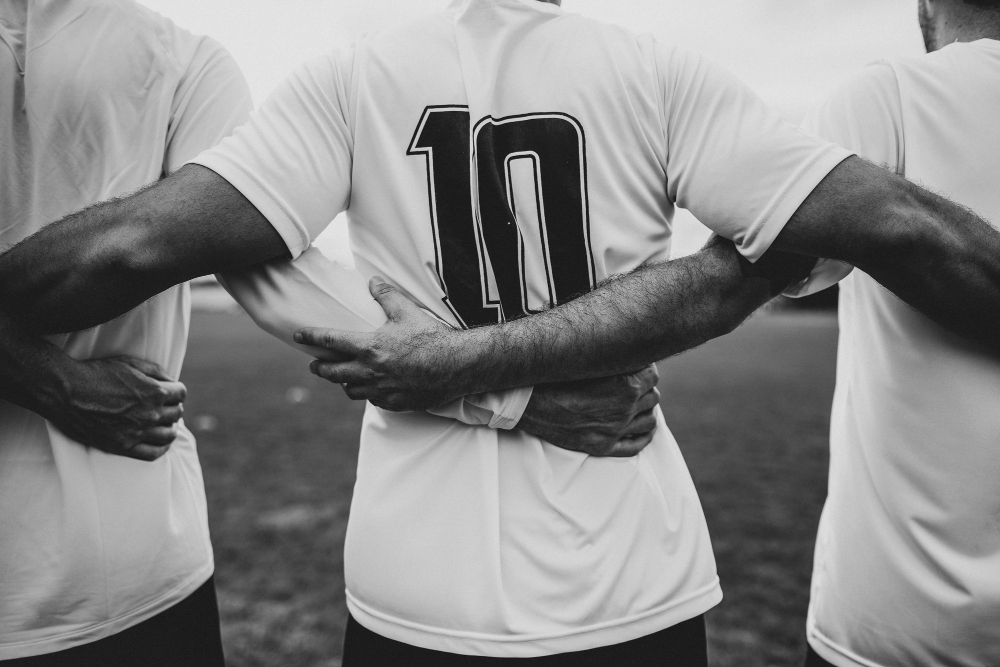
Football still does something other cultural forms rarely manage at the same scale: it lets a local accent, a city history, or a family memory travel without needing translation. FIFA’s own figures for the 2022 World Cup put total media engagement at 5 billion, with more than 3.4 million spectators in stadiums and 88,966 at the final in Lusail for Argentina against France. That scale matters, but the more revealing detail is the smaller one. A child in Casablanca can know the noise around San Mamés, a student in Bogotá can read the meaning of a Barcelona shirt, and a family in Seoul can recognize Lionel Messi’s walk before the camera even finds his face.
A club can still stand for a place
Some clubs carry geography directly, and the Athletic Club remains the clearest example. Its official philosophy still limits selection to players developed in the Basque Country or born in one of the Basque territories, which is why a home match in Bilbao does not feel like neutral entertainment even when the opponent is only there for three points. Barcelona has long operated in a different register, but the old phrase Més que un club, first spoken by Narcís de Carreras on 17 January 1968, still explains why the institution is discussed in Catalonia as social history as much as sport. Badges stick.
Finals become national memory
A final fix identity faster than a manifesto. Spain’s 2-1 win over England in Berlin on 14 July 2024 gave it a record fourth European title, and the goals told their own story: Nico Williams on 47 minutes, Cole Palmer on 73, Mikel Oyarzabal on 86, with Dani Olmo then heading off the line in stoppage time. UEFA’s tournament review put attendance at 2.7 million, counted 6.2 million visitors across the fan zones, and said more than 190 nationalities were represented in Germany. That was football acting as a passport, a memory, and a public square at once.
The ritual moved to a second screen
Matchgoing and television still matter, but football identity now lives on the phone as much as in the stand. During EURO 2024, UEFA recorded 547,000 fan-zone visitors on the day Germany played Spain in the quarter-finals, and that same evening was mirrored on smaller screens by supporters tracking clips, lineups, and group chats between one whistle and the next. In that rhythm, a betting site (Arabic: موقع مراهنات) sits beside score apps, highlights, and team news as part of the modern match routine rather than apart from it. The point is not the product itself; it is that football culture now moves in shorter bursts, crossing languages and borders in the time it takes for a full-back to line up a throw-in.
The women’s game changed the picture, too
The change is visible in the women’s game as well, and the numbers are too large to dismiss as a side story. UEFA’s current records page still lists 87,192 at Wembley for England’s 2-1 extra-time win over Germany in the Women’s EURO 2022 final, where Chloe Kelly scored in the 110th minute and then swung her shirt in front of the crowd. That image lasted because it belonged to more than one player and more than one night. It gave English football a different public memory, and it did so in a stadium usually reserved for the men’s game and major state occasions.
The phone now carries the badge
That cultural traffic is even clearer on ordinary league weekends, when identity is built less by ceremony than by repetition. On 28 February 2026, Barcelona beat Villarreal 4-1, and Lamine Yamal scored at 28, 37, and 69 minutes, his first senior hat-trick for the club; by the end of the night, those three finishes were already moving through fan accounts, family chats, and multilingual football feeds. In the same handheld routine, some supporters check odds, others scroll old clips, and others decide to download Melbet (Arabic: تحميل ميل بيت) before the next round of fixtures lands. The shirt stays.
The map is getting larger again
The shift is now a reality. The 2026 World Cup became the first edition to feature 48 teams and the first to be staged across three host countries: Canada, Mexico, and the United States. The expanded tournament widened football’s global map while preserving the local identities that give the sport much of its emotional power. Across the competition, national teams carried different histories, languages, rivalries, and expectations into a tournament that brought together more countries and cultures than ever before. The results will remain in the record books, but the legacy of the 2026 World Cup also lies in the connections it created between places, communities, and generations of fans.

