

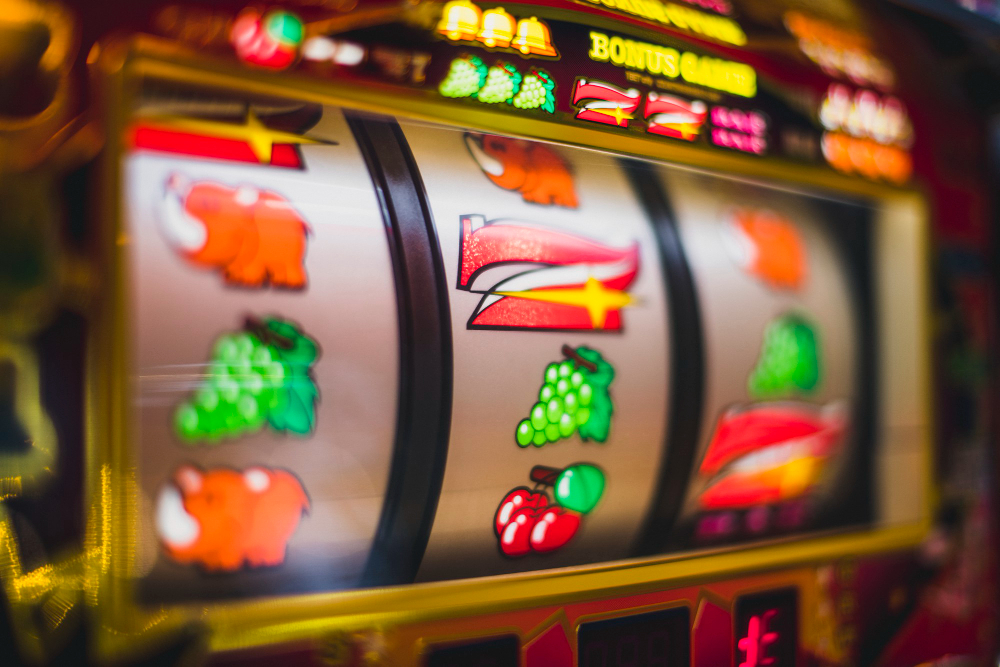
Compared to the slots of today, old mechanical slots had a simpler, more visible mechanism, which is one reason some players say they still find them appealing. The player put the coin in the slot, pulled a lever and waited for the mechanical reels to come to a stop. There weren’t the graphics, animations and fancy bonus mechanics typically seen today, just instant results delivered by the mechanical gears, springs and levers within the cabinet.
We should point out that their simplicity does not mean they were fairer than modern machines, as that’s just not true. Modern gaming machines are more regulated than ever to ensure they deliver random and fair outcomes. That said, some players may describe the older mechanism as feeling more transparent, simply because its physical parts were visible and easier to follow.
When the Reels Were the Mechanism
Charles Fey built the Liberty Bell in San Francisco in 1895. Historical accounts of the machine, including records held by the Nevada Gaming Control Board and slot-machine historians, describe its cast-iron gears, springs and stopping mechanism as adaptations of the coin-operated vending and clockwork engineering already common at the time. It was less a gambling innovation than a mechanical one — the same core principles that governed music boxes and early cash registers, repurposed to spin three weighted reels and stop them at a readable position.
The very first slots were all powered mechanically and would typically dispense tokens to winners that could be exchanged for prizes in the establishment they were located. According to the RNG testing company Gaming Laboratories International, machines such as the first popular three-reel slot, the Liberty Bell, would rely on the reels and mechanical mechanisms to deliver random results. Air, friction, speed and timing would all have an influence on how the reels stopped.
For most players, the experience was easy to understand. The reels and the symbols would spin, and if they landed in a certain combination, they’d win a prize. The player could see with their own eyes how the mechanism was working.
Modern Systems are More Hidden
According to U.S. Patent 4,448,419, filed by engineer Inge Telnaes and issued in 1984, the shift accelerated when microprocessors were introduced to control reel-stop positions electronically. This was built on electromechanical machines from the 1960s and 70s, which had already added circuit boards to control payouts. From that point on, the reel functioned as a display rather than the actual mechanism determining the result.
As for more modern slot machines, how they work is not anywhere near as visible. The reels no longer have a part to play in determining results, and it is hidden software and mathematical algorithms known as random number generators that now determine the outcome of each spin.
Even though the player might see the symbols spinning on the reels, that visual representation means nothing to the result. The outcome is already decided by the slot’s underlying RNG the moment the spin button is pressed. The spinning, graphical effects and animations that look like they have come from top video games are just there for visual purposes.
How Modern Slots Are Tested for Fairness
What players can no longer see has been replaced by testing and certification. Independent laboratories such as Gaming Laboratories International audit random number generators and verify that a game’s mathematical model performs as declared before it reaches the market.
In Canada, gaming is regulated at provincial level. The Alcohol and Gaming Commission of Ontario, for example, requires slot games to be tested by an independent laboratory and certified as random before they can be offered through the province’s regulated iGaming market.
Return-to-player, or RTP, is often misunderstood in this context. It does not decide individual spins. It is the long-run percentage of stakes a game is designed to pay back across millions of results, derived from the game’s underlying maths. Any single session can fall well short of it or well above it, so it shouldn’t be used to predict or plan individual results.
Anyone concerned about their play can find free, confidential support through GameSense, ConnexOntario, or their own provincial responsible gambling helpline.
The Trade-Off Between Simplicity and Technology
Old mechanical slots may have been easier for players to understand because the reels, symbols and mechanisms were all visible. Modern slots, on the other hand, are not as easy to understand, but they operate within considerably more developed regulatory and testing frameworks.
The main difference between the two is where the reassurance comes from: older machines put their mechanics on display, while modern slots rely on independent testing and regulation to demonstrate that their outcomes are random. Whichever version appeals more, both represent a specific moment in mechanical and computing history: one built from visible gears, the other from mathematics no one can see.

