

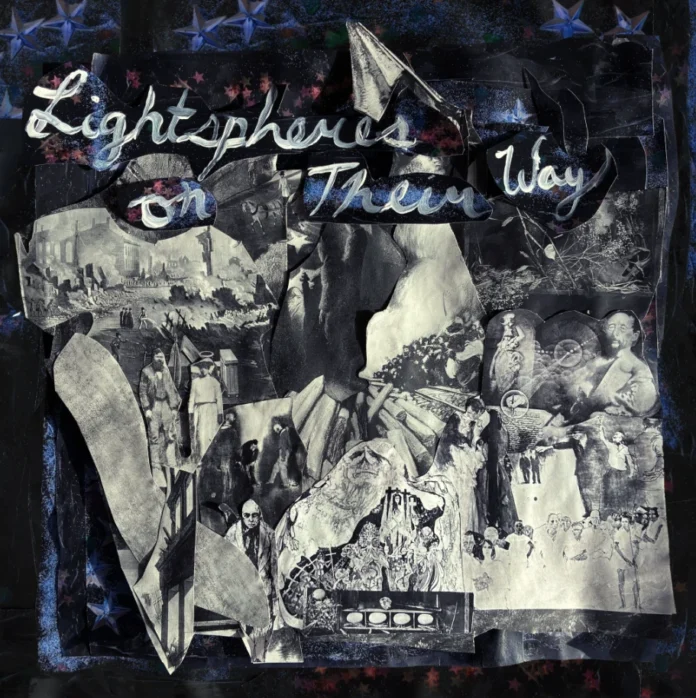
Lily Seabird zooms all the way out on Lightspheres on Their Way. Though revolving around many of the same themes, it stands in almost striking contrast to the rough-hewn intimacy of last year’s Trash Mountain, transposing its emotional volatility to a tangibly spiritual realm. The Vermont singer-songwriter is thinking less about a period of time, or a place in time, than the very nature of it: “Time’s a vortex coming in all directions/ Where I could live in memories for days,” she sings on the fittingly sprawling ‘Portal to the Past’, memory being the engine her music runs on to move through trauma; “Time it’s just like an arrow, and when the winds of change come it’s just like a sparrow,” goes the Adrianne Lenker-indebted ‘Slipswitch’; “Time’s an interval strange and contradictory, how we keep it’s never made too much sense to me,” she admits on ‘Bindlestiff’. To title her most illuminating and dynamic record to date, she invents a word that encompasses it and every other catalyzing force in our lives. Her performances retain an awe-inspiring physicality even as her lyrics flirt with the metaphysical; by the end, you feel like she’s homing in on a universe all her own.
1. The Pulley
While inspired by Leonard Cohen’s Beautiful Losers, the opening track seems to also be in direct conversation with George Herbert’s metaphysical poem ‘The Pulley’, which describes the creation story as a kind of divine generosity towards man: “‘Let us,’ said he, ‘pour on him all we can./ Let the world’s riches, which dispersèd lie,/ Contract into a span.’” Over nothing more than a couple of guitars and gentle harmonium, Seabird brings personal grief into this religious context, wondering, “Am I still allowed to pray even if I don’t believe anymore/ To beg in your morning, to drink from the cup that you pour?” Full of questions that naturally flow into each other, the song is indeed more prayerful than simply contemplative, her voice unusually high as if she’s testing the very limits of its materiality. Life’s richness and restlessness both seem to flow from the same cup, it seems to suggest – and then what?
2. Bindlestiff
“Restless men they search the earth for something that never stays,” Seabird sings, going on to describe them as a kind of endangered species. Then her target becomes singular, not just an allusion to the archetypical wandering man in Steinbeck’s East of Eden but a direct address to the one who’ll someday announce he’s coming home, only to never show. Speeding through ten verses, she hardly catches her breath, but Rick Soszynski’s mournful pedal steel diffuses her tumble of words into pure feeling.
3. Election Day
If the record finds its groove on the second track, you could simply say it builds in intensity with ‘Election Day’, its riotous lead single. But the track takes an almost antithetical approach: Seabird must take a sharp inhale as she stretches out the final syllable of each verse to convey her full emotional force, while Soszynski’s contribution isn’t subtle but torrential guitar, pummeling alongside Daniel Snyder’s drums like waves crashing against rocks.
4. Pennsy
On ‘Pennsy’, Seabird tries to find the language for stories etched in our minds but hardly ever brought up, not in conversation and certainly not in any kind of popular medium. The best way she can imagine this story – ambiguous in detail, but detailed still – is as a film with no heroes or villains, “just a shitty world.” She instructs: “Hold the camera to my eye, make a movie of the madness of the big beautiful lie.” Eliza Niemi’s cello, then, takes on an almost filmic quality, turning up the saturation in what Seabird describes as “watercolor dreams.” It makes for a slightly surreal yet searingly honest journey.
5. Portal to the Past
The bittersweet cello remains Seabird’s companion as her dreamlike introspection simmers down to the dull loneliness of heartbreak. There’s a sense of grandeur in the arrangement, which scans almost like Seabird’s take on a power ballad, but her lyrics are at times achingly plain, ending with an unequivocal declaration: “Know I loved you more than anything and I’d never take that back.” More than halfway through the record, we’ve heard her hit those high notes a dozen times over, but this might be her most spine-tingling performance.
6. Blackstar
Written on a paper napkin in the back of a tour van, ‘Blackstar’ chronicles life on the road, searching for truth in the adage that there’s beauty in everything. But where there’s “fifteen water bottles,” she’s “looking for a smoke/ Ending my life all for the joke.” In the context of a record that begins with ‘The Pulley’, but also a discography marked by the death of a close friend by suicide, it’s a piercing line. In contrast to the previous track, though, Seabird’s singing is tenderly measured, the music lumbering in the moonlight, more Daughter than Crazy Horse.
7. Slipswitch
The album’s invented word may get all the attention, but the most potent one might be that which gives ‘Slipswitch’ its title, inviting the metaphor that makes it stand apart from any other breakup ballad. Struck by burnout, Seabird slows and strips things down again, this time choosing Wurlitzer over harmonium. But the snarl in her voice has dissipated, even as they tell her, “We’re gonna get up on that stage and play some rock’n’roll tonight.” She’s not in the mood for any of that, not here, where the fiery end of a relationship has given way to lonesome serenity. And the sky will open up again for the band to play, and the road will go on forever, even as it builds a portal to the past.
8. The Afterglow
Leaning on a swirlier twanginess, ‘The Afterglow’ is the most easygoing track on Lightspheres as Seabird’s slightly melancholic vocals is blanketed by the return of Niemi’s cello, and even some trumpet courtesy of Sam Atallah. It ends by quietly affirming that inspiration will continue to strike, even if it’s only a reshuffling of old ideas around the same, unshakable feelings; the same skies, the same ghosts. “They came running,” she sings, “They said, ‘We have one more song.’”
9. Lightspheres on Their Way
So Seabird brings back the combination of guitar, vocals, and harmonium from the first track, and as that last instrument drones on and she imagines the wake of her mother’s passing, I can’t help but align Lightspheres on Their Way with the cosmic grief – and strange optimism – of Phoebe Bridgers’ Lost Weekend. Given how viscerally has written about real death – or, more precisely, deaths that belong to the past – it’s no wonder her writing is as vivid as ever here. What’s more surprising is how the band erupts out of nowhere, making good on Seabird’s promise to blow it all into the stratosphere.

