

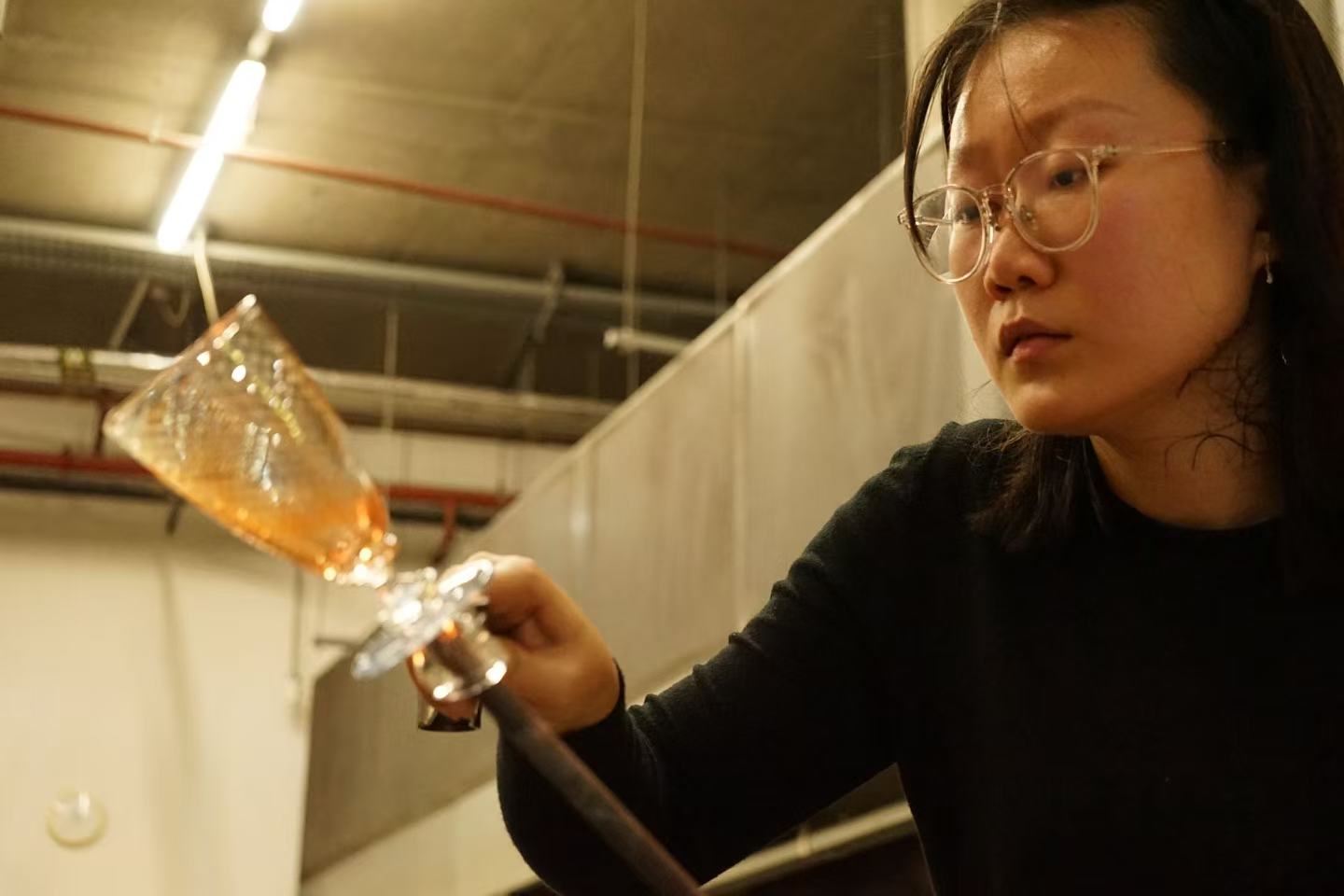
In contemporary glass practice, technical complexity is only one measure of significance. Equally important is an artist’s ability to bring material, process and lived experience into a meaningful relationship. For artists at the beginning of their professional careers, this relationship is rarely fully formed from the outset. It develops through sustained practice, as technical decisions acquire conceptual purpose and the behaviour of the material begins to redirect the work. Gao Yanjie’s practice over the past two years reflects such a development. Drawing on familiar motifs, including greenhouse plants, sweets and seeds, she uses enlargement, fragmentation and reassembly to translate family relationships, sensory memory and the tensions of personal growth into glass. From Greenhouse Plants to Sweet Teeth and Fumble, her work reveals a gradual shift from readily legible symbolism towards a more integrated material language.
Gao graduated with first-class honours from the University of Sunderland’s BA (Hons) Artist Designer Maker: Glass and Ceramics programme. Working primarily in blown glass, she has developed a strong foundation in hot-glass processes. Studio experience, specialist courses and exhibitions in China, the United Kingdom and the United States have also introduced her to different working methods and studio cultures. More importantly, these experiences have encouraged her to move beyond technique as an end in itself and to consider glassmaking as a means of examining personal experience, uncertainty and constraint.
Greenhouse Plants (2025) is an early instance of Gao translating her experience of family relationships into the language of glass. Comprising five blown-glass sculptures, the series places red, plant-like forms within vessels that both host and contain them. This relationship gives material expression to the coexistence of care, expectation and constraint within family life. Although the red forms appear to press against or extend beyond imposed boundaries, they remain physically and visually connected to the vessels around them. This ambivalence prevents the work from becoming a straightforward narrative of confinement followed by escape. Rather than rejecting family ties, Gao considers how an individual might renegotiate personal boundaries without relinquishing emotional connection. Independence emerges not as a decisive rupture but as an ongoing negotiation between attachment and autonomy, shaped both within and against inherited structures.
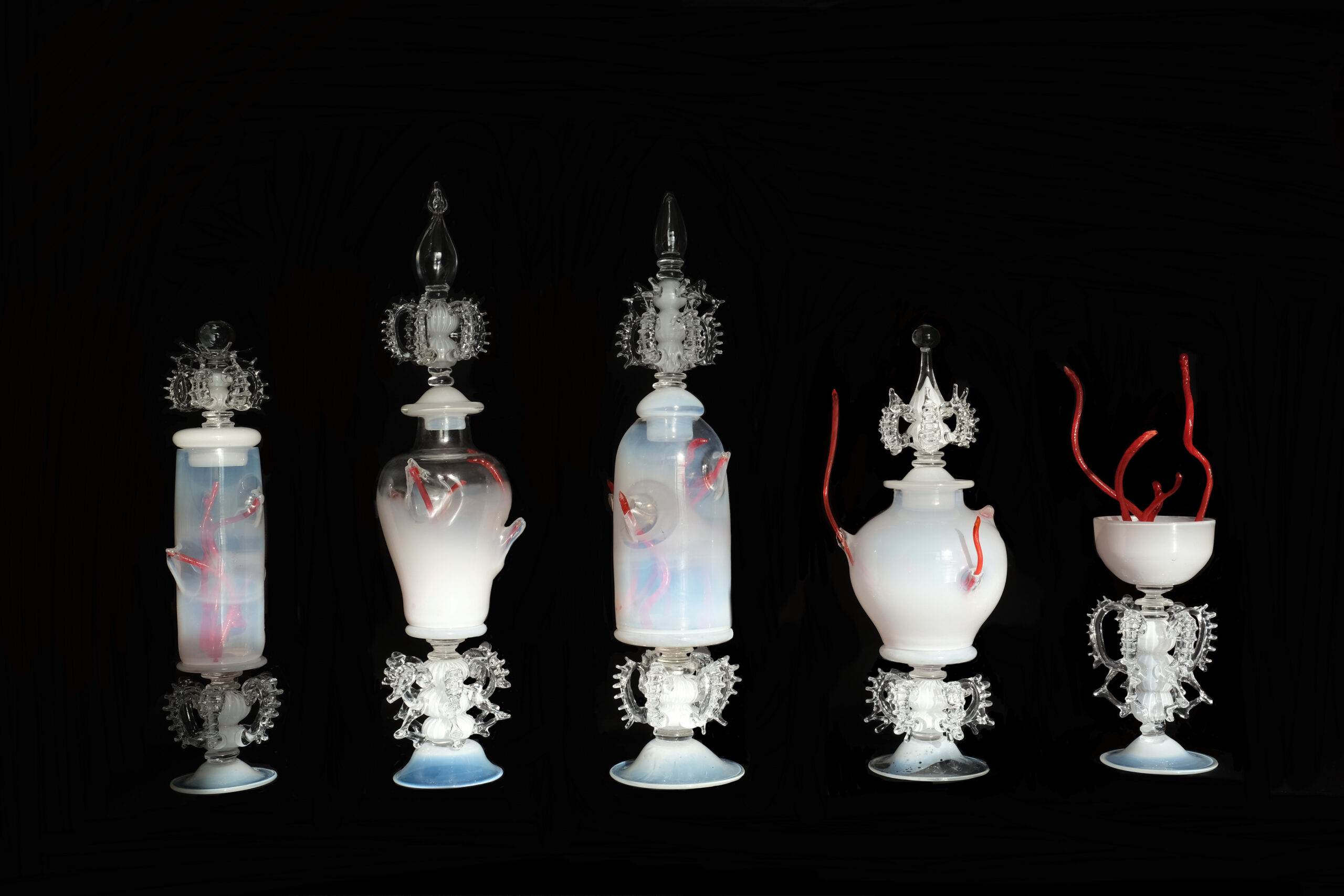
The optical properties of the opal glass reinforce this tension. As light is transmitted, diffused or obstructed, the visibility of the internal red forms changes according to the viewer’s position. Their partial concealment gives visual form to pressures within intimate relationships that may be strongly felt without being immediately visible. At this stage in Gao’s practice, the correspondence between vessel, plant and family structure remains relatively explicit. Even so, Greenhouse Plants establishes a concern that continues through her later work: internal growth unsettles external order, while established glassmaking processes are adapted to articulate personal experience.
In Sweet Teeth (2026), Gao turns from family relationships towards sensory memory and the emotional associations of sweetness. The work draws on childhood memories of sweet jars and the intense anticipation attached to their contents. Rather than reproducing particular confectionery, she isolates remembered qualities such as saturated colour, gloss, rounded forms and spiral patterns, then reconstructs them in glass. Filigrana cane creates the swirling linear detail, allowing technique to operate not merely as ornament but as a material equivalent of attraction, repetition and craving.
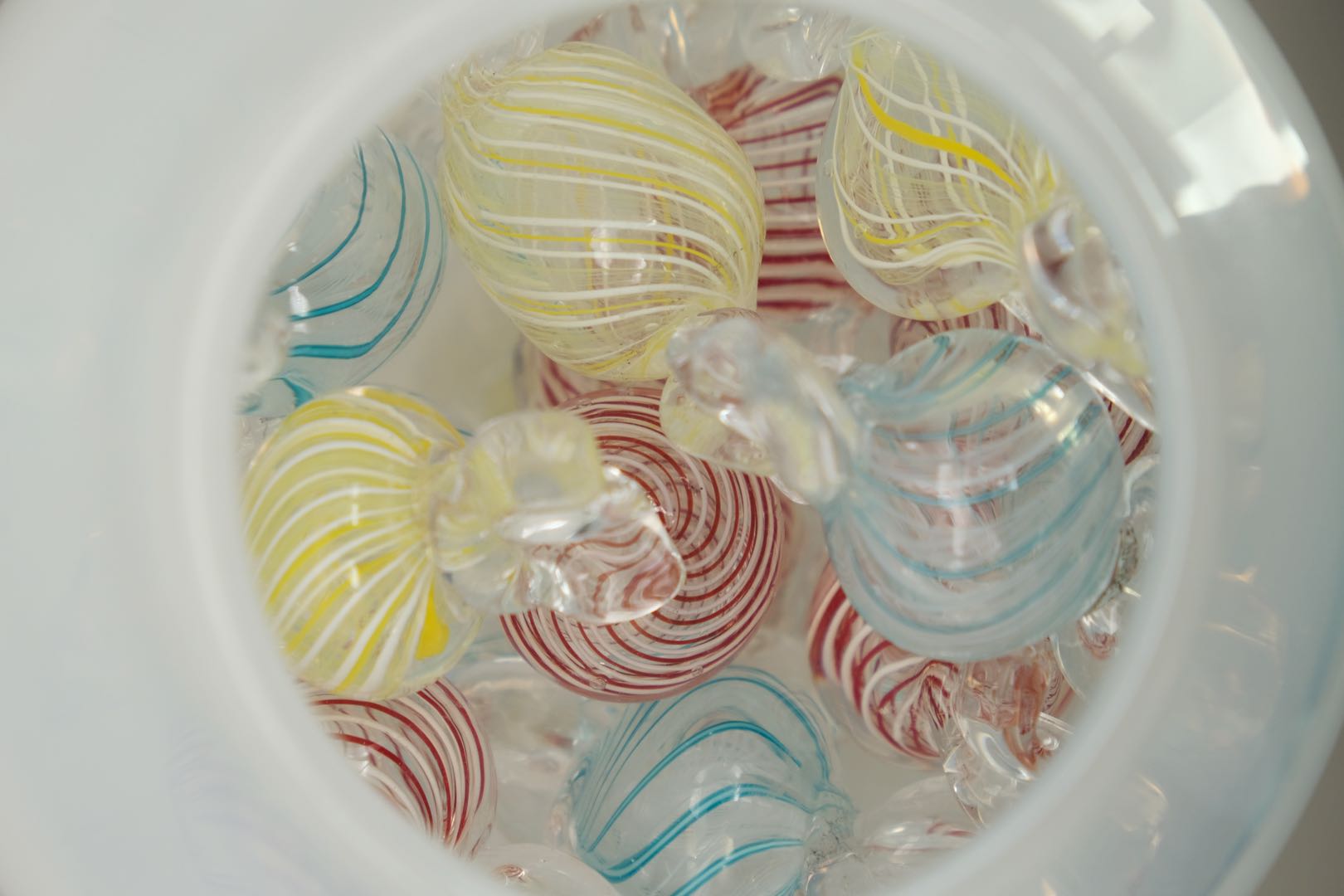
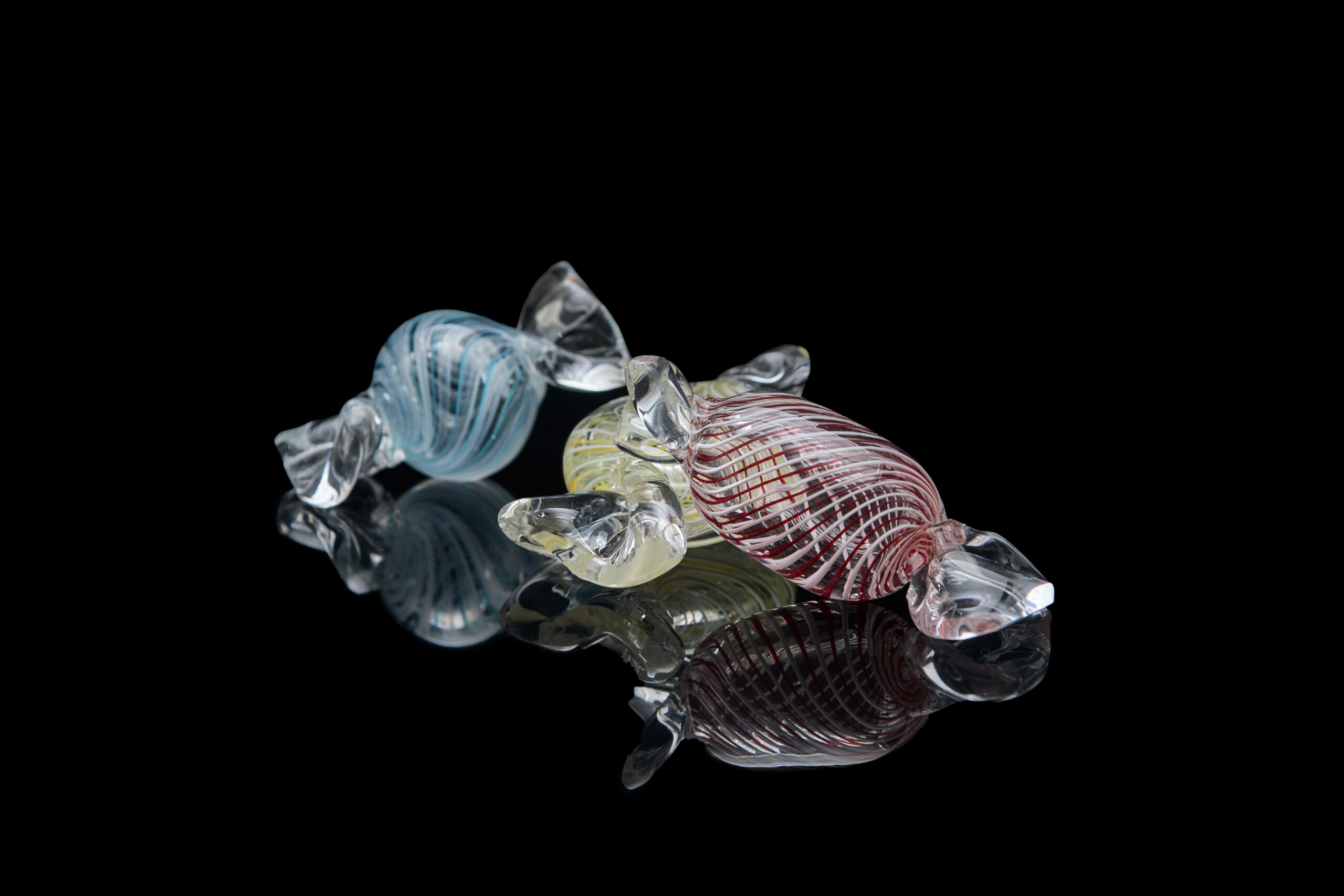
In this work, sweets are associated with the direct pleasure of childhood, but they also suggest the adult use of sweetness as a temporary source of comfort under pressure. The series therefore occupies an unstable position between pleasure and dependence, gratification and excess. A seemingly light-hearted memory acquires a more ambivalent psychological character. Glass is particularly effective in sustaining this ambiguity. Its colour and lustre invite visual desire, while its hardness and fragility resist the softness, taste and consumption ordinarily associated with confectionery.
Compared with Greenhouse Plants, Sweet Teeth relies less heavily on the symbolic opposition between an enclosing vessel and the form held within it. Instead, colour, reflected light, pattern and scale act more directly on sensory recognition. The work marks an important transition in Gao’s practice because material effects begin to carry emotional meaning in their own right. At the same time, the series reveals a difficulty that remains productive rather than fully resolved. Its vivid colours and intricate surfaces can draw attention towards decorative appeal, potentially obscuring the less comfortable themes of dependence and psychological compensation. This tension identifies the work as transitional. Gao is beginning to use material qualities as carriers of affect while still developing a structure capable of binding personal memory, process and concept more tightly together.
In Fumble (2026), Gao moves away from the comparatively direct symbolism of her earlier work and towards an approach structured through process. The three seed-like sculptures combine blown forms with digitally modelled and waterjet-cut components. Although these methods establish a degree of precision, the final structures remain subject to temperature, timing and the changing viscosity of glass during hot assembly. The work therefore develops through negotiation between planning and material response rather than through the straightforward execution of a predetermined design.
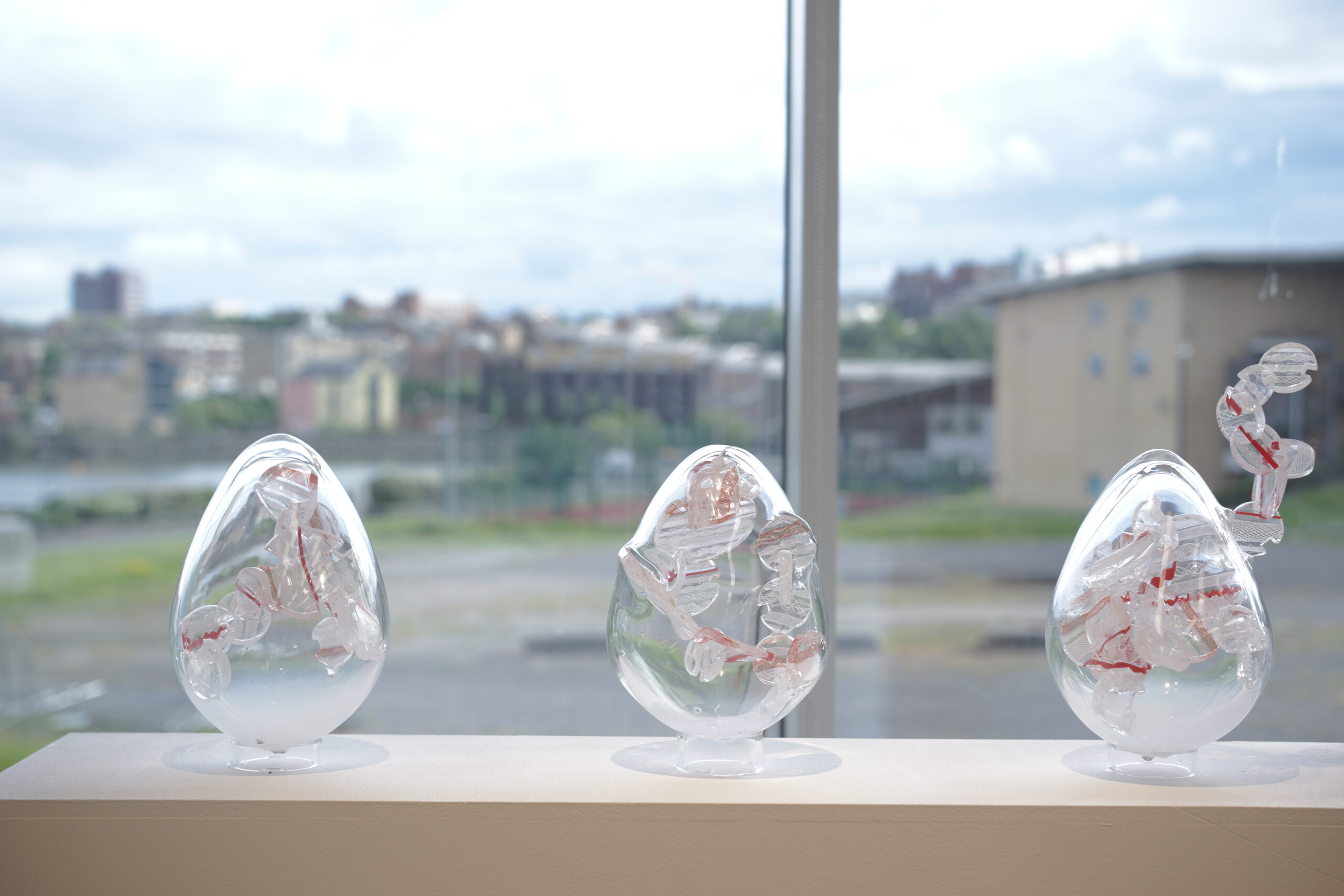
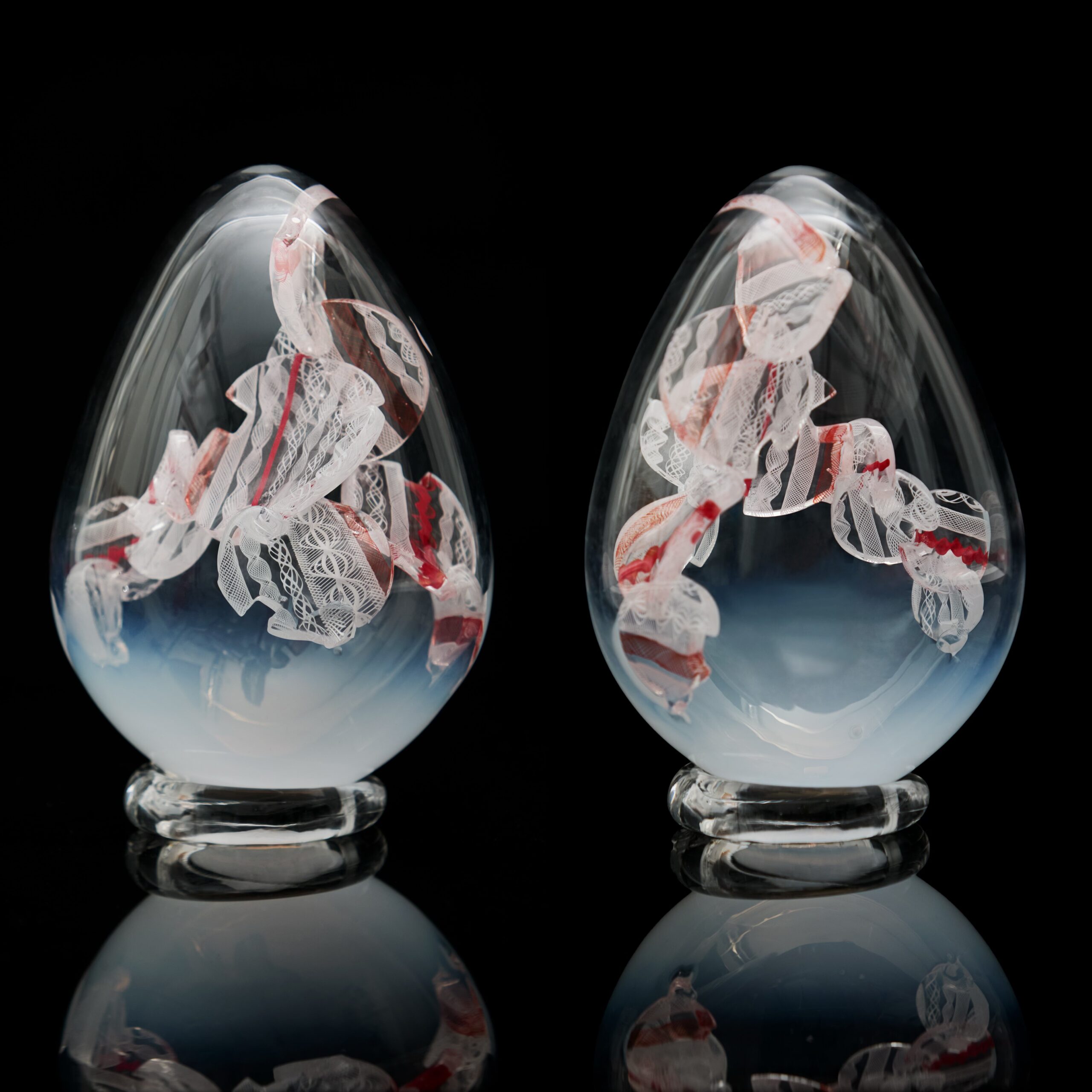
The visible variations between the components are not simply technical imperfections. They record the practical judgements required as digital design is translated into hot glass. Gao’s role shifts from executing a fixed model to responding to the material as the work develops. Technical control remains important, but it becomes conditional rather than absolute.
Seen alongside Greenhouse Plants and Sweet Teeth, Fumble marks a change in where meaning is located. Greenhouse Plants uses the recognisable relationship between vessel and plant to address care and constraint, while Sweet Teeth relies on colour, lustre and pattern to activate sensory memory. In Fumble, meaning emerges more directly through designing, cutting, heating and joining. Process no longer serves only to realise an image but becomes a means of testing and revising the artist’s original intentions.
It would therefore be premature, and critically unhelpful, to define Gao’s practice through a settled signature style. More significant at this stage is the changing relationship she establishes between experience and material. In the earlier works, established glass techniques organise form, colour and imagery. In Fumble, risk, irreversibility and the resistance of hot glass to predetermined plans become part of the work’s content. Technical skill is no longer presented primarily as evidence of mastery. It becomes a means of testing an idea and discovering its limits.
This trajectory is still developing. Some of the symbolic relationships remain explicit, and the interpretation of family, childhood and growth continues to be guided by the artist’s stated narratives. A future challenge will be to retain the specificity of lived experience while allowing greater interpretative space for both material and viewer. Nevertheless, the methodological shift visible in Fumble is substantial. Gao no longer treats glass simply as a medium through which a predetermined subject is communicated. She increasingly allows its physical properties, risks and transformations to redirect the work. Her practice occupies a productive space between inherited craft knowledge and contemporary artistic enquiry, in which technique, memory, judgement and contingency jointly determine how meaning takes form.

