

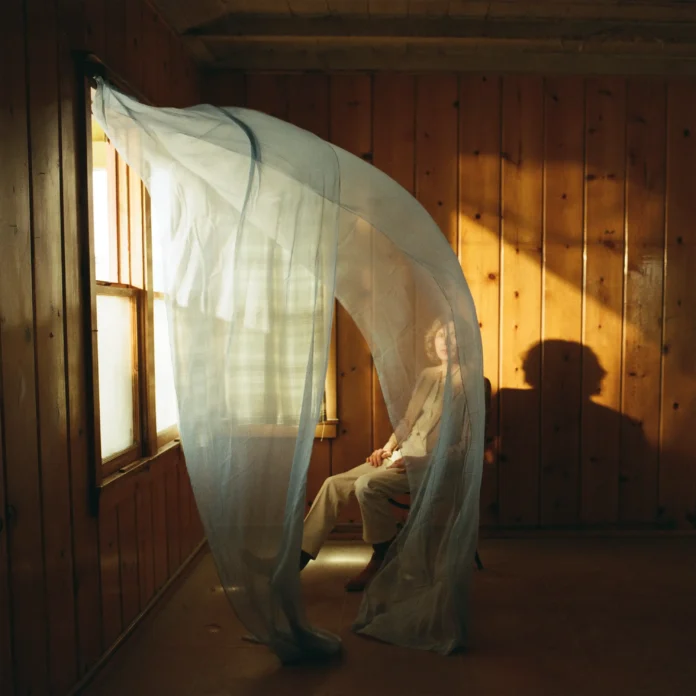
Beck is not an easy artist to pin down, but his most familiar musical side may be his most wounded. Of the eight albums he has released in the 21st century, there is a spiritual throughline between three of them: 2002’s Sea Change and 2014’s Morning Phase, two of his most celebrated LPs, now joined by the just-released Ride Lonesome. The singer-songwriter seems to need about a dozen years to lean back into this somber, confessional mode, processing heartbreak through acoustic guitars and lush orchestration, sounding only subtly different each time. Despite following the end of an 15-year marriage, Beck’s last album, 2019’s Hyperspace, was not much of a personal excavation but rather a synthy, listlessly mellow collaboration with Pharrell. On the new album, he reunites with the band that’s stayed consistent throughout what’s now a trilogy, with producer Nigel Godrich once again behind the mixing boards. More so than the previous albums, Beck’s melancholy is accented by a kind of cosmic aimlessness that sounds alternately dark and comforting. You get the sense that you’ve been here before, looking at the same night sky for a sign, but it never feels quite the same.
1. Ride Lonesome
Beck establishes the album’s titular mood, one of clearly familiar melancholy, right away, but not without suggesting there’s good company in the midst of that lonesomeness: not one, not two, but three delicately interlocking guitars fill out the empty space, along with a couple of backing vocalists, Roger Joseph Manning Jr. on keys, and Justin Meldal-Johnsen on bass. “Paper roses they forgot to bloom,” he sings, and beginning the record with the eponymous track is another way of denoting the relationship was cursed to lead back to solitude as the emotional default.
2. Run Away
An aimless drive is often a gateway to wondrous beauty, which you can hear subtly unfurling on ‘Run Away’. It begins to expand the album’s palette: hushed, delicate harp and glockenspiel on one hand, ethereal synths on the other. The scene the lyrics paint is apocalyptic, but it sounds like you could almost blink it away.
3. In the Night
The subtext of the previous song becomes text on ‘In the Night’, as if we needed clarification on the time of day: “Darkness came on by/ With stories of the sky.” Beck introduces the string section here, and that, too, feels a little too literal, though Blake Mills’ acoustic guitar, in its supple precision, makes up for it.
4. Failed Words
It’s in admitting the failure of language that Beck’s words are more evocative, especially when they trace a gorgeously stirring piano melody. The stories of the sky start to blur, through heartbreak, into his crumbling inner world: “When the sky is breaking/ And the shadows fall/ Underneath the surface/ Behind the wall.” What happens then is of little importance; what matters is that he takes us there, the dependent clause as a feeling.
5. Bleed
Without really introducing any new elements, ‘Bleed’ threatens to drag the album’s momentum, aligning though it may with the song’s themes of emotional malaise and uncertainty. Feeling directionless is the point, but the hope is that the record doesn’t dig itself into a hole after a strong start.
6. Disappearing Act
The single treads similar lyrical territory – looming skies, waiting, roads to nowhere – but Beck’s poetic simplicity and a few instrumental details help it standout; Smokey Hormel’s slide guitar, in particular, is spine-tingling, like the sudden sound the singer mistakes for his former lover.
7. For Your Love
The band’s dramatic exit, if not exactly mirroring the lover’s departure, certainly shifts the mood of the record. Accompanying himself on synth, Beck’s introspection here is echoed through the large array of strings, but it’s the couple of horn players – Allen Fogle and Danielle Ondarza – who add an extra touch of transcendence.
8. Slow Canyon
Ride Lonesome gently – and, at this point on the record, somewhat expectedly – moves towards healing, inflecting its folk-rock with lighthearted layers of woodwinds. “I spend my days/ Holding out for night/ The way the fireworks/ Congratulate the sky,” he sings, one of the record’s most memorable metaphors.
9. It Ends Right Here
As soon as Beck slips into his falsetto, ‘It Ends Right Here’ is a much less doomful phrase than it might have sounded earlier on the record. It’s acceptance with a hint of well-oiled melancholy, right where it needs to be.
10. Falling Through My Hands
More woodwinds ride out a lovely melody, filling out the sound without the imposing presence of strings. “Shadows spin into the silence/ So shed your tears and close your eyelids,” Beck sings, and, surprising us with a brief harmonica solo, seems to be doing just the same.
11. If You Don’t Know What Love Is
The album draws out its wistful resolution with a couple of longer tracks; ‘If You Don’t Know What Love Is’ is wordier and patient in its repetition, which brings out the expressiveness in Beck’s voice, matched more than anything by Greg Leisz’s pedal steel.
12. Beyond the Light
The closing track is an elegant slow-burn for a reason; when you find yourself at any kind of crossroads in your life, you want to savour what he calls the “changing of the light.” Some of Beck’s most pointed lyrics are here: “You stand inside a diadem/ Of all your nameless days/ Where the rivers rise/ To wash away the pain.” Language may fail to give them a proper name, relegating them to the abstract realm of sadness. It’s a good thing Beck is comfortable magnifying each and every shade of it.

