

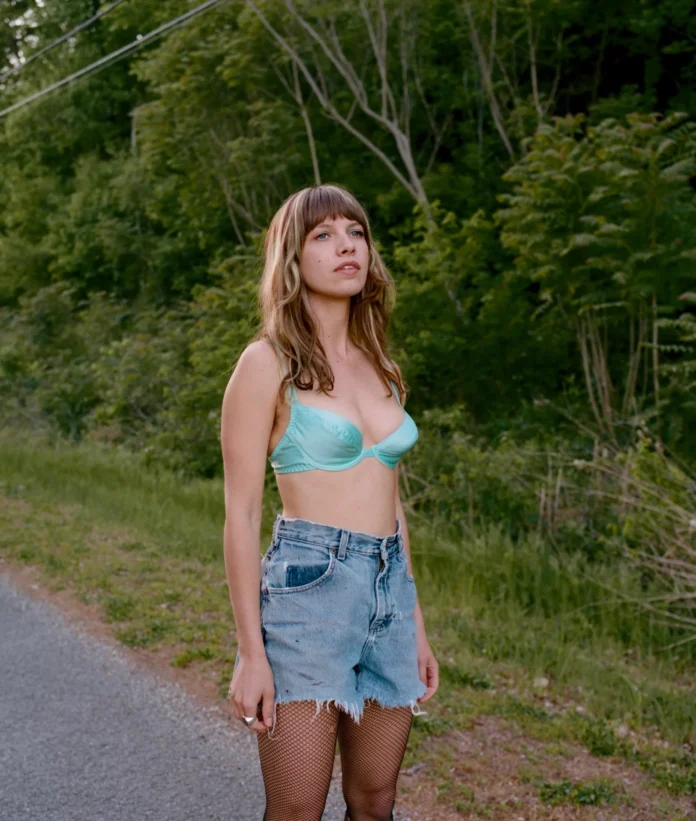
Angela Autumn is a Nashville-based singer-songwriter who grew up in the Appalachian region of western Pennsylvania. She started playing guitar and banjo at 19, and the way she flits between the two instruments in her music both blends and blurs the line between its Appalachian and modern folk influences. Her first full-length album, Frontiers Woman, came out in 2021, followed by the 2023 EP Cowboy Jack Clementine. Her latest album, Believer, finds her reuniting with Isaiah Beard, who had already worked on ‘Electric Lizard’, the penultimate track that became a viral hit before its inclusion on the album. Taking shape in the wake of heartbreak, the record was written across the South and Appalachia: in a treehouse outside Asheville, in the Tennessee woods, and in an empty warehouse near Chattanooga. Throughout it, Autumn marries ample restlessness and nimble restraint in her search for a kind of light: “For a guarantee of sunshine, I got the blues,” she sings on ‘My Alchemy’, in a voice that’s alternately airy, warm, and gutsy. But she puts faith in the idea that the blues – like any other genre or place she may choose to briefly inhabit – is somewhere you can store memories for all time, even before they get to live inside you.
We caught up with Angela Autumn for this edition of our Artist Spotlight interview series to talk about writing on tour, her upbringing, recording Believer, and more.
I was reading an older interview where you mentioned your producer telling you, “You can always sing it differently live,” in the process of making Believer. Now that the record is out, do you feel inclined to follow that impulse and switch things up vocally and musically in a live setting?
Yeah, absolutely. I have been reworking some of the older songs in my set and playing around with speaking the words in a conversational way, because those songs have been in the set forever. Some of my songs, like ‘Dancer’ and ‘Electric Lizard’, have always been very prominent in my live set, so I’ve been playing with those ones more. It feels like I can kind of rest and be more experimental and be an actor in that sense. But with songs like ‘Bleach Bugs’, I didn’t really perform it until now, so it’s very fresh, and I just enjoy performing it like the record because it feels like a flavor saver.
I know you wrote parts of the record on tour, too. How do you feel that the sounds and the places you were exposed to bled into the core landscape of the album?
Yeah, it started in 2025 with Pickathon out in Oregon. I’ve been on this constant tour and I’ve been writing the whole time, so it feels like Believer is the first segment of my journey, and it’s guiding my next step. I’m definitely excited to go back to North Carolina, where I wrote most of these songs. I just love these places so much – I love North Carolina, I love the South, and I love the West, especially Oregon and California. I can only hope that the songs will bring me back to those places and that I’m able to share more about them on the next record. It’s really powerful to be able to experience and write about these places that I’ve been, and only because I’m a touring musician have I seen all these different spots. It’s really not something I think a normal job would ever afford.
I also think about the very specific places where you ended up writing, like the treehouse and the warehouse. Since smell is something that comes up on the record a few times, I’m curious how senses are maybe activated when you remember some of those spots.
Well, I was cold. Just seeking warmth, and seeking a source of some kind. Sometimes in the warehouse area where we were writing, I was sleeping on the floor on some sort of mattress pad, waking up in the morning, having coffee, and getting ready to track the songs and just feel it out. But when I was in the treehouse, it was so cold. There was no heat and no running water, and I was like, “This is going to be great, this is going to be so comfortable,” and it ended up being the opposite. I went outside in the morning to look at the stars, and they were so bright – the brightest I had ever seen. I felt so close to the cosmos and so close to whatever source I was looking for to help me along my path to capture these songs and capture the moment. I feel like the dark and the cold have always been really inspiring to me, because then I’m looking for a light. It sounds very cheesy and metaphorical, but it’s like looking for a fire in the dark of the winte sort of thing.
Do the songs help you tap into that in a live setting, or do you need to find other ways to get into that headspace?
I do think it’s important to visualize while having a performance – I visualize things that are different for each song. For a song like ‘Roving Jewel’, I visualize middle America and Arkansas when I’m playing and performing it, but for a song like ‘Believer’, I visualize Nashville. I’m very visual in my mind, so I think channeling that out through the words and through the playing is what keeps me centered during the performance. You can’t be thinking, “How’s the audience feeling?” It’s your job to paint a picture for them through the words and through the instrument and orchestrate the energy in the end a little bit.
How do you visually remember the first time you performed to a live audience? Is that an image that has stuck with you in a vivid way?
Performance was like the first drug I ever took, and when I took that drug, I could never go back to not performing. But now, I don’t think the same thing that attracted me to performing is what keeps me doing it. I don’t get off stage and am like, “Oh my god, that was the most…” I’m just like, “This is my job.” But obviously, 18 years have transpired since I stepped on stage with a guitar, and it’s just a magical thing. I think when I first started – I was like 12 or something – I was like, “This is magic. How is it that I didn’t mess up that entire song?” It’s really just mind-blowing. So, gaining confidence, and for so many years just doggedly doing it – a lot of time has passed.
And in the middle of that, you moved to Nashville. How many years has it been?
It’s been like seven or eight years. I’m very grateful for the level of experience I had when I got here, but I really cringe sometimes looking back at who I was as a performer, even three years ago. I think last year was when things really clicked for me, especially out at Pickathon when I had a trio of bass, drums, and electric guitar. That was when everything started to feel really, really good.
What do you remember about that moment?
I just remember playing some banjo parts on my electric really well, and my drummer was playing really fast. I was like, “I don’t know if I can keep up,” because it was kind of technically difficult stuff, and it just felt really cool to be plugged into an amp. I was always an acoustic performer and player, and the electric has been so fun. It’s been incredible, and things have really become a lot more exciting since then. Coming to Nashville, you’re definitely going to be surrounded by really stellar professionals. If you’re used to playing with folks who are half-assing it, even if you’re hyper-talented, it’s not going to click in a live setting. This year has also had a lot of solo acoustic performances in between, and that can be a huge, jarring shift – being naked versus having your band, standing there with just the guitar and needing to fill all of that space. But I still love to do that, too.
Growing up, I know that you were exposed to different kinds of music in a communal way, like in church. I’m curious when it became more of a private thing for you, and how you nurture that side that loves the communal aspect of it, but also the privacy of songwriting as its own ritual.
Well, I have an anecdote about this. But I can also just share that I am very serious and protective over my own writing space. I think the difference is, I’ve never been in a band or anything like that, so it’s just always kind of been my own project. I love to collaborate in the right place and the right time and get inspired by other folks. Obviously, we need the creative energy of others and witnessing them to have any desire to be inspired. I do feel that I need to see music live that I enjoy and that is inspiring in order to create. I’m not saying to create in a vacuum – that’s just a recipe for disaster. Don’t do that. I don’t think people should lock themselves away. But some people do – I read recently that Grimes locked herself away when she was making Oblivion. I also read an interview with another artist that you did, where he’s like, “I wrote in this same room.”
Which one?
Oh, Greg Mendez. And I’m like, “I write on the road.” My car is my spot, and I’m just driving. But it works for some people.
What’s the anecdote?
I took choir as a young person because we had to choose if we wanted to be in choir or band, and then choir or art. So I chose choir. And my chorus teacher, she loved me. She gave me all of the solo things, and she was like, “You’re my favorite.” I remember I performed during Guitar Day, which was when everyone who played guitar would perform to the school. And after that, she didn’t talk to me. She gave me the cold shoulder. I was 12 or 13 at the time, and I think it’s just that when you’re different, you’re different, and you’re doing your own thing. That’s kind of how I see that. It was definitely a big trauma. I was like, “Oh my god, she doesn’t approve of me playing guitar music.” She’s just like, “No, that’s not us, that’s not me, therefore you are not anything to me anymore.”
You talked about being protective of your writing space. I know you tracked more than half of the songs in a few hours, and then you spent weeks overdubbing and adding textures. In that production phase of refining and adding things in, did you feel protective or conscious of preserving the immediacy and attitude of the original songs?
I felt entirely safe working with who I worked with, so the strategy was to keep the live vocals from those six songs. So everything from those six songs – a song like ‘Bleach Bugs’ or ‘Mountain Stream’ – all of those core vocals are live, and that was enough for me. I was like, “I’m happy with it, so whatever we add to this is just fun.” I think with a good producer, you shouldn’t have to feel protective over your creation, because you know they have enough respect to not step on what you’ve done. But if you’re in the production process and someone starts to direct how you’re singing, change the delivery, mess with the flow of the song, or tell you how to do something, to me that is just a red flag.
Part of it is the singing itself, and then part of it is how you treat the vocal, or how many vocal tracks you add. I know you double-tracked for a few songs, and I feel like the choice to not do that is just as intentional, like on ‘I Don’t Think About You at All’; the reverb is used very sparingly and pointedly on that song. Were the vocal effects and layering something you went back and forth with a lot?
No, it’s like a relationship. You know how in a relationship, you’re like, “What, should we do this? Should we go here? Should we do this? Should we do this?” And then at a certain point, you’re like, “Do I even want to be here with this person if it’s going to take so much?” It’s like a breeze with Isaiah. He would just say, “Can you go over this? Would you be down to double this?” And he just does it. I feel like that’s such a blessing to have with a producer, and that wasn’t intentional from me – that was Isaiah. I don’t know how he recorded my banjo and vocal for ‘I Don’t Think About You at All’, but he did, and I just played them at the same time. I don’t know how he even had access to one over the other, because they were miked right beside each other. Producers always complain, like, “Can we please overdub the vocal?” But I feel like he understood that I wanted to do them together.
What did you learn about your voice in making this record? Not just in recording, but even in writing these songs and carving out melodies for them. How did you have fun exploring your voice?
Well, on this record, I hear a lot of my “fairy voice,” which is just this high and lonesome, nasally, kind of twangy, girlish voice. But I also hear it with what I’m saying in the lyricism being a little bit darker and occult. So I think there’s a nice contrast between the vocal style that I’ve been building for years – the delivery being soft and kind of sweet – and the words being heavier, and the guitar being heavier, playing with that contrast. As opposed to my previous works, where I feel like they were more on the same plane – just country guitar, country vocals. On this one, there’s definitely more of a gap forming.
Thinking about the structure of the record, it sounds to me like escaping into nature and getting more into this darker, stranger territory around the middle stretch – from ‘Mountain Stream’ to ‘Sage Bundle’ to ‘Bleach Bugs’.
Yeah, it does feel like they represent a no-man’s-land, or a journey, a venture. Whereas ‘I Don’t Think About You at All’ and ‘My Alchemy’ were both written in my bedroom in Nashville, so I think that’s very true. I think that’s very clear – it kind of comes full circle back to the self, reflecting at home and wondering what’s next, and then the middle is more about getting lost, or being in the dark.
‘My Alchemy’ makes sense now that you mention that. It does feel like it’s really at home in that sense, and almost resolves the question of the title track.
I love that you connect ‘My Alchemy’ to ‘Believer’, because to me, they’re from such polar opposite times of my life. But the interesting thing is, I feel like ‘My Alchemy’ is an answer for me, because I was struggling a lot with finding the answers when I was writing ‘Believer’ and just feeling ungrounded. Listening to ‘My Alchemy’ feels almost like a future, higher self talking. I don’t know if it’s necessarily me.
Belief can feel like such an abstract concept, but I feel like “power of my alchemy” narrows it down a little bit. That’s how it feels like an answer to me.
Yeah, it brings it down to just being by yourself, cooking food or smoking weed on your own, which I think a lot of people can relate to. Just these containers for small revelations to happen, you know? We’re going into the winter months and people start to spend more time by themselves processing things that have happened. It makes sense that ‘My Alchemy’ closes the record because it was written in the beginning of the fall, the autumn time, taking the prisoners and dragging them back into the woods.
On ‘Garbage’, you describe home as being “among the concrete, crooked fences.” What else comes to mind when you think about home?
Man, I’ve had so many homes over the last several years. I think what I’ve been doing is gathering ideas of home for myself – different ideas of home. I come from a very traditional, small community, and if my own idea of home had never shifted, I would not have been able to create a structure for this. I do believe that our life can be like a rotation, and then you get back to where you started. And that’s acceptance, you know? I don’t reject where I’m from. I love my home, but I’m also in acceptance that that’s not where I’m meant to be. I’m not meant to be in my hometown, seeing the same things over and over and over again. But in the adventure of discovery, it can get repetitive, actually. Just seeing new places can be its own level of hell and repetition. So you do have to settle into acceptance with home eventually – everyone kind of has to, or else you’re just a wild Anthony Bourdain for the rest of your life.
I was thinking about the line, “Your face is covered with clouds” in relation to the album cover, and it may be a stretch to make any connections to the South, but I wondering if there was something there about a cloudiness of expression, or just as a blurry mood that resonates with your idea of the record.
You know, I’m just a person who goes on dates and has relationships, and it was just about a specific person. But that theme is about sobriety and just witnessing what not being entirely sober can do. I think there are a lot of different ways to sedate yourself with everything that’s going on. I’m not saying the South is more sedated than other places, but they are definitely more chill down here. I mean, it’s just slower. I’m from the East Coast, so yeah, there are reflections between what I see in my relationships and the flow of the South. That’s kind of why in the song I say, “This is not my home,” because I get that people might have adapted to living here in their own way, but it’s not going to be my home. I might live here, but I don’t have to turn away from reality in the way that I saw other people turning away from their reality. I just don’t want to. I would rather be clear and open to different things, and it can be frustrating when others don’t want to see what you’re trying to show them, but whatever, to each his own.
I think one thing that’s happened recently is accepting that I have my own limitations that come with being somebody that records and releases music, and that I can’t possibly pretend like I don’t make my own mistakes and fumbles in the world. I can’t ever pretend that, and I think I do a good job with my music of balancing my own self-reflection and self-awareness with what I see in others. Maybe what I’m seeing is just reflections of my own inner self, which is all I could hope to show through my music anyway.
This interview has been edited and condensed for clarity and length.
Angela Autumn’s Believer is out now via Gar Hole Records.

