

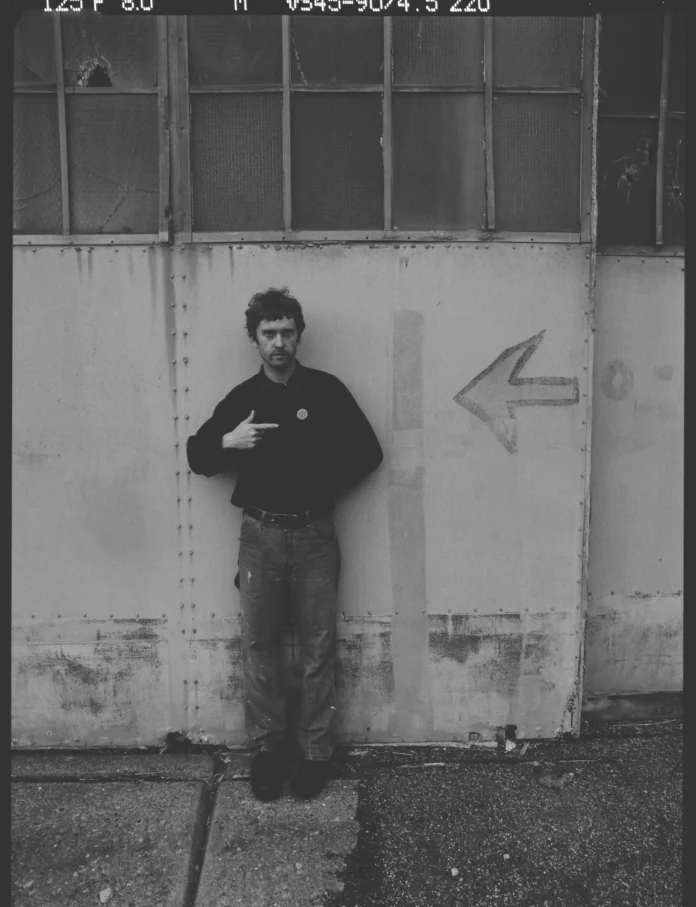
Greg Freeman is a Vermont-based singer-songwriter who grew up in Bethesda, Maryland. He released his debut album, I Looked Out, in 2022 via the Bud Tapes label, and it was reissued in 2024 by Canvasback Music, a subsidiary of Transgressive Records. The following year, Freeman broke through with a riffy and poetically incisive collection called Burnover. Barely a year later, he’s back with a new record, All Set the Bone, which took shape in New Mexico, Vermont, Los Angeles, and various tour stops before being tracked with producer John Congleton. Wrestling with a world that seems to bleaken alongside waves of personal turmoil, All Set the Bone is a document of compounding anxiety that overrides its introverted tendencies with tirelessly ambitious, complex, and anthemic songs. “The memory of last year’s loss/ Gets pulled far away from us/ Like-waves-sucked-out-to-the-sea-and-thrust/ Into the perfect tsunami,” he sings on the breathless ‘Hail Mary’, not interested in taming the tides so much as feeling them.
We caught up with Greg Freeman for this edition of our Artist Spotlight interview series to talk about the making of All Set the Bone, pursuing music full-time, recording with John Congleton, and more.
I read that Burnover was barely finished when you started writing All Set the Bone. How would you describe the bleed-through the two records in terms of timeline?
I had kind of been done with that last record for a while before it came out. There was this long, drawn-out mixing process that I went through with that album. I was done with it by the time it was almost ready to be released, and we were re-releasing my first album, so I had to do a bunch of work for that. It felt like I was doing a lot of work on stuff that didn’t connect to in the same way, a lot of old stuff all at the same time. I really felt like I needed to write some new songs to feel good again about playing music. I didn’t really put any expectation on what these new songs would be, but maybe half the record came to me at that point in time. I think I wrote it all pretty quickly – it was written and recorded within one year, which is kind of crazy. It was gonna be an hour and 15 minutes, but we cut two songs.
When you say half of it, do you mean half the songs, or most of the songs halfway done? When did the rest come together writing-wise?
I mean half of the songs. I was living in New Mexico at the time, and I wrote maybe six songs there, and the other half I wrote in Vermont, mostly. I did a bunch of touring in the spring of 2025, and then I moved to this new house that was in the middle of nowhere, in northern Vermont, near the Canadian border. It’s this big old farmhouse, and I was kind of alone there for most of the time, because my roommate was at work. So I had a lot of time to write there, and I wrote a lot of songs in just a couple weeks there.
I’m curious if the solitude in that specific place affected how you wrote. I’m thinking of that line in ‘Loser’s Prize’, “When I’m alone, I can be anyone, but when I’m with you I’m me,” in the sense of how that aloneness might afford you the freedom to write from different perspectives.
For a long time, I was under the impression that I wrote slowly and gradually, and I think a lot of people are under that impression because of how little time they have to work on their art. But then I finally got the opportunity to not have anything else to do except write songs, and just go fuck off to the middle of nowhere, and I had this realization that I actually could be more productive if I don’t have to work a fucking job all the time that wasn’t music. So that was one part of it, but I can see how it would relate to that line. It’s funny, that’s a line that just popped into my head, I think I was thinking about some relationship. But I think that same principle maybe does apply to the creative world. If you’ve been in a small town too long, everyone just knows you as you. It can be hard to reinvent yourself or think about yourself in any other way. Obviously it’s a two-sided expression, it can be good or bad. But I think for me, being able to leave the Northeast and go work on music somewhere so far away was a good thing for me. It allowed me to break out of whatever mental traps I was in.
Does that come up as a need in the moment – where you need to write – or is it mostly now as you’re talking about it that you’re making these connections?
No, I think about it a lot. I feel like my last record was all me trying to figure out how where I lived affected me, and just my general experiences there. This record feels more transient in nature, in terms of where it’s rooted, which I guess reflects my life at the time. But I think it’s important to contextualize yourself in songs. Whether or not you say it in the song is another thing, but at least have some understanding of your own perspective as the singer, so I usually try and apply that to my songs in some way, I think subconsciously.
Between working on a lot of older material and working on this new batch of songs, was there ever a point where you felt like you needed a break? Or was it all spilling out at a pace that was beyond your control?
I don’t think I really wanted a break, because I just didn’t have any other job at the time; I was coasting off this record deal and a couple of tours. Every time you write a song, you get a little bit of momentum, and then at a certain point, you feel like, “Maybe this could be a whole record.” I felt a lot of momentum writing them, and I wanted to keep that theme consistent with the whole process of recording them, practicing them, recording them, and releasing them. I felt like that was an energy that was, for whatever reason, important. Some immediacy was important, if only for my own sake.
With the focus being solely on music and making a living off it, I wonder if that momentum translated as pressure, however self-imposed.
I don’t know. Maybe my last record, I felt way more pressure, because it had been a couple years and I hadn’t put anything out. I also feel like I made that album kind of not intentionally inaccessible. But at the same time of there being a lot of pressure, I kinda got sick of all the pressure and people talking about me and talking about it. I felt the need to make something kind of weird, something that maybe not everyone would like, or something that was different from the first record. This one, I feel like I had way less pressure. I think the longer you have to think about things, the more pressure you put on yourself.
The only pressure I felt was maybe writing about the world around me. I would never say political, but socially aware – there’s certain songs that are dealing with what’s going on in the world, and I felt like it can always be weird writing about a certain social climate, because it’s obviously changing every day. You start imagining putting something out at a certain point in time when people don’t remember this thing or that thing. Not that I was necessarily writing about specific events, but I guess there was a certain pressure of releasing this album into the same world in which I wrote it.
With the passage of time, I guess these anxieties have only affirmed themselves, just by the fact of the world around them not really changing.
At one point, it can seem like you’re frustrated about something that everyone else doesn’t understand, and then suddenly everyone understands and has the same frustrations. And then something could become cliche or overstated. But I feel like I tried to be nuanced enough in some of those songs; at least from song to song, I tried out a lot of different ways of expressing frustration with the world. Hopefully, it’s not two-dimensional.
Was there a specific frustration you felt like the world hadn’t caught up with in some way when you were processing it?
Oh, man. A lot of ICE stuff here in the States was going on, and I lived in – Vermont is a border state, technically, there’s Border Patrol everywhere. There was a lot of that going on in and around where I lived, and there were a lot of protests about that. Obviously, genocide in Gaza was just something you would see every day on your phone. At a certain point, it seemed like it would be more intentional for me to ignore these things that are going on in the world in terms of their influence on my music, topically. It would take more energy to ignore them than to allow them to come through my music or allow how I felt about them to come through my music. It can be really hard to, not even write about those types of things, but allow them into your music. It’s like, how do you write about them while being productive, or how do you write about your feelings about them without being corny or cheesy?
There’s a part of the record that’s shaped by being away from Vermont, or generally in less familiar places. Could you talk about the few weeks you spent in the California desert rehearsing before going into recording?
I was kind of skeptical about doing the record in LA, because it was so far away from everyone, but I thought it would be cool to be in a very new location. But we just got an Airbnb for a week outside the city, and it was cool to just be focused on one thing, you know? All we had to do was just practice every day there, and it was really fun. It was a really fun, good time for all of us. We’d watch movies at night and rehearse during the day, and it felt like a continuation of – I wrote a lot of that record in the desert, in the Southwest, and then we rehearsed it there also, which I thought was nice. A lot of my other music is so tied to where I wrote it and a lot of that is in the cold of New England, in the snow, and with this record, I wanted to imagine that different environment when in the process of making it. You might not necessarily hear that on the record, but I have a different relationship to it in that way.
In rehearsing the songs, do you feel they changed shape as a result of that shift in setting?
A little bit. A few things changed shape. Some people come to the rehearsals with half a song written, and I’m not really like that. I feel like I have to write the whole song. I kind of overcompensate for writing stuff alone by fleshing things out maybe more than I need to.
I’m thinking of some moments that maybe sound improvised, or like they may have come up in that context, specifically the space you create around the beginnings and endings of ‘Hail Mary’ and ‘Untitled 10’. But maybe they were written into the tracks.
I knew that there was a lot of heavy subject matter on the album, or intense songs, so I wanted to balance it out with quiet instrumental parts. I knew that I wanted a couple on the album. The drummer who played on it, my friend Joey [Sullivan] – he’s a jazz guy, mostly, but he plays rock music a lot also. I had a sense of how the band would play, and I knew that I wanted a couple quiet parts, so they were kind of factored in, but I let everyone do what they wanted to do.
When I think about the record, I often think of that line, “I want to feel like a drummer, felt but not shown.” That seems to encapsulate the record’s emotional attitude in some way.
Yeah, true. It’s funny, there’s a part in ‘Curtain’ on my last album that talks about the drummer. Whenever I play those live, I’m kind of brought back into myself, because I’m referencing the band. It’s always a funny moment.
You mentioned being skeptical about recording in LA. Was there a moment where it felt worth the risk to go about it this way, working with John Congleton?
I definitely had those doubts. I feel like I go off my instinct a lot, so I’ll make a decision that I can’t really justify, and then I doubt it. I doubt it after I make it, but then it’s fine.
What’s the line [from ‘Totaled’]? “Life hits quicker than doubt”?
Yeah, true! So I talked to John on the phone, and I knew that I didn’t need anyone to do anything crazy to the record, really, because the songs were so fleshed out, and the band was so good. John is such a pro and artist-first, so I didn’t really have any doubts, but I had a lot of time to think, because I drove from Vermont to LA with all our gear. There were definitely moments where I was like, “Why are we going so far away?”
How long is that drive?
It’s like a four-day drive. It’s one of the furthest drives you could do in the country.
What do you remember thinking about?
I guess I thought about the album some. Man, I haven’t thought about that drive in a while. I’m pretty good at driving alone a long way, so I was just excited, I think, and my van ended up breaking down, like, day 2 of the drive. The transmission died, so it was completely a bust, so I had to get a rental minivan for three weeks. I spent all my money on fixing my van and getting that rental van, which sucked, but I think it was a good adventure. The last two records I made in the comfort of the place where I lived, and I wanted this one to just feel different.
Do you tend to listen to records on long drives? Do you turn on the radio?
I kind of tap after a while of music – and of everything, really. But I listened to so much MF DOOM. That was the most notable theme of my drive, listening to older hip-hop.
We were talking about momentum, and my experience with the record is that it’s built on these high-tension, high-energy songs, at least up until ‘Marooned’. And that’s kind of an emotional breaking point, where you sing about the child in you that’s scared to feel too much. I feel like it carries a lot of weight, but I’m curious what that song unlocked for you about the record.
I really love that song, I think it was probably the last one that I wrote before we recorded it. I wrote ‘Next to Nothing’ and that one on the same day, pretty much. ‘Marooned’ was one that was way less fleshed out than the other ones when we recorded it. We really had no idea what it would be like, but I really love how it turned out. I do think it holds a special place on the album, but I don’t exactly know what that is. Maybe it’s just the long slow burn, but it also feels like a complicated song. It also opens the door to the last couple songs on the album, which, definitely, if you compare it to the first side of the album, is very different.
Were those last few songs also written towards the end?
Yeah, except for ‘Untitled 10’, which was actually the first song I wrote for the album. But the last couple were all written way towards the end. I already had 13 songs written by the time I was writing those, so I just kept writing songs, and they felt like bonus songs. I didn’t feel like I needed them to be anything, so I think there wasn’t the same urgency and importance that I put on ‘Marooned’ or ‘Next to Nothing’. Which allowed them to be a little weirder structurally, and even lyrically, they feel kind of abstract to me.
Was there a point where you started becoming not just conscious of the runtime of the record, but intentional about it in terms of the structure and impact it would have?
Once I realized that it was gonna be a double record no matter what, I kind of stopped thinking about it. We had all 15 songs on the record for a while, and then I finally came around to the idea of cutting two, because I would try and listen to the whole thing, and it was just so hard. It would take up so much time. I think maybe the sixth time I listened to the whole record, I was like, “Okay, maybe it could be a little shorter,” but I didn’t want to cut too much more. I think I could have maybe cut one song, but even then it would be an hour, which is still long. I felt like the album is sprawling thematically, and it doesn’t have any tidy answers, really, so I wasn’t really worried about having it in a neat package.
This interview has been edited and condensed for clarity and length.
Greg Freeman’s All Set the Bone is out now via Transgressive/Canvasback.

