

Anushka Jajodia’s story starts with color. She grew up noticing heaps of yellow-gold marigolds at Dadar market,Ganpati pandals going up in every neighborhood, the grey-green sea at Marine Drive, the bright sarees of women. As a designer, illustrator, and facilitator based in Baltimore, Maryland, Jajodia is never at a loss for color. She can walk down a Baltimore street and enjoy its murals on the sides of rowhomes and corner stores and in the plants at the Rawlings Conservatory, from desert cacti to tropical palms. But Mumbai was her starting point. It was where she first learned to see the world as something worth looking at closely.
“Mumbai gave me my first palette,” she recalls. “I was creatively inclined, and my family encouraged it wholeheartedly. I also loved being around people and bringing them joy. Design was where those two loves met.”
Learning to design
Jajodia studied visual communication design at Ecole Intuit Lab in Mumbai, graduating in 2015. During an internship at NH1 Design, an Indian branding and design consultancy, she made a series of colorful cultural windows inspired by cities; from dusty-pink sandstone and indigo walls to red brick with yellow sunburnt arches.
She later spent three years as a lead visual designer at Mentor Together, India’s leading mentoring organization. There she designed websites, apps, curriculum toolkits, and outreach materials for young people in rural Maharashtra and Karnataka, often in Marathi and Kannada. For these projects, she visited villages in Karnataka to understand mentees’ homes, routines, and the reality that many joined mentoring calls on their parents’ phones.
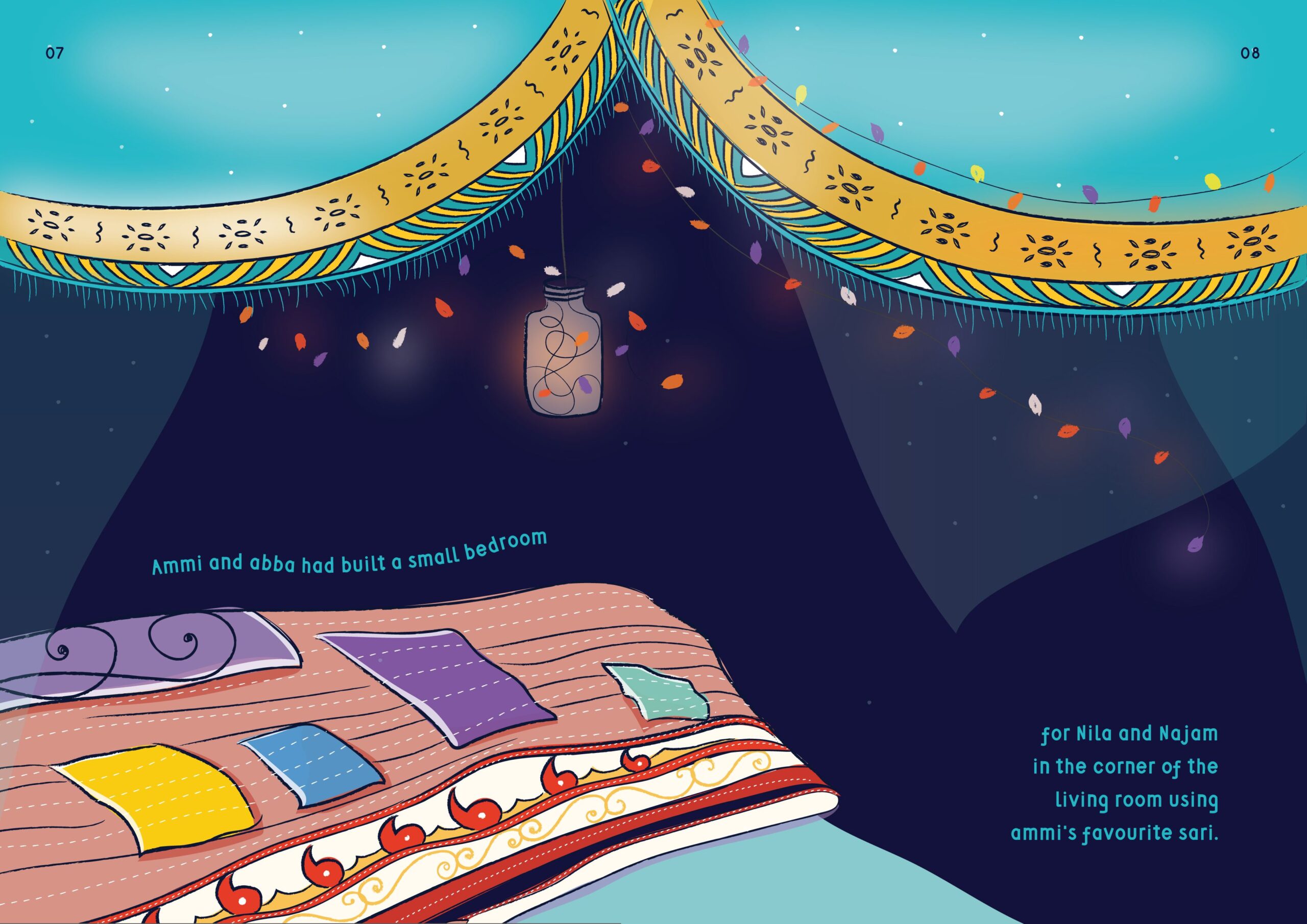
She also did nonprofit illustration work. The Akshara Centre’s annual report was filled with colorful birds and trees. She illustrated Nila and Najam, a picture book about twins who dream beyond gender stereotypes, for The Irrelevant Project.
Yet during these projects, Jajodia encountered a pattern that troubled her. “I kept noticing that the people we designed for were rarely in the room,” she says. “I followed that question all the way to Baltimore and into social design.”
Design inside healthcare
And so the girl who grew up in Mumbai found herself at the Maryland Institute College of Art in Baltimore. She graduated in 2019 with an MA in Social Design and received the school’s Fred Lazarus Leadership for Social Change Award. Through MICA’s Center for Social Design and a collaboration with Johns Hopkins, she became one of the first designers embedded in health research teams.
Since 2022, Jajodia has worked as a designer at the Johns Hopkins School of Nursing. Her work includes design leadership across many different research teams. She has also co-designed an exhibition for Opening Doors to Home Accessibility, turning research into something visitors could walk through and experience.
“At its core, my role is translational,” she says, “turning dense research, complex emotional realities, and layered human experiences into visual narratives and cohesive systems that feel clear, human, and alive.”
Listening before making
Jajodia always begins a project by paying attention. Before she draws any flower, chooses any palette, or sketches a person on a neighborhood front stoop, she asks who the work is for, what they need, and what their days look, sound, and feel like.
The making of any project is playful and unfinished at first: her mind maps things, sketches them out, she fills her ears with music and daydreams. In this way, the best ideas arrive. This is informed by early feedback, and refined. Her illustrations are often penciled at first. Then it becomes vector work in Adobe Illustrator. For softer textures, she draws on her iPad in Procreate or Adobe Fresco.
Color remains her sacred instinct. Orange is her “forever favorite,” with warm pinks and purples close behind. Yet every palette bends toward its audience: calm blue-greens and soft purples for PLAN; colors that speak to both neighbors and funders for Neighborhood Nursing. Nature softens difficult subjects and makes room for recognition.
“A flower in the corner of a page doesn’t make serious work less serious,” she says. “It makes it human.”
One practice, many forms
For Jajodia, design, illustration, music, and portraiture go hand in hand.
She plays tabla and percussion, which teaches her rhythm and nourishes her soul. She took part in a reading of “Bonbibi and Dakshin Ray,” a play rooted in Bengali folklore from the Sundarbans, presented by Vital Matters in Baltimore as part of Climate Change Theatre Action. Jajobia makes colorful, nature-filled portraits for pleasure.
In Baltimore, that impulse has become communal. She organized a monthly creative series with artists, healers, and visionaries, built around music, healing, storytelling, belonging, and play.
What’s next?
Jajodia wants to build work where color, care, and community meet, but she wants to make it bigger, bolder and more alive. She hopes to create more exhibitions, installations, and immersive experiences that invite people into research and social issues.
A mural is high on her list of goals: she envisions a large, colorful public artwork, full of people and nature, that a neighborhood can live alongside. She also wants to bring hand-drawn, nature-filled illustrations into clinical spaces, so people encounter warmth where they expect paperwork. She loves to travel, and some places have moved her deeply, from Rajasthan’s dunes, and New Mexico’s desert, to Barcelona’s vibe.
Above all she is inspired by the natural world. “We are all nature,” she says. It is the idea Jajodia returns to again and again. Her home is full of roots, branches, trees, birds, mountains, wind, and sky.
“I’ve even learned to make my own paper, pressing turmeric and flowers into it,” she says. “Remembering that we are part of nature keeps my work grounded, playful and alive.”

