

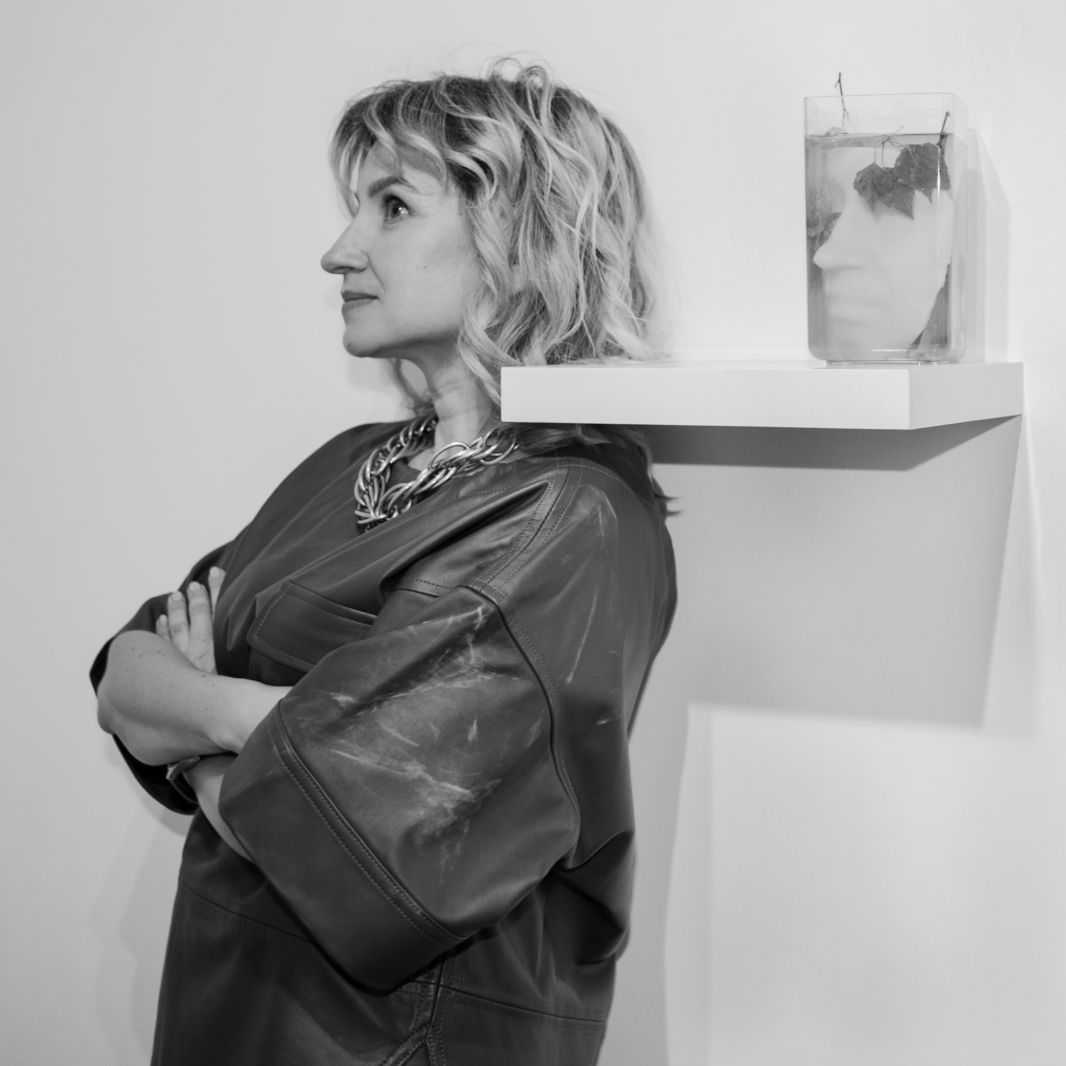
Maria Gvardeitseva is a Belarusian-born visual artist based in Riga. For sixteen years, she worked in communications. Today she has totally changed her career direction and has become a full-time artist who makes installations about memory, loss, identity and the female body. Her artworks are being presented in museums across the region.
As a teenager, Gvardeitseva created and exhibited art, working primarily with a digital format. At seventeen, she decided to build a career in communications, and art slipped into the background for quite a long time. As she mentions, it came back at the 2019 Venice Biennale.
“I had this overwhelming feeling of being at home – of entering a world whose language I understood instinctively. It made me question why I was spending my life doing anything other than art.”
One artwork in particular stopped her: Shilpa Gupta’s installation For, In Your Tongue, I Cannot Fit, a room of suspended microphones reciting poetry. She recalls that she did not want to leave. “I remember thinking very clearly: this is what I want to do,” she says.
Within a few months Maria had her first exhibition. About a year and a half later, she left her previous career to focus on art. Ever since the installation has stayed at the centre of her practice.
What she left behind, and what she kept
The change came at a price. “A regular income. That is definitely what I left behind – and probably what I miss most about my previous professional life,” she admits. But the corporate years also gave her something many artists often struggle with: discipline, planning and the ability to run complex productions involving budgets, logistics and institutions.
“I think sixteen years in business trained me to turn an idea into something that actually gets produced.”
Language came with her too. Gvardeitseva writes constantly, in notes, diaries and texts, and words often become part of her installations.
Research first, medium later
What is interesting about Maria is the fact that she never starts with a medium. She starts with a subject and stays inside it for a long time. Bitter Herbs grew out of her research into Holocaust memory in Belarus and the Baltic region. She was researching how landscapes of mass killings had physically healed into forests and fields. Within this approach, she collected plants from these sites for botanical atlases and filmed them from above with drones. Later she added latex printed with the texture of skin, human hair and photography – which is turning the project not only artistic, but also in historic and anthropological research.
“Images start appearing in my mind and can become incredibly persistent – they almost terrorise me until I understand what they need to become.”
Persistence as a method
Gvardeitseva rarely creates projects to fit artistic open calls. She develops an artwork independently and then looks for institutions where it belongs. For Bitter Herbs’ presentation, she was looking for museums working with memory and Holocaust remembrance, made a spreadsheet and contacted them one by one. The project received 77 rejections before it was eventually shown in four museums. However, “I’m quite comfortable with rejection,” she says.
Venice also brought a setback. Gvardeitseva was a finalist for the Belarusian Pavilion at the 59th Biennale, but her candidacy was withdrawn because of her political views. Supported by the Mark Rothko Art Centre in Daugavpils, Latvia, she got the opportunity to create the initially proposed installation, DRYGVA, independently, which, as a result, drew international press coverage.
“There is that saying that it takes about five years to become an overnight success. In the art world, my suspicion is that it’s closer to fifteen. The trick, I suppose, is to survive those fifteen years without becoming a dead artist – although, from the market’s point of view, limited inventory does have its advantages.”
A vocabulary that developed with her
Memory, loss and identity have been present in her artworks since the beginning of the career. The body, intimacy and ritual appeared in the artistic practice later. “I think I needed a certain degree of inner freedom before I could speak openly about bodily experience, intimacy and sexuality,” she highlights. In her recent work, religion and ritual increasingly frame questions of suffering, desire and transformation.
What’s next
On 5 November, Gvardeitseva is opening La Petite Mort at CUT ART Gallery in Riga. The show’s narrative is developed around her artist’s book 5-Minute Bedtime Stories, published by Skira in 2025, and explores divorce through the lens of the mythology of her own making.
“I’m creating rituals for separation: rituals that, unlike those surrounding marriage, barely exist in our culture.”
In 2027, Maria is already planning to create two research projects. First – Man’s Cookbook that is focused on the theme of contemporary dating through the language of recipes and medical prescriptions. A second project questioning why Western traditions have commemorated some forms of suffering so richly while childbirth and maternal pain still remain largely invisible.
She will also have a solo exhibition at INDUSTRA ART, where she will create an eight-to-ten-metre version of The Prayer Braid, a sculpture first made for Ex Contactu. It will become her first work on a monumental scale.

