Home Blog Page 1073

Review: The Lower Depths (1957)

“I’d always wanted to make Gorky’s play into […] a really easy and entertaining movie. After all The Lower Depths isn’t all gloomy. It is very funny and I remember laughing over it. That is because we are shown people who really want to live and we are them—I think—humorously.”

Akira Kurosawa1

In 1957—the same year he transposed William Shakespeare’s Macbeth to feudal Japan as Throne of Blood—legendary director Akira Kurosawa set his sights on making another film adapted from foreign theater. Of little surprise given his admiration for Russian literature and its influence on his career (e.g., a movie version of Fyodor Dostoevsky’s The Idiot), he turned to Maxim Gorky’s sardonically funny The Lower Depths, about the deceitful lives of slum residents. First performed in 1902, Gorky’s play swiftly caught overseas attention, premiering in Japan in 1910;2  and while Kurosawa’s literary interests certainly factored into his choosing such material, he also knew of—and had even lived through—parallels in Japanese history.

In adapting The Lower Depths, the director and frequent writing collaborator Hideo Oguni changed the setting from Imperial Russia to Edo-era Japan, when “thousands were living almost unendurable lives. Their resentment we can still feel in the [satirical poems and entertainments] of the time.”3 Many Japanese in the 1950s had similarly lived through economic slumps (during the Great Depression, the Pacific War, the American Occupation), some still dwelling in neighborhoods wracked with poverty. Kurosawa’s memoir Something Like an Autobiography documents visits to the Tokyo neighborhood Kagurazaka, where his older brother Heigo lived “like some unemployed samurai” and whose residents were—not unlike the characters in The Lower Depths—“downright humorous. Even the small children made wisecracks.”4 Gorky’s play also acclimated to Kurosawa’s fascination with dishonesty, which he’d famously explored in 1950’s Rashomon. Filming this particular story allowed him to once again tackle how people manipulate/fabricate reality—this time with a vicious sense of humor.

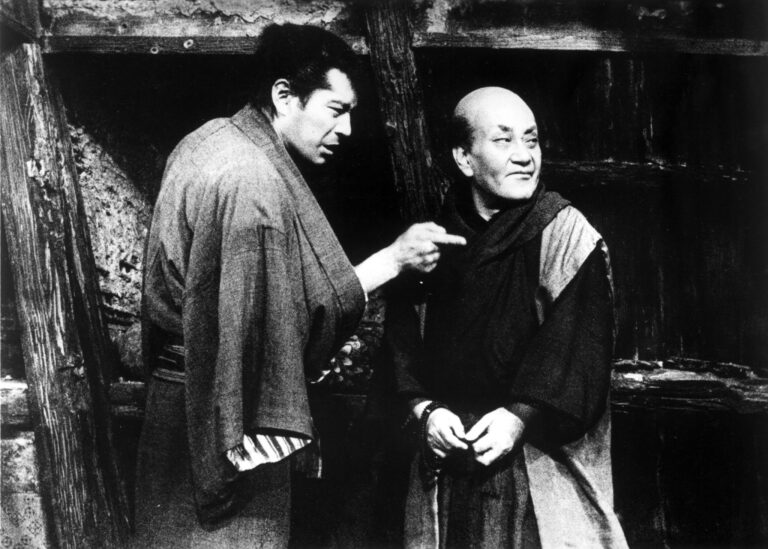
The Lower Depths retains Gorky’s basic four-scene structure, taking place in a flophouse run by a greedy landlord (Ganjiro Nakamura) and his scheming wife (Isuzu Yamada); the latter sleeps with one of the tenants, a thief played by Toshiro Mifune, who in turn has designs on his mistress’s kinder sister (Kyoko Kagawa). Meanwhile, the other tenants—a gambler (Koji Mitsui), a samurai (Minoru Chiaki), a prostitute (Akemi Negishi), a washed-up actor (Kamatari Fujiwara), a tinker (Eijiro Tono) with an ailing wife (Eiko Miyoshi), etc.—go about their penurious lives, constantly squabbling and catching one another in fibs. (An opening gag consists of one resident boasting she’ll never be a housewife, unaware everyone knows she’s marrying an officer to escape poverty.) Into their existence comes the film’s Luka equivalent: a drifter (Bokuzen Hidari) with a perpetually positive, life-affirming attitude. Nearly everyone in the slum’s drawn to this man’s encouraging words, which ultimately derive from his own lies and benefit no one. The stranger proves cowardly, fleeing during a third-act scuffle wherein the landlord (the first to figure out the drifter’s less-than-saintly being) is killed. By drama’s end, the flophouse has lost additional residents, and those who remain carry on as they had before: wry and pessimistic, still spinning tales about themselves.

The Lower Depths represents its theatrical origins, in some ways, more so than Throne of Blood. Although the latter was charged with exaggerated Noh-style acting and music, it featured a lavish presentation: huge castle sets, location photography, special effects (e.g., a “moving forest” shot by Eiji Tsuburaya’s crew), and a climax wherein the film’s Macbeth equivalent is brutally assassinated by archers. By contrast, The Lower Depths is smaller and more confined. The four (substantially lengthed) sequences remain largely inside the flophouse, occasionally spilling into the outside yard; characters loaf, complain, hurl insults, and unknowingly reveal their own vices. The prostitute sobs over a noble lover she claims to have given up, her tale falling apart when the samurai notices the supposed man’s name changing mid-story. She later exposes her fellow tenant as an imposter. “I’ll beat you to death!” the samurai barks. Her reply: “If you really were a samurai, you’d say, ‘I’ll cut you down.’” In each instance, the surrounding characters roar with laughter at their companions’ feeble embellishments.

Kurosawa shoots these interactions often with multiple cameras, maintaining the atmosphere of a photographed play while still imposing a cinematic flair. The yard confrontations are particularly immersive: the players scamper about while their director calculates—sometimes in split-seconds—where the next shot needs to be; in other instances, Kurosawa resorts to stationary setups and creates momentum via dynamic changes in blocking. Throughout, the actors constantly interact with their ramshackle set (slamming doors, throwing themselves under sheets, leaning against angular beams), treating it like a participant in the drama. According to actress Isuzu Yamada, Kurosawa required sixty days of rehearsal on this project before shooting began5—plainly evident in the meticulous coordination on screen.

The entire cast delivers larger-than-life performances suitably emphasizing the characters’ energy, wit, and willingness to pounce on one another. Standouts include Isuzu Yamada as the landlady; Bokuzen Hidari as the seemingly noble drifter; and Kamatari Fujiwara as the washed-up actor. Mifune, of course, contributes his usual commanding presence, and in doing so creates a character unlike what his director intended. “I wanted [him] to play his part in the style of Nezumi-kozo [a fictional romantic robber akin to Robin Hood],” recalled Kurosawa, “but that didn’t work. Mifune is simply too well-built, he has too much presence. He can’t help but bring his own dignity to his roles.”6 Most impressive, however, is Koji Mitsui as the sardonic gambler, who claims one of the best closing shots in cinema history. The Lower Depths retains Gorky’s ending wherein one tenant wanders outside just before the residents engage in a frolicsome dance—a scene which itself took twenty days to rehearse;7 the samurai barges in, announcing the man hung himself. Kurosawa never shows the body, merely the reactions, finally cutting to a close-up of Mitsui, whose shocked expression gradually drains into an annoyed smirk. “It was such a great party. Then he had to go and ruin it. Bastard!”

Shot over four weeks, The Lower Depths enjoyed a September 1, 1957 test screening before going into roadshow release sixteen days later, attaining wide distribution at month’s end.8 Kurosawa by that time was in Europe, oblivious that, back home, the picture was receiving mixed to negative reviews. Film historian Donald Richie recalled Japanese critics not sharing the director’s amusement with the material and lashing at his “negative” attitude.9 A criticism shared by Shinobu Hashimoto, another frequent Kurosawa writing partner, who’d abstained from the project due to a neck injury and confessed in the memoir Compound Cinematics: Akira Kurosawa and I to being turned off by the “dark, gloomy feel.”10

The picture did receive some accolades. For his performance, Mitsui took home the Tokyo Blue Ribbon Prize11 while Mifune won the Mainichi Best Actor Award12 and Yamada was named Best Actress by Kinema Junpo magazine (who likewise chose The Lower Depths as Japan’s tenth best picture of 1957).13 In spite of these honors, however, Kurosawa’s Gorky adaptation became—and to an extent remains—a somewhat overlooked entry in the director’s oeuvre. While not as grandiose as Seven Samurai (1954) or as stylish as Throne of Blood—or as memorable in its tackling man’s relation with the truth as Rashomon—this film version of The Lower Depths is every bit as funny as it is morose, viscerally bleak and simultaneously amusing. “The Lower Depths is a very funny play,” wrote Donald Richie, “and the film is a very funny film. If life is not something to cry over, then it must become something to laugh about.”14


Bibliography:

  1. Richie, Donald. The Films of Akira Kurosawa (Third Edition, Expanded and Updated). Berkeley: University of California Press, 1996, p. 125
  2. McDonald, Keiko and Thomas Rimer. “Akira Kurosawa’s The Lower Depths.” Criterion DVD Booklet, 2004
  3. Richie, p. 125
  4. Kurosawa Akira. Something Like an Autobiography. New York: Vintage Books, 1983, pp. 81-3
  5. Yoshimoto Mitsuhiro. Kurosawa: Film Studies and Japanese Cinema. Durham: Duke University Press, 2000, p. 270
  6. Richie, p. 133
  7. Akira Kurosawa: It Is Wonderful to Create. “The Lower Depths.” Kurosawa Production Co., 2002
  8. Galbraith, Stuart, IV. The Emperor and the Wolf: The Lives and Films of Akira Kurosawa and Toshiro Mifune. New York: Faber & Faber, 2002, p. 240
  9. Richie, p. 133
  • Hashimoto Shinobu. Translated by Lori Hitchcock Morimoto. Compound Cinematics: Akira Kurosawa and I. New York: Vertical, Inc., 2015, p. 161
  • Galbraith, p. 240
  • Conrad, David A. Akira Kurosawa and Modern Japan. Jefferson: McFarland & Company, 2022, p. 127
  • Galbraith, p. 245
  • Richie, p. 133

Hannah Georgas Unveils New Single ‘Fake Happy’

Hannah Georgas has released a new single, ‘Fake Happy’, taken from her upcoming album I’d Be Lying If I Said I Didn’t Care. It follows previous cuts ‘Beautiful View’ and ‘This Too Shall Pass’. Check it out below.

“It was inspired by a relationship that drifted,” Georgas said of ‘Fake Happy’ in a statement. “Over the years we had grown apart and trying to maintain a connection had begun to feel awkward and forced. I think sometimes we cling on to what’s left of friendships even if our values no longer align and we’ve changed as people. The space the pandemic afforded for reflection made me realise that I don’t need to do that and should focus my energy on the people who support me and are positive sources in my life.”

“The song is ultimately about how much better I think we’d all be if we just communicated exactly what we were feeling or what we were going through,” she added.

I’d Be Lying If I Said I Didn’t Care arrives August 25 via Real Kind Records.

Tkay Maidza Teams Up With Flume on New Single ‘Silent Assassin’

Tkay Maidza has shared a new single, ‘Silent Assassin’, which was produced by Flume. The track comes with an accompanying video directed by Milo Lee. Check it out below.

“I like to move in silence, but this song is a reminder that people shouldn’t count me out or underestimate my abilities; they should be afraid when I’m quiet as I come back more evolved,” Maidza said in a statement. “I’ve always wanted to work with Flume and was immediately ecstatic when he played the instrumental for this; I wanted to channel Busta Rhymes and Missy Elliot.”

Last year, Maidza released the single ‘Nights In December’. The final installment of her Last Year Was Weird trilogy came out in 2021 and landed on our best EPs of the year list.

From Hand to Hand: Effective Business Card Distribution Tactics

The tangible nature of business cards offers a unique and personal touch to networking. However, designing and printing a business card is only the first step. How you distribute them can significantly influence their effectiveness in growing your network and promoting your business. For additional inspiration on how personalized print materials can reinforce your brand, view direct mail letter examples here. This article delves into the tactics for effective card distribution, from networking events and strategic placements to digital channels and follow-ups

Networking Events: Maximizing Opportunities for Exchange

Networking events, be they industry-specific conferences, seminars, or casual meetups, provide ideal opportunities for printing a business card and passing it along. Being among professionals in your field or potential clients, these events offer a platform to engage in meaningful discussions, following which a card exchange seems natural and contextually appropriate.

The key here is subtlety and appropriateness. Don’t just distribute cards indiscriminately; instead, engage in a conversation first, and if there seems to be mutual interest, offer your card as a means to continue the dialogue later.

Strategic Placement: Ensuring Visibility in Targeted Locations

Strategic placement of business cards is an old but effective tactic, especially for local businesses. Restaurants, cafes, libraries, community centers, and any place your target customers frequent are prime locations. Leave them by the cash register or any other high-visibility area. Many local businesses support this kind of cross-promotion.

It’s crucial to maintain a professional image when using this method. Ensure your cards are neat, organized, and regularly replenished. To ensure your business cards look professional, consider using business card templates for easy and efficient design creation. A well-organized and sleek design is crucial, as a messy pile can give the wrong impression about your business.

Collaborative Exchanges: Partnering with Complementary Businesses

Collaborating with complementary businesses is a win-win tactic. For instance, a wedding photographer might leave their cards at a local florist, or a graphic designer could place their cards at a local printer’s store. This method not only broadens your potential audience but also adds value to the partnering business, enhancing the customer’s overall experience.

Remember, though, that the first impression is essential, and your card ideas should reflect the quality you bring to your work. Reliable services like 4OVER4 provide a comprehensive business card maker tool that ensures a professional and impressive result. Business cards 4OVER4 are quality and suitable for various use cases and industries. 

Direct Mail Campaigns: Reaching a Wider Audience

Direct mail might seem like an old-fashioned approach in the digital era, but its effectiveness cannot be underestimated. It allows you to reach a targeted audience with a personal touch. Enclosing your business card with a direct mail piece such as a letter, flyer, or brochure provides the recipient with a tangible reminder of your business, potentially leading to future engagement. Business owners are often looking into a guide to mail delivery times so they could better plan campaigns around seasonal demand or product launches. This foresight helps align outreach efforts with customer expectations and improves the chances of timely responses.

Digital Channels: Sharing Business Cards Online and via Email

In today’s connected world, extending your card distribution to digital channels is a must. Embed a digital version of your card in your email signature, or share it on professional networking platforms like LinkedIn. While it might not replace the impact of a physical card, a digital business card ensures your professional details are accessible wherever and whenever needed.

Following Up: Leveraging Business Cards for Continued Engagement

Distributing your card is not the end of the journey. Following up with those who’ve received your cards—perhaps with a personalized email or a phone call—is crucial to establishing lasting professional relationships. This ongoing communication can lead to fruitful collaborations, new clients, or valuable partnerships.

In conclusion

While business card ideas are plentiful, their effectiveness largely depends on the distribution tactics employed. Networking events, strategic placements, collaborative exchanges, direct mail campaigns, and digital channels all provide viable avenues for ensuring your card lands in the right hands. Remember, the goal is not just to distribute as many cards as possible but to create meaningful connections that promote your business in the long run.

Remember to leverage the services of a professional business card maker like 4OVER4. Not only do they offer a wide array of customization options for printing a business card, but they also ensure high-quality finishes that reflect your brand’s professionalism.

Engage with us and share your experiences or thoughts on business card distribution tactics. How have you used business cards to enhance your networking and grow your business? Let us know in the comments below!

Bethany Cosentino Shares New Single ‘For a Moment’

Bethany Cosentino has released ‘For a Moment’, the latest single from the Best Coast singer’s upcoming debut solo album, Natural Disaster. The track was co-written by Madi Diaz, Kate York, and Sarah Buxton, who also provide backing vocals. Check it out below.

“The idea for ‘For A Moment’ came to me one morning on a writing trip to Nashville,” Cosentino explained in a statement. “After waking up to the tragic news of an acquaintance‘s partners’ sudden death. I was laying in bed thinking about how quickly it can all be gone, and how important it is to lean into love and vulnerability while we’re here. As the world changes, moments of joy mean more now than ever before, even if they only last for a moment. I brought the idea to Kate York, Madi Diaz and Sarah Buxton, and the magic of collaboration and songwriting just flowed. I knew I wanted this to be a beautifully lush song filled with mandolin, pedal steel and huge harmonies. It’s also a song that really allowed me to play with my range as a singer. No holding back on this one, literally and figuratively.”

Natural Disaster is due for release July 28 via Concord Records. It includes the previously shared singles ‘It’s Fine’ and ‘Easy’.

ANOHNI and the Johnsons Share Video for New Single ‘Why Am I Alive Now?’

ANOHNI and Johnson have shared a new single, ‘Why Am I Alive Now?’, alongside an accompanying video. It’s set to appear on the forthcoming album My Back Was A Bridge For You to Cross – out this Friday, July 7 – alongside the previously released cuts ‘Sliver of Ice’ and ‘It Must Be Change’. Check out the clip, directed by Euphoria‘s Hunter Schafer, below.

“I started listening to Anohni in high school, so it’s a huge honor to help her build a visual world for WAIAN,” Schafer commented in a press release. “This music video was an honest attempt to answer the question that WAIAN begs, Why Am I Alive Now? I wanted to focus on the idea of finding sisterhood in a world that does nothing to help – I hope the direction, choreography, and tone conveys a small piece of that journey.”

Hinako Omori Shares New Single ‘foundation’

Hinako Omori has unveiled a new single called ‘foundation’. The track follows last month’s ‘in full bloom’ and comes alongside the announcement of a headline show at London’s ICA on December 2. Listen to it below.

“‘foundation’ is a letter to ourselves on trusting our intuition and inner guidance to lead us along our unique paths,” Omori explained in a statement. “The object on the cover artwork (cyanotype printed and designed by Emi Takahashi) is a trick lock which I found at a Japanese antique store – it’s an old padlock for a kura, which is a traditional storehouse where you would keep your most valuable possessions. I thought it could be a fitting metaphor for the song, where the ‘kura’ represents our mind – and how the only things that block us from working through our stuck points are the tricks and barriers we place on ourselves, and our own inhibitions.”

Omori’s debut album, a journey…, came out last year.

Stolen Jars Release New Single ‘Smoke in the House’

Stolen Jars have dropped a new single, ‘Smoke in the House’. It’s lifted from their forthcoming LP I Won’t Let Me Down, which includes the previously released tracks ‘Reality TV’, ‘Run It Wild’, ‘Won’t Stay Gone Forever’, ‘Somewhere Else’, and ‘Adeline’. Take a listen below.

Mixed and co-produced by Hop Along’s Joe Reinhart, I Won’t Let Me Down is set for release on August 4.

London Gears Up for Korean Art London Artists Fair

A wave of contemporary South Korean artistry is set to sweep the London art scene as the inaugural Korean Art London (KAL) artists fair prepares to make its grand debut at Mall Galleries on July 6th. Initiated by respected gallerist Rok Hee Hwang, and curated by Genie Ahn, Vittoria Beltrame, and Seulki Yoo. This significant cultural event is backed by the Federation of Artistic & Cultural Organisation of Korea (FACOK). Over thirty innovative artists from South Korea will showcase their talents, creating an immersive exposition of contemporary Korean art. The KAL fair will occupy all three of Mall Galleries’ expansive spaces, enveloping 450 square metres.

Talking about the exhibition Hwang stated “Our mission is to show the world-class quality of Korean contemporary art, as well as the outstanding talents of individual Korean artists. We are here to provide a platform, leading to exhibition debut opportunities around the world.”

The art fair will run from the 6th to the 22nd of July, 2023.

List of artists: 

Painting: Na Ri Choi, Jin Hyun Nam, Lee K, Mi Ran Woo, Sang Woon Nam, Ji Young Hong, Anikoon, Won Seok Lee, Dong Jin Kim, Ha Jin Lee, Ji Yeun Hong, Jeong Min Kim, SUU, Sun Ok Lim, Chae Rim Heo, Duk Hwan Cho, Gyu Won Lee, Hyoung Pyo Hong, Kyoung Mook Park, Ellyang, J RYU, Soon Young Yang, Jun Won Lee.

Mixed media: Choong Mok Yoo, Je Won Yoon, Jin Seok Lee, MeME, So Ra Shin, Sung Hee Kim.

Sculpture: Min Chan Kim. Print: Mi Jeong Cho, Ju Eun Chung. Product Design: Jong Beom Kwak.

Calm Beaches on The Outer Banks: Perfect For A Solo Trip

Are you looking for a peaceful and relaxing solo vacation? Consider exploring the Outer Banks, NC. This charming seaside boasts a stunning stretch of sand and a welcoming atmosphere. If you plan a solo trip, July-August is the prime time for vacations. Whether you want to spend your days lounging on the beach or exploring the local shops and restaurants, there is something for everyone. 

The OBX offers a wide variety of vacation rentals that are perfect for solo travelers, including one-bedroom oceanfront condos and cozy homes. The region also offers plenty of activities for solo travelers, including hiking, fishing, kayaking, and more. 

This blog will explore the calm beaches of the Outer Banks that are perfect for a solo trip. 

1. Hatteras Island

This island offers a breathtaking stretch of barrier island shoreline dotted with quaint villages and pristine beaches. This is your escape to a serene beach getaway! You can find many local amenities and a nostalgic small-town vibe. You can soak up the sun on the open and uncrowded beaches as you relax and unwind. That’s why Hatteras Island is a dream destination for all minimalists, introverts, and people who love serene locations! 

2. Kitty Hawk

Kitty Hawk has a surreal coastal town with soft beaches, a coastal reserve, and unique attractions. This beautiful reserve offers you incredible wildlife scenery and soulful nature walks. You can also explore Kitty Hawk on rental bikes. You can visit the iconic Avalon Fishing Pier, the serene Sandy Run Park, or the charming Kitty Hawk Pier.

3. Duck 

Say goodbye to the hustle of city life for once and discover a hidden gem at Duck Beach. Duck Beach is the perfect retreat for a wallflower. It is calm, surreal, and has an aesthetic ambiance. The town and the area give you a quaint small-town vibe that will make you feel right at home. Take advantage of the exciting festivals that light up the location all year round. If you wish to enjoy Duck and Kitty Hawk in one trip, you can choose to stay in Southern Shores rentals, a midpoint for both destinations. From mouth-watering local cuisine to charming shops and live music venues, you will find something exciting each day.

4. Corolla Beaches

The Corolla Beaches are truly magical. This magnificent destination on the Outer Banks is a must-visit spot for any solo traveler. Corolla is abundant with nature, restaurants, and easy accommodation facilities. Imagine strolling along the beautiful beach and suddenly coming across a majestic sight – the rare and beautiful Corolla wild Spanish mustangs. Corolla has plenty of things to offer you. During your stay, you can also check out the stunning Art Nouveau architecture and furnishings of the Whalehead Club historic home. Make sure to add it to your must-see list!

5. Ocracoke Island

Beautiful Ocracoke Island, a barrier island on the Outer Banks, is a must-visit for calm nature lovers. The tranquil ambiance of the island is ideal for rest and rejuvenation. The beaches here are uncrowded and undeveloped. It is beautiful and appealing to nature lovers. It also has amazing restaurants that offer mouth-watering local cuisines.

Bottom Line

The beaches on the Outer Banks are perfect for your summer solo trip. Rejuvenate yourself with the calm and soothing sounds of water waves crashing against the rocks. You can find many places to eat, shop, and drink along the boardwalk, many of which specialize in seafood. You will indeed have a wonderful time on any of the above beaches.