There’s so much music coming out all the time that it’s hard to keep track. On those days when the influx of new tracks is particularly overwhelming, we sift through the noise to bring you a curated list of the most interesting new releases (the best of which will be added to our Best New Songs playlist). Below, check out our track roundup for Monday, March 16, 2026.
Death Cab for Cutie – ‘Riptides’
“‘Riptides’ is about the challenge of dealing with personal struggles as the world around us experiences tragedy and loss on an unfathomable scale,” Ben Gibbard said in a statement about Death Cab for Cutie’s new single, which leads their upcoming album, I Built You a Tower. “And how when these two elements intertwine themselves in our psyches, it feels utterly paralyzing.” It’s driving and progressively disorienting, with Gibbard singing, “I’m too tired to stop/ I can’t bring you up to speed/ There’s too many riptides in this ocean to proceed.”
Lily Seabird – ‘Demon in Me’
Lily Seabird has shared her first single of 2026, ‘Demon in Me’. It arrives on the heels of the singer-songwriter’s excellent 2025 album Trash Mountain, and it suggests that whatever Seabird has on the horizon is lusher and more exuberant, even as the new single leans on “the dark side, probably a symptom of anxiety or depression.” Seabird went on, “The beginning of the song I talk about this longing for freedom. Whether it’s freedom from the demon or letting the demon be free, I’m not really sure, but by the end the music is supposed to embody that.”
Gladie – ‘I Want That for You’
Gladie’s killer new album No Need to Be Lonely is out this Friday, and today they’ve dropped another single from it. ‘I Wnat That for You’ gives the record its title; “It’s the last song we wrote for the record and kind of encapsulates to me the whole message of No Need to Be Lonely,” Augusta Koch explained. “It came from a conversation with a beloved friend that was having a hard time. We were talking about how it’s strange and difficult to be a human sometimes. I often think about how easy it is to see the beauty and wonderful qualities in someone else but how hard it is to apply that same love to yourself. ‘I Want That for You’ is basically about encouragement and wanting everyone to stick around, even when it’s really hard, including ourselves.”
Anna Calvi – ‘Is This All There Is?’ [feat. Matt Berninger]
Ahead of the release of her new duets EP Is This All There Is? on Friday, Anna Calvi has unveiled the title track. Following collabs with Perfume Genius and Iggy Pop, she’s teamed up with the National leader Matt Berninger for an expansive ballad that’s “about the bravery it takes to hope,” in Calvi’s words. “It’s the willingness to ask questions, even when knowing you’ll never get a definitive answer…The tone of Matt’s voice has such an epic, almost ancient quality to it, which felt perfect for a song asking such a big existential question. We’re both searching for answers — together and yet somehow always apart, which I find beautiful. He brings an intimacy to the song that I couldn’t have imagined.”
Bloodworm – ‘Alone In Your Garden’
Nottingham’s Bloodworm have shared a brooding, frosty new track, ‘Alone In Your Garden’. “This song was written during Autumn over a particularly cold couple of days,” frontman George Curtis explained. “I was inspired by the very unique feeling of that time of year, the smell of the air, the falling leaves, the damp stillness that all feels so specifically English. I was trying to invoke those feelings within a song. The song was an attempt at mixing old English folk, with all its folklore and emphasis on tales, with the gothic sound that I am drawn to.”
Truthpaste – ‘Bus Song’
Truthpaste, a group of five multi-instrumentalists, have shared the mesmerizing ‘Bus Song’ via Dirty Hit/Memorials of Distinction. The band’s Esme described it as our emo rock song. It’s another side to Truthpaste that its time people heard outside our live set. We don’t stick to one thing, if it sounds good we’ll do it.” Euan added: “This song was knocking around my head for a couple of weeks, it wasn’t until we got together as a band and decided to make it a duet that it really started to feel like it has come to be.”
Paris fashion week is a strange place. For Loewe’s Fall 2026 show, Lazaro Hernandez and Jack McCollough dragged us to Château de Vincennes, once a royal playground for plotting and sword-swinging, now a gothic playground for tourist selfies and Tim Burton poses. For a collection built on playfulness and experimentation, those medieval walls couldn’t have been more misleading. Successful mismatch, if there ever was one.
“As we began conceptualizing our second collection for Loewe, we were struck by a simple truth: for us, the act of making is, at its core, an expression of joy – an intellectual, process driven pursuit charged with playfulness. The path taken matters as much as the end result… Humor, levity, and a bright, inclusive spirit – qualities we recognize as intrinsic to Loewe’s Spanish heritage – led us to the work of Cosima von Bonin, an artist we have long admired and with whom were fortunate to spend time recently,” the brand’s notes insisted, in all their pressy glory. Which, to be honest, explains a lot.
For starters, the set. Walk in and you’re greeted by a glossy yellow floor so banana-bright it hurts your eyes, and instantly, the thought of slipping and landing face-first becomes even more toe-curling. Though if you were one of the lucky ones the PR team favored, your seat came with a three-foot fuzzy dog, a lobster, maybe even a clam, Bonin’s creatures ensuring the softest seat neighbor of your life.
And if the environment wasn’t doing it for you, the palette, textures, and shapes made sure you were in on the fun. Latex, pretending to be lace after a bit of moulding, strutted out first to announce the show had officially begun. Next up, a gradient fur with matching mittens that, from afar, looked like paws, and suddenly, all I could think of was a bear. I quickly snapped out of it and locked eyes with inflatable-looking parkas and scarves, just in case you needed to take off mid-show, looped leather bouclé coats, plaid sweaters knitted from impossibly thin leather yarn, and those very familiar Loewe-meets-Polly-Pocket pieces, now in zip-up dresses, for when your inner kid insists on attending. The guests were thrilled, the dolphin was hard to read.
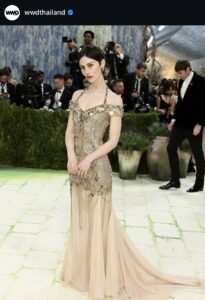
In 2026, the brooch sits comfortably in the category of accessories no one under the age of seventy actively thinks about. The only remaining enthusiasts seem to be those impeccably dressed, old-world grandmothers you photograph on the street like a rare species, and Daniel Roseberry. Elsa Schiaparelli, of course, had a weakness for that sort of thing. Those surreal little Schiap buttons collectors lose their minds over were designed by Alberto Giacometti, who once gifted her a brooch called ‘The Sphynx’. Guess what Roseberry’s Fall 2026 collection was named after. “This chimera — half-person, half-animal — speaks to the sort of contradictory thing inside of you, inside of me, inside of the brand as well,” the creative told WWD.
Daniel Roseberry has a knack for temporal tourism. His collections constantly drag us back decades, sometimes centuries, through clothing alone. This time, even the venue wasn’t allowed to stay in the present. The maison’s invitation, topped off with a gold ring in the shape of an actual finger, led straight to Carrousel du Louvre. The ultimate spot if you wanted to relive Parisian runways of the ’90s and early ’00s, podium and all.
What would Schiaparelli be without contrast, illusion, and a healthy obsession with the natural world? Luckily, we’ll never have to find out. Picture trompe-l’oeil denim that looks exactly like fur, knitted panels cut like puzzle pieces hovering on the body thanks to tulle, and jersey manipulated enough to create depth. One look toward the end glittered entirely too much, turns out it was made from crushed CDs and cassette tapes. Accessories returned with a sense of order. Elsa’s iconic keyhole popped up on blazer labels, bags, and jewelry, keeping at least one foot in reality. The shoes, however, were having none of it. Roseberry took ‘kitten heels’ a little too literal, crowning pumps with full-on cat and dog faces. As realistic as they looked, no animals were harmed. Resin, on the other hand, had some rough days at the atelier.
At this year’s National Film Festival for Talented Youth (NFFTY), one of the world’s largest short film festivals, Another Day We Sleep, directed by Zihan Yang, stood out among the Programmer’s Picks. Previously, the film held well-received screenings at Millennium Film Workshop, curated by renowned filmmakers Priyanka Das and Joe Wakeman, as well as at the New York Indie Shorts Awards, one of FilmFreeway’s “Top 50 Most Popular Film Festivals.”
The film follows Yi, a young Chinese woman, as she visits her aging grandmother, Lao Lao, who lives alone in New York City. Together, they move through the quiet repetitions of everyday routines, finding themselves in the delicate space between holding on and letting go.
The film resonated deeply with audiences and programmers alike. As NFFTY programmer Julia Chou noted in her review, the film “beautifully blurs the line between fiction and nonfiction, allowing these moments to feel deeply lived in.”
Our Culture spoke with the filmmakers, Zihan (“Z”) Yang and Jiaying Lin, behind the film and explored how its story took shape through collaboration with non-actors.
Casting as Chance Encounters
The project began with a chance encounter in Flushing, Queens, where director and casting director Yang met local resident Shihui Chen while location scouting. Through a tailor shop downstairs, Yang was introduced to Shihui, and immediately, Shihui invited Yang to visit her apartment, where she lives alone. “There was something about her that immediately reminded me of my own grandmother,” Yang recalls.
For Yang, street casting is essential in building the realism of the story. “I wasn’t looking for actors in the traditional sense,” they explained. “I was looking for people whose presence already carried a history and a life.”
The experience gradually shaped Yang’s understanding of the role non-actors can play in cinema. During the casting process, Yang became increasingly aware of the lack of nuanced representation of older Asian women in New York’s film scene. “So often, their image is shaped through outdated outsider perspectives rather than lived experiences,” they explain.
Meeting Shihui was purely by chance. Chance encounters have inspired Yang’s path into street scouting and casting and remain a core reason why they pursued this career. After this film, Yang went on to scout for larger productions representing communities in the Asian diaspora, including the upcoming A24 crime series Superfakes, starring Lucy Liu and executive produced by Josh and Benny Safdie, as well as My Mother and Yours, the upcoming feature currently in production from director Constance Tsang and casting director Casting Double, whose debut feature Blue Sun Palace won the French Touch Prize in the Critics’ Week section of the 2024 Cannes Film Festival.
For Yang, encounters are among the most beautiful and magical parts of life. They open a path forward, and through that path, one discovers something new—not only about the subjects, but also about oneself and the kinds of stories one wants to tell.
Storytelling Beyond the Script
After casting Shihui, Yang knew they wanted a professional actor for the role of Yi, the granddaughter. A trained actor can adapt quickly on set and create a dynamic that influences non-actors in unexpected ways. After Yang cast Fan Chen as Yi, their rehearsal process was far from traditional. Rather than beginning with the script, Yang and Fan spent weekends in Flushing visiting Shihui, sharing meals, taking walks, and getting to know one another.
When Yang discussed the ending of the film with Shihui, in which Lao Lao passes away in her sleep, Shihui reacted strongly and expressed discomfort with reenacting a death. She hoped the story would leave more room for ambiguity. For many older Chinese individuals, portraying death can carry an ominous meaning.
Yang empathized with Shihui’s sentiment, and instead of insisting on the original approach, they looked for new ones. Shihui’s co-star, Fan, also advocated respecting Shihui’s wishes. Together, they reimagined the ending of the film as a quiet long shot of the empty living room of Lao Lao’s apartment, as Yi slowly comes to terms with her loss off-camera.
Crafting Authenticity in the Edit
While the cast prepared for production, editor Jiaying Lin joined the project early in development, anticipating an unconventional editorial process grounded in evolving and spontaneous performances. The team understood early on that the film would emerge not only from the screenplay, but also from the relationships and discoveries that unfolded during production.
Lin describes the editing process as something closer to documentary storytelling than narrative editing. “It became a question of how to pace a quiet life on screen,” Lin explains. “Which moments should feel transient, and which moments should linger long enough to reveal what the characters cannot openly express?”
With many spontaneous performances to choose from, the first assembly of the film was nearly an hour long. One of these performances was when Shihui Chen delivered a meandering monologue about the mundanity of her life: how she sleeps and eats on repeat, scrolls through short videos in her free time, and carefully asks if Yi had seen the ones she sent. The honesty in Chen’s delivery struck Lin as a priceless moment, and Lin advocated keeping it in its entirety in the edit. “Funny enough, sometimes editing is about not cutting,” Lin says. “If a moment feels truthful to us, it can resonate with the audience too.”
Editing Emotion
Before editing began, Lin knew that the film had strong influences from Chantal Akerman, a Belgian filmmaker known for her use of long takes. For Lin, understanding the sensibility of her collaborator is just as important as understanding the story itself. “There is something poetic about the long take at the end of the film,” Lin describes. “It’s distancing the audience from the sight of a loss, but you can still feel it in every corner of that empty room.”
Originally, in the footage, the long take ended with Yi walking out into the living room. “But we felt that it reads as if Yi is already detached from her grief,” says Lin. By cutting this moment, the impression that Yi remains with Lao Lao in the bedroom is sustained. Yi’s absence from the frame, heightened by her off-camera sobbing, conveys her grief more authentically. Across her editorial work, Lin prioritizes genuine performances, trusting sound and image to carry the story on their own.
In addition to editing alongside award-winning editors Youmin Kang and Kali Kahn on feature films, Jiaying Lin will begin her residency as one of four editors in the Canadian Film Centre Editors’ Lab this year. The collaboration between Lin and Yang has also evolved into the short film Not Valid For Travel, which is set to make its California premiere at the Academy Award and BAFTA-qualifying Palm Springs International ShortFest this June.
For both filmmakers, working with non-actors ultimately shaped the storytelling itself. Rather than enforcing total control over the performances, the filmmakers adapted around the instincts and lived experiences of the cast. “Sometimes reality gives you something more honest than anything you could write,” Yang says.
Death Cab for Cutie have announced a new album, I Built You a Tower, and shared its lead single, ‘Riptides’. The follow-up to 2022’s Asphalt Meadows is set to land on June 5 via ANTI- Records. Check out director Jason Lester‘s video for the driving, jittery new single below, and scroll down for the album cover and tracklist.
According to Ben Gibbard, ‘Riptides’ “is about the challenge of dealing with personal struggles as the world around us experiences tragedy and loss on an unfathomable scale. And how when these two elements intertwine themselves in our psyches, it feels utterly paralyzing.”
The new LP was produced and engineered by John Congleton from three weeks’ worth of sessions split between Animal Rites in Los Angeles and the band members’ homes in Seattle, Portland, Bellingham, and Los Angeles. “The anniversary tours exorcised any nostalgia in our systems,” guitarist and keyboardist Dave Depper commented. “We felt part of this powerful force greater than all of us and went into the studio with a sense of, how can we capture that feeling and put it into something new?”
Bassist Nick Harmer added: “The whole experience of this record got us back to the earliest versions of this band: If the musicians in the room like what we’re working on, that’s enough. We reconnected with the confidence that comes with that.”
“There’s this need to find a place in ourselves to put loss and grief,” Ben Gibbard explained, referring to the titular tower. “A place that can hold it so we can move on with our lives. But there are these moments where the trauma breaks out of that shell we created for it.”
Death Cab are also going on tour in support of their new album, beginning in Minneapolis on July 10 and wrapping up in Paso Robles on August 7.
I Built You a Tower Cover Artwork:
I Built You a Tower Tracklist:
1. Full of Stars
2. Punching The Flowers
3. Pep Talk
4. I Built You A Tower (a)
5. Envy The Birds
6. Stone Over Water
7. How Heavenly a State
8. Trap Door
9. Riptides
10. The Flavor of Metal
11. I Built You A Tower (b)
Yinka Ilori will present a new exhibition at Cristea Roberts Gallery this summer. Yinka Ilori: Joy Through Resistance opens on 5 June and runs until 11 July 2026, marking the artist’s first solo gallery exhibition in London, his home city. The show brings together new and recent works across painting, print, sculpture, immersive film and sound, offering an insight into themes that shape Ilori’s colourful visual language.
Born in North London to Nigerian parents, Ilori’s work draws on Nigerian storytelling traditions and parables, which he translates into contemporary design and public art. His projects, known for transforming urban spaces through bold colours and patterns, encourage participation and connection within communities. Previous presentations of his work include exhibitions at the Design Museum, the Royal Academy of Arts and the Saatchi Gallery, alongside public commissions across the UK and internationally.
The exhibition takes inspiration from Ilori’s own experiences and the resilience of the diaspora. Through layered imagery that combines the Nigerian yellow trumpet flower with the British daffodil and decorative lace motifs, the artist reflects on how cultural memory can transform hardship into a form of communal strength. A sculptural sound installation featuring handmade congas, a custom shekere and a drumkit, each wrapped in lace, anchors the exhibition’s central tension: the resonant pulse of percussion held within the fragility of textile. Presenting these ideas through a mix of media, the exhibition invites viewers to consider joy as a form of resistance.
The exhibition will be on view 5 June – 11 July 2026 at Cristea Roberts Gallery (43 Pall Mall, London SW1Y 5JG).
Your Star will continue to shine, 2024 Screenprint. Paper and Image: 75.0 x 75 cm. Edition of 30. From: Paradise for All
Anjimile Chithambo, who writes and performs music under his first name, was raised by Malawian immigrant parents in the suburbs of Dallas, Texas. He moved to Boston to attend Northeastern University before relocating to Durham, North Carolina, where his management company, as well as the producer of his new album, You’re Free to Go, are based. After working with Shawn Everett on 2023’s starkly dramatic, grief-stricken The King, his 4AD debut following 2020’s critically acclaimed Giver Taker, Anjimile linked up with Brad Cook (Bon Iver, Waxahatchee, Hurray for the Riff Raff) to help craft the airier, relaxed, and quietly cathartic songs that emerged from a period of renewed freedom. “It comes in waves/ Memory and empathy/ It stays and waits with me,” he sings on ‘Waits for Me’, patiently letting them ripple across and crash into his music, often retreating into a question instead of resolving. Whether for something as abstract as freedom and embodiment or palpably simple like kissing a partner, you want the desire to wash over you, and Anjimile makes it sound easy.
We caught up with Anjimile for the latest edition of our Artist Spotlight series to talk about settling into his songwriting, working with Brad Cook, collaborating with Iron & Wine, and more.
What is your relationship to the new songs like as we’re nearing the album’s release?
I was talking to my partner, who I wrote a lot of the songs on the album about, last night, and I was like, “Rust & Wire’ is coming out tomorrow.” That song was written in the summer, and it just brings us both back to when we fell in love, summer heat, warmth, and sunshine. Something about a spring album is really doing it for me.
I’m curious how that warmth is reflective of your process as much as the themes of the album. Do you feel like you’re easing into your songwriting more with each release, or is it more about where you were in your life when you were making it?
I definitely feel like I’m at a point in my artistic career where I feel confident about my songwriting. But also, I’m really interested in expanding it and doing things I’ve never done before. Even structurally, I have a goal of writing a song with a refrain instead of a chorus, or having a song that has literally only two chords in it. I would love to write a two-chord banger. These songs are about my feelings about very specific situations that have occurred in the last three years, but those specific situations engender such big feelings, and those feelings ripple across my life, my relationships, my conversations. These big emotional moments don’t exist in a vacuum, and I feel like that’s what’s cool about songs, is that you can put that big emotional experience in a little bit of a vacuum. Just be like, “Here is pure emotion. Here you go.”
I also don’t consider myself much of a narrative songwriter. I’m not like, “I was at the beach on Tuesday.” I don’t want people to know where I was at or with whom. [laughs] I don’t need the government to know my whereabouts constantly just because I sing about them. But I like to get down to the feeling. Maybe meeting my partner who inspired a lot of the songs on this album has helped me lean into the emotionality of just who I am as a person, which has let me feel more confident about expressing that sonically.
You’ve said that songwriting, for you, feels like “a prayer, a plea, or a question.” ‘Exquisite Skeleton’, for example, is a song that turns into a plea halfway through. I wonder if you feel like a song needs to approximate one of those things in order to feel complete.
It’s definitely an unconscious process. However, I do find, and I have found that there are a lot of questions in my songs. Ending songs with a question, or just having that be the bridge, or having it be an important component, it’s something that I tend to do, for sure. I have so many questions for my higher power and for the universe that I know I’m not necessarily gonna be getting the answers to. And also, I have questions for the subjects of these songs that I’m not necessarily gonna be getting the answers to. But something just feels right about using songwriting as a conduit, an opportunity to present these spiritual or existential questions.
When revisiting your previous record, the line “In my stillness, I am safety” felt like a prayer that stretches out to the nakedness and the stillness of the new record. Despite the musical shifts between the two albums, do you feel like there’s a thread there?
I haven’t thought about that at all. [laughs] But it does resonate extremely. In the aftermath of making my second album, The King, I was pretty emotionally spent, post-tour, post-everything. Songs are painful and meaningful to me, and I love them, but I didn’t expect the emotional weight of singing these songs every night to accumulate, literally, on my body. After the tour, I was like, “I need a break. I need to not think about this music, or maybe my music career at all, and just restabilize.” The distance between recording The King and this new album, I had some breathing room, and that’s what I needed to clear my mind and get back to putting pen to paper, feeling like I would even want to make another record. Making an album and then releasing it, it’s an awesome, exciting, wonderful, beautiful, mysterious, crazy process. And it’s also a lot.
I had this space to breathe, and it was in that space that I was able to meet the producer of the album, Brad. Honestly, I think Brad had a lot more to do with this album’s existence than I give him credit for. Obviously, he was a producer and he was there recording it every step of the way. But he inspired my songwriting as well by just showing me cool music and encouraging me. I would send him songs, and he would be like, “Hey, this is awesome.” He became a sounding board for my process in a supportive and non-judgmental way. It was just purely for the love of art. When it was time to record this album, me and Brad had linked up, we were buddies. I’m trusting Brad, I’ve written a song with him that’s on this album. By the time we’re recording, I’ve fallen in love with this new partner. I’ve written all these songs about her, I’ve ended a previous relationship, there’s just a lot of life changes happening. But I think my relationship with Brad and that trust provided a sense of stability that helped me approach this recording process with a clear heart and mind.
What are some things that made you feel comfortable and kind of spiritually aligned in the studio, that maybe surprised you, even though you and Brad had become friends by that point?
I already knew that he was just a chiller. He’s just easy to spend time with. He’s a kind individual with a great sense of humor. He smokes so much weed, more weed than I’ve ever seen anybody smoke in my life. He has such an incredible, silly, and sharp mind. I already knew that he had great feng shui. He’s got salt lamps all over his house; this guy’s got fantastic lighting. So nice, so smooth. He’s got delicious candles. He introduced me to a candle called Pasta Water. I’m not kidding: delicious, incredible, artisanal. He’s a man of the senses. But getting into this studio and seeing how simultaneously focused, completely locked in, and also objectively ridiculous he is as a person – it’s really hard to describe. Brad has an indescribable je ne sais quoi that exudes through every pore into the studio.
I’ll tell you one moment on the record where I can visualize that. When you say the words “Fucks sake” on ‘Exquisite Skeleton’, I feel like that’s an example of him allowing that ridiculousness and humour to permeate an otherwise dark song.
When I wrote that, I wasn’t trying to be funny, but I was like, “That’s funny.” And Brad got that too. We were listening to the playback, and he’s like, “I can’t believe you started this song with the lyrics, ‘I don’t want to be a son of a bitch,’ that’s hilarious.” And I was like, “It’s funny, because it’s true.” I think that’s also why it works.
Having had that breathing room, when did you feel like you were re-entering the flow of a new album as you were writing new songs?
A lot of it just had to do with the fact that I’m signed to a label. Commercially speaking, it’s in my best interest to release an album at least every three years, ideally less. But that’s just been my goal. So when I saw that I was coming up on that mark, I was like, “Okay, what have we got?” Whenever I write, I’m like, “Three years from now, this is gonna be probably an album.” But it was only through meeting with Brad, and with my managers, showing them all of the songs that I had accumulated over the past couple of years, that it became clear that there was a collection of songs that worked together. It’s a weird process to put all your songs in a playlist and then be like, “Yup, yup, no, no, yup, no, sucks, good.” [laughs] But that was more or less the process. It’s hard to describe, because I feel like thematically these songs fit a certain narrative. But I feel like music, in the same way that the songs kind of write themselves, I feel like the album kind of has a will of its own, almost. The songs are magnetically attracted to each other in a way.
Do you remember what kind of music Brad Cook introduced you to?
Yeah, Brad introduced me to Cameron Winter. Heavy Metal came out right after we finished recording, and he was like, “Dude, check this out.” He introduced me to this band called Good Morning. I think they’re from New Zealand. I don’t know if there’s anybody whose music tastes I just unequivocally trust as much as Brad. He showed me this record called Peanut by the artist Otto Benson. I don’t even know how to describe it. It’s indie, but there’s electro, and there’s also some Midwest emo going on. Brad introduced me to Cate LeBon, the record Reward.
How were you affected when Sam Beam entered the studio, given how Iron & Wine has inspired your songwriting?
That was surreal. Brad is just buddies with him, he knows him. Sam Beam lives 25 minutes away from us, and it quickly went from, “Oh man, I love Iron & Wine,” to Brad being like, “We’ll get him in the studio,” to Sam Beam just being there. I guess Brad had sent him some tunes, because I would not expect Sam Beam to know what my music is. Just to have him be like, “Brad showed me the songs, and they’re beautiful,” I was like, “Is this a joke? Am I alive or dead?” It was awesome. And then, he has just the most beautiful voice. It was a pleasure, and honestly a huge, unforgettable learning experience just to watch him sing. I was like, “This man’s voice is completely unreal.”
Do you have a favorite of the three collaborations? It’s really striking to hear his voice on ‘Ready or Not’, especially, given the weight of that song.
I think it probably is ‘Ready or Not’. He just went in there, and he was auditioning crazy harmonies that I would never even think to try. Again, I was like, “Is this a dream? Is this reality?” In addition to the beautiful harmonies, for the last 20 seconds of the track, it’s him breathing rhythmically, and when he laid that shit down, I was like, “It’s so good!” It’s just intuitively perfect. And then you listen to it and it’s cerebrally perfect.
One production detail that ties into the vocals is the modular synth on ‘Waits for Me’, which stood out to me because your voice isn’t really heavily effected elsewhere.
The inspiration of that tone came from the demo, which I just made in my room. I ran the vocals through an amp plugin on Ableton and just thought it sounded cool. But Matt McCaughan, who did a bunch of drums on this record, came in with a modular synth, and that distortion created the most sonically thick and satisfying version of that little lick. And you’re right, there’s not a ton of effected vocals at all, certainly not a ton of distorted-sounding stuff in my work on this record. I imagine that point in the song is a little victory lap, and I feel like that modular synth supports that feeling.
What other parts on the record stand out as victory laps to you?
Definitely the ending of ‘Like You Really Mean It’. Nate Stoker, who played guitar, he rips the last chorus with this tapping riff that’s just totally insane. I don’t know if victory lap is the right word to describe it, but towards the end of the record, there’s a song called ‘Afarin’, which is kind of a sad love song. The outro builds with drums entering in the last 20 seconds of the song. I’m hesitant to say victory lap because that song is sad, it’s yearning. But something about the drums in the outro just felt perfect, and maybe that feeling of perfection is victory to me. The perfect way to expand on and honor this emotional moment in the song.
Are you more of a perfectionist when it comes to endings? Do you usually put a lot of stock in the ending of a song?
Not really. [laughs] I wouldn’t say that I’m a perfectionist, but as a songwriter, I do ascribe to the school of thought where my song should have an end, instead of just it being assumed that it will fade out. A fade-out is beautiful and awesome, but I think it’s important to end a song sometimes. I think sometimes a song needs to be over. For my songs that have endings, which I feel like is most of them, I like for there to be a definitive end.
One song where that feels especially pronounced, maybe because it’s a short song, is ‘Point of View’, which has one of my favorite vocal moments on the record, the repetition of “But you know.” How does the memory of singing these songs in the studio sit in your mind?
‘Point of View’, from an emotional standpoint, I wouldn’t say was fun to sing. But from a technical standpoint, it was fun to sing because the mood for that song feels unique to me. A bit of controlled hysteria, or like something’s about to fall over. There was definitely a joy and an ease to recording and singing these songs on the album, but it can also be challenging to get out of your head enough to sing the song, the way that it is, without worrying about anybody around you or who’s gonna listen to it – or who isn’t, or who it’s about, or who it’s not about. In that sense, it was simultaneously so easy and so hard. But one of the standout singing moments for me was ‘Ready or Not’. Me and Brad wrote it together, and the melody came about super spontaneously, and the lyrics came about pretty quickly, a stream of consciousness. I remember feeling a sense of catharsis, the freedom of saying something true and having it feel right. For a lot of these songs, Brad was auditioning backing vocals behind me while singing, being like, “How about this? This could be sick.” So I felt supported. I wasn’t singing alone; I wasn’t experiencing some of these tough emotional moments alone.
Something that comes up on this record a couple of times is the relationship between time and songs. On ‘Like You Really Mean It’, you sing about how “time became a song that carries on without me,” and on ‘Ready or Not’, you sing “I wait too long/ I make no time for my song.” I’d love for you to talk about that feeling of songs existing outside of you, and I’m also curious what making time for songs looks like for you at the moment.
I’ll answer the second one first and say that making time for songs for me is not just a physical thing of, like, “I need to sit down, put my body here next to a guitar” – that definitely needs to happen, but I also need to be somewhat emotionally clear in order to express whatever needs to come out. If I don’t know how I feel, then I can’t write a song. If the feeling is I don’t know how I feel, then that’s a feeling. That counts. That’s a song. But if I feel like I have to live with a certain degree of emotional awareness and practice that in order to write music at all.
In terms of songs existing outside of time – love that. The producer for The King, Shawn Everett, once described music to me as decorations of time. I just think that’s so beautiful. Songs have a runtime, but at the same time, music exists around you, and you can feel it moving inside you. Literally, when there’s bass, when you’re at a live show; metaphorically, when that chorus hits and you start crying. For a phenomenon that doesn’t technically have a body, music is a pretty physical experience. For a phenomenon that exists in the air, in sound waves, and exists somewhere in our nebulous concept of time, it has the power to grip you, just like anybody’s hand. Bob Marley said when it hits you, you feel no pain. And I don’t know about that, for me personally, in terms of the feel-no-pain part, but it definitely hits. It’s just cool that music can exist around you, you can be completely surrounded by it, and have that surroundingness feels like a completely timeless moment. When you’re at an amazing show, and everybody’s sweaty, and the sound is everywhere, it’s this magic moment in time that is forever captured and you’ll never experience again.
You talked about The King‘s songs being painful to sing. Do you think a part of older songs becoming timeless has to do with them not hurting as much? You’re carrying them, but is there a point where they feel separate from you in that way?
I wouldn’t say that the hurt goes away. I’d say the point at which it feels like the songs exist without me is release day. That’s when the songs aren’t mine anymore. It’s not that the emotions in these songs don’t still resonate with me, but once you give your art away, it’s something that everybody can put their heart into. I value my life experiences and I care about them, and I’m grateful they’ve inspired this music, but I don’t need anybody who listens to this music to know anything about me for it to resonate with them, and honestly, I’d prefer that they didn’t.
I’ve played a song I wrote for an ex years and years and years ago, and it doesn’t have the same meaning. It’s like looking at an old photograph of an ex: there’s love and experience here, but not this now-ness. It’s the graciousness of the past, not necessarily diluting the feelings, but letting me look at it from farther away and see: I was hurt, and she was hurt, and we were hurt, and this isn’t about me. The passage of time helps me zoom out from these songs. The meaning of these songs evolves over time, which has been the weirdest experience about writing and performing them over the years.
This interview has been edited and condensed for clarity and length.
At the turn of the millennium, fashion was no longer confined to the runway. The early 2000s marked a moment when popular culture, media, and celebrity visibility began shaping the way people dressed on a global scale. Music videos, red carpets, reality television, and emerging internet platforms created a shared visual landscape where trends moved quickly and images traveled even faster.
In this environment, clothing became more than personal style. It became a form of cultural participation. What people wore was increasingly influenced by what they saw on screens.
The Rise of a Media-Driven Style
One of the defining characteristics of early 2000s clothing was its deep connection to mass media. Cable television and music channels such as MTV and VH1 played a major role in shaping youth culture. Music videos were not just about sound; they were visual statements where clothing helped define entire identities.
Pop stars, hip-hop artists, and R&B performers appeared in carefully styled outfits that were instantly recognizable. Oversized logos, statement accessories, low-rise denim, and bold graphics became visual signatures of the era.
Because these images were broadcast repeatedly across television and magazines, the styles quickly moved beyond celebrity circles and into everyday wardrobes. Fashion was no longer distant or exclusive. It felt immediate and accessible.
Celebrity Culture and the Everyday Look
The early 2000s were also the golden age of celebrity visibility. Paparazzi photography, tabloid culture, and entertainment news programs brought the private lives of public figures into constant view.
Unlike the carefully curated glamour of traditional red carpets, paparazzi images showed celebrities in casual situations: leaving restaurants, walking through airports, shopping in city streets. These moments blurred the line between fashion performance and daily life.
As a result, casual clothing gained cultural importance. Tracksuits, hoodies, denim, and simple tees appeared repeatedly in celebrity photographs, transforming everyday garments into recognizable trends.
People were not only inspired by formal fashion moments. They were copying what celebrities wore on ordinary days.
The Influence of Music Subcultures
Music scenes played a significant role in shaping the visual identity of early 2000s fashion. Hip-hop culture, in particular, had a strong influence on silhouettes and styling choices. Baggy denim, statement sneakers, and branded streetwear became part of a broader cultural movement tied to music and urban identity.
At the same time, pop artists introduced a different kind of visual energy. Bright colors, playful accessories, and experimental styling pushed fashion into more expressive territory.
Rock and alternative scenes added their own aesthetic elements — darker palettes, layered looks, and distressed fabrics.
The result was a fashion landscape shaped by multiple musical influences rather than a single dominant trend.
The Early Internet and Visual Circulation
Another key factor behind the spread of early 2000s fashion was the rise of the internet. Although social media as we know it today did not yet exist, online forums, fan websites, and early digital photography played a role in circulating images.
Fashion magazines were still influential, but digital spaces began accelerating the speed at which trends traveled. Fans shared photographs of celebrity outfits, runway collections, and street style moments online.
These early forms of digital culture created a new kind of visual archive. People could revisit outfits, discuss trends, and reinterpret styles within their own communities.
Even before platforms like Instagram or TikTok, fashion was already becoming a global visual conversation.
Fashion as Cultural Performance
Looking back, y2k fashion reveals how closely clothing was tied to performance and visibility. Outfits were often designed with cameras in mind. Whether on stage, in music videos, or captured by paparazzi lenses, fashion was part of a broader spectacle.
This visual emphasis encouraged experimentation. Logos became larger. Accessories more dramatic. Fabrics shinier. Clothing needed to stand out not just in person, but also on screen.
The result was a period where fashion felt energetic, sometimes excessive, but always expressive.
A Legacy That Still Resonates
Today, the influence of 2000s fashion can be seen in contemporary design and youth culture. The renewed interest in Y2K aesthetics reflects more than simple nostalgia. It reveals how strongly the era shaped the visual language of modern fashion.
Many elements that defined the time — graphic prints, statement denim, athletic-inspired silhouettes — continue to reappear in modern collections and street style.
The difference is that today’s interpretations are often filtered through a contemporary lens, combining the boldness of the original era with more refined styling.
Fashion as Cultural Memory
Ultimately, the significance of early 2000s fashion lies in how clearly it reflects the cultural environment that produced it. It was a time when media visibility expanded rapidly, celebrity culture intensified, and the internet began reshaping the way images circulated.
Clothing became part of this transformation. It captured the mood of a generation learning to navigate a world where identity, media, and image were increasingly intertwined.
What people wore during that period was not just about trends. It was a reflection of how culture itself was changing.
And in that sense, the style of the early 2000s remains more than a nostalgic curiosity. It stands as a cultural record of a moment when fashion and media began dressing the world together.
In the world of AAA video games, the role of the “music designer” has become a critical bridge between artistic composition and technical implementation. Part-enginner and part-musician, Udit Srivathsan is a music designer and audio engineer sitting at this unique niche. His audio work spans some of the most anticipated titles in the gaming industry, including Marvel’s Wolverine and Ghost of Yōtei, which just won a Music Editing award at the 73rd Motion Pictures Sound Editors Awards, which was announced March 2026. Srivathsan was part of the Music Editing team that won the Golden Reel Award with Sony Interactive Entertainment for winning the Outstanding Achievement in Music Editing for Game Music.
Udit is currently serving as a Music Designer at Sony Interactive Entertainment America, and his career offers a look into the complex systems that allow video game music to react dynamically to player choices. His approach, which he describes as a combination of “creativity with logical problem solving,” involves taking recorded material and designing the systems that determine how it transitions during gameplay.
“It’s like scoring a movie, but it can go in so many directions,” Udit said in a recent interview.
Engineering the Sound of Superheroes
Udit’s portfolio includes high-profile contributions to several major franchises. On Marvel’s Wolverine, he initially served on the engineering team, where he was responsible for preparing composer stems for recording sessions. This involved analyzing the score to determine how to record ensembles in a way that maximized flexibility for music editors later in production.
Just as his work on Ghost of Yōtei recently garnered a 2026 MPSE Golden Reel Award for Outstanding Achievement in Music Editing, it’s a testament to the increasing recognition of music design as a specialized craft within the industry.
“Being brought on to work on Ghost of Yōtei with a team of experienced veterans was an honor and I’m thankful for their trust in me! I learned so much along the way from people like Andrew Buresh, Sonia Coronado and Ted Kocher and I look forward to continuing to work together on many more projects in the future.”
Meanwhile, while working on titles like Saros, Udit collaborated with the PlayStation music team in the UK, working with music by composer Sam Slater. Udit was tasked with creating “mashups” of existing themes for specific boss fights, ensuring the music remained tonally consistent while cutting through the game’s dense sound design. “This was definitely a challenge,” he said, “making the cues stand out enough yet work amidst the super crunchy and satisfying sound design already in the game.”
Mastery of Immersive Formats
Beyond gaming, Srivathsan has established himself as a specialist in immersive audio formats, particularly Dolby Atmos. He served as the Upmix Engineer for the Counter-Strike 2 Masterminds II Music Kit box, taking stereo mixes from composers such as Austin Wintory and Ben Bromfield and expanding them into a spatial environment.
His engineering credits also extend to legendary experimental acts; he served as the Lead Recording Engineer for Dr. Dark (2025) by The Residents. This technical versatility is rooted in his training at the San Francisco Conservatory of Music, where he studied both music composition and audio engineering.
Bridging Film and Games in The Studio
Udit’s background in film post-production—including dialogue editing for the feature film Second Chance (2024) and assistant engineering on the horror-thriller Ick (2024)—has informed his perspective on interactive media. He maintains that the disciplines are more similar than they appear, noting that both require an understanding of narrative context and the ability to anticipate changes in a scene.
“In a movie, there’s a story, cutscenes, dialogue, and sound design—all of which can change,” Udit explains. “Understanding when a scene is ready to score or edit and how to anticipate any changes is something that working with films has given me insight into.”
Udit’s Artistic Exploration
While much of his work involves technical implementation for major studios, Udit continues to pursue independent artistic projects. Alongside co-composer Cullen Luper, he wrote and produced “Unbound,” an hour-long narrative immersive album. The project featured a live performance with a multichannel speaker system, utilizing twelve speakers to surround the audience, further pushing the boundaries of spatial storytelling.
As the industry moves toward more sophisticated audio systems, Udit’s hybrid role as an engineer and music designer highlights a growing trend in entertainment: the blurring of lines between the person who writes the music and the person who builds the system that delivers it.
With upcoming projects including Kena: Scars of Kosmora and continued work on Sony’s premier titles, keep an eye on Srivathsan’s musical work on his website, uditsrivathsanmusic.com.
The 2026 Academy Awards took place last night (March 16). In the music categories, Ludwig Göransson won Best Original Score for Sinners, beating out Jerskin Fendrix’s Bugonia, Alexandre Desplat’s Frankenstein, Max Richter’s Hamnet, and Jonny Greenwood’s One Battle After Another. Marking his fifth nomination and third Oscar win, the award was presented by the reunited cast of Bridesmaids at Hollywood’s Dolby Theatre.
Best Song went to HUNTR/X’s KPop Demon Hunters hit ‘Golden’, which won over Diane Warren’s ‘Dear Me’ from Diane Warren: Relentless, Raphael Saadiq and Ludwig Göransson’s ‘I Lied To You’ from Sinners, Nicholas Pike’s ‘Sweet Dreams of Joy’ from Viva Verdi!, and Nick Cave and Bryce Dessner’s ‘Train Dreams’ from Train Dreams. The songwriting team accepted the award from Lionel Richie. “Growing up, people made fun of me for liking K-pop,” Ejae said in her speech. “Now everyone is singing our song, and in all of the Korean lyrics. I’m so proud. I realize this award is not about success; it’s about resilience.”
During the ceremony, Sinners star Miles Caton and Raphael Saadiq performed their Best Original Song-nominated ‘I Lied to You’ alongside blues legend Buddy Guy (who makes a cameo in the film), Brittany Howard of Alabama Shakes, Shaboozey, and more. Later on, Ejae, Audrey Nuna, and Rei Ami took the stage to perform ‘Golden’. In previous years, all nominated songs would be performed throughout the show, but the Academy announced earlier this year they were going to “move away” from live performances for the ceremony.
The full performance of “Golden” from ‘KPOP DEMON HUNTERS’ at the Oscars.