Paul McCarthy’s latest exhibition SS EE Saint Santa Eva Elf Drawing Sessions 2025 with Lilith Stangenberg opened at Hauser & Wirth in Paris on 21 March, where it runs until 31 May. The exhibition brings together a new series of large-scale drawings alongside a six-channel video installation, continuing the leading contemporary American artist’s long-running exploration of performance and cultural symbolism.
Developed in collaboration with German actor Lilith Stangenberg, the works extend the pair’s ongoing A&E project, with both artists inhabiting the characters of Santa and the Elf. Through these figures, McCarthy revisits one of his most enduring motifs, using the familiar iconography of Santa Claus to examine corporate capitalism and the spectre of fascism. The drawings were produced during improvised performance sessions staged within McCarthy’s Los Angeles studio, a reconstructed interior of the artist’s childhood home.
Rather than presenting finished images alone, the exhibition situates drawing as part of a broader performative process. The accompanying multi-screen video installation places viewers within the unfolding action, emphasising McCarthy’s interest in instability, authorship and interpretation. The exhibition offers a continuation of the artist’s provocative and often unsettling interrogation of cultural myths and the structures that sustain them.
The exhibition is on view through Sunday 31 March at 26 bis rue François 1er, Paris 75008.
Philo built her cult back when Céline still carried its accent. Today, that same audience trails her to her namesake brand, arguably with even greater devotion. Although there hasn’t been a single fashion week show, her pieces somehow always manage to land in the front row. Which says a lot, considering the whole operation runs on lookbooks, minimal communication, and a series of Instagram previews that weirdly feel like global events.
Collection E, the fifth by now, will make its way into stores this June. The Instagram drop hit on March 19th, but long before that, sometime between haute couture week, it was uneveiled in a discreet Paris showroom, attracting loyalists and newly converted alike, all there to inspect silk and leather up close. Front and center were gentle-to-the-touch shearlings, in deep bordeaux, honeyed browns, and midnight blues, applied everywhere across the board, nipped in peplum jackets, coats, hoodies, pants too.
Next to them, picture slouchy leather salopettes and jackets completed with knit collars. Technical tees covered in 3D embroidery, the kind of layered texture that makes flowers look straightforward. T-shirts turning into sheer maxi dresses, wanting to touch the floor and cover nothing. Outerwear loaded with pockets and cinched waists. Minimalistic earrings, shiny cuff bracelets, and suede belts. Everything looks simple, until a tiny twist here or there makes the cult lose their minds.
What happens when avant-garde meets “add to cart”? In 2026, it looks like Zara securing John Galliano for a two-year run, just another Tuesday. Luxury has developed a curious soft spot for the mass market, the headline-grabbing one-offs are basically tradition at this point. Jonathan Anderson might be a private guy, but his long-term situationship with Uniqlo is quite hard to miss. And sometimes, it’s not a detour, it’s the destination. Take it from Francesco Risso, who went from Marni to GU’s $30 racks. If anything, this feels intentional.
It’s been almost two years now since Galliano’s Margiela dolls walked his last show. Since then, he’s been touching grass, literally. He explained it like “walking through the woods without my phone, getting lost but not being afraid to get lost, and relying on instinct again, reconnecting with instinct, like breathing correctly,” to a little bird that turns at the name Vogue. That same bird also reports that “he’s been secretly working in an atelier ‘somewhere around Paris’ since January.”
How would a creative start, you ask? With the beloved archival deep-dive. Lucky him, Zara’s personal time capsule of previous hits (and misses), is roughly 50 years worth of déjà vu. “I’m super excited, because it’s not something I’ve done before, so that kind of tickles me—the newness, the excitement, the actual process,” he told Vogue. Well, one thing’s certain, September sees wallets loosened and checkout buttons abused. The crowd is ready.
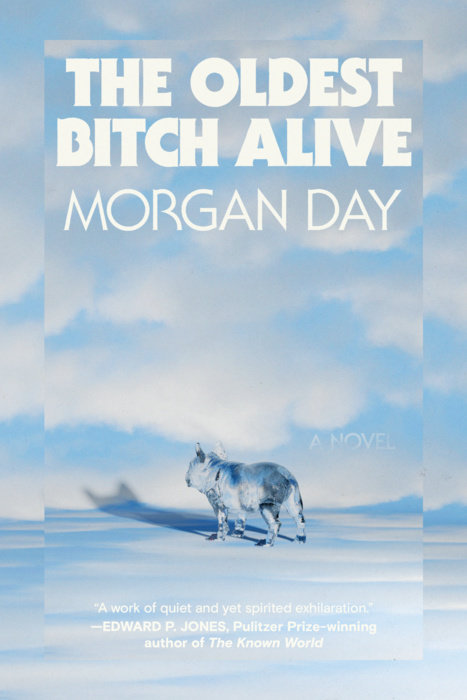
Gelsomina is a French Bulldog riddled with worms she got by lapping at pond water, living out her days in a glass house. In her shockingly scholarly voice, she begins to ponder the creatures around her—John and Wendy, her owners, Zampanò, the puppy they added to the house to provide Gelsomina a playmate, and the outside world, which she has little access to, despite the house’s transparency. With a range of perspectives—from the triad of worms inhabiting her, each fretting over their place in the group, and an omniscient, worldly consciousness—Gelsomina attempts to fill her last days getting to the heart of the unknown.
Eloquent and playful in its exploration of the divine within the mundane, The Oldest Bitch Alive breaks apart traditional novelistic conventions to create something bizarrely new. Morgan Day sat down with Our Culture to chat about skill issues, crafting voices, and Russian dolls.
I feel like this book is so ambitious, yet sticks the landing. You explore the perspectives of dogs, humans, tapeworms, as well as an uncanny omniscience. What made you want to go for everything at once?
It actually was born out of a slight skill issue. I’m starting to realize now, as I’m working on other projects, that I write a lot and cut down a lot. My editor, Tara, very kindly calls it ‘sculptural.’ It’s just a mess on the page that gets broken down and thrown away at some parts. It was frustration with having to choose a perspective. It originally was a fully omniscient POV, but I felt it wasn’t doing Gelsomina, the French Bulldog, justice. I really wanted to understand her experience. And over time, the words made an entrance in the novel, and I thought, ‘Well, it’s not fair to the worms if they don’t get a shot…’
Which is a normal thought process.
I started to build in that way. And there was a lot of nonfiction I wanted to be in the book, but I wanted it to stand on its own, side-by-side with the fiction. It just became this… I don’t know what to describe it.
Photo by Rodrigo Restrepo Montoya.
I love when I read a book that clearly took a lot of research. You tackle science, philosophy, architecture—what drew you to these themes?
I’m not an architect, but I’ve worked for architecture firms for a number of years. And I’ve always been, as a writer, really fascinated by their capabilities for this act of worldbuilding, which is so ambitious and impressive. Science, to be honest, I don’t know, I’m not one who’s studied a lot of science, but as I was researching things about parasites, I’d come across these surreal and revolting facts of life that would draw me in. It was tumbling from there. And I would read philosophy books and have no idea what’s going on, but it’s this beautiful, artistic act on the page that I’m engaging with. I feel like something’s happening in my brain.
Tell me about crafting Gelsomina’s voice and perspective. For a French Bulldog, she’s surprisingly erudite.
She is an interesting voice. When I was done, I realized it might be the voice that feels most natural to myself in writing. It’s obviously a projection of a human voice onto a dog. But what I wanted to get at was the texture of language, and the ability of the language to refract, in a way. One sentence could take multiple meanings, or it could just be more of a sensorial experience than a literal one. A lot of times, I would sit there and open a book, choose a word and start with it, then look it up along with an etymology. Another word would come up, and it would piece together in that way.
I was just glad it didn’t have the tone of those 2016-era dog Instagram accounts, where everything’s misspelled and they take on the voice of a toddler. It’s marketed as a book from a dog’s perspective, so you never know…
[Laughs] Yeah, something we talked about a lot was how to position and talk about the book. I think so far we’re starting to find that people are very surprised, whether it’s good or bad, for a dog book.
You write about ({i}), the standard representation of life, which is made up of the physical form, cosmic matter, and the self. It’s so vague when usually, novels try their best to position the reader within the world. What made you write about this?
I wanted to get at this feeling of being in the world that’s very abstract, and there’s different philosophies in the book I pull in about our interconnectedness. I felt like I needed something that could encapsulate that, but at the same time, it comes up later that the Urban Dictionary definition of the symbol is “online clitoris.” That’s what you’d type, back in the day, before emojis. That was a way to both have this lofty, elevated explanation of being in the world for everyone that was brought down by this crass and juvenile symbol. I wanted to have both in one thing.
I noticed a parallel between that formation and the worms inside Gelsomina inside the glass house.
Exactly. Maybe it goes back to architecture, and being around architects, but I was really interested in scale, and that Russian doll effect. For us, what it means for us to be in our room, within our apartment, within our house, within our city… it’s porous but not.
Over time, the words made an entrance in the novel, and I thought, ‘Well, it’s not fair to the worms if they don’t get a shot…’
I read that the novel might have been inspired by your real life French Bulldog.
Yeah, my family had two. I started writing the book after they passed away a few years ago. I guess it was a way of grieving, but I was just reflecting on their life, especially their end years. When it was over, I started wondering about what they saw and how many people they interacted with. They weren’t friendly dogs. They weren’t out and about. How many spaces were they in across their life? How many creatures did they interact with? What was their sense of the world? Was it just their individual perimeter sites that we plopped them in, and they don’t know anything else? It was fascinating to me.
What did the writing process reveal about your relationship with her?
It sounds obvious, but I couldn’t remove myself in trying to write her experience. I was always present, and that’s how I was interacting with her. Inevitably, there’d be a projection of human emotion or dynamic onto her. I also started reflecting on her as a being that can be sexual and can reproduce, but never did. She had this sterile existence, literally. I started thinking about whether she was cognizant of that.
Finally, what are you working on next?
I’m working on a novel about furniture. [Laughs]
I would expect nothing less.
I forgot how hard it is to start a project. You finish one, then say, ‘Let’s start a new one, that sounds fun.’ I’ve been banging my head against the wall for months. But it’s going.
Vines, the project of composer and producer Cassie Wieland, has announced an EP called Covers I. It’s out May 15, and it finds her tackling songs by Frank Ocean, Sufjan Stevens, Wheatus, and Fleetwood Mac. Check out her cover of ‘Silver Springs’ with Helado Negro below.
We are now in the digital era, where almost everyone aspires to become content creators. While many still utilize traditional methods of content making, some seek alternative and more efficient ways to get the job done. Thankfully, deepfake apps now exist. The emergence of these AI-powered media tools has significantly changed how digital content is created, edited, and shared.
As we move further into this year, more and more people are adopting them for swapping faces, generating avatars, and producing convincing synthetic videos to streamline the work and enhance their output. However, with numerous apps being launched, finding the right pick can feel like searching for a rare file in a crowded archive. To save you time and effort, we have already done the dirty work for you and compiled the deepfake apps worth trying in 2026. Let us look at them one by one!
Five Best Deepfake Apps of 2026
1. Simfa
Image Credit: Simfa
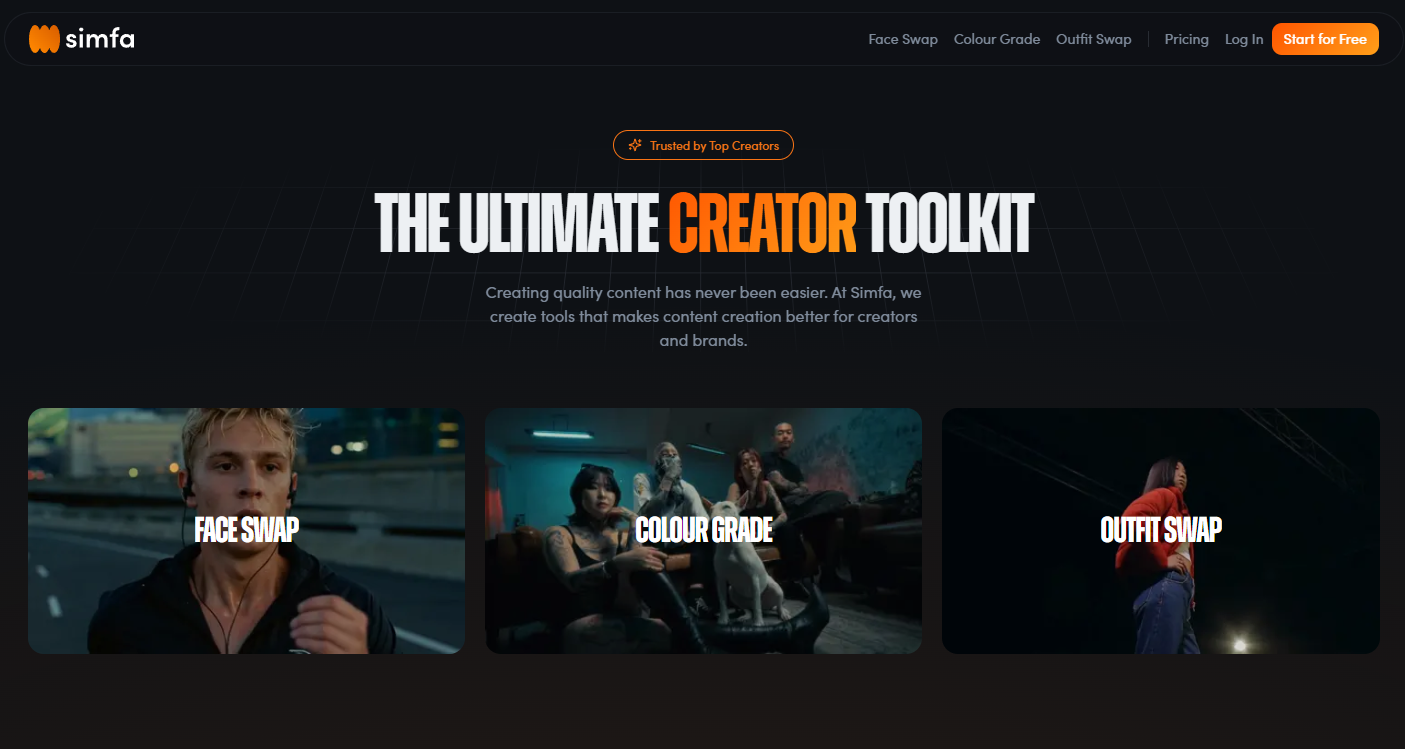
Leading the options on the list is Simfa, the ultimate creator toolkit. From face swapping to outfit swapping and color grading, it is designed to produce high-quality outputs with minimal effort, catering to creators and brands. This tool is also one of the most efficient and user-friendly deepfake tools available in 2026. Simfa focuses on simplicity without sacrificing quality, enabling users to complete renders within 2 to 5 minutes. Unlike other deepfake platforms on the market, this one is ideal for achieving reliable results without a steep learning curve or manual tuning. All of these promising features come at available package prices with credits that never expire, making Simfa a top-tier choice for creators who want fast and private results.
Key features:
Advanced AI face swapping, outfit swapping, and color grading
Fast processing optimized for performance
Clean, intuitive interface
2. Zoice
Image Credit: Zoice
Zoice is an all-in-one platform featuring various AI tools that enable users to create realistic visuals and audio. In detail, you can use it for avatar generation, face swapping, video synthesis, image generation, and voice cloning. With seamless tool-switch features, every user can achieve a coherent workflow. Zoice offers credit-based and subscription-based purchases. However, an active paid plan is required to buy credits.
Key features:
Diverse suite of AI tools
Integrated all-in-one ecosystem
Free plan availability (limited features)
3. Synthesia
Image Credit: Synthesia
Another option to consider is Synthesia, which is an AI video generation tool. It serves as the central platform where users can create, localize, manage, and publish AI media. The features include AI avatars, video editing, team collaboration, and translation to over 160 languages. Synthesia aims to reduce the use of resources in video production by 90%. Beginners, creators, and enterprises will find suitable plans among the packages available, with a free basic option for starters.
Key features:
Advanced AI avatar video generation
Signed off by CFOs
Free plan availability (limited credits)
4. Reface
Image Credit: Reface
Reface is a mobile-first deepfake app that reimagines everyday life with AI. Focused on casual face swapping, users can place their face on photos, movie scenes, viral clips, and GIFs in a matter of minutes. Reface is ideal for beginners looking for templates to create images and quick videos, as it lacks advanced customization and control. Its plans are basic and premium packages, with the latter bearing more features.
Key features:
Instant face swap features
Extensive library of templates
Quickly share to social media platforms
5. DeepFaceLab
Image Credit: DeepFaceLab
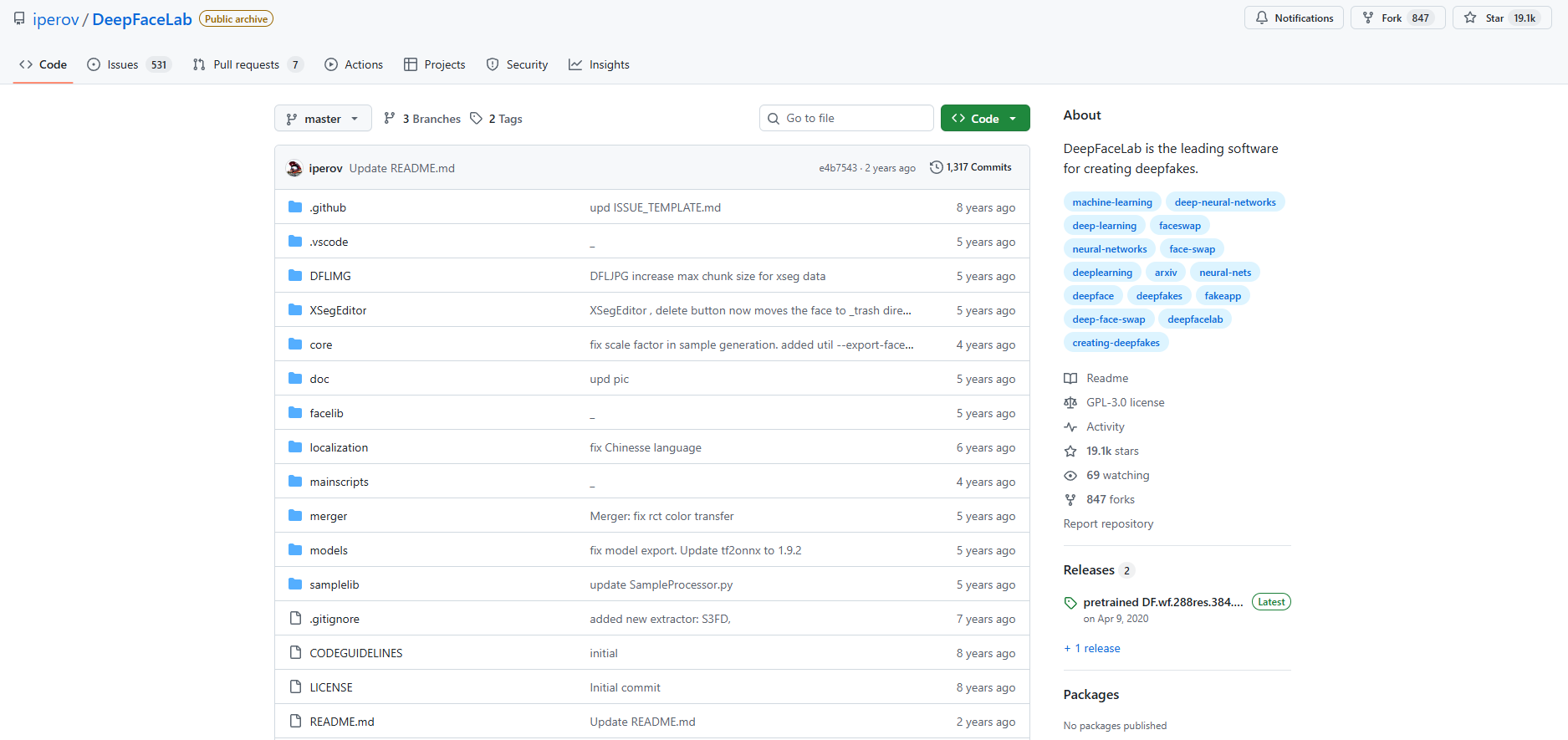
Closing the list of deepfake apps is DeepFaceLab, which is an open-source tool designed for advanced creators and researchers. Instead of automated workflows and templates, it enables model training and manual configuration to create high-quality deepfakes from the ground up. While it is far more technical and challenging to use, users can control everything, paving the way for a specifically tuned output.
Key features:
Highly customizable
Free to use
Ethical Considerations When Using Deepfake Apps
Powerful tools like deepfake apps are here to help content creators become better, not turn them into something worse. With such features at your fingertips, everyone must use them responsibly. Creators should avoid misuse that can lead to misinformation, identity concerns, and privacy violations. We encourage mindful usage to ensure that these technologies remain a positive force in digital media.
Choosing the Right Deepfake Apps in 2026
With a flood of top deepfake apps worth trying in 2026, content creators can choose from beginner-friendly mobile tools to advanced options. However, you would be wasting time, money, and other resources if you select randomly. Choosing without careful consideration can even lead to subpar results.
Among the many available tools, only a few manage to reach the standard, and five of them are on this list. Accordingly, Simfa is at the center of this evolving landscape, offering a streamlined, high-performance solution for modern content creation. Its combination of usability, accessibility, speed, and quality makes it a strong choice for entertainment, marketing, storytelling, and beyond.
Think about the last time you slipped on a pair of sandals and forgot they were there. Not because they were unremarkable, but because they fit so perfectly, so naturally, that your feet simply accepted them as part of the experience. That feeling, that seamless union of foot and footwear, is exactly what HEYDUDE has spent years engineering into every sandal they create. And with the latest additions to their ever-growing sandal collection, the brand has reached a new level of anatomical precision that deserves your full attention.
The HEYDUDE Sandal Series is not interested in being just another set of warm-weather options you grab on your way out the door. These are sandals that have been thoughtfully constructed around the actual shape and needs of the human foot. From contoured EVA footbeds that mirror the natural curves beneath your arch to DUDEWAVES TECHNOLOGY that textures the surface for enhanced grip and airflow, every design decision serves a single purpose: keeping your feet genuinely happy from morning to night.
What makes this collection particularly exciting right now is the breadth of new arrivals. HEYDUDE has introduced fresh styles across multiple categories, covering flip flops, platform slides, espadrille-inspired designs, and minimalist wave slides. There are options built specifically for women who want elevated style with serious comfort, and there are options built for men who need something rugged enough for water days yet refined enough for evening plans. Across the board, every sandal in the series shares a commitment to being lightweight, travel ready, and engineered with the kind of cushioned support that most sandal brands simply do not prioritize.
Let us explore each new arrival in detail and help you find the sandal that was designed specifically for the way you live.
Maui Breeze Flip | $34.99
Some sandals try to be everything to everyone and end up being nothing special to anyone. The Maui Breeze Flip takes the opposite approach. It knows exactly what it is: a beautifully uncomplicated flip flop that delivers an extraordinary level of comfort for its effortlessly simple design.
The product description captures the experience perfectly. The Maui Breeze Flip feels like wearing a yoga mat on your feet. It is lightweight, plush, and what HEYDUDE calls “super squishy in the best way possible.” That squishiness comes from the contoured EVA footbed, which does far more than simply cushion your step. The contouring follows the natural anatomy of your foot, cradling the arch, supporting the heel, and allowing your toes to spread comfortably across the surface. This is the kind of footbed engineering that you typically find in premium orthopedic sandals, yet here it sits inside a $34.99 flip flop that looks effortlessly casual.
The synthetic upper keeps the design clean and low maintenance, while the easy-on system means there is zero fussing with straps or adjustments. You slide in and you go. The lightweight flexible outsole ensures that every step feels natural and unforced, and the 40 C Durometer footbed rating indicates a softness level specifically calibrated for maximum underfoot comfort without sacrificing structural support.
Available in six vibrant color options including a stunning Pink that commands attention, the Maui Breeze Flip is sized in women’s 5 through 12. It is also marked as travel ready, meaning it packs flat, weighs almost nothing, and transitions seamlessly from poolside to boardwalk to beachfront dining. For women who want a flip flop that genuinely prioritizes their comfort without asking them to compromise on color or style, the Maui Breeze Flip is a standout choice.
Hey2O Flip Flop Mesh | $44.99
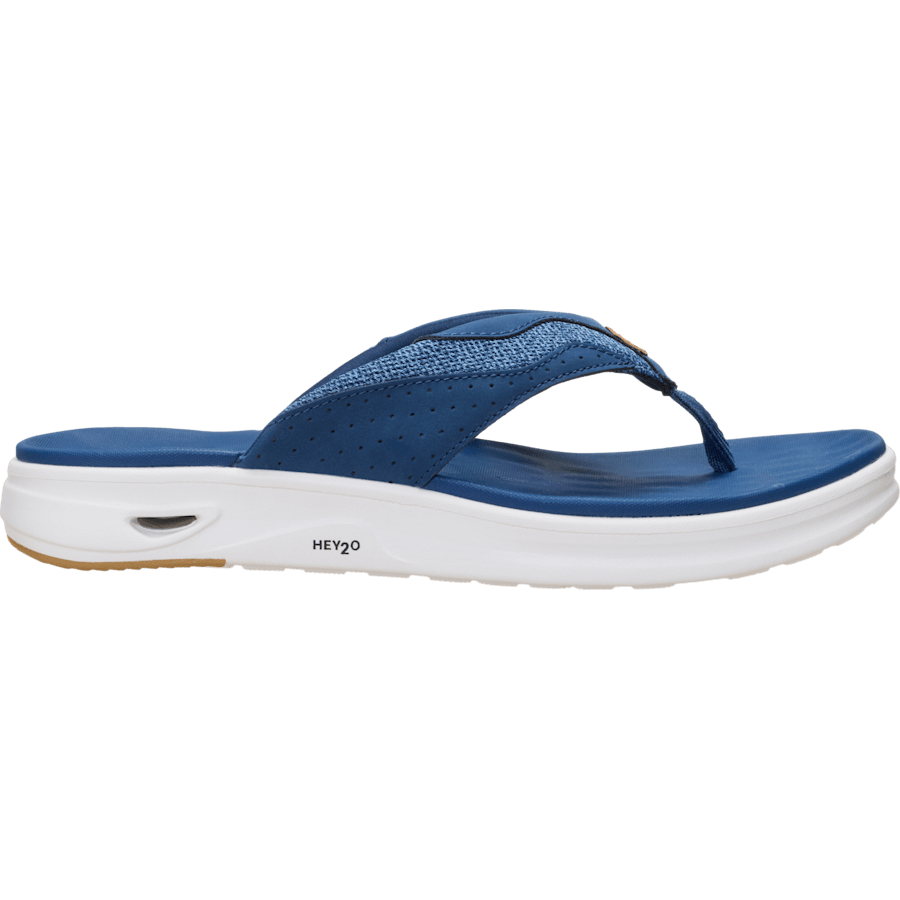
Water and sandals have a complicated relationship. Most flip flops become slippery, uncomfortable, or outright hazardous when they get wet. The Hey2O Flip Flop Mesh was engineered from the ground up to eliminate every one of those problems, making it the ultimate sandal for men who split their time between sand and street.
The name gives away the philosophy: this is a flip flop built for water days and warm weather escapes. The breathable mesh upper is the first thing that sets it apart from conventional flip flops. Where most sandals use solid rubber or synthetic straps that trap moisture against your skin, the Hey2O’s mesh construction allows water to pass through and evaporate quickly, keeping your feet cool and comfortable even after a swim or a walk through the surf.
The micro-fiber wrapped toe post is another thoughtful detail that addresses a common complaint about thong-style sandals. The soft microfiber prevents the irritation and chafing that hard plastic or rubber toe posts often cause during extended wear. It is a small touch that makes a significant difference over the course of a full day.
Beneath your foot, the textured footbed enhances comfort while improving underfoot airflow, and here is where the Hey2O really shines for water use: the drainage outsole is specifically designed to channel water away from the footbed rather than letting it pool beneath your foot. This means that even when you step directly out of the ocean or a pool, the sandal sheds water rapidly and maintains its grip. The lightweight flexible outsole with traction pods adds further confidence on wet surfaces, providing reliable footing where other sandals would leave you sliding.
Available in three color options including a bold Sargasso Blue/White and sized in men’s 7 through 15, the Hey2O Flip Flop Mesh is priced at $44.99 and tagged as both NEW and travel ready. For the man who needs a sandal that performs equally well on a boat deck, a beach trail, and a waterfront restaurant patio, this is the one to own.
Austin Slide Classic | $49.99
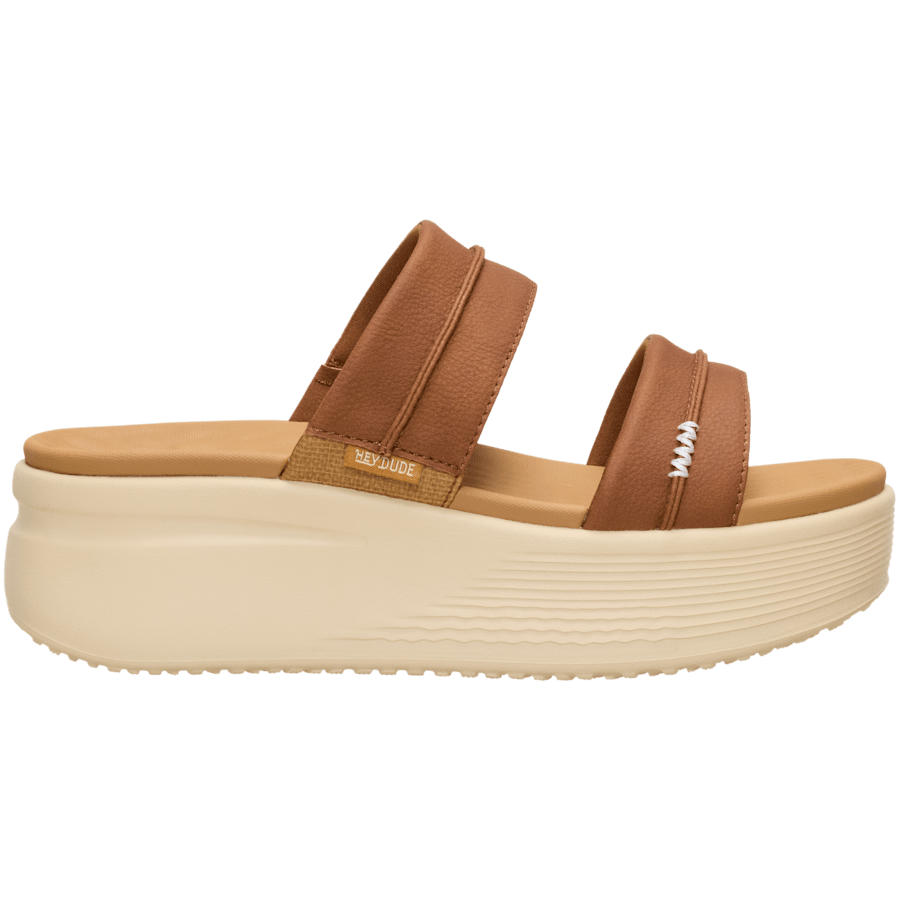
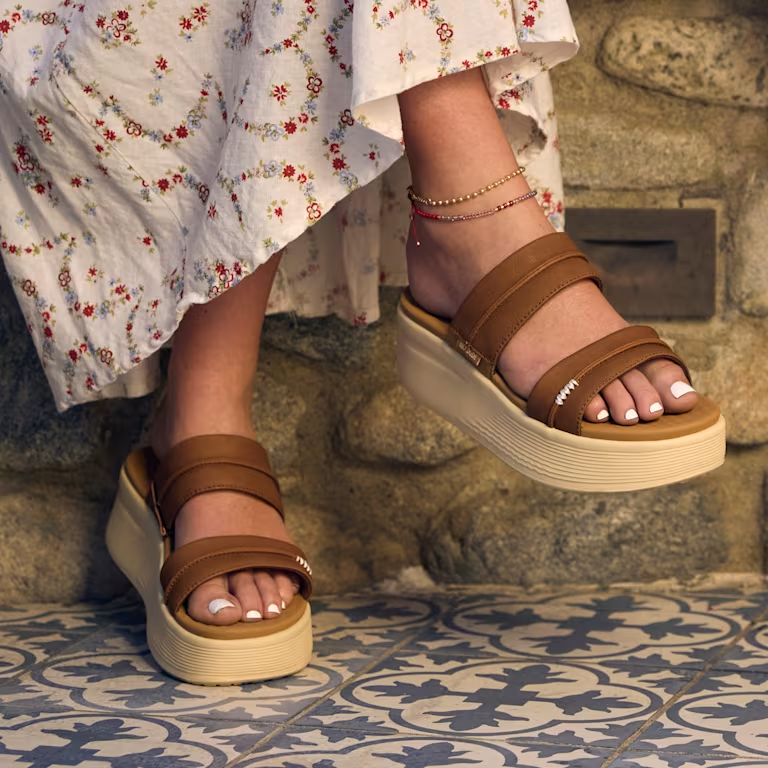
Platform sandals have dominated women’s fashion for several seasons now, but finding a platform that actually feels good to wear for more than an hour has remained a persistent challenge. The Austin Slide Classic is HEYDUDE’s answer to that challenge, and it is a remarkably convincing one.
Described as the sandal “voted most likely to be worn on repeat all summer,” the Austin Slide Classic is a platform sandal you can wear with jeans, dresses, and just about anything else in your closet. It has been built with what HEYDUDE calls “extra attention to the details,” and those details are immediately apparent when you examine the specifications.
The memory foam cushioning on the straps is a feature that most platform sandals completely ignore. While other brands focus all their cushioning efforts on the footbed, HEYDUDE recognized that the straps themselves are a major source of discomfort in slide-style sandals. By lining the straps with memory foam, the Austin Slide eliminates the pinching, rubbing, and pressure points that typically develop across the top of the foot during wear.
The contoured EVA footbed provides the same anatomical support found throughout the collection, enhancing comfort and improving underfoot airflow. The platform height of 65mm (approximately 2.5 inches) gives you a noticeable lift without creating the instability that taller platforms often introduce. The synthetic upper keeps the look clean and versatile, and the easy-on system ensures you can slip into these slides without any adjustments.
Available in four elegant color options including a rich Cognac that pairs beautifully with summer earth tones, the Austin Slide Classic is sized in women’s 5 through 12 and priced at $49.99. Like every sandal in the series, it is travel ready and features the 40 C Durometer footbed for optimized softness. This is the platform sandal that finally lets you have the height you want without paying for it in foot fatigue.
Delray Buckle Classic | $69.99
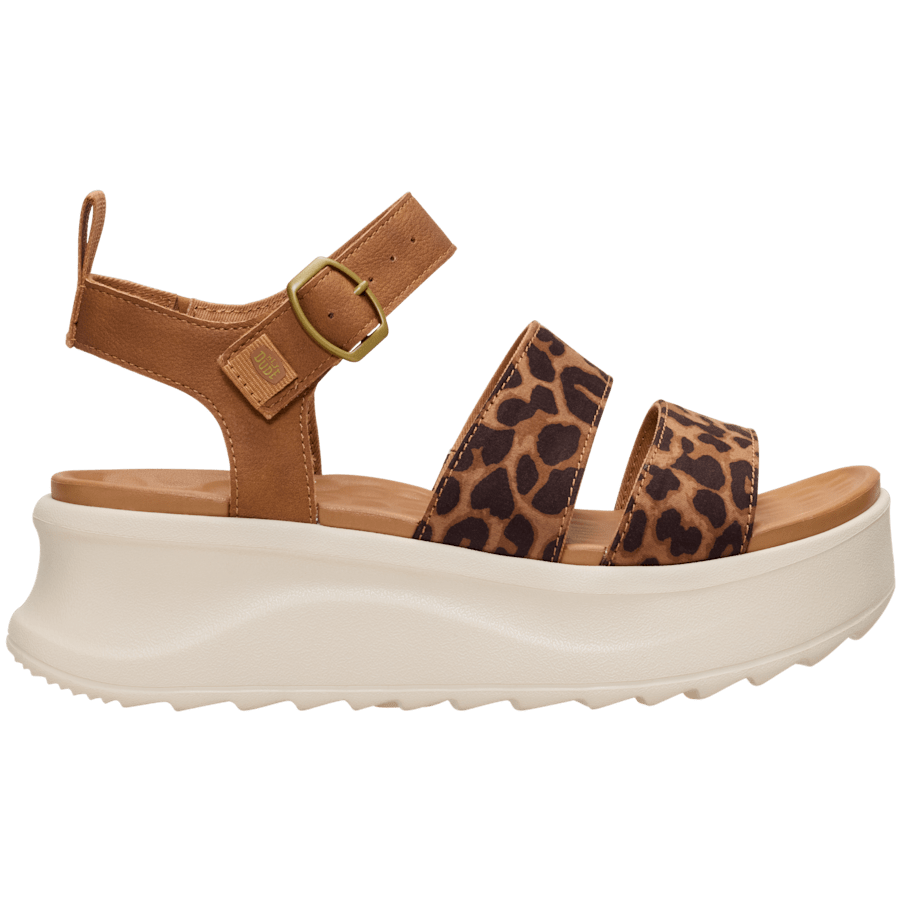
For women who want a sandal with more structure, more presence, and more personality, the Delray Buckle Classic delivers on every front. This is the most feature-rich sandal in the current collection, and its 4-star rating from 47 reviews confirms that customers are responding enthusiastically to what it offers.
The Delray Buckle Classic is where foam and function meet foot. It combines on-trend style with lightweight footing and secure straps to give you ultimate comfort and style wherever you go. The design centers around an adjustable functional buckle that allows you to customize the fit across the top of your foot, while an internal gore system hidden beneath the buckle provides additional stretch and flexibility for a fit that adapts to your foot throughout the day.
The textile lining adds a soft layer of comfort against the skin, and the heel pull tab makes getting the sandal on and off quick and effortless. The contoured EVA footbed provides the anatomical support that defines the series, and the platform height of 66.5mm (approximately 2.6 inches) delivers a fashionable lift that pairs beautifully with everything from casual shorts to summer dresses.
Available in four bold colorways including an eye-catching Leopard print that makes a genuine style statement, the Delray Buckle Classic is sized in women’s 5 through 12 and priced at $69.99. It is tagged as NEW, and its combination of adjustable fit, premium materials, and striking design makes it the go-to sandal for women who refuse to choose between fashion and comfort.
Tide Espadrille Slide | $39.99
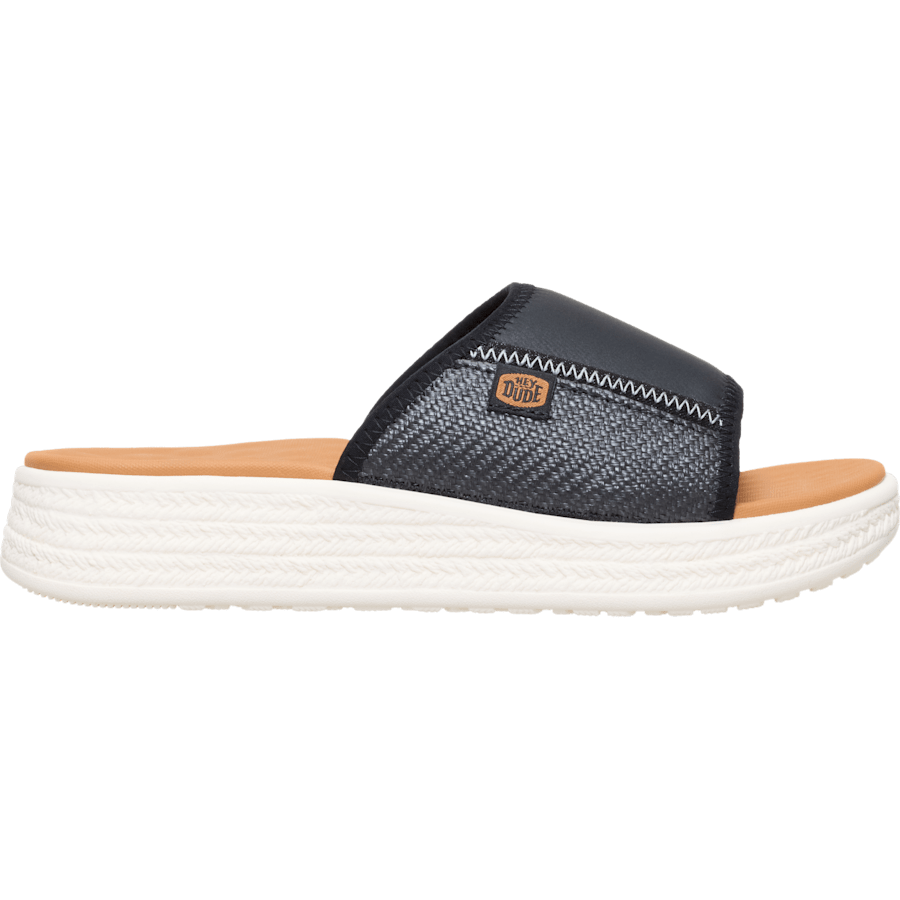
There is something inherently appealing about espadrille styling. It evokes coastal living, relaxed weekends, and the kind of effortless sophistication that never goes out of season. The Tide Espadrille Slide captures that entire aesthetic while delivering the modern comfort technology that HEYDUDE is known for.
The description says it best: easygoing comfort meets coastal vibes. The squish foam lined upper strap is the signature comfort feature here, wrapping your foot in a soft, padded embrace that makes the sandal feel broken in from the very first wear. The slip-on design keeps things effortless, requiring nothing more than a quick slide to get you out the door.
What makes the Tide Espadrille Slide technically impressive is the DUDEWAVES TECHNOLOGY integrated into the footbed. This proprietary texture pattern enhances comfort while improving underfoot airflow for breathability, addressing the common problem of hot, sticky feet that plagues many closed-footbed sandals. The molded espadrille-inspired outsole gives the sandal its distinctive coastal character while providing a stable, comfortable base for all-day wear.
Available in Black/Egret and sized in women’s 5 through 12, the Tide Espadrille Slide is priced at an accessible $39.99 and is travel ready. For women who want a sandal that carries a sense of relaxed sophistication without the weight or discomfort of traditional espadrilles, this slide is a perfect match.
Wave Slide Men | $24.99
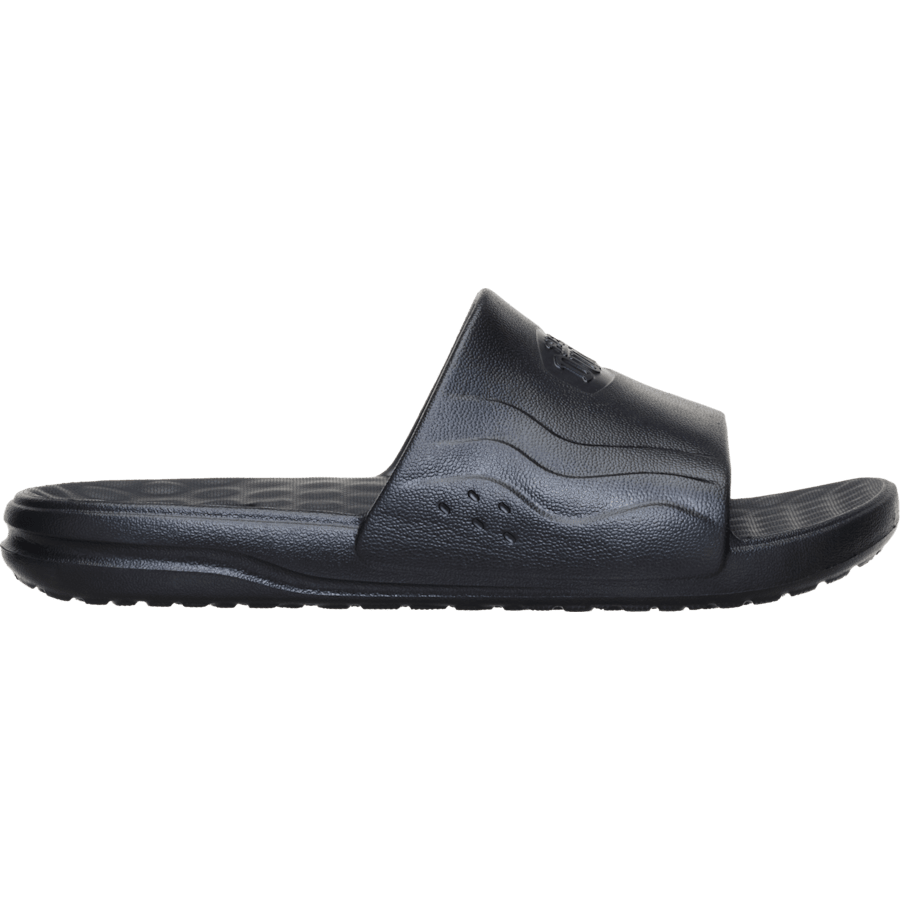
Sometimes the best design is the one that strips everything back to its essentials. The Wave Slide Men embodies this philosophy completely, delivering a monochromatic, minimalist slide that prioritizes pure comfort and function at an unbeatable price point.
At just $24.99, the Wave Slide Men is the most affordable sandal in the current collection, but do not let the price fool you into thinking corners have been cut. The upper molds to the foot for a snug fit, meaning the sandal adapts to your individual foot shape rather than forcing your foot to conform to a rigid structure. This molding capability is a feature typically found in much more expensive sandals, and its inclusion here makes the Wave Slide an exceptional value.
The DUDEWAVES TECHNOLOGY footbed texture is present and accounted for, enhancing comfort and improving underfoot airflow for breathability. The lightweight outsole and flexible outsole work together to create a walking experience that feels natural and unrestricted, while the travel-ready construction means this slide packs easily and weighs almost nothing in your bag.
Available in Black and sized in men’s 7 through 15, the Wave Slide Men is tagged as NEW and serves as the perfect everyday summer staple. Whether you need something for the gym showers, the backyard, the pool, or a quick grocery run, this slide handles it all with quiet confidence and remarkable comfort.
The Technology That Ties It All Together
Across every sandal in this collection, two technological pillars stand out. The first is the contoured EVA footbed found in the women’s styles, which provides anatomically shaped cushioning that supports the foot’s natural structure. The 40 C Durometer rating on these footbeds indicates a carefully calibrated softness that absorbs impact without bottoming out, striking the ideal balance between plush comfort and functional support.
The second is DUDEWAVES TECHNOLOGY, HEYDUDE’s proprietary footbed texture system that appears across multiple styles for both men and women. This technology enhances comfort by creating a textured surface that improves underfoot airflow, reduces moisture buildup, and provides subtle tactile stimulation that keeps your feet feeling energized rather than fatigued.
Both technologies reflect HEYDUDE’s broader commitment to anatomical comfort, the idea that every sandal should be shaped around the foot rather than asking the foot to adapt to the sandal.
Your Summer Starts Here
The HEYDUDE Sandal Series offers something genuinely rare in the footwear market: a complete range of sandal styles that all share the same unwavering commitment to comfort, quality, and thoughtful design. From the yoga-mat softness of the Maui Breeze Flip at $34.99 to the fashion-forward presence of the Delray Buckle Classic at $69.99, from the water-ready performance of the Hey2O Flip Flop Mesh at $44.99 to the unbeatable value of the Wave Slide Men at $24.99, every price point and every lifestyle is covered.
Every sandal in the collection is travel ready, designed to be lightweight enough for packing and versatile enough for any warm-weather destination. And with the Refer a Friend program offering 25% off for you and 25% off for someone you share it with, plus Afterpay available for orders between $30 and $1,000, there has never been a better time to discover what anatomical comfort truly feels like.
Your feet carry you through every adventure, every errand, and every moment that matters. This summer, give them sandals that were genuinely designed around them.
Disclaimer: This article may contain affiliate links, and we may earn a commission if you make a purchase through these links.
The world of online gambling has been constantly expanding and evolving, with mobile casinos coming out on top in terms of recent innovations. According to projections, 2026 could be the year when a record number of people will be playing online casino games using their mobile devices. In fact, the level of convenience and accessibility that mobile casino gaming offers is such that you could find yourself playing during your commute, while relaxing at home, or even during your travels on mostbet online.
Besides the games themselves, one of the greatest charms of mobile casinos is the wealth of bonuses that players can receive. Whether it is a welcome offer, free spins, or loyalty rewards, such incentives can dramatically increase your gaming time and chances of winning. Of course, not all bonuses are created equal and if you want to get the most of your gaming session, you need to know how and when to use them.
This article will be your guide to mobile casino bonuses in 2026 and offer tips on how to get the most out of them.
Why Mobile Casino Bonuses Are More Popular Than Ever
Mobile casinos have been competing intensely for new customers and this has resulted in bigger and better bonus offers that are also more innovative. Since the majority of people who gamble nowadays prefer playing on their phone rather than using a computer, gambling operators come up with newer and better offers almost monthly that are targeted only at mobile users.
The major reasons why mobile casino bonuses are considered great are that you can:
Get quick access to promotions right through the application
Receive free spins for selected slot games
Enjoy cashback deals that compensate you for losses
Get loyalty points which can be redeemed for rewards
Have exclusive access to mobile-only bonuses
Being aware of these perks and knowing how to make the right choice and use bonuses will turn them into your secret weapon.
Welcome Bonuses: The First Step to Bigger Gameplay
A casino welcome package is typically the largest bonus the platform throws in with a new user’s first deposit. Its main aim is to lure new users to the site and is commonly a combination of a deposit match bonus and some free spins, especially when playing on Mostbet Casino.
In fact, a mobile casino can come up with the following offer:
100% deposit bonus up to $500
50 100 free spins on chosen slots
More loyalty points for mobile gaming
On the other hand, don’t forget to check the bonus conditions. Wagering requirements, game limitations, as well as time restrictions may make it hard for you to cash out your winnings.
The Rise of No Deposit Bonuses
A no deposit casino bonus is undoubtedly one of the most attractive promotions in the whole world of online gambling. Simply by the name, you can get a small bonus from the casino, usually free spins or a few dollars in credit, without even making a deposit.
These types of promotions are, in fact, very frequent in 2026 and mostly on mobile platforms since casinos are eager for people to install their apps and try the new games.
The advantages of no deposit bonuses are:
Exploring games without any risk
Testing mobile capabilities
Winning real money without any investment
Yes, these bonuses have more strict wagering requirements than usual but nevertheless, they are a wonderful way for newbies to get familiar with online casino playing before investing their own money.
Free Spins and Slot Bonuses
Almost all the games in mobile casinos is slot games, that is why free spins are the most popular promotional offers. So if you are a person who likes spin the reels, first you have to know how to win casino slots because that is where the bonuses give you more pluses.
Free spins give players a possibility to have a go at the games without spending their own money. Usually any winnings that come from these spins can be turned into real cash by meeting the wagering requirements.
Can You Really Start Your Own Online Casino?
Online gambling is growing so quickly that many entrepreneurs have started thinking about how to start a casino. Using modern white-label solutions and gaming software providers, launching a digital casino is something you can do now.
Nevertheless, it still involves:
Getting proper licences and following regulations
Having safe payment methods
Making deals with game developers
Creating powerful marketing campaigns
Despite the complexity, the booming mobile gaming industry keeps drawing the attention of those who want to invest in the next big casino brand.
Final Thoughts
In 2026, mobile gambling will be faster, smarter, and more rewarding than ever before. As the smartphone is becoming the main device via which people get their entertainment, mobile casinos are always coming up with new promotions to not only attract players but also keep them engaged.
Bonuses like welcome packages, no deposit casino offers, and free spins are among the best methods players have at their disposal for trying out different games and making their winnings grow, potentially. Knowing the rules, selecting the right promotions, and even mastering the winning ways of a casino slot can all contribute to turning a mobile casino bonus into an essential part of your gaming strategy.
If you play with a responsible attitude and take full benefit of the best offers, mobile casino bonuses can actually turn an ordinary gaming session into a very thrilling and even rewarding one.
A Friend, a Murderer isn’t your average crime docuseries. Rather than focusing on the victims or killer, the Danish production shines the spotlight on the killer’s close friends. This approach ups the unsettling factor.
It also makes the series incredibly watchable. With 3.5 million views last week, A Friend, a Murderer is currently the fourth most-watched non-English show on Netflix in its second week navigating the charts. Should viewers expect more episodes?
A Friend, a Murderer Season 2 Release Date
At the time of writing, there’s no official news about any potential A Friend, a Murderer season 2. Given that this is a docuseries, a follow-up is unlikely unless new information comes to light.
Even then, the production focuses on the perspective of the perpetrator’s entourage. There’s a good chance they’ve shared everything they felt comfortable to, so the three episodes available might be all there is.
A Friend, a Murderer Cast
The docuseries offers interviews with three of the killer’s former friends. It also features contributions from a journalist, a local priest, and other figures relevant to the case.
What Is A Friend, a Murderer About?
A Friend, a Murderer is a three-part true crime series that explores how a quiet Danish community was shattered by a string of violent crimes. Not only that, but it delves into another shocking revelation.
The docuseries is told through the perspective of three friends who look back on their past with someone they trusted. As the investigation unfolds, they are forced to confront an unbearable truth. Turns out, the person responsible for inflicting terror was someone who had been part of their everyday lives.
Blending interviews and reconstructed memories, the series focuses less on the killer himself and more on how he managed to hide in plain sight. That way, it removes the usual distance we place between ourselves and true crime. There’s no obvious villain archetype here, like a loner or outsider. Just a man living a horrifying double life. It makes you ask yourself how well you truly know the people around you.
The killer is now behind bars, and the friends have told their story. While A Friend, a Murderer season 2 is unlikely, the three episodes streaming are unnerving, to say the least.
Augusta Koch came to Jeff Rosenstock asking for advice. The ex-Cayetana songwriter, who now plays in the bands Gladie and Universal Girlfriend, had been touring with the punk rock lifer on and off for over a year when she sent him demos of Gladie’s galvanizing new record, No Need to Be Lonely, the follow-up to 2022’s Don’t Know What You’re In Until You’re Out. By that point, more than just demo friends, they were friends friends, putting Rosenstock in the general category of people that many songs on the album feed off of and serve to uplift. “I brace myself to embrace you,” roars the chorus of one early single; “Know that I look to you, just to keep myself moving,” goes another. Rosenstock decided to produce the record, and they tracked it live to tape with Jack Shirley at Atomic Garden in Oakland. It’s no surprise the most dynamic songs on No Need to Be Lonely end up sounding eruptive, but the collaborative spirit enriches and sweetens the quieter songs, too, from the devastating catharsis of ‘Fix Her’ to the raw confessions of ‘Blurry’. It’s the rare gut-punch of a record that makes you feel lighter each time you play it.
For the latest installment of our In Conversation series, Jeff Rosenstock and Gladie’s Augusta Koch hopped on Zoom to talk about their friendship origin story, sobriety, making No Need to Be Lonely, and more.
Augusta Koch: This is gonna be hard, because we really hate each other.
Jeff Rosenstock: [laughs] I think it’s gonna be hard because the opposite, which is the truth, Gus, which is that we really like each other, so I prepared nothing. I’m like, “It’ll be fine,” but now I’m like, “What do I have?”
AK: Yeah.
JR: What color’s your hair? Why do you play all six strings of the guitar? What’s your favorite kind of instrument cable?
AK: I actually got really cool new ones, Jeff.
JR: Yeah? Do you have coilies?
AK: No, they’re all neon.
JR: Nice, I love that. Do you all have neons, or is it just you?
AK: Just me.
JR: Lead singership.
AK: I know, I’m a brat. That was good.
JR: I started using white cables, and I found that I don’t trip over them as much on stage anymore.
AK: Because you see them. That’s valuable.
JR: They’re very valuable cables. You know what’s fucking bullshit? [laughs] This is maybe for no one, but remember how Monster guitar cables were more expensive, but then it was you could go to Guitar Center, and they’ll just give you another one anytime they break?
AK: I know that.
JR: Well, they don’t do it anymore. Now they’re like, “We have to mail them away,” which is useless on tour. But the cheap ones, they do that with. Anyway.
AK: Weird. Do you buy cheap ones now?
JR: Yes.
AK: Cool. I’ve never broken a guitar cable.
JR: What? I think I break them all the time. It’s the easiest thing to break.
AK: I don’t break guitar strings either, though.
JR: You don’t change your guitar strings, right?
AK: Here’s a good way to start the interview. How long ago do you think I changed my guitar strings?
JR: I don’t think you’ve changed them since we made the record.
AK: Absolutely.
JR: Is it the guitar you brought on our tour?
AK: Yes.
JR: I don’t think you’ve changed him since that tour?
AK: I did change them before we recorded.
JR: Oh, okay. So a year. The guitar of mine that you used, I haven’t changed the strings on since the recording. But I haven’t toured with it. You know who doesn’t like to change strings? A little old man named Neil Young.
AK: I’m just like Neil. [laughs]
JR: You’re just like Neil.
AK: I’ve been saying this.
JR: Alright, that’s all my questions.
AK: Yeah, that’s all I got.
JR: We started at a book club. I feel like this could delve really quickly into, like, what’s all the private stuff that we get into on our own time that is both not interesting and also…
AK: Really depressing.
JR: Yeah?
AK: We talk about depressing stuff.
JR: But talking about depressing stuff isn’t depressing, talking about depressing stuff is good.
Are the books you’re reading depressing?
JR: It isn’t an uplifting book so far.
AK: The book club is called Bookworms.
JR: We have a Discord with a few friends. We’re currently reading The Great Believers. Some of us are… It seems like we’re all reading.
AK: Allegra [Anka] is reading it.
JR: Goo got it. Matt [Schimelfenig] got it. Ginger [Alford] couldn’t find it and got a different book.
AK: That’s not how a book club works, but okay.
JR: [laughs] But maybe it’s how our book club works.
AK: I like it, freestyle book club. But it’s a good book. I was reading it this morning.
JR: How do you feel about the middle of books?
AK: I’m locked in. I’m gonna be in the van for 36 hours, I’m gonna finish that book.
JR: I know, and I’m playing that game, Silksong, that Mike [Huguenor] and John [DeDomenici] were screaming at in the back of the van on our whole last tour.
AK: Yeah, that was annoying.
JR: It’s a hard game, and I’m probably not that deep into it, but I feel like that was slightly overreacting.
AK: Yeah, when I went on tour with Jeff last year, there were people screaming about a video game.
JR: But I was screaming, too. I was screaming aboutjumpy game. So, half of us were playing Silksong, and then me and Rick and sometimes Gus were playing this game called Velgris, which is part of this other game called UFO 50, where you just have to keep jumping. It was a very complicated game, and then a very simple game. And all of it made us scream. Kevin [Higuchi]’s watching YouTube. Christine [Mackie]’s scrolling. Dan P’s up there, ribbing Rick Johnson. What’s your van vibe like? I know that you and Matt split the drives, but what’s everybody else up to?
AK: Well, everybody drives now. We listen to music.
JR: I know, Miles [Ziskind], death metal guy, we talk about death metal a lot. But what’s everybody listening to?
AK: If you’re the driver, you pick the music. Classic rule. But Miles listens to a lot of jazz.
JR: Freaky jazz or chill jazz?
AK: Both. And a lot of hip-hop. Evan [Demianczyk] likes 90s’ emo shit. I listen to, you know, the same old stuff.
JR: What’s the same old stuff? What gets your gears turning when the wheels are turning?
AK: I like to listen to new music on tour. I make some playlists. I’m excited, because Aldous Harding’s record is coming out while we’re on tour. I also like to listen to podcasts. I think we’re gonna try and do a book on tape for this drive.
JR: Do you know what yet?
AK: No, we’re doing some research. You have any good recommendations?
JR: It depends on how willing you are to commit to this, but Scar Tissue, which is Anthony Kiedis’ biography.
AK: Oh, I’ve heard that is really good, actually.
JR: Ryder Strong, who played Sean Hunter on Boy Meets World, is excellent.
AK: Funny you bring that up, he was my first crush.
JR: Oh my god, this is a hard recommendation. You will not be disappointed.
AK: I do love music books, and I heard it’s really messed up.
JR: It’s really messed up. He does voices for the characters, which is also kind of funny.
AK: That’s a great idea. There’s a Bruce Springsteen biography, which is fun. He reads it himself, and he says “fake problems” at some point, which is just fun to hear him say.
AK: I’ve read that book. I want to read the Replacements book. Danielle said it’s really good.
JR: I read Trouble Boys, but there’s another one, right? Did you read Trouble Boys?
AK: No.
JR: Trouble Boys was good. Man, that’s a sadass story.
AK: They were pretty crazy, huh?
JR: There’s the famous, Bob having quit drinking, and then Paul Westerberg saying, “Drink a beer, get the fuck off my stage,” and then he died of alcoholism after that.
AK: That is sad. Shouldn’t be mean to your sober friends, ever.
JR: Yeah, you shouldn’t be mean to your sober friends ever. Can we talk about that? Are you…
AK: Sure.
JR: How long have you been so–
AK: Well, remember when we were on tour, and I thought I had been sober for 4 years, but then I realized it was 5?
JR: Yeah. [laughs] One, five years to me feels like a major milestone, and I love that you just didn’t realize that you did it. And also, congratulations.
AK: Oh, thank you.
JR: Does it feel regular at this point?
AK: It definitely feels regular, I don’t really think about it at all, unless… Well, when my dog died, I wanted to drink. I think I texted you being like, “I want a drink.”
JR: Yeah, that makes sense. RIP Benny. Sweet dog.
AK: Yeah, the coolest dog. But yeah, it feels regular, I feel good. It’s nice to have something that you’re proud of.
JR: Sure.
AK: And… I don’t wake up feeling like shit.
JR: No?
AK: I mean, for other reasons.
JR: Come on, I’m not believing that!
AK: I don’t wake up, like, covered in shame.
JR: That’s true. Well…
AK: Just regular self-hate.
JR: [laughs] Regular shame, not drunk shame.
AK: Yeah, I can’t even imagine it.
JR: I’m noticing that younger folks drink less. Younger folks don’t drink at all. They don’t give a shit.
AK: They don’t. They’re over it.
JR: You’re on the next wave already. You’re basically Gen Alpha.
AK: I know. I’m getting younger.
JR: What’s beyond that? Gen Beta? Which brings us to cuck chairs, which you love, so that makes sense. And we could quickly explain cuck chairs, how do you feel about that?
AK: You can explain it, Jeff.
JR: I mean, is your press cycle all cuck chairs because of… [laughs]
AK: Yeah, I think so.
JR: So, cucking is essentially, you sit and you watch your partner fuck somebody else, and you do whatever you do while that’s happening. A cuck chair – which, once you see it, you can’t unsee it – it’s in pretty much every hotel room. There is an inexplicable armchair that’s just angled towards the bed. I kind of always thought it was for, like, if you want to sit and read a book or something.
AK: I think it is a reading chair.
JR: It could be both. So, what are you looking for in a cuck chair?
AK: Just something funny. Like a ‘70s vibe. Do you ever see those egg chairs?
JR: Yeah. Like a hangy egg chair?
AK: Yeah. Or a hammock.
JR: Cuck hammock.
AK: That’s gotta be… Someone’s doing that. We gotta move on from this. Why don’t we talk about our friendship origin story?
JR: I was trying to think about this. It seems like we were friends, and then we were immediately, like, very good friends. And I don’t know when that switch flipped. I know the bond got strengthened when we did that tour with [Sydney] Gish that we had to end. But I feel like it was already pretty strong there, and I’m not sure exactly where that came from.
AK: You know where it came from? ‘Cause I was thinking about this today. When we hung out at Steve’s house from PUP, when it was Cayetana’s last show in Canada. That was the first time we really talked. Like, we had been friends, but we never talked.
JR: At that point, you had done the compilation, right?
AK: Oh, Don’t Stop Now? Yeah, I had done a few of those. And you always said yes, which was nice.
JR: Yeah, I loved it, and I loved Cayetana, I loved Gladie.
AK: And then we played the Sheena, Anika, and Augusta shows.
JR: Yeah, and that was fun. What a great record.
AK: And then we became better friends. Yeah, I was listening to it the other day.
JR: For anybody reading this, the Sheena, Anika, and Augusta 7”, Simple Pleasures, with artwork by the wonderful Danielle DuBois.
AK: But then we played that show, and I think that was also the beginning.
JR: Yeah, it was like building blocks. I think we have a lot of same-brain stuff – aside from our mental health issues, we like a lot of the same music, books, and things like that. I guess once we were on that tour, it was just like, “Let’s go.” And I think we were all just blown away by Sydney Gish every night.
AK: Yeah, that was a really fun tour. That was the first tour in a long time where I was like, “This is so fun.”
The first time you really talked, do you remember what that conversation was about? Music, books, mental health?
AK: You know what I think we were talking about?
JR: What?
AK: Politics.
JR: Okay. Was that when you found out my politics were good? [laughs]
AK: I always assume that they’re terrible.
JR: Same with you, and I was like, “Wow! She doesn’t like Trump. Okay, I’m in.”
AK: I think that’s what it was, because I do remember tangentially talking about Bernie Sanders, but not really…
JR: I bet that was around the time that we would be talking about the conflict that exists within Bernie Sanders having a lot of really good policies that I agree with, but how nice it would be to not vote for a fucking old white guy?
AK: Yeah, because that was 2019, so it would have been right before good old Sleepy Joe.
JR: Good ol’ Sleepy Joe. Our finest president.
AK: Is he dead? I think he’s dead.
JR: Which one’s gonna die first? Oh my god, do you know about this fucker, I forget his name, who’s like 59 years old – he looks like he’s 30 years old, and he’s like, “My goal is to never die. And if I ever am close to dying, I’m gonna be uploaded to the singularity, so people could learn from me.” It’s like, “Learn what? You’re a fucking idiot, and you don’t respect how fucking life has worked for millennia, you dumb shit?”
AK: Is he the guy who has the documentary about himself?
JR: Maybe. I just read an article on him. He sounds like a guy that would.
AK: Would you want to be uploaded to a cloud?
JR: No. I am uploaded to a cloud. Music. I already did it, you know, and so did you. But I think it’s gross. I think it’s really arrogant to be like, “I want to be in the cloud so people can experience me for all times.” But at the same time, I think it’s beautiful that when you make music, in a way, even if in a small way, it lives on, if not forever, for a really long time. It could get passed down from generation to generation to generation, even if just one tape survives 20 years from now. And even beyond music, just your memories of somebody keeps them alive, and retelling their story keeps them alive. So, I’m into that shit, and then I’m like, “Well, is that really any different than this fucking ding-dong?”
AK: I think it is. Because it’s music, and it’s beautiful.
JR: Would you want to upload yourself to the cloud?
AK: Absolutely not. Would you ever want to be frozen? Like, so you could get brought back to life?
JR: Oh! Yeah. I’ve never thought about it, but sure. You wouldn’t want to?
AK: I wouldn’t. I don’t want to wake up in, like, 50 years and be…
JR: Oh, wait, I’m gonna be brought back to, like, 50 years from now? [laughs] That’s not exciting.
AK: Yeah, wouldn’t it be weird?
JR: Yeah, but I don’t know, it’s weird now.
AK: I mean, maybe it will be better.
JR: I don’t think I would benefit from it mentally or emotionally or anything, but I think it would be funny, and I love a good bit.
AK: It would be scary. Everyone you know would be dead.
JR: Yeah, but… That’s true. That’d be fucked up.
AK: Did you ever read that book when you were a kid, Tuck Everlasting?
JR: No.
AK: Where they drink this water, and it makes them live forever, and it’s really sad.
JR: Okay, living forever… hard pass. Hard pass onliving forever. Let’s say it’s a fine point to be frozen when, like, I’m about to die, but also my body still works, and something’s miraculous about it. And then I get to live out my final year in, like, a crazy future. Why not?
AK: Yeah, that’s kinda nice, actually. How about this, Jeff, we can talk about how we came to make the record together.
JR: You sent me demos, right?
AK: We send each other demos, which is a really cute thing. I think that’s one of my favorite parts of playing music, is friends sending each other demos.
JR: I send demos to you and, like, Chris Farren, and that’s pretty much it.
AK: It’s nice, though. It’s nice to have demo friends. I sent you mine, because I was asking for advice. And you called me, because I remember sitting outside, and Matt was there too, and you were like, “Let’s do this!”
JR: I remember being in the van, asking everybody. I was like, “I think I wanna produce this Gladie record.” Because I hadn’t really produced a record since before the pandemic. I recorded this record by this band, Fuss, on my 8-track, but that wasn’t really the same thing as this. I was scared to do it, but you were like, “Do you have any advice on this stuff?” And I remember feeling like I do have advice, but I feel like more than advice, just being there and being able to try and encourage everybody into believing that it’s good, and feeling all the shit in there, and getting Jack involved to record it super clear and super well. I really liked the demos, and I really liked the songs. I think I said, “I feel like I could see some spots for, a little bit of extra dynamic,” and you were like, “Yeah, I feel like maybe it feels a little flat.” And I was like, “Okay, we should just do this.” Because that’s easier than texting. I don’t even know what I would text. I really like your records, they’re really lush and cool, and when I heard these songs after touring with you for so long, I was like, “I feel like Gladie’s ready to rip.” I just wanted to be the little friend in the ear being like, “Hey, make this one rip!”
AK: Yeah. I would say one of your greatest qualities as a person is that you’re very encouraging.
JR: Thanks. I’m glad you feel that way. Sometimes I feel like Tina Fey in Mean Girls. I’m a pusher. I’m a mean old pusher.
AK: No, it’s a good thing. I was thinking about what to write for the record tomorrow [release day], because I haven’t done it yet. I’ve been doing an email blast.
JR: Love it. I like emails these days.
AK: Me too. I saw this fucking quote on Instagram yesterday, and I don’t repost quotes because I’m like, “That’s corny,” but in my heart, I love them. It was something like, “I always try and mention my friends’ names in any room that wants to hear them, because that’s what friends do.” And I always try to do that, but I also think you are a great example of that.
JR: I try to do that.
AK: But you do that for everybody, and as someone who is now – I know you’re not gonna like this, but your band is really big now, and you still do that. So many people that I came up playing music with got really famous, and I saw that they don’t really uplift people anymore. And I’m like, “Damn, that sucks.” It’s so important for me – that’s how music works, I think. You have to uplift smaller bands. I still listen to and try and know what’s going on in Philly with 20-year-old bands, kids that are young, because that’s what’s helped me. I’ve tried to do that for people, and I think you’re really good at doing that. Encouragement to me is a big part of the record. A lot of it is friends that encourage me, and me trying to be a good friend. And also trying to do that for myself even though I’m out of it.
JR: It’s hard, the second thing’s harder. I wonder if there’s some toxic part of it – of course I wonder if there’s a toxic part of this nice thing you just said to me [laughs] – where it’s easier to do that for others than it is to do for yourself, because there’s a really blurry line between when you give yourself a compliment versus when you are an arrogant fucking prick. Where you’re full of yourself and you got a big head and your ego’s crazy. That’s the kind of person I don’t like to be around, and that I don’t want to be, and it makes me feel gross. But we all see bands get more popular, and when they don’t bring everybody into the party – the bands I liked growing up did that. I would read the thank you notes on the liner notes of records and find out about bands that way, because I feel like these punk bands that got bigger would shout out their smaller punk band friends, and it worked like that. And then I feel like there was maybe a bit of an era where a band would get some indie fame, and it was like, where’s this scene behind you? You gotta do what you gotta do to keep it going, in a sense. But also, I don’t think it works, man. That isn’t gonna work out for you, because then when your moment is done, you’re just around, and you have no one, and where are your friends? You kind of said fuck you to all of them. Maybe I’m speaking too hypothetically now, because I don’t even know what I’m talking about.
AK: No, I think that’s true.
JR: I think AJJ’s really good at that.
AK: They’re great at that.
JR: I think it’s cool that as big as they have gotten, they’ve really always taken friends–
AK: They’ve taken me on tour twice. That kind of stuff is so helpful. I always think about how I want to be, and how I would like to be as opposite from all the bad things in the world.
JR: Very noble of you, Gus.
AK: No, but in the sense of, like, if I’m going to hate these elites, or these people destroying the world, I want to try and figure out how to do the opposite, which is not being bitter, not being individualistic, not being a hater all the time, even though I can hate a little bit. Really trying to remind myself of living by some good values. And it’s also nice to have role models. We have a lot of good friends that do that, I think.
JR: Leaning into that vibe, something that stood out to me when I heard the demos of this record were the lyrics. They’re very much like talking to a friend, but also, talking to a friend that’s often encouraging you, and encouragement is such a difficult thing to put into a song without it sounding saccharine or like self-help bullshit. But I think you really pull it off in an incredibly special way on this record, especially ‘I Want That for You’ and ‘Brace Yourself’. Do you feel like there was a shift on this record where you wanted to do that more? Does it feel like something you were always doing? Does it feel like a natural progression?
AK: I don’t know if it’s changed, I feel like it’s kind of the same. But your life changes, so it’s gonna change what you’re writing about a little bit. The last record was so much about being sober, and the weird thing that happens when you’re sober for a while is, I do think you kind of learn who you really are, for better or worse. I realized that I had some really bad codependency issues, and I think when people say codependency, it’s like you’re reliant on a partner. But when I actually started working on that, I realized it was being a people pleaser. Being a people pleaser, to me, now that I’ve tried to do some work on it, is not really knowing who you are; or knowing who you are, but being afraid to advocate for yourself or be strong. I notice it in little tiffs that come up where I’m alarmed, and I don’t know how to react because I don’t want the person to think badly of me. It’s not a good thing.
JR: I know, for sure.
AK: In a way, it’s incredibly disingenuous. It’s been something that I have had to work on a lot. But then it’s also revealing your true nature, which can be good and bad. Because it’s hard to stand up for yourself. I think a lot of the record is about standing up for yourself. Something I’ve noticed in this sobriety healing shit is that when you change and you were always a pushover, people don’t like it. And that’s really hard, and people talk about that, but seeing it in actuality – I’ve had relationships that have really changed that were really important to me because I stopped being a pushover. And that is super weird and really depressing, because then you realize: Did you ever really love me, or did you love that I just accommodated you all the time? So with the encouraging aspect, I try and be a friend that people can come to, and – here’s a compliment, I will say I’m a good friend.
JR: You’re a great friend.
AK: But I also realized that a lot of my relationships changed when I was like, “This isn’t a reciprocal friendship.” When I stopped being a pushover, I lost some people that I really cared about. And so, the encouraging of friends is also selfishly written for me.
JR: I’m not trying to just throw a warm blanket and a mug of tea at you right now, but also, that stuff that is for you, like psyching yourself up to face difficult moments through the course of this record, it’s just strength and resilience that you can feel and makes you feel like, “I could do this too.” There’s something really special about the lyrics on this record that resonate with the person inside, at least me, and I think will with others, that wants to get better at that, to be strong enough to advocate for themselves, and not conflate advocating for yourself with being unkind to others. I think that must be difficult for you as, honestly, one of the kindest people I’ve met in my entire life. Like, how do you advocate for yourself when people see you as this beam of kindness? And it’s like, well, no, sometimes I feel like shit, and sometimes I want things too.
AK: Yeah. And I do think the nice thing that I learned in this little chapter is I’m being more honest with myself, and I’m being more honest in my relationships. I’m not gonna have a bunch of relationships that aren’t real anymore. And I think the relationships I do have are much richer.
JR: Can I ask you some questions about the making of the record?
AK: Sure.
JR: Can you describe the smell of the house that we stayed in?
AK: It smelled like sewage.
JR: How did you feel about the sewage smell?
AK: It didn’t bother me that much.
JR: What was your favorite thing you watched while we were there?
AK: Mr. Beast videos.
JR: That was your favorite?!
AK: I think that’s all I remember. You showed me MrBeast!
JR: MrBeast is… Look, I’m not in or anything, but I feel like everybody’s gotta see one of those once, it’s crazy.
AK: I think it just came out that he’s alt-right.
JR: That he’s alright?
AK: No, that he’s alt-right. So the opposite.
JR: Who the fuck is shocked that MrBeast is alt-right?
AK: Not me.
JR: No one. I feel like he was doing these stunts where it’s like, “I bring a million gallons of water to this starving community somewhere,” and I feel like people were like, “Fuck you, man,” even though he was trying to do a good thing. So I could see how he would get, like, “Fuck you, guys, I’m just gonna be 100% bad. I’m not trying to be 2% good.” So, I can’t buy Feastables anymore at the store, because he’s alt-right, that’s good.
AK: I know, sorry, Jeff, it sucks.
JR: Cancel my subscription to his zine. [laughs] What about Jack? He’s a fun little sweet weirdo, and I love him.
AK: Well, I was scared of him at first.
JR: Yeah? Why?
AK: Because he’s a hardcore guy, and I was like, “What if he hates me?” Everything he records is, like, crazy. Besides your band, of course. But he records a lot of heavier stuff! And then, he was so sweet. He does intermittent fasting, which I think is really cute.
JR: What’s your favorite song on the record right?
AK: I think my favorite is ‘Talk Past Each Other’.
JR: Cool!
AK: I like a slowie, you know this.
JR: It’s a short, chill slowie, too. And you got no slow songs as a single, huh?
AK: Well, ‘Brace Yourself’ is kinda slow, right?
JR: I guess I’m equating slow with quiet, which is wrong.
AK: ‘Blurry’ was cool.
JR: One take?
AK: One take. And ‘Fix Her’, I think, is one of the ones I’m most proud of.
JR: You should be. That song is special.
AK: We’re playing it on this tour, which is fun.
JR: How are you doing the piano stuff?
AK: We’re not.
JR: Cool!
AK: It’s just guitar. But my favorites are always the songs that no one likes. How about you?
JR: ‘Fix Her’ is one of my favorites, too. If I had a voice in it, which I shouldn’t have, because that isn’t how it works, but if I was in this band and I got a vote on a single, I would have ‘Fix Her’. I like ‘I Want That For You’ a lot.
AK: That’s the most meaningful song, I think.
JR: Yeah, that’s a beautiful tune. ‘Car Alarm’ is a banger. Really like ‘Unfolding’. And low-key ‘Poison’. It’s such a good punk jam.
AK: That’s gonna be fun to play on tour. Wait, really important question, are you still blue?
JR: Kinda. [Takes off hat] I have a little, but it’s on its way out. I had a short little era here, and that was fun. What, you’re disappointed?
AK: A little bit.
JR: I don’t want to like the maintenance of it. It doesn’t seem like you have to do maintenance at all. Because I toured with you, and it was just good blue the whole time.
AK: I just throw it in my hair and then wash it out.
JR: How do you not get it all over your fucking head?
AK: I don’t have that problem.
JR: Yeah. You got more hair! When you got more hair, it’s easier. But I’m also low-key painting, like, the thin spots of my head with blue, which feels weird.
AK: I think it’s cool.
JR: It’s fine, it’s fun, but also, I’m not gonna do it for a little bit. Now I’m in Suicidal Tendencies hat era, which I feel like is gonna be a short era.
AK: Dude, I’m in hat era, too.
JR: Yeah, let me see some hats. What do you got?
AK: It’s not in this room. I have one hat. It’s blue, and it says Angel Du$t.
JR: Oh, wow. So they’re both hardcore hats.
AK: We’re tough.
JR: Yeah, we’re tough. What record are you looking forward to this year, aside from Aldous Harding? Talk about Aldous Harding a little bit.
AK: I always talk about her, man. I love her. But I’m also excited for Hurray for the Riff Raff’s live record that comes out tomorrow. I don’t normally like live albums that much, but I heard the first two songs from it, and it’s so good. I’m excited to be record birthday twins with that record.
JR: I’m really excited for your record to come out tomorrow. I think people are really really gonna love it.
AK: I’m excited, too, because if it fails miserably, I’m just gonna go to nursing school.
JR: So, either way… Either the record is good or you’ll be like, “Thank God I don’t have to keep trying to fuckin’ be a professional musician,” one of the dumbest things you could try to do.”
AK: But I’ve done it a lot longer than I thought I would.
JR: And the thing that I think rocks about you, and this is where, again, same brain: I think you’re gonna play music forever.
AK: For sure. I really look forward to being an old lady playing music in my garage with my friends.
JR: If we’re living in the same location, and we’re old, can we rock together? Or at least play shows together.
AK: I would love to rock together, our band would be so good.
JR: Right? What are we playing? I’m playing drums, what are you playing?
AK: I’m just singing.
JR: Wow, now we’re a mature indie band. Drums and vocalist.
This interview has been edited and condensed for clarity and length.














 Water and sandals have a complicated relationship. Most flip flops become slippery, uncomfortable, or outright hazardous when they get wet. The