For the hysterectomy, this is a major surgical procedure that can also require precision, proper medical judgment, and strict adherence to these medical standards. When the doctors or healthcare professionals fail to meet these standards, the patients can suffer severe and sometimes permanent injuries. For hysterectomy malpractice lawyer it can help victims by pursuing compensation for the physical, emotional, and financial harm that can be caused by negligent medical care.
For Understanding Hysterectomy Malpractice
The medical malpractice might occur during or after this hysterectomy when these surgeons, nurses, or medical facilities fail to provide care that meets the accepted medical standard. Here are some common forms of this negligence:
Surgical Errors
By Accidental perforation the bladder, bowel, or ureters
For Inadequate control bleeding
Leaving surgical instruments or the sponges inside these body
Incorrect surgical technique leading to organ damage
Misdiagnosis or the Unnecessary Surgery
Performing the hysterectomy that was not medically required
Failure to explore less invasive treatment for options
Misinterpreting imaging or the test results
Anesthesia Errors
Improper administration this anesthesia
Failure to monitor vital signs
Allergic reaction complications ignored or for mishandled
Postoperative Negligence
Failure to diagnose internal bleeding
Untreated an infections
Delayed intervention for these complications
Inadequate discharge for instructions
Here are some common injuries associated with these hysterectomy malpractice claims
With this negligence, a hysterectomy can lead to serious and life-altering injuries, such as:
Organ damage, for example, to the bladder, bowel, ureter
By this severe infection, or the sepsis
Uncontrolled bleeding
Blood clots
Chronic pelvic pain
Loss of fertility
Need for the corrective surgeries
Long-term disability
These injuries may often require extensive medical treatment, and this can have lasting emotional effects.
How a Hysterectomy Malpractice Lawyer Can Help
A skilled medical malpractice attorney provides the essential support, including:
Through this Case Investigation
Your lawyer will review medical records and consult with experts to identify where the standard of care was violated.
By Proving Medical Negligence
To win a malpractice case, these attorneys will have to show:
This doctor-patient has relationship existed
The healthcare provider breached these medical standards of care
The breach caused injury.
The injury may led to damages
Working With Those Medical Experts
These expert eyewitnesses are crucial in these hysterectomy malpractice claim cases. They can help you by explaining what the medical team should have done and by how mistakes caused it harm.
By Pursuing Maximum Compensation
A hysterectomy malpractice lawyer fights for damages such as:
Medical bills (past and future)
Lost of wages and diminished earning capacity
These Pain and suffering
This Emotional distress
Loss of the quality life
Costs for this future medical care or the rehabilitation
This is by Handling Insurance and legal procedures.
When those medical malpractice cases are complex and heavily defended. An attorney will manage all communication, filings, and deadlines for these negotiations by ensuring your rights are protected.
Who Will Do Contact a Hysterectomy Malpractice Lawyer
It should be to seek legal help immediately if you have experienced complications or injuries after a hysterectomy and suspect negligence. Early consultation helps to preserve evidence and maintain deadlines, and these strengthen your claim.
A hysterectomy has to change a person’s life, and when the complications occur due to medical negligence, these victims deserve justice. A hysterectomy malpractice lawyer can help you to hold the negligent healthcare providers accountable and pursue the compensation you need to move forward.
Newborn sessions fly by, even when the room seems still. You have got a small window when the baby will be settled, the light will be soft, and the parents will be feeling relaxed. The real pressure comes after the shooting. Knowing how to edit newborn photos is giving your customers images that look delicate, natural, and uniform. The right editor allows you to keep warmth in your skin, believability in the image, lift shadow without blowing out detail, and remove small distracting flaws such as flaky skin or blanket lint.
In this guide, we compare professional newborn photo editing software options that will ensure flattering yet believable baby pictures to match your clients’ expectations.
1. Luminar Neo
Luminar Neo is a strong fit when you need gentle polish, fast decisions, and a repeatable look across a full gallery. It allows you to balance the exposure and warmth so skin looks calm, not orange. After that, you can move on to more targeted adjustments in your baby photo editor: reduce glare on the forehead, soften tiny flakes, and keep texture in cheeks and lips.
Luminar Neo is sold as a one-time purchase in three perpetual tiers: $119 (Desktop), $159 (Cross-device), and $179 (Max). It supports Windows and macOS on desktops, and the Cross-device/Max plans include the mobile app for iOS, Android, and ChromeOS.
Pros
Cons
Face AI and Skin AI portrait-focused tools speed up soft, controlled retouching.
It is easy to over-smooth newborn skin if you fully rely on AI without manual control.
A consistent finish across a full session with customizable presets.
The file management capabilities are limited.
Cross-device plans are useful when you need quick previews or fixes away from the desk.
Older laptops can slow down on large RAW batches.
2. Evoto AI
When a newborn gallery needs the same calm, creamy skin tone across 60–120 selects, Evoto can feel like an extra pair of steady hands. A practical approach is to even out redness and small flakes first and keep the sliders low to preserve authenticity.
The yearly tiers include 800 credits for $89, 1600 credits for $149, and higher plans (credits roll over if you renew, up to limits tied to your plan). It runs on Windows and macOS, and Evoto for iPad is supported on iPadOS 15.0 or later.
Pros
Cons
Fast, portrait-focused adjustments can standardize a whole set quickly.
Credit math can complicate quoting unless you standardize the working process.
iPad support is useful for on-location sessions and quick parent previews.
Users should be cautious with AI tools to avoid plastic-like appearances.
Common baby photo editing. issues (uneven redness, tiny blemishes) are handled with minimal effort.
You may still want a separate culling tool if you shoot high volume.
3. Aftershoot
Newborn sessions generate a lot of near-duplicates with tiny changes in fingers, eyelids, and mouth corners. Aftershoot is perfect for that stage of editing newborn photos when you need to turn hundreds of nearly-identical frames into a tight set of hero frames requiring a subtle polish.
The pricing plans are listed at $15/month (Selects), $25/month (Essentials), $48/month (Pro), and $72/month (Max), with lower effective monthly prices when billed annually. Aftershoot supports Windows and macOS.
Pros
Cons
It can write star ratings and color labels into XMP sidecar files, so your selections transfer cleanly into other editors.
AI can still misrank subtle moments. Manual control and subtle human tweaks are obligatory.
The software keeps your originals safe with a non-destructive approach.
You will still need a separate dedicated skin retouching tool.
Helpful for busy studios that need a reliable turnaround week after week.
Subscription costs add up if you already pay for multiple tools.
4. Neurapix
Neurapix is a Lightroom Classic plugin that applies a personalized “SmartPreset” based on how you already adjust your photos. For newborn work, it is the most useful when you want the same soft warmth and gentle contrast across an entire session without retweaking every frame.
The Pay-per-Picture model is listed at $0.04 per image, with optional AI cropping/straightening at +$0.01 per photo. The Flat Rate is shown at $49.95/month (billed yearly) or $79.95/month (billed monthly), and it emphasizes local editing on your computer (Windows or macOS).
Pros
Cons
The plugin runs locally on your computer, so you don’t have to rely on an internet connection.
You still need a human check on delicate skin tones and redness.
You can choose between pay-per-image or a flat-rate plan, so you can match pricing to your volume instead of forcing one model.
The pay-per-image pricing can feel unpredictable until you track your typical gallery size.
Optional AI cropping/straightening can standardize framing across a newborn gallery.
If your editing style is inconsistent across past jobs, the “learned” look can drift until you retrain/curate inputs.
Conclusion
Selecting the right photo editing software is fundamental for professional baby photographers. You can test all the options from this guide and even combine them to achieve perfection in your newborn photography.
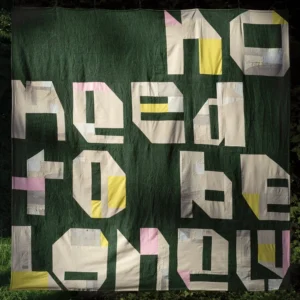
Gladie have announced their next album. The Jeff Rosenstock-produced No Need to Be Lonely, which follows 2022’s excellent Don’t Know What You’re In Until You’re Out, is out March 20 via Get Better Records. Check out the punchy lead single ‘Future Spring’ below, and scroll down for the album cover and tracklist.
Following November’s ‘Car Alarm’, ‘Future Spring’ manifests a gentle voice in the direst . According to the band’s Augusta Koch, it’s “about grappling with the isolation and loneliness that’s created by the cruelty of the world we live in. I wanted to capture the feeling of being in conversation with a friend, questioning why at times we can let outside influences shrink us. I think the world would be a lot better if we encouraged each other to be kinder to themselves and by extension others. It’s good to remind people that you are happy they’re here.”
1. Push Me Down
2. Brace Yourself
3. Car Alarm
4. Talk Past Each Other
5. I Want That For You
6. Fix Her
7. Poison
8. Lucky For Another
9. I Will If You Will
10. Future Spring
11. Blurry
12. Unfolding
Buck Meek of Big Thief has announced a new album called The Mirror. The follow-up to 2023’s Haunted Mountain is set for release on February 27 via 4AD. It’s led by the freewheeling single ‘Gasoline’, in which Meek sings, “Making words up while we made love/ One month and she’s in my blood.” It comes with a music video by director Noel Paul. Check it out below.
The Mirror finds Meek collaborating with his Big Thief bandmate James Krivchenia on production, and it features longtime collaborators including Adrianne Lenker on vocals, Adam Brisbin on guitar, and Ken Woodward on bass. Composer and ambient musician Alex Somers contributed synthesizer, toy microphone, and an old piano; Mary Lattimore played harp; Adrian Olsen created sounds and melodies using modular synths.
The record’s rotating cast of four drummers included Jesse Quebbeman-Turley, Jonathan Wilson, Kyle Crane, and Krivchenia, while Germaine Dunes, Staci Foster, Jolie Holland, and Lenker sang as a choir on multiple songs. The album was recorded in Meek and Dunes’ Los Angeles log cabin studio, Ringo Bingo, with Meek recording vocals outdoors on the front porch as the band played inside. Meek’s brother, Dylan Meek, contributed piano, keys, and vocals.
Big Thief released their most recent album, Double Infinity, last year.
The Mirror Cover Artwork:
The Mirror Tracklist:
1. Gasoline
2. Pretty Flowers
3. Can I Mend It?
4. Ring of Fire
5. Demon
6. God Knows Why
7. Heart In The Mirror
8. Worms
9. Soul Feeling
10. Deja Vu
11. Outta Body
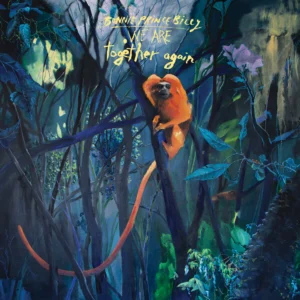
Bonnie “Prince” Billy has announced a new album titled We Are Together Again. The follow-up to last year’s The Purple Bird is slated for release on March 6 via Domino/No Quarter. It’s led by the new single ‘They Keep Trying to Find You’, which strikingly introduces the album’s themes of community and friendship as antidotes to loneliness. “Ignore everything that is frightening or strange/ Allow isolation to fully derange/ Becoming one with the darkness within,” Will Oldham sings. Check out its Abi Elliott-directed video below, and scroll down for the album cover and tracklist.
Oldham began working on We Are Together Again before recording The Purple Bird in Nashville, revisiting them last spring. He laid them down at End of an Ear Studios in Louisville with his current tour mates Jacob Duncan (flute and saxophone) and Thomas Deakin (clarinet, whistle, baritone electric guitar, accordion, cornet), along with Ryder McNair, Chris Bush, Ned Oldham, and Erin Hill.
“This record was made closer to the Ohio River than any I’ve been involved with since 1993’s Palace Brothers There Is No-One What Will Take Care of You,” Oldham explained in a statement. “Louisville’s current-and-past vital musical community is highlighted on every song. Catherine Irwin, who sang on the BPB release Ease Down the Road, is back here on ‘Hey Little’ and ‘Vietnam Sunshine’. Lacey Guthrie, Tory Fisher, and Katie Peabody, the three front women of the band Duchess, sing together on the opening and closing songs, parallel odes to the beast that is fear.”
We Are Together Again Cover Artwork:
We Are Together Again Tracklist:
1. Why is the Lion?
2. They Keep Trying To Find You
3. Strange Trouble
4. Life is Scary Horses
5. (Everybody’s Got a) Friend Named Joe
6. Vietnam Sunshine
7. Hey Little
8. Davey Dead
9. The Children are Sick
10. Bride of the Lion
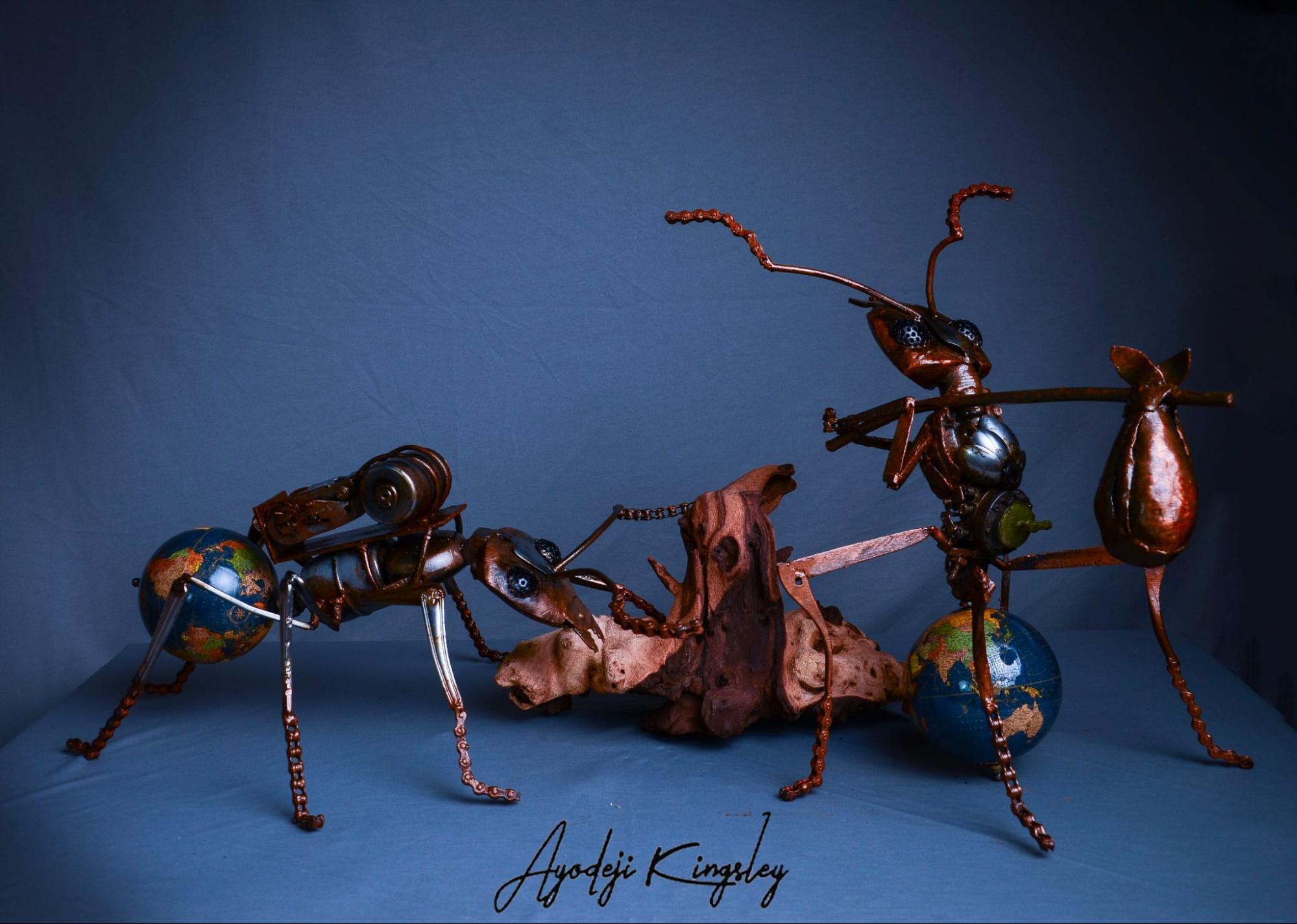
The Industrial Age enabled humans to expand so quickly, and one consequence is the climate catastrophe we’re living in today. While we may now be in the Information Age, it’s this industrial machinery that enables the modern comforts of living, yet it’s largely hidden from view. How many of us see how cars, clothes, and furniture are made? Ayodeji Kingsley brings this industrial machinery back into the foreground by transforming discarded machinery, tools, and industrial detritus into sculpture.
He uses these discarded parts to sculpt creatures from the natural world, in a knowing nod to the irony that the very machinery used to create the artwork has separated us from it. We have reached a point where many urban dwellers aren’t able to recognise some of the most common animals you may find a few miles outside of the city.
The peak of this irony may be seen in ‘Hoof Hearted’, a metal sculpture of a horse’s head. Until the dawn of the machine age, it was horses that did much of humanity’s heavy labour. Once supplanted, their numbers declined significantly, and they were retained only for leisure activities. In recreating a horse from metal, it recognises one of the most significant transitions in human history.
Kingsley’s heritage is Nigerian, which provides vital context for his work. A lot of the industrial and technological waste from the Western world ends up in Africa, and so creating works from industrial leftovers is a commentary on the unseen problems that old machinery creates and the recognition that we need to approach the globalised world through a more sustainable lens.
Art itself has had to face several questions about its sustainability, given its use of oil-based products and the carbon footprint of shipping. It’s through the use of discarded materials that I’m seeing a lot of the innovation in art. While the use of found materials goes back to Marcel Duchamp’s Urinal, the need to utilise them for sustainability feels like it’s only just getting started. The use of scrap metal in art is likely to increase as sustainability takes on a stronger role, and these works suggest that Kingsley is a forerunner of this movement.
This merging of the delicately sculpted and the readymade is evident in a work in which two rats scramble over a fire extinguisher. It’s a playful work but also reminds us that our detritus is also affecting the natural world, where animals work our rubbish into their lives, often to devastating effects, think of animals caught up in plastic causing them to suffocate.
Ayodeji Kingsley’s sculptures can be taken at face value as technically crafted artworks, the product of hours of skill and labour. However, there’s also deeper messaging within them about the Anthropocene age we’re living in, our disconnection from nature, sustainability, and our responsibility as the species that has damaged the earth and is also the one species that can save it.
More information on Ayodeji Kingsley’s work may be found on his website and Instagram.
When we see an artwork, we are seeing the final output of a creative journey. While it can be inspiring in itself, sometimes the value lies in witnessing how the work was created. Oluwaseun Ademefun applies this to her creative practice, opening it up so that others can see her creating art, and this extends to her participatory workshops.
Art has therapeutic benefits in viewing and creating it, and it’s this community value that the artist applies to her work. Community is vital in her native Nigeria, but here in the UK, it can often feel fractured, with many viewing our current generations as living through a loneliness epidemic. Her work embodies the idea of community and how it can create bridges across divides.
In her work ‘Generational Identities’, we see how persons from different generations are wrenched apart as the canvas curves away from the frame, leaving a gap between them. Yet it’s not a gap so large that it can’t be overcome. It’s recognising a communication problem, but it strikes me as hopeful work.
In her painting of Gbemisola, we see a young girl struggling to fit into British society while remembering her Nigerian roots. It’s a struggle that many immigrant children face as they want to assimilate with their new friends, adopting a Western name and values, while often putting their home country behind them. Yet it’s an identity that many of those same individuals return to as they age, proving that it’s what makes us different and stand out that is our strength. It’s an experience any first-generation migrant can identify with, and many second-generationers like myself also find personal.
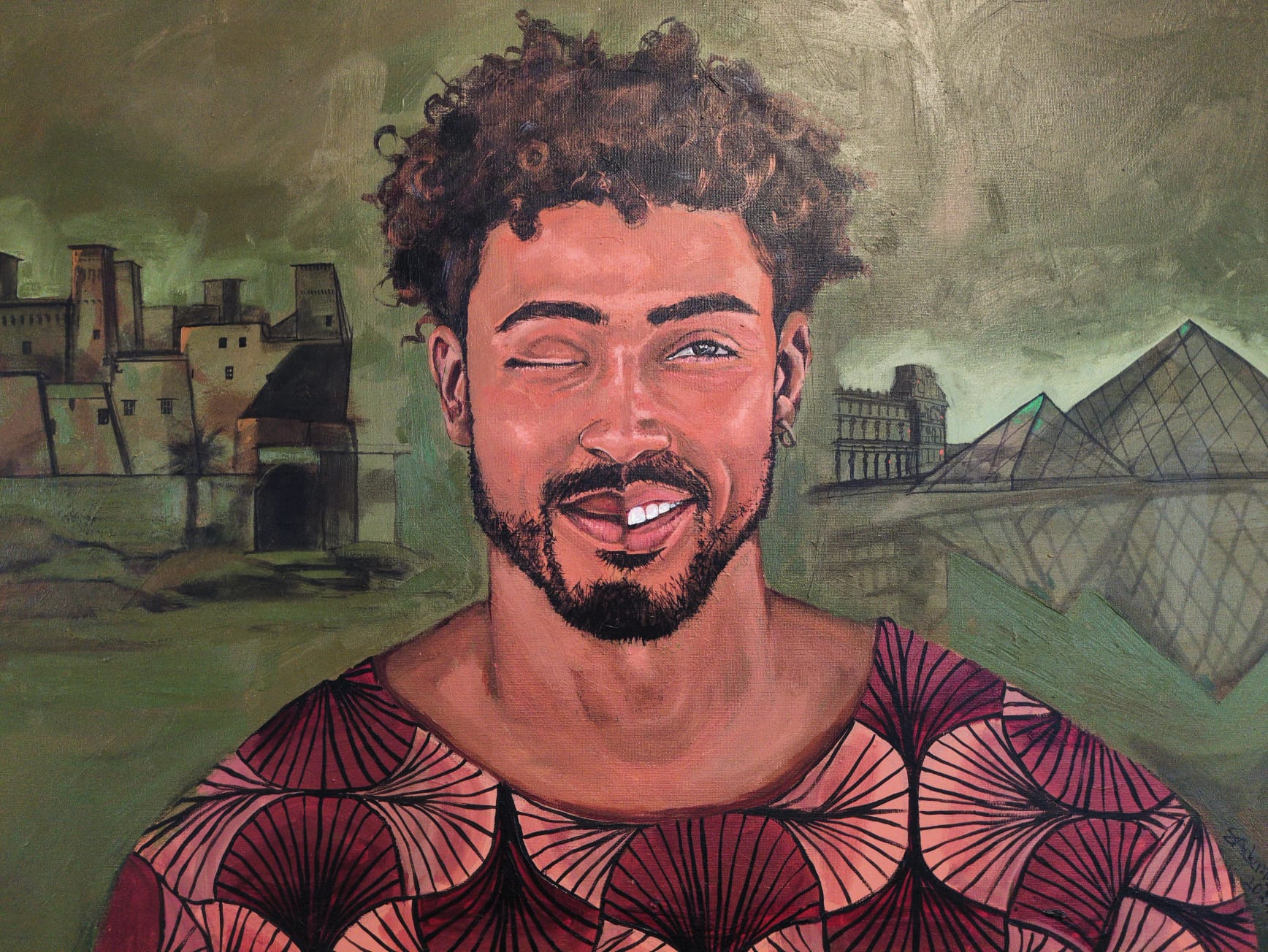
We see a similar story of dual identities play out in the painting ‘Morrocan’. On one side is his Moroccan hometown, and Le Louvre on the other, as he has travelled to Paris for financial opportunities. It’s that delicate balance of remembering one culture, while assimilating another, and many of us feel like we can never fully fit into either, becoming what are referred to as ‘third culture kids’.
Ademefun can also apply this vision to murals, as we see in one she designed in Southwark, now on display in Clichy, France. Some of her works incorporate discarded items, with a nude woman’s breast made of wine corks and a smoking man collaged from non-biodegradable materials. It’s a recognition that we are over-polluting the planet. If artists are going to provide a better vision for the planet’s future, they must also incorporate sustainability into their practice. Using other materials can add unique textures to artworks, beyond what paint alone can achieve. It also draws people in to interact with the works and study the intricate details and materials of each.
While recognising contemporary issues, including the climate catastrophe and the growing number of people living alone on a more populous earth, these aren’t works that espouse doom and gloom. They are a symbol of hope. Yes, we find ourselves in dark times. Still, it’s through community and collective engagement that we can create a better future for humanity, and Oluwaseun Ademefun’s work will continue to champion her wish for togetherness.
You can find out more about Oluwaseun Ademefun’s art on her website.
Light next to dark on a canvas may seem like opposites, but one cannot exist without the other. If there are no lighter colours to compare it to, how can the richness of the darker elements be evocative? It’s this dual harmony and tension that lies at the centre of the work of Azerbaijani artist Zibeyda Seyidova.
Works such as ‘Threshold of Night’ bring to mind those of the Abstract Expressionists and Colour Field paintings, particularly Mark Rothko’s Seagram Murals at Tate Modern. Both his works and those of Seyidova’s draw you in with the depths of their darkness, and the longer you stare into the darkness, the more they peer into your soul. Are they doorways to somewhere spiritual or something altogether darker?
Limiting her work to the lens of Western art history only highlights half the story. Her works draw upon Islamic philosophy, particularly the dialogue between ẓāhir (the manifest) and bāṭin (the hidden). Heavily layering her works gives them a sense of texture. Still, her process also involves scraping back layers to reveal what’s beneath, prompting questions about what she has revealed to us through her paintings and whether more elements will reveal themselves the longer we gaze at them.
Islamic art has a long history of excluding figures, a practice known as aniconism. Through Seyidova’s abstract works, she is channelling human emotions through abstraction in a process known as dhikr, or remembrance.
Her abstract works do feature representational elements, as we see in her work ‘Point of Equilibrium’, where the dark triangle slashing across a pale canvas suggests something in the foreground is casting a shadow. It’s a recognition that there are architectural elements in abstract art, and she uses this to significant effect when she displayed her work in a hospital with the pale colours and clean lines mirroring those of the institution where they were housed.
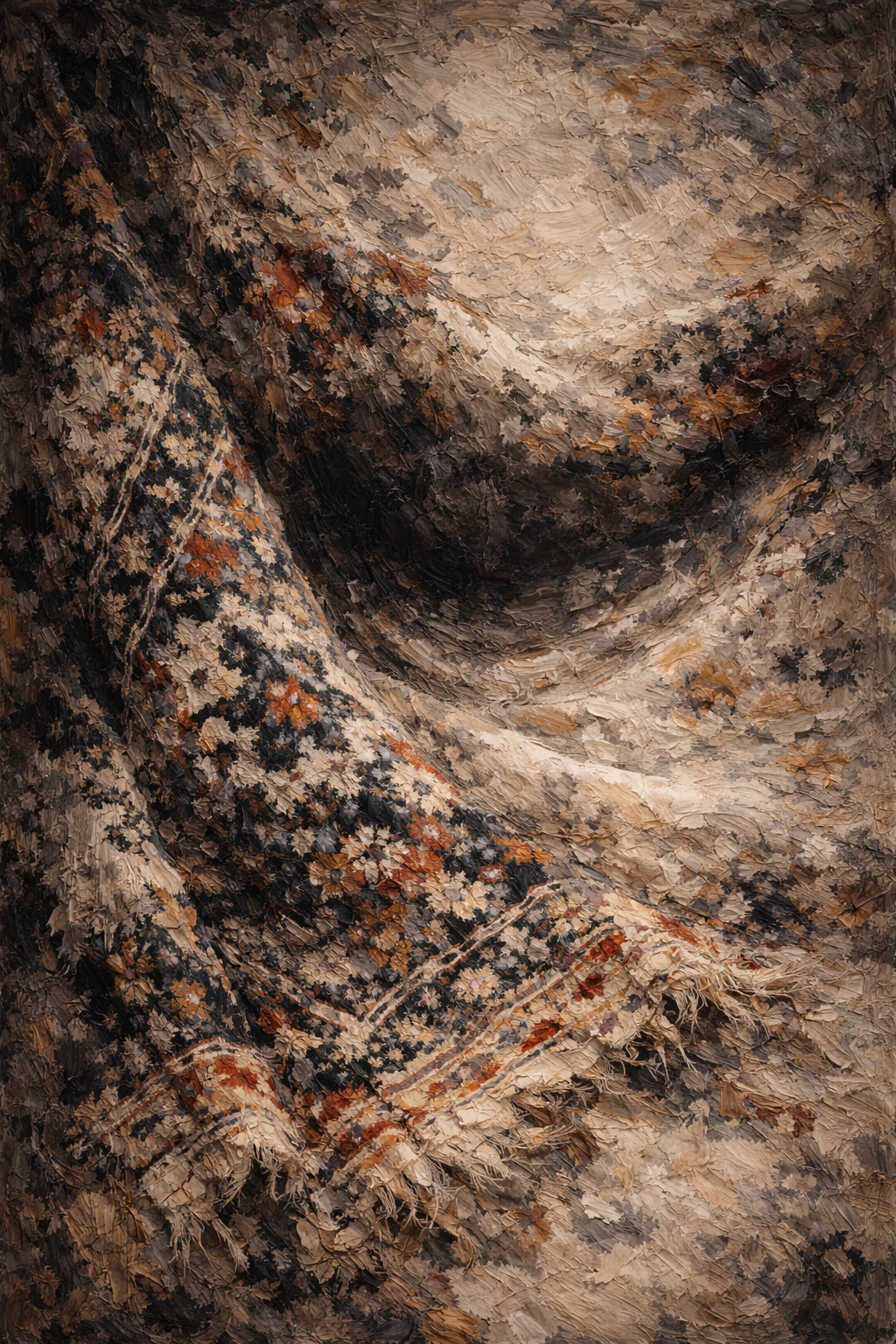
The interplay of light and shade continues in her representational works, including ‘Veil’, in which a cloth is lit by sunlight streaming through a window. The haziness of the light suggests a moment captured in a dream, while the thick impasto texture suggests we can reach into the painting and grab the cloth.
We see this again in her work ‘Transmission’, exploring the textures of a rug that makes you want to run your fingers along it. ‘Carried by Duration’ is the one piece where a human figure does appear, but it’s subtle, as it may not be noticed on first glance. Yet in the work, it feels less about the figure and more about how the light interacts with the textures of her hair and skin.
Spirituality is an essential part of Seyidova’s work, and these pieces, with their use of light, evoke the religious paintings of the Renaissance and Baroque eras. Whether viewing her abstract or more representational works, we’re asked to look deep into them, to discover what sits between the manifest and the hidden. Combining Islamic philosophy and Western art history gives her a unique voice within the world of abstract contemporary art.
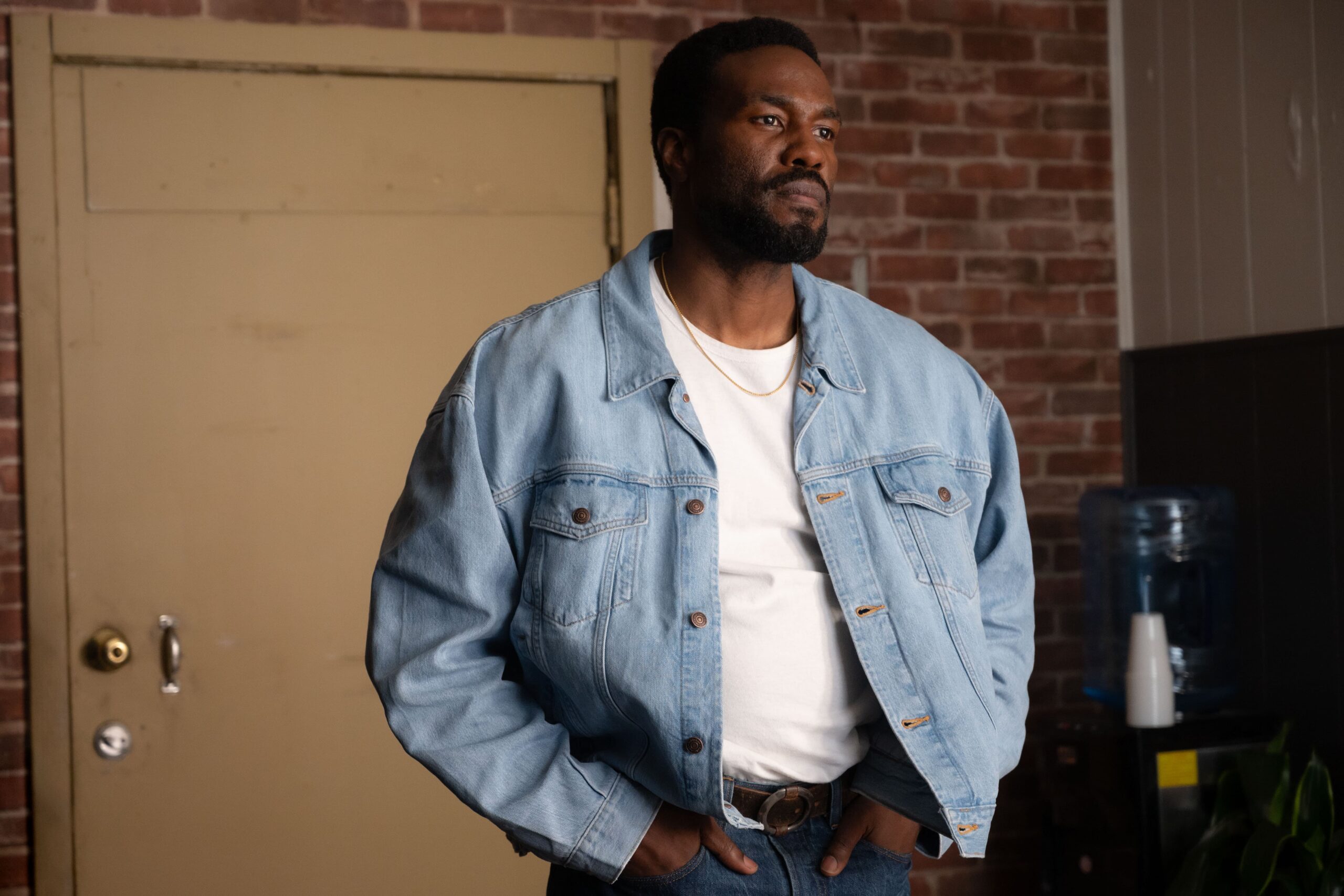
Auditioning to play a superhero is difficult enough on its own. Doing it while secretly being one is where the official trailer forMarvel’s Wonder Man drops us into. For a MarvelTV series set to arrive in January 2026, Wonder Man has flown unusually under the radar, with the studio keeping details close to the chest until now. The recently released official trailer for the series finally pulls back the curtain on Yahya Abdul-Mateen II’s Simon Williams, an “aspiring actor” with superpowers who finds himself auditioning to play a superhero in a big studio remake.
The movie in question is an in-universe Wonder Man reboot, set in motion when a legendary filmmaker comes out of retirement and opens the casting call to the public. Marvel is using the classic “film-within-a-film” (or here, film-within-a-series) trope to poke fun at where superhero stories are right now, and honestly, it looks absurdly entertaining, and far more self-aware than a standard origin story. With the series now just a few weeks out from its release, here’s everything we know so far about Marvel’s Wonder Man, including its release date, plot, cast, trailers, and more.
Marvel’s Wonder Man: Release Date
Marvel’s Wonder Man is set to premiere on January 27, 2026, on Disney+, making it one of the first MCU releases of the year. The eight-episode Disney+ series is co-created by Destin Daniel Cretton, who previously directed Shang-Chi and the Legend of the Ten Rings and the currently in-production Spider-Man: Brand New Day, and was developed alongside Andrew Guest, who’s also serving as the series’s showrunner.
Marvel’s Wonder Man: Cast
The cast lineup for Wonder Man features familiar MCU faces alongside actors making their Marvel debut. Leading the series is Yahya Abdul-Mateen II as Simon Williams, an actor trying to make a living in Hollywood. This marks Abdul-Mateen II’s third live-action comic book role, following his work on HBO’s Watchmen and his turn as Black Manta in DC’s Aquaman films.
The most recognisable Marvel return comes from Sir Ben Kingsley, who reprises his role as Trevor Slattery. Kingsley first appeared as the character in Iron Man 3 and later returned in 2014’s Marvel One-Shot short film All Hail the King and Shang-Chi and the Legend of the Ten Rings. Also returning is Arian Moayed as Agent P. Cleary, representing the Department of Damage Control, who we also saw in Spider-Man: No Way Home.
The supporting cast also includes Demetrius Grosse as Eric Williams, Simon’s brother, and Ed Harris as Neal Saroyan, Simon’s agent, alongside a broader group of actors. Here’s the currently confirmed cast for Marvel’s Wonder Man:
Yahya Abdul-Mateen II as Simon Williams aka Wonder Man
Ben Kingsley as Trevor Slattery
Zlatko Burić as Von Kovak
Arian Moayed as P. Cleary
Demetrius Grosse as Eric Williams aka Grim Reaper
Ed Harris as Neal Saroyan
X Mayo
Olivia Thirlby
Byron Bowers
Lauren Glazier
Béchir Sylvain
Manny McCord
Simon Templeman
Joe Pantoliano
Image Credit: Marvel Entertainment
What Will Marvel’s Wonder Man Be About?
Marvel’s Wonder Man is very much a superhero series, though it’s told from an unusual perspective. According to the official logline, the series follows “aspiring Hollywood actor Simon Williams is struggling to get his career off the ground. During a chance meeting with Trevor Slattery, an actor whose biggest roles may be well behind him, Simon learns legendary director Von Kovak is remaking the superhero film “Wonder Man”. These two actors at opposite ends of their careers doggedly pursue life-changing roles in this film as audiences get a peek behind the curtain of the entertainment industry.”
The Disney+ series is releasing under Marvel’s Spotlight banner, which essentially means the story will be more self-contained, with fewer ties to the wider MCU. Moreover, Marvel has been clear that this is not a typical superhero series and will instead focus on character work, performance, and the realities of trying to make it in Los Angeles.
Studio boss Kevin Feige has described Wonder Man as “extremely different than anything we’ve done before,” while executive producer Brad Winderbaum has called it a sincere and “beautiful” project that is a love letter to filmmaking and acting as a profession.
Winderbaum told Collider, “It’s a very new flavour for Marvel. It’s straight from the minds of (co-creators) Destin Daniel Cretton and Andrew Guest. Honestly, it is one of my favourite things ever. I think it’s the best show no one’s ever seen, and I’m very excited to see the audience reaction to it. I think it’s a love letter to what we do as filmmakers.” He went on to add, “It’s a love letter to acting as a profession, and it’s a very sincere, beautiful show.”
Is There A Trailer For Marvel’s Wonder Man?
Marvel kicked off the new year with the first official trailer forWonder Man, offering a closer look at the upcoming Disney+ series. The footage introduces Simon Williams (Yahya Abdul-Mateen II), an aspiring actor struggling to break through in Hollywood, and Trevor Slattery (Sir Ben Kingsley), a washed-up performer whose biggest roles are long behind him. Their paths cross when legendary director Von Kovak announces a reboot of the in-universe superhero film Wonder Man, giving both men what could be their first or last real shot.
The catch is that Simon is clearly hiding a rather large secret. When he shows up for an audition, he’s asked to sign a disclaimer confirming he doesn’t have superpowers. He answers with a casual “Yeah,” even though he’s clearly not telling the whole truth.
We also see Arian Moayed returning as Agent Cleary from the Department of Damage Control, who wastes no time in calling Simon an “extraordinary threat,” so it looks like keeping his abilities hidden might be the real challenge ahead for Yahya Abdul-Mateen II’s Simon.
Are There Any Other Shows Like Marvel’s Wonder Man?
While you wait for Wonder Man, you can check out Loki or WandaVision on Disney+, both of which are more meta in nature. Outside the MCU, Prime Video’s The Boys pushes the meta angle even further, with a far darker, more cynical spin on superheroes.
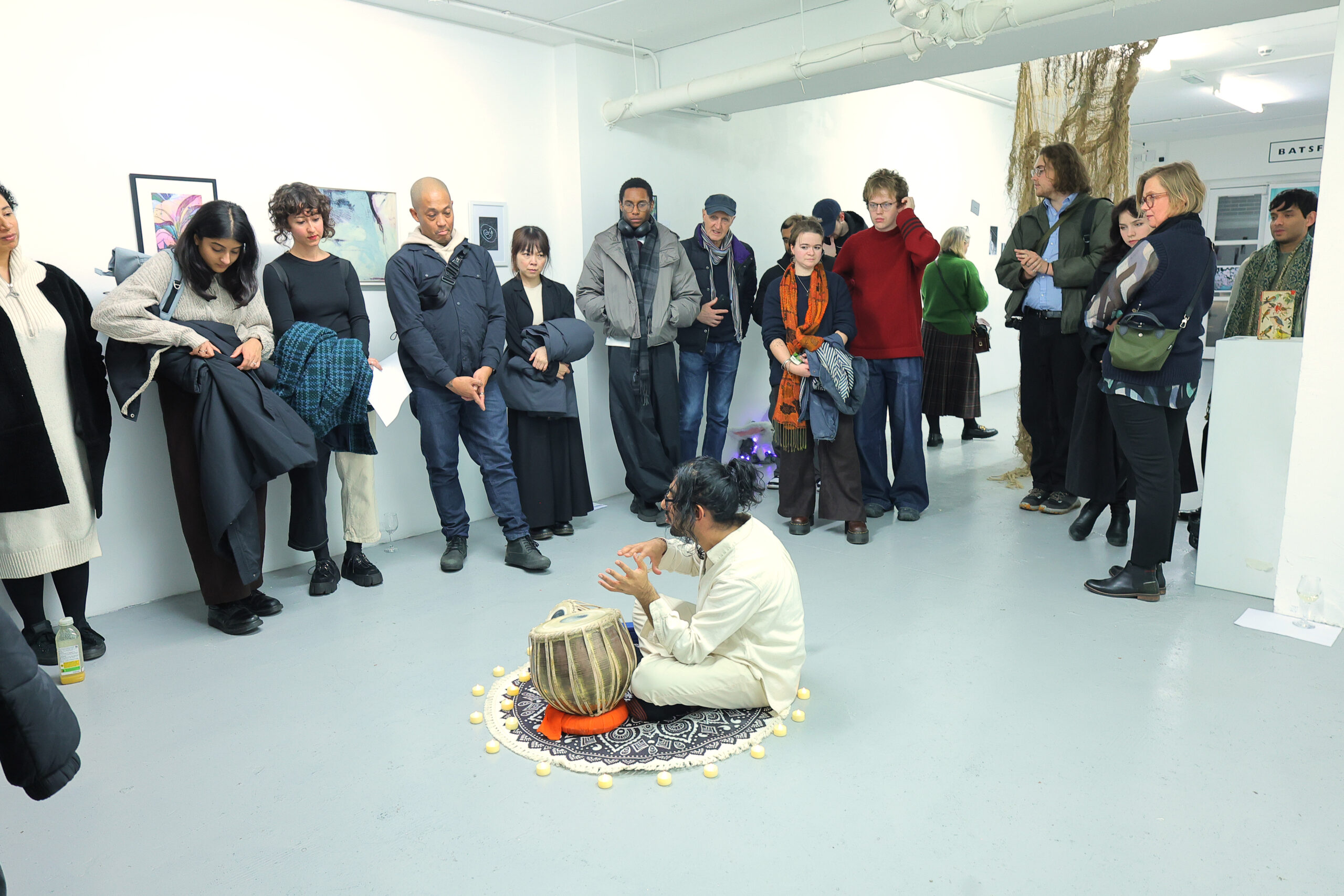
Entering the space of Kairós: Between Choice and Fate at Batsford Gallery has a very charged yet subtle quality. The gallery’s atmosphere seems more akin to a threshold than an empty box for exhibiting artworks. This feeling of being suspended is deliberate, and it makes perfect sense. The exhibition is based upon Kairós, the Ancient Greek term that refers to that critical juncture where chance, choice, and destiny are aligned. At first glance, the show sets itself up in that fragile space of uncertainty and choice as being experientially lived, as opposed to merely stated.
Kairós: Between Choice and Fate was organized by PA Art; PA Art is a long-standing supporter of contemporary visual art, curator experimentation, and the growth and development of artists. As such, PA Art functions within the changing landscape of London’s art community as a connective tissue between artists, ideas, and larger cultural conversations. That attitude is very apparent in this exhibition. The exhibition does not express one unified idea. Rather, it provides a platform for multiple voices to converge, intersect and sometimes contradict each other.
Hui Qi and Huan Zhou curated Kairós: Between Choice and Fate and have resisted the urge to represent freedom and fate as mutually exclusive. Instead, the exhibition treats freedom as an interdependent entity; as something that is often compromised and influenced by factors including our psychological habits, social structures, technology, and inherited stories. Therefore, the exhibition serves as a meditation on how choices emerge under constraints, and how the decisions we make are rarely as autonomous as we would prefer them to be.
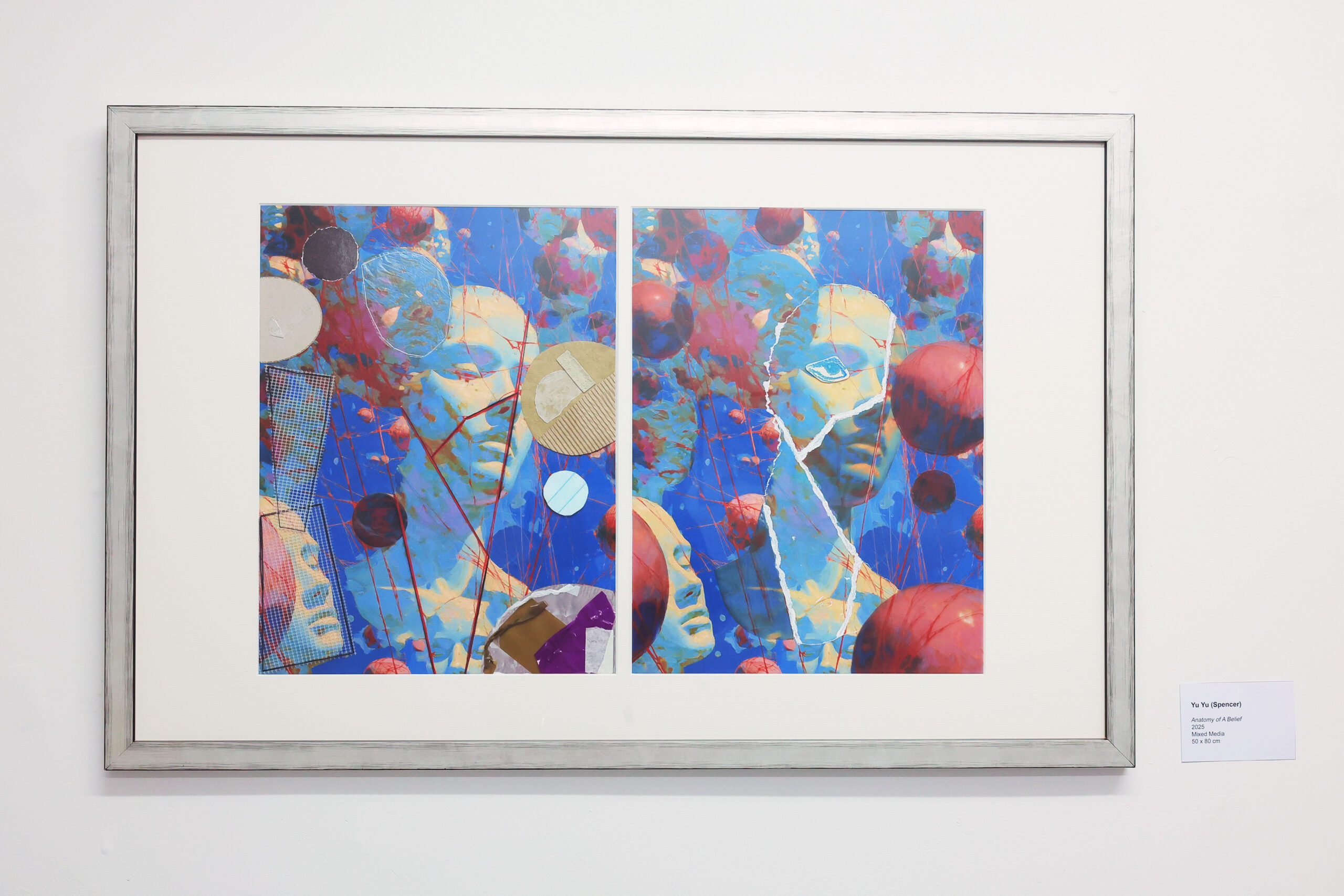
Anatomy of a Belief by Yu Yu (Spencer) is perhaps the most psychologically engaging work in the exhibition. The work is exhibited as a diptych composed of mixed media and relates to the phenomenon of confirmation bias. An abstract behavioral concept is rendered in a tactile and unsettling way. The left side of the panel is compact and restricted. Red yarn is threaded throughout fractured material and creates a visual enclosure which illustrates how information-based environments can confine thought and identity alike. The sense of confinement experienced here is similar to the experience of being surrounded by an algorithmically-supported belief system.
Credit: Jiaqing Chen
The right panel does not provide release, instead it creates disruption. The figure is broken apart and remade, with an additional eye symbolizing awareness rather than escape. Spencer portrays self-awareness as a laborious and disorientating process. To see is not to be free immediately, but to face the discomfort of realizing your cognitive boundaries. Within the exhibition’s overarching structure, the work represents the relationship between agency and inevitability. We perceive our beliefs as being selected by us, however they are frequently unconsciously constructed well prior to our recognition of them.
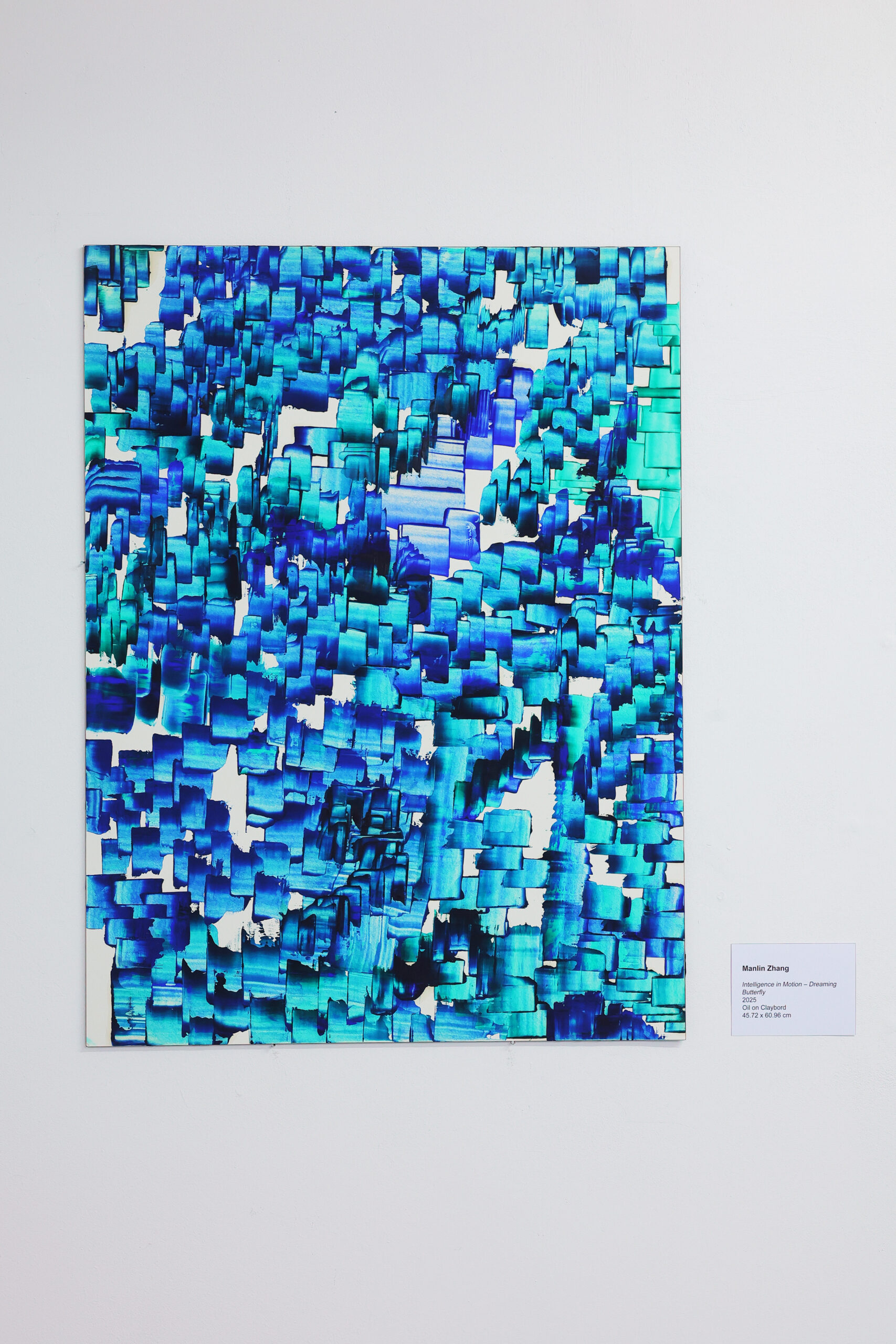
While Spencer examines the structural influences of belief, Manlin Zhang examines the origin of thought. Intelligence in Motion-Dreaming Butterfly is an oil-on-claybord painting that depicts intelligence before it develops into language or logical constructs. The surface is alive, and holds the forms of both intuition and computation in a state of ambiguity. Everything is fluid. Thought appears to be recursive, incomplete, and inconclusive.
Credit: Jiaqing Chen
A fragile equilibrium exists in the work, and there is an indication that meaning is forming, but that it has not made a decision as to what form that meaning will take. In the context of Kairós, this is a pivotal moment. It is the point of transition before a decision is articulated, and before an action evolves into a consequence. Zhang’s painting reminds us that freedom may be most active in those pre-symbolic realms where intelligence remains in flux and results remain undefined.
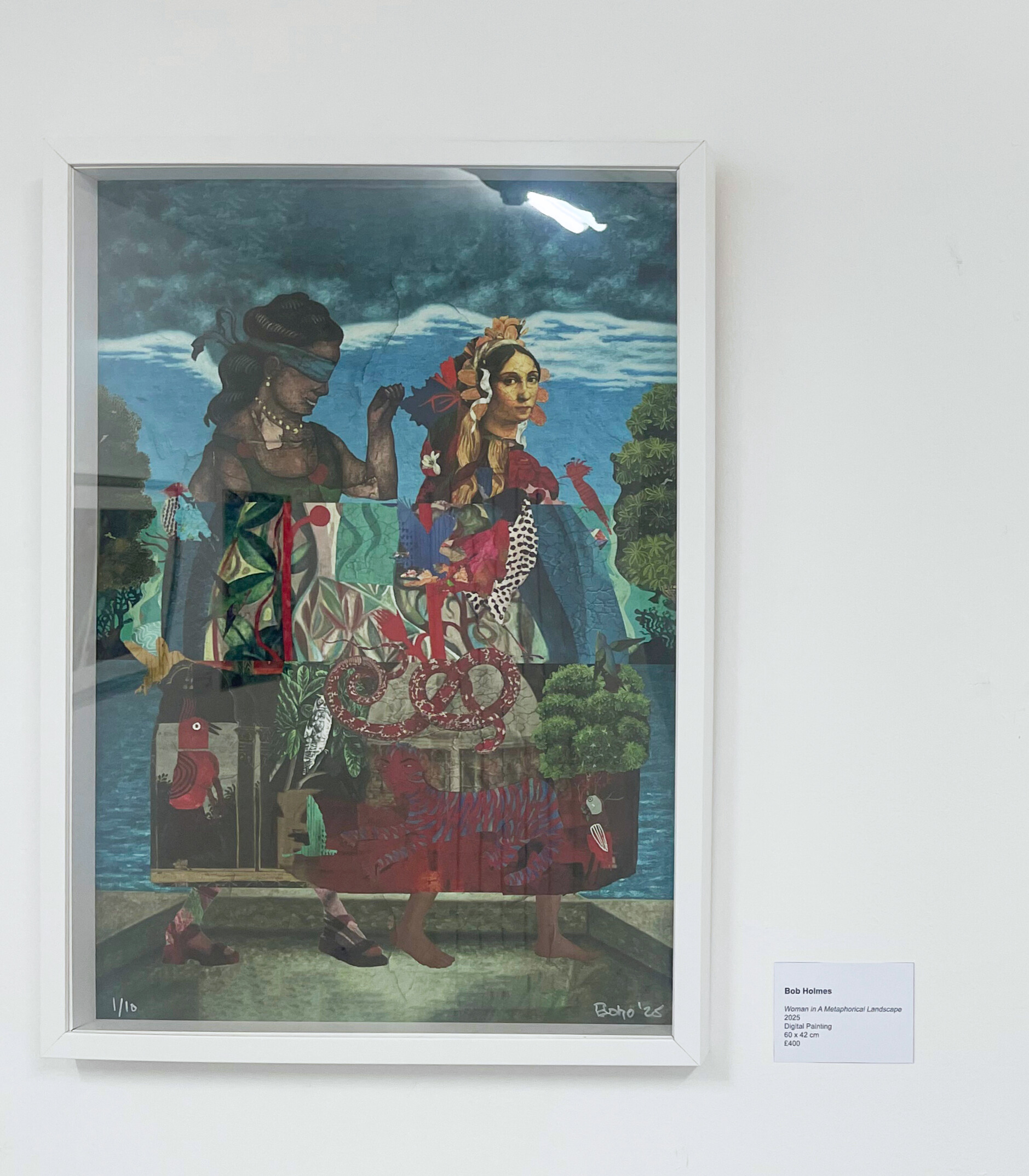
Bob Holmes’ use of a more obvious symbolism is evident in Broken Continuum. Two female bodies are merged into a single fragmented body, eliminating the distinction between the self and others, memories and perceptions. Blindness and awareness are present in an uneasy balance, indicating that insight is never total, and that vision is always incomplete. Animals and botanical motifs appear throughout the composition, referencing ancestral memories, folkloric traditions, and myths.
Credit: Jiaqing Chen
Holmes appropriates the visual elements of Classical Portraits; however, he disrupts them through their fragmentation, layering and disjointedness. As such, the portrait appears to be both solidified and at the same time disconcertingly unrecognizable. Justice, inner sight, and internal blindness to the divine emerge, but they do so without finality. In this way, the work occupies a state of ambiguity as opposed to one of moral clarity; thus, it is consistent with the exhibition’s reluctance to represent choice as being either positive or heroic. Ultimately, the work demonstrates that choice is intertwined with what we inherit, what we forget and what we fail to see.
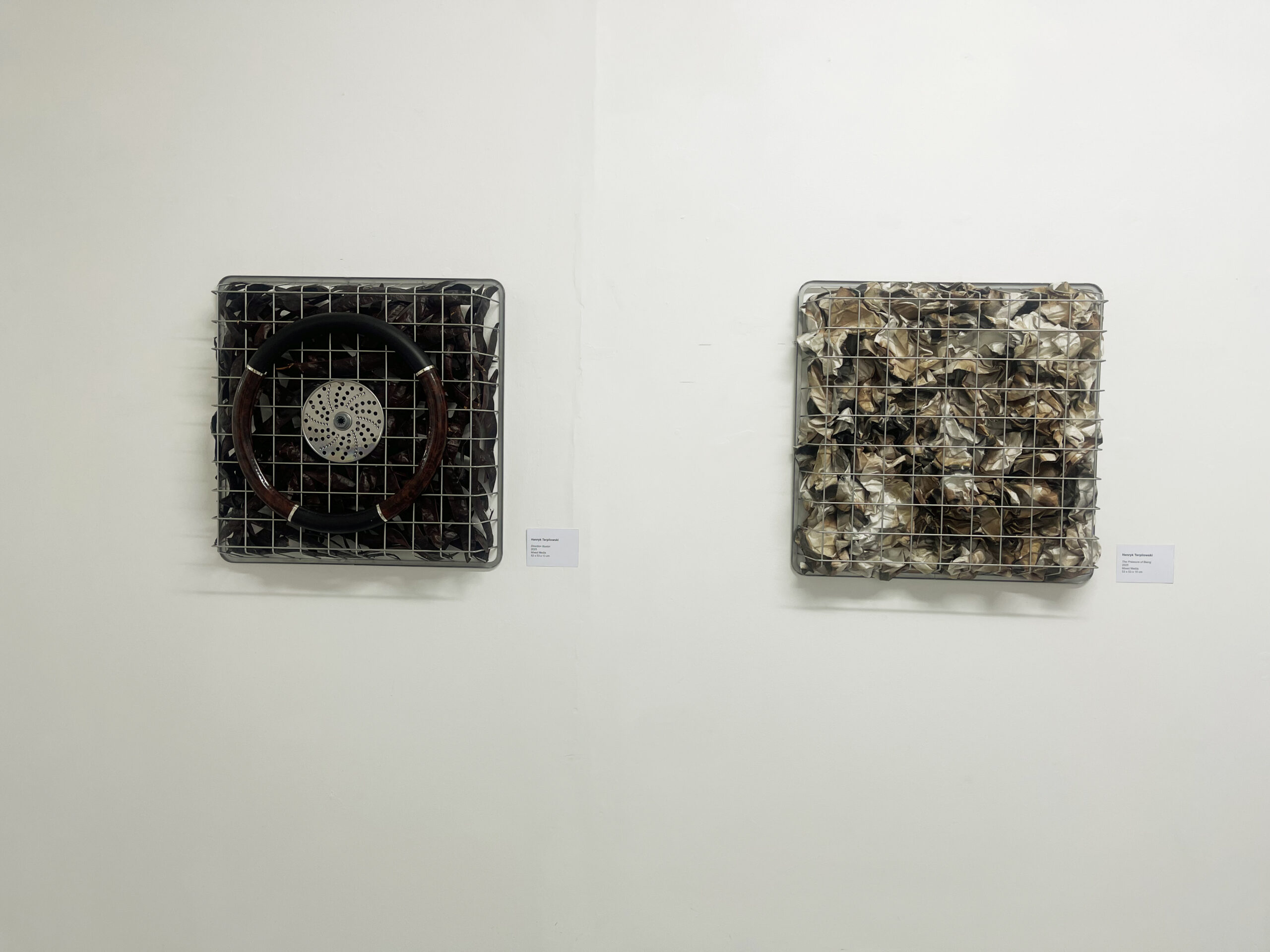
The opposition between apparent control and structural constraint is made visually explicit in Direction Illusion by Henryk Terpilowski. Compressed seed pods are a powerful symbol of growth and possibility which are embedded in a steel lattice grid. On top of the seed pods lies a found steering wheel; while the steering wheel is a ubiquitous symbol of human agency and direction, it is stationary. Therefore, it has no ability to turn.
Credit: Jiaqing Chen
The visual impression is immediate and subtle yet disturbing. Within a single object exist natural capacity, human intent and structural constraint. The work posits that our gestures of control are merely ritualized motions that occur within systems that determine the parameters of all possible outcomes. While the steering wheel implies choice, it provides none. It serves as a stark illustration of how quickly symbols of agency can camouflage structural limitations on freedom.
The presence of multiple artists (Alice Boot, Anastasia Neff, Eskild Beck, Gera Dunachie, Luke Bacon, Marian Obando, Rachel Barlow, Xiaohan Sun, Xiaoxiao Chen, Xiwen Xu, Yao Feiyun, Yilun Liu and Jiawen Zin Zhang) adds additional dimensions to the exhibition as opposed to each artist vying for attention. Their contributions collectively create a multilayered context of viewpoints. The overall atmosphere of the exhibition is conversational as opposed to didactic with each artist adding a unique nuance to the central inquiry of how choice functions in today’s society.
A live performance by Jay Mistry contributes to the temporal element of the exhibition. Performances take place solely in the present. They cannot be completely captured or replicated. The addition of performance reinforces the notion that certain types of agency are ephemeral, embodied and irreversible.
Credit: Jiaqing Chen
Ultimately, it is the exhibition’s willingness to leave questions unanswered and to avoid defining freedom and providing ways to regain lost freedom that distinguish Kairós: Between Choice and Fate. The exhibition creates a space in which ambiguity regarding freedom is both accepted and celebrated. Through the careful curation of Hui Qi and Huan Zhou, the exhibition develops into a space of reflection rather than conclusion.
Given the current cultural obsession with optimization, clarity and control, the refusal to provide answers or solutions to the dilemma of freedom seems relatively radical. The exhibition suggests that perhaps true freedom will not come about when individuals master systems, but rather when they recognize the points of intersection between decision and destiny. When choice does not cancel out fate, but instead comes close to it, there occurs a temporary shift.
Artists include Alice Boot, Anastasia Neff, Bob Holmes, Eskild Beck, Gera Dunachie, Henryk Terpilowski, Jiawen Zin Zhang, Luke Bacon, Manlin Zhang, Marian Obando, Rachel Barlow, Xiaohan Sun, Xiaoxiao Chen, Xiwen Xu, Yao Feiyun, Yilun Liu, and Yu Yu (Spencer).
The special performance is by Jay Mistry.
The exhibition is curated by Hui Qi and Huan Zhou.
Photography is by Jiaqing Chen.
Exhibition support is provided by Chün-Tse Chang and JiaJun Huang.