Home Blog Page 57

Bill Callahan Announces New Album ‘My Days of 58’, Shares New Song

Bill Callahan has announced a new album titled My Days of 58. The follow-up to 2022’s YTI⅃AƎЯ comes out February 27, 2026 via Drag City. Today’s announcement comes with the release of the new single ‘The Man I’m Supposed to Be’, which is rueful and apprehensive. Check it out and find the album cover and tracklist below.

Last year, Callahan released the live album Resuscitate. “Improv/unpredictability/the unknown is the thing that keeps me motivated to keep making music,” he explained. “It’s all about listening to yourself and others. A lot of the best parts of a recording are the mistakes — making them into strengths, using them as springboards into something human.”

Guitarist Matt Kinsey, tenor saxophonist Dustin Laurenzi, and drummer Jim White are among the musicians who play on My Days of 58, which Callahan describes as a “living room record.” He added: “I’m not talking about fidelity at all here. Living room attitude. Living room vibe. Not too loud, not otherworldly. I asked for the horns to be relaxed like someone on the couch playing, not a blast from heaven or hell.”

My Days of 58 Cover Artwork:

Bill_Callahan My Days of 58

My Days of 58 Tracklist:

1. Why Do Men Sing
2. The Man I’m Suppoised To Be
3. Pathol O.G.
4. Stepping Out For Air
5. Lonely City
6. Empathy
7. West Texas
8. Computer
9. Lake Winnebago
10. Highway Born
11. And Dream Land
12. The World is Still

Between Control and Chaos: The Abstract Art of Adetunji Onigbanjo

0

What do we see when we look at abstract art? In works of Op Art, like those by Bridget Riley, the clean lines blur and shimmer as we struggle to focus on what, at first glance, appear to be simple dots or stripes. If it’s a work by Jackson Pollock, we imagine the energy he used in creating it, throwing paint across a canvas on the floor.

Adetunji Onigbanjo, known by his artist name ‘Lawyartist’, brings his own twist to abstraction through his Neon series. White ribbon-like structures curve, bend, and wave across the canvas, covering a brighter background that varies throughout the series – sometimes dominated by metallic blues and reds, other times by a more vibrant palette.

They are graceful and controlled in their execution, far more than in the works of the Abstract Expressionists, but they also appear to have a chaotic nature to them, and maybe the ‘ribbons’ are all that’s holding them back. They also remind me of the work of street artist Otto Schade, who uses ribbons to create more figurative works dotted around the East End of London.

Image above: NEON IV or Deep Zima Blue (2024), markers, pencil and pen on paper (84.1 x 59.4cm), Adetunji Onigbanjo

It also suggests a natural evolution of the representative works he’s arguably better known for. While those works feel much closer to pop art and look very different from his Neon series, there is a thread that connects them. In every piece that Onigbanjo created in this series, there is a sense of unbridled joy that takes over each work as motifs compete to grab your attention. This sense of the artist trying to get all his thoughts into a single artwork and to control the composition, so it remains contained within it, features across all his series.

The nature of this repetitive and meditative practice is that it can create a disconnect between the hand and brain, so the hand operates on muscle memory led by intuition. Some days it will take him in figurative directions; other times, in abstract directions. The great Paul Klee once described drawing as taking a line for a walk, and that’s what Onigbanjo appears to be doing.

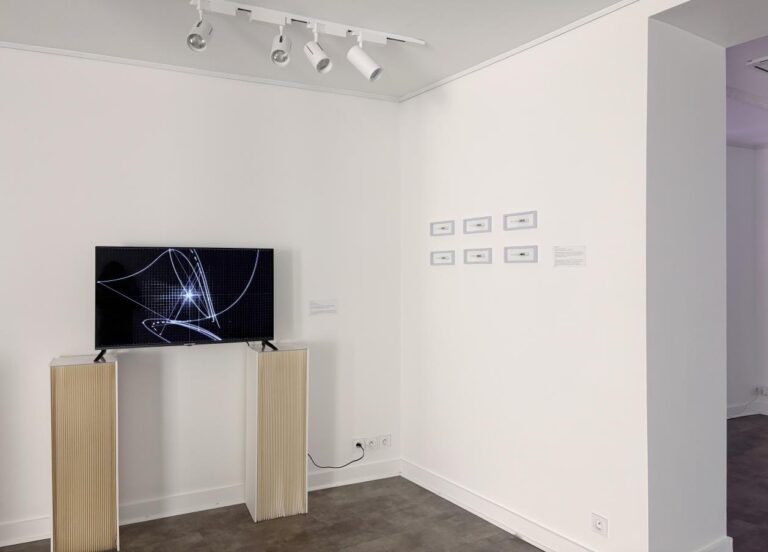
An installation image from his recent solo show.

Returning to the Neon series, most UK writers would view these works through the lens of Western art history. However, it’s important to note that abstraction has a long history in the Global South as well. We see this in works by Aboriginal artists such as Emily Kam Kngwarray, as well as in the work of the Nigerian Modernists, who were influenced by Western Art but created their own versions of the movements that define 20th-century art.

It’s within this context that we should view Onigbanjo’s art. He is an artist of Nigerian heritage living in the UK. Therefore, he is influenced by both his roots and the socio-political issues in West Africa and Europe. He sits across both worlds, while not being tied to either. It’s within these dual spheres of influence that we’re seeing his art evolve, and in his diversity of styles, we can see it’s still growing.

More information on Adetunji Onigbanjo may be found on his website and Instagram. His latest solo exhibition, Neon II, was at Stone Yard Studio, (41, Biggin Street) Loughborough, Leicestershire, UK, from November 7 – 9.

Pokémon GO Shows New December Community Day 2025 Details

0

Pokémon GO has shared the full details for its December Community Day 2025. This upcoming event is an annual celebration that lets trainers to meet and catch Pokémon. For the year-end edition, developer Niantic is offering several characters, bonuses, and research tasks.

Featured Pokémon and Attacks

According to Niantic, the celebration will have a different set of Pokémon for each day. On Saturday, players can find Fuecoco, Karrablast, Pawmi, Shelmet, Sprigatito, and Vanillite. Meanwhile, Sunday will include regional variants of Blue Flower Flabébé, Red Flower Flabébé, and Yellow Flower Flabébé. Plus, lucky players can face Orange Flower Flabébé and White Flower Flabébé regardless of the region. The second day will also include Jangmo-o, Pikipek, Rookidee, Solosis, and Quaxly.

The last 10 minutes of each hour from 2 PM to 5 PM on both days feature the following characters:

  • Eevee
  • Machop
  • Ralts
  • Totodile

At the same time, the December Community Day will feature attacks. Trainers need to evolve Pokémon from December 6 (9 PM) to December 7 (9 PM) local time. Here is a closer look at the evolved forms and their featured attacks:

  • Accelgor with Charged Attack Energy Ball
  • Corviknight with Charged Attack Air Cutter
  • Escavalier with Charged Attack Razor Shell
  • Feraligatr with Charged Attack Hydro Cannon
  • Florges with Charged Attack Chilling Water
  • Gardevoir or Gallade with Charged Attack Synchronoise
  • Kommo-o with Charged Attack Clanging Scales
  • Machamp with Charged Attack Payback
  • Meowscarada with Charged Attack Frenzy Plant
  • Pawmot with Charged Attack Brick Break
  • Quaquaval with Charged Attack Hydro Cannon
  • Reuniclus with Fast Attack Charm
  • Skeledirge with Charged Attack Blast Burn
  • Toucannon with Charged Attack Beak Blast
  • Vanilluxe with Charged Attack Avalanche

Eevee will also have a featured attack when hatched. In the same way, each of its eight evolutions will know a unique attack.

December Community Day Bonuses

Based on the announcement, the event has limited-time evolution requirements for Eevee, Floette, and Pawmo. However, they will go back to the usual requirements on Sunday (9 PM) local time.

Also, players can look forward to the following rewards throughout the weekend:

  • 50% less Stardust for trades
  • Double Candy
  • Double chance to get Candy XL (Trainers level 31 and up)
  • Double Stardust
  • Double XP
  • Half Hatch Distance
  • Longer Incense duration
  • Longer Lure Modules duration
  • One more Special Trade per day

Collection Challenges and Research Tasks

Aside from the initial offerings, Niantic will include catch-focused Collection Challenges. Completion of the event-themed tasks gives trainers Stardust and XP.

Similarly, players can join a field research and Special Research (separate ticket required) during the celebration.

Availability and Important Reminders

Pokémon GO’s December Community Day 2025 will take place on December 6 (Saturday) and December 7 (Sunday), from 2 PM to 5 PM local time.

Trainers are reminded to stay aware of their surroundings and follow local guidelines while playing.

Meanwhile, Niantic said that there will be no Seasonal Special Background for this edition. They are testing new things and will review them for next season.

Bollywood Beats Meets Westcoast Hip Hop: Manya Aggarwal On Teaching Teens at The Ghungroo Dance School

0

In a scene where dance styles meet contemporary music, The Ghungroo Dance School in Stevenson Ranch is expanding its repertoire beyond traditional Indian classical forms. Under the guidance of choreographer and instructor Manya Aggarwal, the school is now bringing the energy of Bollywood hip-hop to a new generation of young dancers. 

Manya is bridging cultural divides and igniting a passion for a dynamic fusion of styles.She is a recent graduate of the California Institute of the Arts with a Bachelor of Fine Arts in Dance Performance, and has toured with Joya Kazi Unlimited as a dancer for her well-renowned production- “Rhythm India: Bollywood and Beyond” by AMP Worldwide which tours once annually. 

The Ghungroo Dance School, traditionally known for its mastery of semi-classical Indian dance, has embraced a broader vision for its students. “We want to provide a studio for dancers to learn from local choreographers like myself, while exploring a range of dance styles, tied to Indian culture,” explains Manya, who heads the school’s hip-hop and bollywood training. 

Bollywood dance relates to the Hollywood of the east, known as Bollywood, founded over 50 years ago in India. Many of the Bollywood films are romantic themes and have choreographed dance songs, which are uplifting in nature. Bollywood dance fuses together eastern and western dance styles, incorporating hip movements and traditional folk elements.

“I believe that dance is a medium with the power to transcend cultural boundaries,” she said. “Whether it’s the energetic Bollywood beats or bassy rhythms of hip hop, every dance style has a place at our school.” This inclusive philosophy is deeply ingrained in the school’s founding belief that dance is a universal language capable of fostering connection and storytelling.

Manya herself brings a wealth of experience and a unique perspective to her teaching. Raised in Mumbai, India, her early training at The Danceworx Performing Arts Academy in ballet, contemporary, jazz, hip-hop and her exposure to bollywood fusion has equipped her with a versatile skill set. Having studied dance her entire life, her specialization in these diverse genres allows her to blend cultural influences from India with American pop culture, creating a distinct artistic voice that resonates with her students. 

The popularity of Bollywood dance in the United States has seen a significant surge in recent years, a trend Manya has witnessed firsthand (it currently has over 22 million hashtags on TikTok). “I have definitely seen it grow, and there are a lot of fans of Bollywood films, music, and even dance,” she states, referencing the rise of Bollywood-inspired TikTok trends. “I am seeing the love and respect grow for Bollywood dance every day as people are fascinated by how fun it is, and how people who aren’t from the culture are embracing it.”

When it comes to teaching, Manya’s approach is intuitive and creative. “I choose songs that make me move instantly and fuel my creativity,” she shares. “As I teach all age groups, I see what vibe goes best with the youngsters versus the adults and accordingly plan the class.” This adaptability ensures that each session is tailored to keep students engaged and motivated.

While Bollywood dance is gaining traction, Manya’s personal passion lies with hip-hop. As a hip-hop instructor, she understands its immense demand. “I personally love hip-hop dance the most; it is what I relate with and love in terms of freedom in movement,” she explains. “I love the body language you get to embody when practicing the style. I feel like it’s in demand because of the culture and popularity of hip-hop in mainstream pop culture.” 

“It is the only dance form that is so free and has so little judgment for the kind of people who can do it. It’s welcoming in its approach, and hip hop music transcends me,” said Manya.

This inherent freedom and welcoming nature of hip hop perfectly complements the vibrant spirit of Bollywood. Manya expertly navigates the intersection of these two powerful genres through what is often termed “desi hip-hop.” 

This regional style, she explains, has its roots in both Bollywood and hip-hop. “In my understanding, I use Bollywood music and teach a fusion of hip-hop and Bollywood to it,” Manya clarifies. “In a lot of Bollywood movies, you will see this style being brought out because it is a perfect blend of western techniques as well as the Bollywood emotions.”

Manya’s playlist for her classes at The Ghungroo School often reflects this global fusion. “I love using songs with artists that collaborate with one another from different countries, such as Ed Sheeran with Arijit Singh,” she notes. “But nonetheless, I pick music based on what I see inspires me and is trending the most, as it excites the younger crowd.”

When it comes to her teenage students in Los Angeles, Manya finds their ability to learn astonishingly quick. “Teenagers are great at picking up the steps quickly,” she observes. “They tend to be slightly shyer than other age groups but do best with how fast they can pick up.” This rapid assimilation of choreography, combined with their burgeoning confidence, makes for dynamic and engaging classes.

With her extensive training, her passion for bridging diverse dance styles, and her innate ability to inspire young dancers, Manya Aggarwal is not just teaching Bollywood hip-hop moves; she is cultivating a new generation of artists who embody cultural appreciation, creative expression, and the sheer joy of movement. As The Ghungroo School continues to broaden its horizons, Manya’s vibrant instruction is sure to leave a mark on the Los Angeles dance scene.

The most rewarding aspect of Manya’s job at The Ghungroo School is the opportunity to connect with young minds through the art of dance. “I absolutely love being surrounded by children, and getting to teach them feels like a privilege because of their presence itself,” she beams. “I love seeing them pursue what they love and see them working hard to improve each class.”

Photos of Manya Aggarwal by Vince Trupsin.

Scream Queen Kris Prihodova On Her Roles In Horror Films With Three October Film Premieres

0

In a month typically reserved for ghosts and ghouls, New York horror star Kris Prihodova has carved out her own reign of terror, dominating the scare season with an impressive trio of film premieres in October 2025. The Czech-born actress has quickly become a formidable presence in the genre, and her recent festival sweep shows she may be one of modern horror’s most exciting new indie scream queens.

The chilling marathon kicked off on October 13th with the premiere of “Anya,” a psychological thriller that screened at the prestigious NY Shorts International Film Festival. Just two days later, on October 15th, her film “Vlogcam” captivated audiences at the Downtown Film Festival in Manhattan. The grand finale came on Halloween night itself, October 31st, as “Nightmare Knocking” made its debut at the AMT Film Festival, ensuring Prihodova’s presence was felt throughout the entirety of the spooky season.

For Prihodova, October is more than just a month on the calendar; it’s an event. “October is the best month to release horror films because people cannot wait to be scared,” she explains. “There is something about that time of the year, when days are shorter, air is colder and everyone wants to cuddle up in a blanket and watch a movie.”

Behind the scenes of the film “HER,” photo of Kris Prohodova by Casey Chen

She believes the audience’s mindset is key to a horror film’s success during this period. “From my experience, audiences are much more emotionally open to fear in October. They want to feel that adrenaline, to jump in their seats, to scream and then laugh right after. It becomes a shared, exciting experience rather than just watching a film.”

This thrilling October was the culmination of a whirlwind two years for the actress. A graduate of the New York Film Academy with a surprising background in chemistry from Masarykova Univerzita, Prihodova has built a formidable resume in a short time. Her recent credits include the zombie horror “The Outbreak” (2024), the slasher “Hoodie” (2024), which was later renamed to the premiere title “Nightmare Knocking,” and the found-footage horror “Vlogcam” (2025). Her first feature, “The Devil” (2023), filmed in a remote cabin in her native Czechia, is still navigating the lengthy post-production process.

“Finishing movies can take really long sometimes and we actors are of course impatient to see the final result,” Prihodova admits, adding with a laugh, “‘The Outbreak’ was a zombie horror and I actually survived that one, which I’m very happy about. I got killed by the rest of them.”

Onto her next project, Prihodova recently wrapped filming on a new slasher, “Krazy Klowny,” (its TBA title), which utilized the historic and atmospheric Amsterdam Castle in Amsterdam, NY, as its backdrop. She describes a chilling plot centered on a children’s party clown whose deep loneliness and frustration, fueled by relentless bullying, boil over into a brutal, axe-wielding rampage against his former clients.

Filming in the castle provided an unforgettable layer of authenticity. “The space itself already has this mysterious energy which added something extra to the filming,” she recalls. “The sequence takes place during a large mansion party; we had around twenty background actors, and even a huge cake that became a centerpiece of the scene. The setting itself added so much character to the story.”

Beyond the jump scares and bloody rampages, Prihodova is drawn to horror that delves into the human psyche. Her film “Anya,” which portrays a woman struggling with schizophrenia, is a project she feels is particularly important. She is a passionate advocate for bringing mental health conversations into the spotlight.

Kris Prihodova talks at the Czechoslovak Society of Arts and Sciences for a presentation


“Mental health is a topic which should be always around,” she states. “The conversation comes in waves and people often forget to be more empathetic.. The reality is, you never know who is going through a tough time around you and kindness is something that costs you nothing but can make people’s lives much easier.” 

Prihodova revealed her own connection to the subject, explaining: “I wrote a script about a girl who struggles with OCD, because I myself do have this disorder and wanted to write something that explores more authentic angles about this topic.”

When asked if she considers herself a “scream queen,” which is the slang term for a horror film actress (who often dies in the movies), her answer is immediate and confident: “True. I definitely consider myself a bit of a scream queen at this point.”

For her, the title is a badge of honor, as horror is a mainstay in the film market. “Horror has become one of my favorite genres to work in, mostly because it allows you to explore so many different sides of yourself as an actor,” she says. 

“You can go from being vulnerable and terrified to powerful and unhinged, all within a single film,” said Prihodova. “If you do not get killed in the beginning, that is.” 

She also geeks out over the technical craft, praising the special effects that make the terror tangible. “Whether it’s fake blood, prosthetics, or a complex stunt sequence, those elements make filming such a fun and unpredictable experience.”

Prihodova finds a unique sense of empowerment in these often-intense roles. She sees the genre as a space where female characters can transcend traditional limitations.

“Acting in horror films is actually very empowering as a woman,” she said. “In horror, female characters are rarely static; they fight, they survive, they face their deepest fears, and often they’re the ones who carry the emotional core of the story. That journey, from vulnerability to strength, can be incredibly powerful to play.”

With an award-winning turn in “Anya,” multiple projects in post-production including “Drug Of Choice,” and a thriller she directed herself titled “Her” on the horizon, Prihodova’s triple-premiere October shows the piqued interest in the horror genre, which will continue throughout the year.

The best part of starring in horror films? Rather than staying poised and controlled, as she did walking down the runway as a model for Vera Wang during fashion weeks years ago, Prihodova loves the unhinged quality of playing in horror films.  “For me, horror allows women to break free from being ‘perfect’ or ‘controlled,’ I can be messy, terrified, furious, or completely unhinged,” she said. “There’s a lot of freedom in that.”

5 Directors Who Revolutionized Cinema Viewing Forever

0

Movies have this incredible way of speaking to us, don’t they? They cross language barriers and cultural divides like nothing else can. But behind cinema’s biggest leaps forward, you’ll find directors who weren’t afraid to break the rules and try something completely new.

Let’s look at five filmmakers who didn’t just make great movies – they changed how we watch them entirely.

  1. George Lucas: The Guy Who Made Space Feel Real

Before Star Wars, space movies looked pretty cheesy. George Lucas changed all that. This wasn’t just about better special effects (though Industrial Light & Magic certainly delivered on that front). Lucas made us believe in lightsabers and the Force because he understood something crucial: technology means nothing without a great story.

Think about it – when you watch the Millennium Falcon jump to hyperspace, you’re not thinking about the technical wizardry behind it. You’re just along for the ride. That’s Lucas’s real genius. He opened the door for filmmakers to dream bigger, and suddenly movies could take us anywhere.

Today, when you’re watching these classics on something like the Samsung TV, you can see every detail Lucas and his team crafted. The clarity makes you appreciate just how far ahead of his time he really was.

  1. James Cameron: The Man Who Won’t Take No for an Answer

Cameron’s obsessive. Ask anyone who’s worked with him. But that obsession gave us Terminator, Aliens, Titanic, and Avatar. When Avatar hit theaters in 2009, it wasn’t just a movie – it was an event. Suddenly, everyone was talking about 3D again, and theaters were scrambling to upgrade their equipment.

Cameron doesn’t just use new technology, he invents it. Underwater cameras for The Abyss, motion capture systems for Avatar – the guy literally went to the bottom of the ocean. That’s not normal director behavior, but it’s why his movies feel so real. When you’re watching Avatar, you’re not just seeing Pandora – you’re visiting it.

  1. Alfred Hitchcock: The Master of Making You Squirm

Hitchcock knew something most directors don’t: the best scares happen in your head. Take Psycho’s shower scene – you think you see everything, but Hitchcock barely shows anything at all. It’s all quick cuts, shadows, and that screaming violin music. Your imagination does the rest.

What made Hitchcock special wasn’t just the suspense (though he was ridiculously good at that). He understood audiences. He knew exactly when to give you information and when to hold it back. Watching a Hitchcock film is like being in a conversation with someone who’s always one step ahead of you.

  1. Stanley Kubrick: The Perfectionist Who Changed Everything

Kubrick was famous for doing dozens of takes. Actors either loved him or wanted to strangle him (sometimes both). But look at 2001: A Space Odyssey – made in 1968, and it still looks better than most sci-fi movies today. That’s not luck. That’s obsessive attention to detail.

Kubrick didn’t just make movies; he made statements. The Shining isn’t just scary – it’s a study in isolation and madness. Full Metal Jacket isn’t just a war movie – it’s about how institutions break people down and rebuild them. Every shot means something – every color choice, every piece of music, every camera angle. It’s exhausting to think about, but the results speak for themselves.

  1. Steven Spielberg: The Storyteller Who Gets It

Spielberg has this gift – he can make a movie about a killer shark (Jaws) or the Holocaust (Schindler’s List) and somehow find the human story at the center. That’s not easy. Most directors are good at one thing. Spielberg seems to be good at everything.

What I love about Spielberg is that he never talks down to his audience. Kids can watch E.T. and get swept up in the adventure. Adults can watch it and see a story about divorce and childhood loneliness. Same movie, different layers. That’s masterful filmmaking.

He also understands that movies are collaborative. The shark in Jaws wouldn’t be scary without John Williams’ music. Indiana Jones wouldn’t be Indiana Jones without Harrison Ford’s performance. Spielberg knows when to step back and let his collaborators shine.

Why These Five Matter

These directors didn’t just make good movies – they expanded what movies could be. Cinema keeps evolving with new technologies, new storytelling methods, and new ways to reach audiences. But the foundation these five built is not going anywhere. They set the bar, and every filmmaker since has been trying to clear it.

As movie lovers, we’re lucky to live in their aftermath. The tools they developed, the techniques they pioneered, the boundaries they pushed – all of that lives on in every film we watch today.

Can 4K Streaming Quality Be Achieved Without Breaking a Startup’s Bandwidth Budget?

Startups often face a tough balance between delivering high-quality 4K streaming and keeping bandwidth costs under control. Many assume that ultra-high-definition streaming demands enterprise-level budgets, but that’s not always true. With the right planning, infrastructure, and optimization, startups can achieve smooth 4K streaming without overspending on bandwidth.

The key lies in understanding how bandwidth works and how to make every megabit count. Factors like codec efficiency, adaptive bitrate streaming, and network setup can significantly reduce data use without cutting quality. By focusing on cost-efficient planning, startups can maintain professional-grade video performance even with limited resources.

This article explores practical ways to optimize bandwidth for 4K streaming, from choosing the right compression methods to managing multiple streams effectively. It shows how small teams can compete with larger players by using smarter, not necessarily faster, network strategies.

Understanding 4K Streaming Bandwidth and Cost-Efficient Planning

Achieving smooth 4K streaming depends on stable bandwidth, proper compression, and smart network management. Cost efficiency comes from balancing resolution, bitrate, and the number of active streams without reducing viewing quality.

Defining 4K Streaming and Bandwidth Requirements

4K, also called Ultra HD (UHD), delivers a resolution of 3840×2160 pixels—four times more detail than Full HD (1080p). This higher resolution increases data transfer needs, making bandwidth a key factor in maintaining steady playback.

Bandwidth measures how much data travels through a network per second, usually in Mbps (megabits per second). A higher bitrate produces clearer images but consumes more data.

The codec used also affects efficiency. H.265 (HEVC) compresses video better than H.264, using less bandwidth for the same visual quality. For example:

Resolution Codec Typical Bitrate Estimated Bandwidth
720p (HD) H.264 3–5 Mbps Moderate
1080p (Full HD) H.264 5–8 Mbps High
4K (UHD) H.265 15–25 Mbps Very High

Network congestion, multiple devices, and poor Quality of Service (QoS) can reduce throughput, causing buffering and lag even with high nominal speeds.

Minimum Internet Speed and Bandwidth for 4K Streaming

Most streaming platforms recommend at least 25 Mbps per stream for 4K playback. This allows for consistent download speed to handle large frame sizes and higher frame rates.

However, startups managing multiple streams or remote teams should plan for 50 Mbps or more to maintain reliability during peak usage. Upload speed matters less for viewing but is critical for live broadcasting or content uploads.

Smooth 4K streaming bandwidth depends not only on raw speed but also on stability. Temporary drops in throughput or packet loss can disrupt playback. Using wired Ethernet connections and modern routers that support Wi-Fi 6 helps maintain consistent performance.

Testing with tools like Fast.com or Google’s speed test gives a realistic view of actual speeds under real network conditions.

Balancing 4K Quality With Bandwidth Budget Constraints

Startups can control costs by optimizing bitrate and compression settings without sacrificing noticeable streaming quality. Using HEVC (H.265) or similar modern codecs reduces bandwidth usage by up to 40% compared to older formats.

Adjusting QoS settings ensures that streaming traffic gets priority over background tasks. Limiting simultaneous 4K streams or switching some displays to 1080p can also lower total bandwidth demand.

Monitoring data usage helps avoid overage fees or throttling from internet service providers. A single hour of 4K content may use 7–10 GB, so planning for monthly usage is essential.

Efficient bandwidth management allows startups to deliver HDR and Ultra HD video while keeping network expenses predictable and sustainable.

Practical Strategies to Optimize 4K Streaming on a Startup Budget

Reliable 4K streaming depends on efficient bandwidth use, stable connections, and compatible hardware. Careful selection of internet plans, routers, and streaming settings can help startups maintain high-quality video without overspending.

Choosing the Right Internet Plan and Router

A stable connection matters more than raw speed. Most platforms like Netflix or YouTube Live need at least 25 Mbps per 4K stream, but shared office use may require 50–100 Mbps. Startups should run a speed test during peak hours to measure real performance before upgrading plans.

Fiber internet offers the best stability, but cable or DSL can work if speeds remain consistent. Avoid data caps, which can quickly increase costs when streaming or broadcasting regularly.

A dual-band router that supports Wi‑Fi 5 (802.11ac) or Wi‑Fi 6 helps manage multiple devices efficiently. Routers with Quality of Service (QoS) settings can prioritize streaming traffic, reducing lag and buffering. Placing the router centrally and minimizing interference from walls or other networks improves signal strength.

Router Feature Benefit
Dual-band (2.4GHz + 5GHz) Reduces interference and congestion
Wi‑Fi 6 support Faster data handling and better range
QoS settings Prioritizes streaming data
Wired Ethernet ports Provides stable connections for key devices

Device Compatibility and Network Setup

Devices used for streaming must handle 4K efficiently. Outdated hardware can bottleneck performance even on fast networks. Systems should have enough RAM and modern processors to run encoding tools like OBS smoothly.

Connecting main streaming devices through Ethernet instead of Wi‑Fi reduces latency. If Wi‑Fi is necessary, use the 5GHz band for lower interference. Testing each setup before going live prevents issues during broadcasts on Twitch, Facebook Live, or other platforms.

Smart TVs, streaming boxes, and laptops should support the latest HDR and codec standards. Regular firmware updates help maintain compatibility with evolving streaming services and compression formats.

Efficient Streaming Service and Compression Choices

Choosing the right streaming service and compression settings can save bandwidth without sacrificing quality. Platforms like Netflix and YouTube Live use adaptive bitrate streaming, which adjusts quality automatically based on available speed.

For startups producing their own content, optimizing encoder settings in OBS helps balance clarity and data use. Using efficient codecs such as H.265 (HEVC) can cut bandwidth needs by up to 40% compared to older formats.

Reducing frame rates from 60fps to 30fps also lowers bandwidth while keeping image quality acceptable for most viewers. Testing different resolutions and bitrates ensures stable playback within budget limits.

Conclusion

Achieving 4K streaming quality on a limited budget is possible when startups plan carefully and use efficient tools. They can balance cost and performance by focusing on bandwidth management and adopting modern compression technologies.

Using HEVC (H.265) or AV1 codecs can reduce data usage by up to 50% compared to older formats. This allows smooth playback without requiring expensive internet upgrades.

A reliable CDN and adaptive bitrate streaming (ABR) further help maintain quality across different connection speeds. These systems adjust video resolution automatically, preventing buffering while keeping data use low.

Startups should also monitor network use and prioritize streaming traffic. A simple bandwidth plan might look like this:

Number of 4K Streams Recommended Bandwidth Connection Type
1 25 Mbps Wired or Wi-Fi 6
2–3 50–75 Mbps Wired Preferred
4+ 100 Mbps or more Fiber or Dedicated Line

By combining smart compression, stable infrastructure, and traffic control, startups can deliver 4K content efficiently. This approach keeps costs manageable while still meeting viewers’ expectations for sharp, high-quality video.

This Is Lorelei Releases New Song ‘Holo Boy’

0

This Is Lorelei – the project of Water From Your Eyes’ Nate Amos – has shared ‘Holo Boy’, the title track from his upcoming LP. The album, out December 12, finds him re-recording 10 songs from his back catalog. Its title references a holodeck, a device used to project realistic simulations in Star Trek. Check out ‘Holo Boy’ below.

“‘Holo Boy’ was originally written in Chicago sometime in 2014 or 2015,” Amos explained in a statement. “I’m pretty sure it’s the oldest song on the album and I’m pretty sure it’s one of my favorites.”

Read our Artist Spotlight interview with This Is Lorelei.

Charli XCX Enlists John Cale for New Song ‘House’

Charli XCX has teamed up with Velvet Underground co-founder John Cale for ‘House’, which was written for Emerald Fennell’s Wuthering Heights. One of several songs she contributed to the soundtrack, the eerie, claustrophobic song comes paired with a music video directed by Mitch Ryan. Check it out below.

Last week, Charli wrote a note on X about how the collaboration came to be. She said:

I got a call from Emerald Fennell last Christmas asking whether I would consider working on a song for her adaptation of Wuthering Heights. I read the script and immediately felt inspired so Finn Keane and I began working on not just one but many songs that we felt connected to the world she was creating. After being so in the depths of my previous album I was excited to escape into something entirely new, entirely opposite. When I think of Wuthering Heights I think of many things. I think of passion and pain. I think of England. I think of the Moors, I think of the mud and the cold. I think of determination and grit.

A few years ago I watched Todd Haynes’ documentary about The Velvet Underground. As many of you know I’m a huge fan of the band and was really taken by the documentary. One thing that stuck with me was how John Cale described a key sonic requirement of The Velvet Underground. That any song had to be both “elegant and brutal”. I got really stuck on that phrase. I wrote it down in my notes app and would pull it up from time to time and think about what he meant.

When working on music for this film, “elegant and brutal” was a phrase I kept coming back to. One day whilst on tour in Austin, Finn and I went to the studio and wrote the bones for a song that would eventually become “House.” When the summer ended I was still ruminating on John’s words. So I decided to reach out to him to get his opinion on the songs that his phrase had so deeply inspired, but also to see whether he might want to collaborate on any.

We got connected, we spoke on the phone and wow… that voice, so elegant, so brutal. I sent him some songs and we started talking specifically about “House.” We spoke about the idea of a poem. He recorded something and sent it to me. Something that only John could do. And it was… well, it made me cry.

I feel so lucky to have been able to work with John on this song. I’ve been so excited to share it with you all, sitting quietly in anticipation. And on Monday, it’s yours.

Wuthering Heights arrives in theaters on Saturday, February 14, 2026. Fennell’s adaptation of the Emily Brontë novel stars Margot Robbie as Catherine Earnshaw and Jacob Elordi as Heathcliff.

Album Review: Rosalía, ‘LUX’

Rosalía‘s fourth studio album is a towering epic, a four-movement work that draws inspiration from female saints and poets with “the intention of verticality.” But the most disarming, by pop standards, aspect of LUX isn’t the Spanish superstar’s spiritual and musical ambitions, or the way she folds them into a compelling structure, but its heart-rending sentimentality, apparent in both the dramatic ways she wields these stories and every small waver of her voice. That’s the quality of its operatic scope that cuts through on each listen, taking stock of her lived experience as much as it seeks to undress it and ascend to a new world. Recorded in 13 languages with the assistance of the London Symphony Orchestra, it’s a sensational record that undoubtedly reaches for the universal. But it’s also a singular document of an artist at the top of her game, shamelessly looking to the past while confronting the oblivion of the future. Gaze still upward, this is her soul overflowing like it’s all unfolding right before her eyes.


1. Sexo, Violencia, y Llantas

LUX’s opener positions the album in the space between earthly love and divine connection. Rather than flitting between the two, the singer carves a linear progression: “First I’ll love the world then I’ll love God.” Beautiful as her lone voice is, the first spine-chilling moment comes when it is supernaturally, if briefly, amplified, as if going through a portal.

2. Reliquia

Lest LUX’s overture appear too high-minded, Rosalía presents a startlingly personal map of memory that becomes an immediate highlight. You may not have found yourself in all the places she mentions – she is a pop star, after all – but it’s likely a few bits and pieces resonate. Over the understated flamenco beat that sounds like an acknowledgement of her past, I was reminded of listening to Los Ángeles upon its release when I was in the UK, where she says she lost her smile. When those glitchy electronics come in – in case you were wondering what Daft Punk’s Guy-Manuel de Homem-Christo is doing in the credits – I remembered MOTOMAMI breaking out while I was in Jerez, where she lost her hands. She’s allowed her heart to be touched by them all, but never felt ownership over it, a question lingering over her lament: How much can the world be worth, then?

3. Divinize

“This ghost’s still alive/ I’m still alive,” Rosalía sings, the album’s first English lines signalling profound vulnerability. And hanging by a thread, the song’s arrangement, swirling and muffled, seems to add. When she gets to the pre-chorus, singing “Each vertebra reveals a mystery/ Pray on my spine, it’s a rosary,” she channels LUX guest star Björk, both vocally and in her organic imagery. Through “divine emptiness” her performance remains totally embodied.

4. Porcelana

LUX may not open with a ‘SAOKO’, but for those who care, there’s still ‘Porcelana’ to scan as the record’s pop-adjacent “banger.” Rosalía uses AutoTune as a means of transformation, paying tribute to the Japanese monk, teacher, and poet Ryōnen Gensō, whose beauty distracted other students to the point that she burned her face. Rosalía focuses less on the story than its complex elements – grief, fragility, mutability, anger – while capturing every linguistic nuance of the word diva.

5. Mio Cristo Piange Diamanti

“That’s gonna be the energy,” Rosalía mutters at the end of the song, rapturing its grandiose orchestral finale. Even when she conducts a more traditionally structured aria – singing in Italian with no AutoTune or off-kilter experimentation – the energy is all that matters to her, and it is deeply human even as her acrobatics make her sound like no other human on Earth. When her voice pierces the gut in its smallness, you have to control yourself in anticipating the eruption. Yet she’s in full command of it and the music around her; when she wonders, “How many hugs have you given that could have been blows?” the orchestra seems to stab right back.

6. Berghain

‘Berghain’ is no less baffling in the context of the album than it was as an early single. It’s less Rosalía’s operatic vocals – you’re used to them by now – that strike like thunder, but her guests: Björk’s elegiac intervention and Yves Tumor’s fiery reprise of Mike Tyson’s tirade: “I’ll fuck you ‘til you love me.” It feels like an important piece of the puzzle that doesn’t totally fit, which is enough to announce we’ve moved on to the second movement of the album.

7. La Perla

LUX may be an album inspired by the stories of female saints, but for a brief waltz, Rosalía abandons its dramatic pretenses to throw a bit of shade (presumably at her ex-fiancé Rauw Alejandro). It’s playful and gossipy, even if there’s weight to accusations of emotional terrorism and unfaithfulness. Rosalía knows this language well, and she’d rather speak it now than forever hold her peace.

8. Mundo Nuevo

Rosalía quickly swerves from the jauntiness of ‘La Perla’ for what might be another side of heartbreak; surrender. She sings of going back into the womb to “see if in a new world I’d find more truth.” As if her attempt to love the world has failed, her instinct is to recoil rather than ascend. Her voice still exalts, but the silence between the lines is painstaking.

9. De Madrugá

Pharrell’s assistance adds another layer of immediacy to a track that already feels right in Rosalía’s comfort zone, taunting and surging in less than two minutes. And just like that, the second movement is over.

10. Dios Es Un Stalker

Rosalía complicates the concept of divinity through cheeky first-person narration; a devilishly funny take on ‘God Is a Woman’. She frames herself as “the labyrinth you can’t escape,” yet every left turn is invigorating.

11. La Yugular

The album’s epic scope reveals itself on ‘La Yugular’, where she reaches back out and immerses herself in the world: “I fit in the world/ And the world fits in me/ I occupy the world/ And the world occupies me.” Skip around the song and you’ll notice it sounds heavenly in all sorts of configurations: guitar and voice; a breathtaking chorus backed by strings; an elegiac choir. She drives the point – infinity as transcendence, the plurality and oneness of voices – home by sampling a 1976 interview with Patti Smith. Simply being part of the world can mean liberating it, breaking on through.

12. Sauvignon Blanc

‘Sauvignon Blanc’ is one of the most straightforward love songs in Rosalía’s catalog; as she dreams of renouncing luxury in favor of partnership, it feels like the purity she seeks throughout the album has come to bear. It’s a song she cannot stretch very far, perhaps because her fame does not permit her to. Yet she gives it one of the album’s most memorable endings: just as she’s done climbing up and down her vocal register, those familiar handclaps bow the song out, almost like a call to arms.

13. La Rumba del Perdón

Or an old song fading back into view: if ‘La Rumba del Perdón’ also stirs flashbacks to El mal querer, it might be because Rosalía and El Guincho have had it in the bag for over five years. Joined by flamenco stars Estrella Morente and Silvia Pérez Cruz, she opens the fourth movement with a story about forgiveness that you actually have to read into; it’s the one song on LUX where the text carries as much, if not more, weight than the music around it.

14. Memória

It’s notable that Rosalía isn’t singing alone on two of the album’s concluding, and arguably most emotional, songs. If ‘La Rumba del Perdón’ is about the meaning of forgiveness, the rueful ‘Memória’ is about the feeling of remembering. Portuguese fado singer Carminho makes it sound like Rosalía isn’t addressing someone in her life but rather another, perhaps future version of herself.

15. Magnolias

One of the things Rosalía wonders about is if she’ll be grateful; she’s quick to answer her own question in ‘Magnolias’. “Life flashed me its knife, took everything I had, and I thanked her for that,” she sings. Her voice, in its constant flux, pierces and stabs like that, too, but the overall feeling is one of delicate serenity. As in the opener, she frames herself between the ground and the beyond, promising to meet God in the middle. On one hand, LUX demonstrates Rosalía’s cultural omnipresence and appetite, peering through the centuries to elevate examples of female divinity; on the other, it is a strikingly disarming and humanizing portrait of her own celebrity that goes as far as to imagine her funeral. It’s a lot to balance, and Rosalía unflinchingly holds her own.