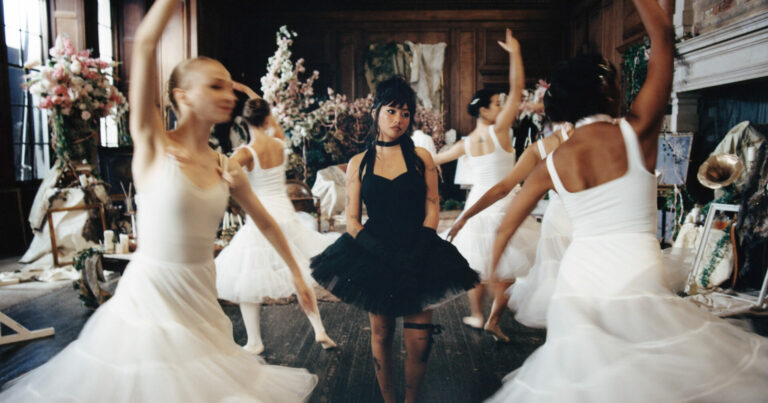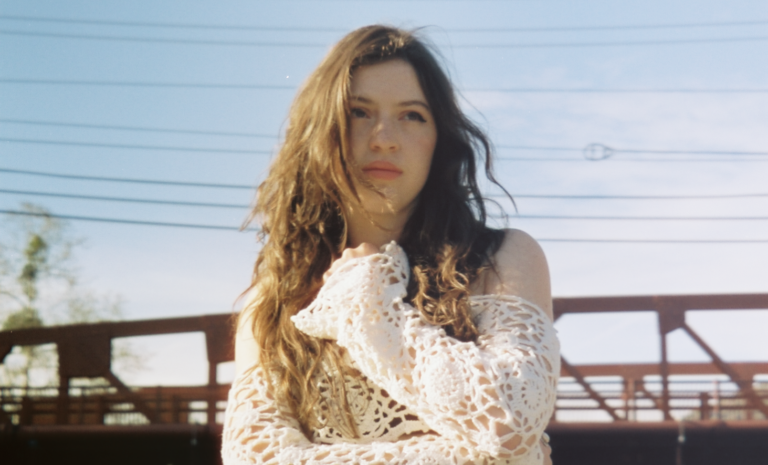
Hailing from Park County, Montana, Alaska Reid spent much of her early teenage years commuting back and forth between her hometown and Los Angeles. She began her career signing in basements, churches, and gyms before forming her first band, Alyeska, borrowing her parents’ minivan to tour around the mountainous American West. Alyeska disbanded after the release of 2017’s John Agnello-produced Crush, and Reid’s debut solo EP, 2020’s Big Bunny, was a collection of coming-of-age songs that showcased her knack for storytelling while folding in influences from alt-rock, pop, and Americana. It wasn’t hard to imagine her ethereal vision stretching out to a full-length LP, and her just-released debut album, Disenchanter, succeeds in immersing the listener into a wide-eyed, fully-realized journey. Once again working with her partner and PC Music label head A.G. Cook, Reid laid down each track live at home in both Montana and California, continuing to split her time between the coastlines. Gritty yet euphoric, Reid’s music thrives in those in-between spaces – between markers of home and the outside, between strangers and friends, between generations – and the production on Disenchanter allows her detailed songwriting to shine through and, at times, run off someplace new. By the time you get there, it already feels strikingly familiar.
Following our Artist Spotlight feature, we caught up with Alaska Reid to talk about some of the inspirations behind Disenchanter, including Montana sunsets, family, fantasy novels, country music, and more.
Big skies, Montana sunsets
This ties into the final track, ‘Airship’, which has some of my favorite lines on the record, like “Can you feel my heart expanding/ Swallowing sunsets and getting used to the real thing” and “It’s been big skies and half empty clubs for me.” To me, it encapsulates this feeling that you almost have to swallow the dreams you’re chasing to make them happen.
There’s a couple of things about that song. The West in general has this very big sky, and when my boyfriend came for the first time – he’s from the UK – he’s like, “It’s crazy how big the sky is here.” He was trying to think of it in a very visual and spatial way, and he’s like, “It must be because the mountains are so big, but very far apart.” And I realized later traveling in my life that that’s something that I feel like is such a part of me and that I need to see periodically; I need to get out on a road where I can see the sky and the mountains and the sunset. That just feels like home to me.
The second thing about that song is it’s one of my most personal songs, because I’m talking about my life and the chorus is me saying, “Spent my years so serious and sad/ But then I realized breathing brings enough of that/ Can you feel my heart expanding/ Swallowing sunsets and getting used to the real thing.” I think that was just about me making a conscious decision to try and not be as anxious in my life and not take things for granted. Realizing that contentedness is something that I could have control over personally for me and my brain, and that I could make a choice to not obsess and dwell on things, which is very much sometimes how my brain works. I was writing that as an assertion of strength, of me being like, “I am strong enough to realize that life throws people and me a lot of hard things, and I’m going to you work against that to be happy when I can, and to be content.”
The California grapevine
‘Airship’ is also about – when I started coming to LA, I never flew. I always drove with someone. I’d do it in one shot, and we’d sleep in a Walmart parking lot or someplace like that. It was me seeing the same places and stopping in the same rest stops, and it was so weird because it’s those places off the highway are not necessarily supposed to feel familiar, but they felt familiar to me. I really remember that stretch of coming down the grapevine and the sky opens up and you’re heading north on the 15 North Highway to Montana. It’s gorgeous, but it’s also arguably ugly in some ways, and desolate.
Detective novels: James Crumley’s The Last Good Kiss, John Ross Macdonald’s The Way Some People Die
I remember I read The Way Some People Die and I was very struck by it, because it was an interesting take on LA – I guess it’s Los Angeles noir, in a way. I love the way that he did very concise imagery in the novel. It’s almost a hardboiled crime novel, but it’s very poetic. California and Los Angeles is a place that’s written about all the time, so as a writer I often have fear, knowing that it’s part of my history but not really understanding a way that I could write about it or show people how I connected with it in a way that seemed genuine and my own. Reading the Macdonald novel – also Kate Braverman, she’s another author that speaks about LA – I found that I was able to use that as a key to speaking about it in my own way. It kind of freed me from this idea of, you can’t write about California, it’s too written about, it’s too cliche. It helped put me up to the challenge.
The Last Good Liss is really interesting because the protagonist travels all over, but it primarily takes place in Montana; the detective is based in Meriwether, Montana. I actually laugh out loud when I read that book because it’s crazy, and it has a combination of things that are really tied to my history and how I grew up. James Crumley just has this crazy old man vibe that reminds me a lot of my dad’s friends, novelists that I was around growing up. When I was younger, I used go to a bunch of dinner parties that my parents would throw or be invited to that were all writers, and something about that language in Crumley’s book just reminds me of that. It’s so epic, and it’s such a jumble of different images that all feel like it’s related to this Montana sensibility in a way. Sometimes it’s very dirty old man vibes, but I don’t take it that seriously. I think the author, too, thinks it’s funny. He’s a rock star author, in a way. I felt like that really informed my album, because I’m trying to bring together all these images and all these crazy things and have it be a bit Montana, a bit LA, and really just reflect myself in them. Those two tie together in my mind and bridge this geographical gap, the two places in my life.
Ray Young Bear’s poetry collection Manifestation Wolverine
My dad got me the book after reading one of his poems, and he’s just incredible. He speaks about the natural world in a way that’s not overly precious – I don’t know how to really articulate it. But when I was getting writer’s block writing, I would just sit down and read one of his poems and it would kind of loosen my mind enough.
Fantasy novels: Nicholas Eames’ Bloody Rose, Patrick Rothfuss’ Name of the Wind, Stephen King’s Fairy Tale
I am constantly reading fantasy books. There’s something about fantasy where the authors are working with places that don’t exist, made-up names, all this stuff, so you become really close with the main character because the rest of the stuff surrounding isn’t necessarily familiar. There’s something about how strong you have to hold on to the character, this hero’s quest. I like that because it parallels an album in a way – not that an album is necessarily a hero’s quest, but it’s definitely a personal journey. Bloody Rose is this great book where they talk about adventurers as if they’re bands, but it’s spent in a fatasy time. They call these mercenary groups bands, and they go and play arenas, which is where they duel with beasts and stuff.
Fiend Folio (Dungeons & Dragons)
I think the Fiend Folio was a bunch of art, these beasts made up by different players that were submitted. It’s almost like folk art. [The Disenchanter] is kind of like an aardvark creature that’s putting its snout on its shield and sucks the magic out of these magical items, so they take away the enchantment from an enchanted shield or sword or what have you. I just love that. I love the word enchantment and I love the idea of that, but if I called my album Enchanted, everyone would eye roll a bit. It just doesn’t encapsulate everything that it is.
Something about Disenchanter is really interesting, because I started thinking of the role of the songwriter being an observer, almost like this disenchanter where you’re pulling these things out of situations around you that are that you find magical, and you’re making that into something else new. You’re you’re disenchanting this thing by saying, “I want to take that.” I felt like this would be good for this album, because it felt like I made a conscious effort with each of the songs to really consider different things and turn them around in my head in a way where I was trying to extract the magic and put that magic in a song. It just clicked for me the second I saw it, because it’s not really negative and the creature is not violent, but it’s also not harmless.
How can you tell if something is gained or lost from trying to extract that magic?
I was talking to a songwriter about this, and it was this idea that you almost put something away when you write a song about it. You put it away in your brain. I spend so much time analyzing it and working it over, like poking the cut, and when I’m done with the song, I’ve sort of gone everywhere that I could with it, that I wanted to go, or that I felt was useful. Then the song becomes its own thing, and I just get to sing it. Kind of the worst part of the process is the actual songwriting, because if you’re writing about something that’s upsetting, you’re really living in it. But once it’s done, you don’t need to go over it anymore.
When I’ve found situations to feel really magical, the real situation to be magical, and then I’ve gone and tried to write about it, it obviously becomes a fiction. The original experience becomes what I wrote in my song; maybe it’s the tidier version, maybe it’s the more interesting version, maybe it’s the messier version. But by writing it in a song, I change my personal history with it. I think that’s a bit of the disenchanter, I don’t really think you’re necessarily gaining or losing meaning. I think you’re just shifting it into different parameters when you’re writing, because you can’t write all the information from one thing in a song. You have to bring out the best bits and elevate and make it universal for other people.
Hiking
This idea of taking an experience and transforming it by looking at it from different angles relates to ‘Back to This’, which was inspired by this group you encountered while hiking in the Absaroka-Beartooth Wilderness. But it also seems to speak to a broader theme about interacting with the natural world.
I think hiking and being the natural world is so interesting because it does not give a shit about you. It is not really for us, right? It will go on, it has a different relationship with time than we have. It just makes a lot of things that we deal with, even if they’re really tricky or really hard or really crazy, just kind of blows that to bits. When you’re really out in the middle of nowhere, it’s distance for you to examine what’s going on in your real life in a way you wouldn’t have if you were sitting in your bedroom, because you’re seeing things that don’t care, don’t move, don’t adhere to the same human social structures. I think that’s what helps me get out of my brain, being in nature, because it’s so constant, so intense and relentless that it makes me realize there are social constructs in the world that just don’t matter when you’re outside. It’s that feeling of feeling in awe of feeling powerless. Even though I sometimes find it scary, it does help me think, and it provides perspective.
Family and friends
A song that struck me interns of the way you write about family is ‘Palomino’, where you imagine yourself in your mother’s place. What prompted you to go back to these stories that she would tell you and your sisters?
I’m an older sister and I am really close with my siblings, so it’s really interesting to observe people that you love go through things in their life that are similar or different. Both my sisters are 18, so I think about, what was it like when I was 18? How was I doing things differently? How are our experiences the same? The other thing about that is it’s impossible to tell your younger siblings, like, “Trust me on this.” Sometimes they take my advice, most of the time they’re like, “Fuck you.” It’s very intense and hard for me, but it helps me think about my past as well, to watch them go through everything. I write about that sometimes, and I thought about that with ‘Palomino’, because I remember my mom talking to me when I was 18, about when she was in LA, when she was the same age as me, saying this stuff that felt very, like, passed down from mother to daughter to sister. She’d always be like, “You can always get in your car and go if you ever feel weird about something.” I was playing a lot of shows when I was that age around LA by myself, and you have a mixed bag of experiences. My mom would always be like, “I remember this,” comforting and warning, like a mother’s advice.
I really wanted to write ‘Palomino’ for her, talking about that period in her life. She was working at this country music club in North Hollywood. I wrote it also for myself, because I listen to what she said and I went through some similar things. And then I wrote it for my sisters, because I have been watching them have experiences and figure out stuff. I wanted to feel like a song that was passed down through all of us girls in a way. Also this idea that – this is something my mom spoke about – a lot of times when you’re young, people try to make you into this fantasy or think that you’re something that you’re not, and in reality you’re just trying to figure yourself out. My mom was always saying, “You don’t need to get bogged down in some relationship or anything, you just need to figure out who you are.” That line – “I wasn’t trying to fall in love/ Just figure out the world” – is kind of about her philosophy.
‘French Fries’ is more about friendship, and I love the way it highlights these big, complicated emotions and love that underlie small, ordinary moments.
I was worried for a second the song seemed very judgmental or finger-wag or whatever. It comes from a place of love to be talking to this character, one character saying, “I don’t judge you for all these things that maybe you judge yourself for. I judge you for not being stronger to make healthy decisions in your life.” It’s really tricky to say, it’s almost like saying to somebody, “The things you feel bad about, erase it, it doesn’t have anything to do with it. I just want you to be good to yourself.” It kind of breaks your heart to see that. I think I’m a person who has a tendency to be judgmental, so I struggle with that in myself a lot.
Country music (Dolly Parton, Hardy, Lainey Wilson, Parker McCollum, Jason Isbell)
I love country music. I grew up on it, I started kind of doing it. I didn’t think as much about genre when I was super young. I’d listen to ‘Freak Scene’ by Dinosaur Jr. and then I’d go listen to Doc Watson’s ‘Tennessee Stud’. There’s such a high bar for songwriting and storytelling, and that community really values that. It’s almost a requirement for country music that you bring a really good song with a really good story to the table. I think I wanted to demand from my new album that I have stories the way that country, Americana musicians demand from their work that they have stories. Also, a lot of the people I listed aren’t afraid of twisting something, of taking familiar ground and changing it a little and looking at it from the side and going in between and having nuance. That’s why I gravitate, especially towards Hardy, Jason Isbell, and obviously Dolly Parton – she’s magical to me. I always look to her for inspiration, because she can write about all sorts of different things and she still stands out there and performs with a smile, with this incredible voice. I can’t put into words how much I admire her.
Lindsey Buckingham
I think he’s an incredible writer, and I love how tightly crafted a lot of his stuff is, and I love his language with guitar. I try and emulate what he does to elevate things, and I often start thinking about him at the final stage of songwriting, when I’m trying to condense a riff or structure. That’s when I’ll simplify and make it the best it can be.
This interview has been edited and condensed for clarity and length.
Alaska Reid’s Disenchanter is out now via Luminelle Recordings.