

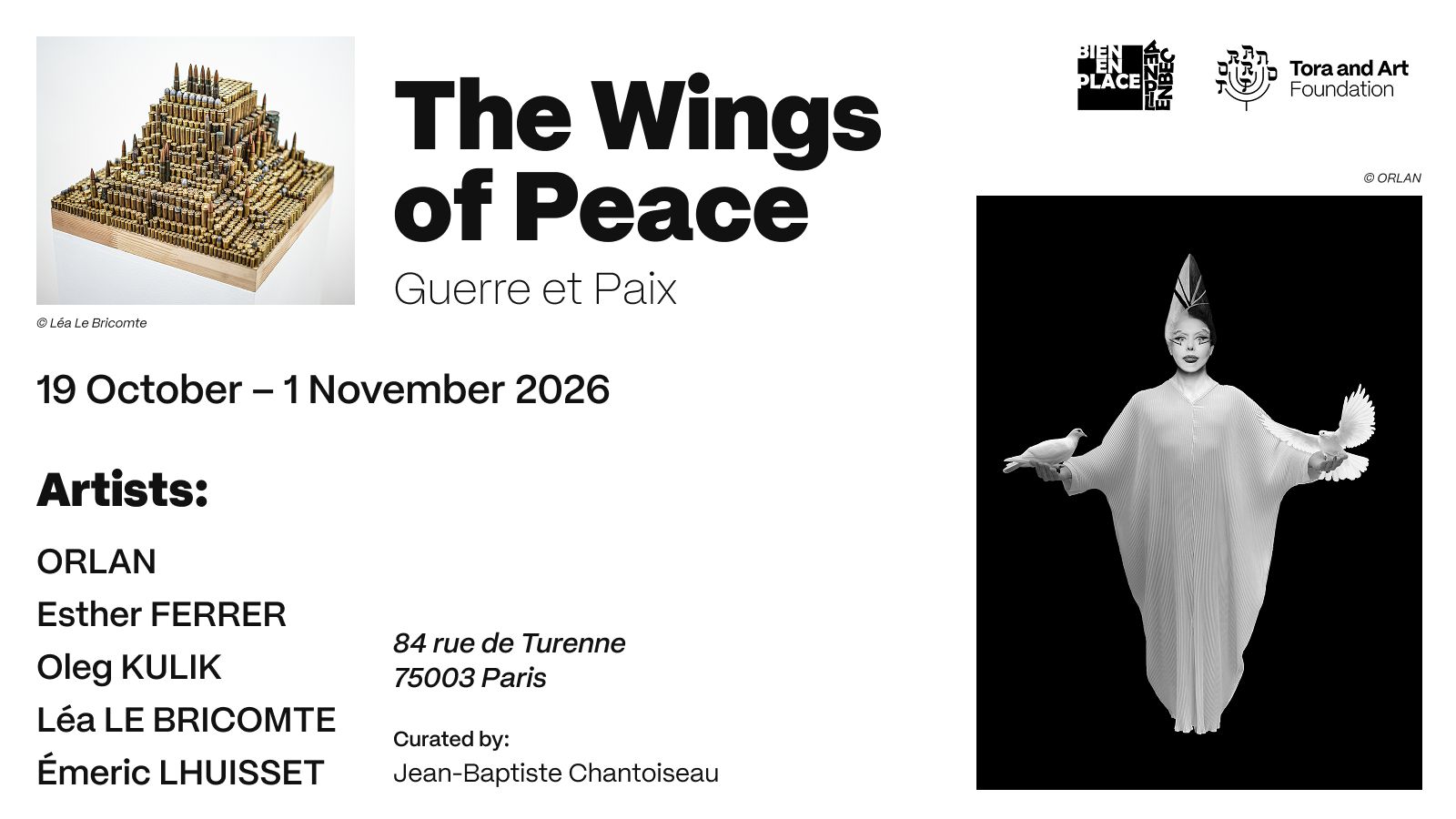
As Paris is about to be filled with collectors and gallerists for the new Art Basel season, an exhibition in the heart of Marais is about to launch. Vers la paix perpétu-aile(s) / The Wings of Peace brings together artists from different generations and explores a language in which the theme of peace can be spoken about today.
The title chosen for the exhibition is wordplay that resists translation. Paix perpétuelle, “perpetual peace,” is actually the phrase Kant used for his essay on ending war. Here the word aile, “wing,” is folded into it. The result is a peace with wings: fragile, mobile, always about to slip away. ORLAN gave this title to one of her sculptures, and after it became the name of the whole exhibition. Organised by Tora and Art Foundation and the French cultural platform Bien En Place, the exhibition is curated by the French art historian Jean-Baptiste Chantoiseau.
The project runs alongside Art Basel Paris, but its tone is far from the fair’s. The curator describes its purpose:
“Alongside ART BASEL PARIS 2026, and against a backdrop of unprecedented world wars, ORLAN invites four artists deeply committed in their work to join her in awakening consciences and calling on each of us to take responsibility.”
ORLAN: the dove after the Louvre
Since the 1960s, ORLAN has used her own body as her main artistic medium, examining the concepts of identity, representation and social norms through it. She has been working with performance, photography, sculpture and video, and more recently with artificial intelligence, robotics and biotechnology. This time, ORLAN’s part in the exhibition is a continuation of her Leçons d’artiste lecture series at the Louvre. In this exhibition, the motif of the dove becomes a reflection on peace that has to be rethought in light of real conflicts.
Her central piece is the sculpture Pour la paix perpétu-aile(s) (2024), made of marble powder using 3D scanning and a cast of the artist’s body. In the project it is shown alongside a photographic version and the lenticular photomontage L’Origine de la guerre (2023), whose title openly refers to Courbet’s L’Origine du monde.
Esther Ferrer: when toys become weapons
One more artist taking part in a project – Ester Ferrer. In her series Juguetes educativos (Educational Toys), she puts childhood associations next to the destructive purpose of weapons, creating an uncomfortable contrast between the two. The artwork draws its force from how close the two turn out to be.
As curator Jean-Baptiste Chantoiseau mentions, “From a child’s toy to an instrument of mass destruction, there is sometimes only one step, once power is entrusted to childish and irresponsible leaders.”
Oleg Kulik: a prophecy from the nineties
Oleg Kulik was one of the defining figures of 1990s Moscow Actionism. He is best known for confrontational performances in which he took on the persona of an animal, exploring the visceral bond between humans and animality.
This year in Paris, he presents artworks from the late 1990s, including At Home and a piece At the Church, from his famous series The Russian. These photomontages with digital printing take a look at the contradictions, absurdity and kitsch of post-Soviet life. Created more than a quarter of a century ago, they still feel almost prophetic today – like images of a catastrophe that happened already with unfolding consequences.
Léa Le Bricomte: defusing war
The French artist Léa Le Bricomte works with the physical and symbolic materials of war and changes what exactly they mean. Her installation Dripping Medals is produced from original First World War military medals and ribbons, which hang down in streams that recall abstract drip paintings. As curator highlights “ she defuses war by subverting its means. A first step towards peace?”
Émeric Lhuisset: the Cossacks’ reply
Impossible not to mention Émeric Lhuisset, who is also participating in the exhibition’s artistic dialogue. His point of view is actually tied to his background – he has worked in conflict zones, often at personal risk: Iraq, Afghanistan, Syria, Ukraine, Colombia, Kurdistan. That is why what particularly interests the artist is how people can reclaim their own history, which is quite often told by outsiders.
In Paris, he presents J’entends au loin la réponse des cosaques (From Far Away, I Hear the Cossacks’ Reply). The photograph is a contemporary restaging of Ilya Repin’s Reply of the Zaporozhian Cossacks, created in Ukraine in 2023 with the help of soldiers.
In the exhibition, all five artists take different routes and present different points of view on the dichotomy of conflict and peace. Some of them confront violence head-on, while others approach it through body language, symbols, memory or political imagery.
The exhibition does not try to explain to visitors an already prepared idea, leaving the interpretation open for everyone and suggesting to find the answer on his. What is conflict and what is peace?

