

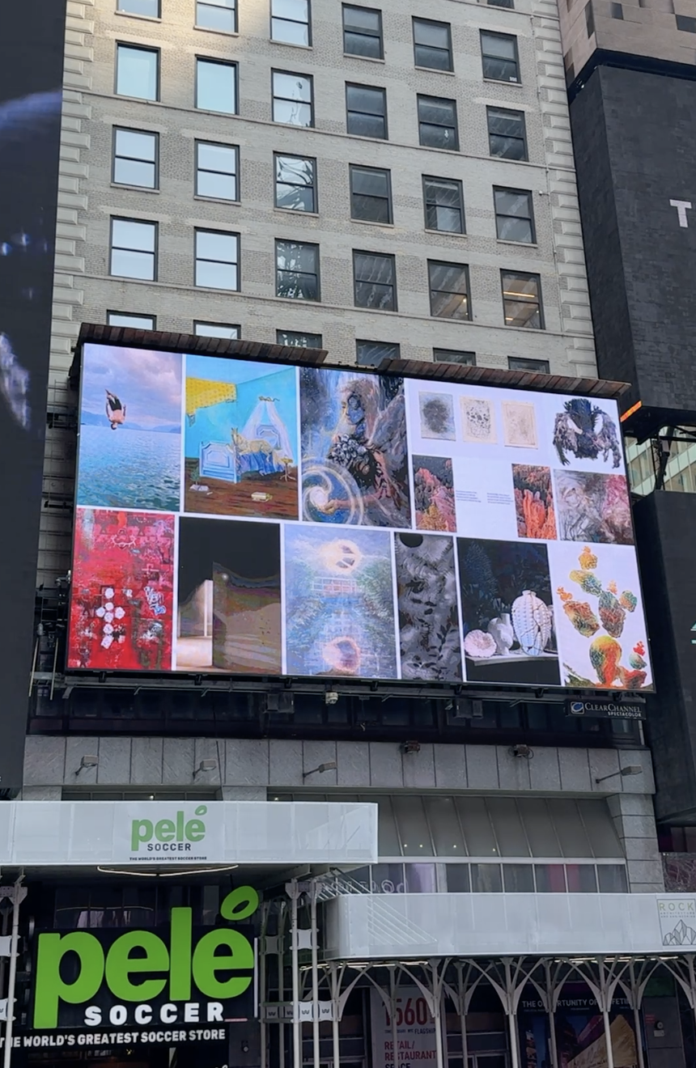
In contemporary urban life, attention has become a scarce form of value—something continuously pursued, measured, and monetized by platforms, brands, and media systems. This is the basic logic of the attention economy: visibility is no longer neutral, but bound up with competition, circulation, and the struggle to hold a viewer’s focus. Advertising, social media, news feeds, and brand imagery together form a highly saturated information environment, where images are no longer simply objects to be viewed, but presences competing against one another. New York’s Times Square is one of the clearest embodiments of this visual mechanism: enormous electronic screens cover building facades, images rotate at extremely high speed, and almost no single image remains in view for long.
In such an environment, the appearance of art carries an inherent tension. What it confronts is not a neutral exhibition space, but a visual system governed by speed, recognition, and communicative efficiency. The question, then, is not simply whether a work can be seen, but whether its presence in such a setting might lead viewers to look in a way different from how they look at commercial imagery.
The work of artist Xi Liu offers precisely this kind of image experience, one that departs from the dominant visual logic of the present. Her practice is grounded in a process of slow formation: painting, material experimentation, and sustained observation of micro-ecological structures together shape her way of working. Within this process, the work emerges gradually through the interaction of time, material, and environment. The images therefore carry a rhythm that is not in a hurry to resolve itself, while preserving the uncertainty inherent in their own making.
This quality is especially clear in her series Untitled (2025). Based on handmade paper, the work allows pigment to seep and settle into the fibers, forming intricate and subtle traces. These marks, not fully controlled by the artist, are generated through the combined effects of material, humidity, time, and gravity. The forms within the image evoke both the growth patterns of plants and some unclassified natural structure, remaining poised between recognition and indeterminacy.
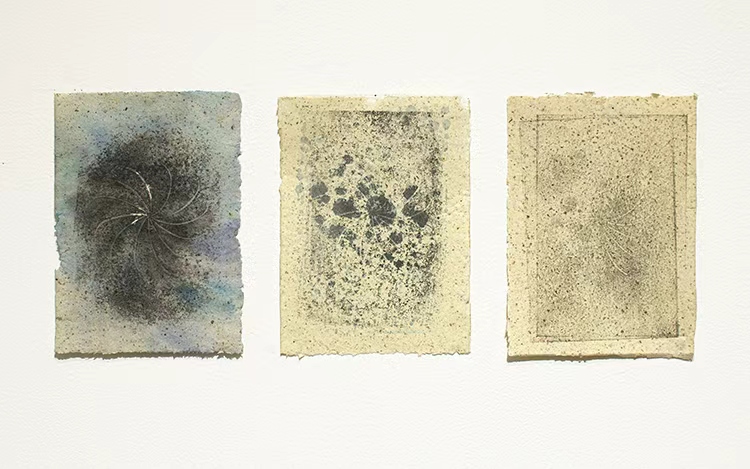
In this series, Liu also carves stamps and layers recurring spiral-like motifs across the surface. These impressions bring repetition and structure into the composition, establishing a clearer human order alongside the naturally diffused traces of pigment, and gradually giving the image a symbolic quality.
This symbolic dimension is tied to Liu’s reflections on language. In her work and research in 2024, she examined ancient symbols across different cultures, including elemental forms such as the sun, moon, water, and fire. From there, she arrived at a further question: beneath the differences of language and culture, do human beings still share some more fundamental mode of perception? The repeated motifs in these works are therefore no longer merely visual forms; they also become a way of probing that shared ground.
When this group of Untitled (2025) works appeared on the large screens of Times Square on August 16, 2025, the qualities inherent within them became further intensified. Surrounded by commercial imagery engineered for maximum immediacy and communicative efficiency, Liu’s works sustained a markedly slower, lower-density visual rhythm. Rather than competing through heightened stimulation, they resisted urgency and refrained from offering a singular, readily legible point of recognition. It is precisely this subtle divergence from the surrounding visual environment that enables the works to occupy an alternative mode of presence within the continuous stream of images—inviting viewers into a form of visual engagement that unfolds gradually, rather than being instantly consumed.
It is here that the relationship between the work and Times Square becomes particularly layered and compelling. Times Square does not merely provide the work with a platform of greater visibility; the work, in turn, introduces a brief shift in the habitual mode of looking that the space typically produces. A screen usually devoted to instant recognition and rapid transition comes, for a moment, to hold another image logic—one that does not emphasize conclusion, does not seek immediate legibility, and instead returns viewing to sensation, pause, and incompletion.
Within the logic of the attention economy, this kind of image experience carries particular significance. At a moment when most visual content is driven toward greater legibility and faster transmission, Liu’s work suggests something else by slowing rhythm, preserving openness, and reducing informational density: an image does not exist only as a vehicle for delivering information. It can also serve as a point of departure for reactivating perception and reorganizing the act of looking.
From this perspective, Xi Liu’s Untitled (2025) preserves its own temporality, structure, and stillness within a highly accelerated visual field. It does not stand outside the image environment of the present, yet neither does it fully submit to its rules. What the work introduces, then, is a subtler kind of shift—one that makes visible the possibility that, within viewing habits continuously shaped by speed and efficiency, another mode of perception may still remain.

