

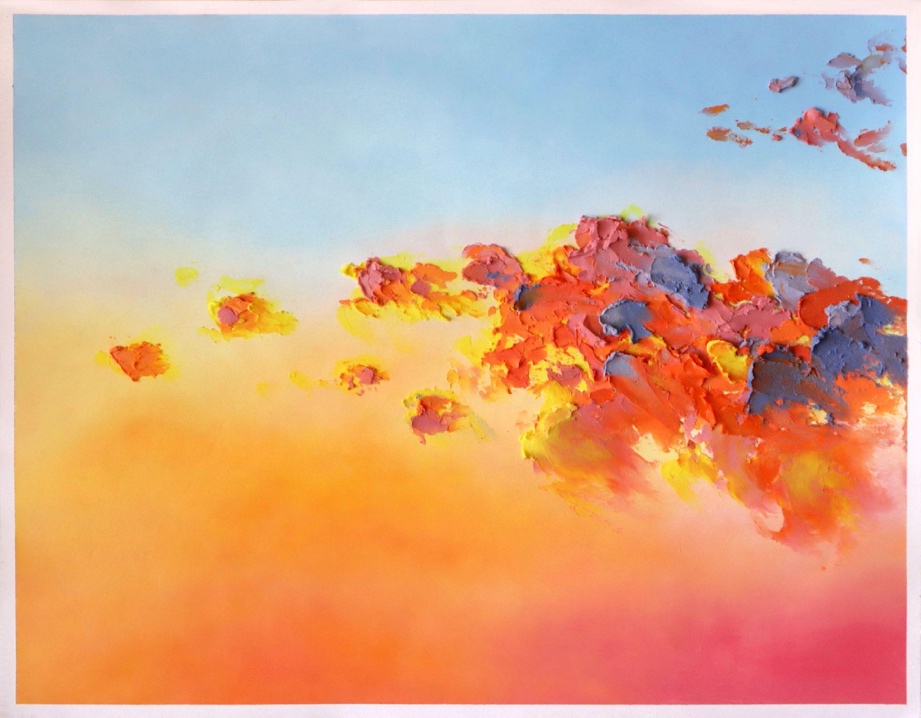
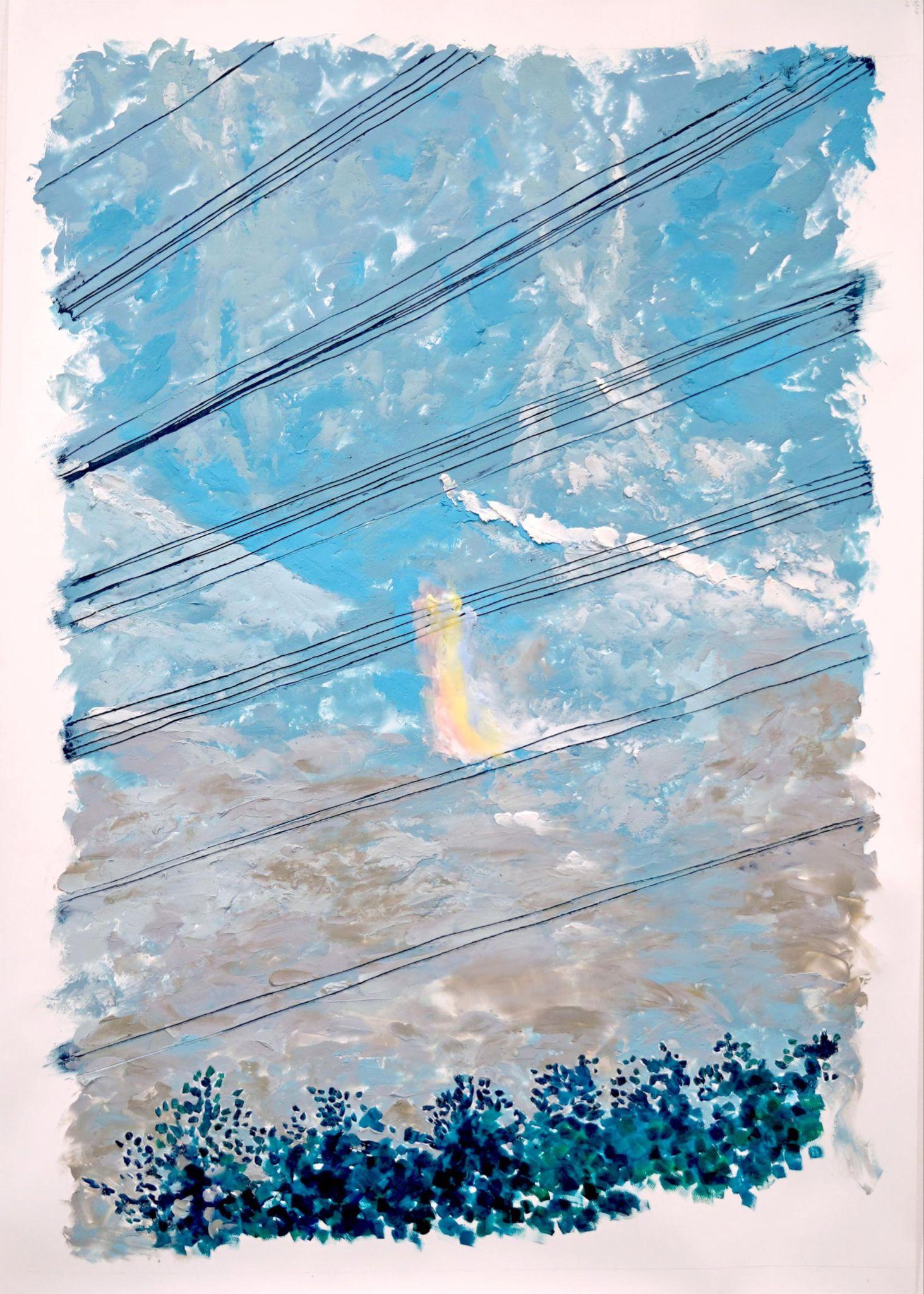
Zhen Wei’s A dash (2025, oil and cold wax on paper, 19 × 24 inches) begins with an ordinary but sharply brief visual experience. At sunset, while looking through the window of a moving car, the artist saw a cloud briefly illuminated by light before it disappeared from view. Rather than reconstructing that moment as a complete landscape, Wei preserves what remains after the image has passed: a shift in attention, a residue of light, and the afterimage of something seen only for a few seconds.
The painting does not approach this scene as a conventional landscape. Its background is handled with softness and restraint. Blue, orange, pink, and yellow dissolve gradually into one another, creating an atmospheric field that appears almost smooth to the touch. This luminous surface does not describe a specific location. Instead, it evokes a visual condition in which form, light, and time are already unstable. The cloud is not fixed as an object in the sky; it is caught at the point where seeing begins to turn into memory.
Against this softened field, the foreground carries a markedly different material force. Wei pushes, layers, and accumulates oil paint and cold wax directly on the paper, allowing cloud-like forms to rise from the surface with a nearly sculptural presence. The contrast between the smooth background and the heavier wax structure gives the work its central tension. The image appears light and transient, yet its material body insists on weight, pressure, and physical presence. Through this contrast, the cloud becomes more than atmospheric scenery. It becomes a material event on the surface.
This is where the painting’s force begins to take shape. Wei is not simply depicting a view of the sky; she is giving structure to a brief act of seeing. The viewer is asked to consider not only what the image depicts, but how a moment is held, interrupted, and transformed through surface. The painting moves between flatness and depth, figuration and abstraction, visual memory and tactile presence. What might have been a passing view from a car window becomes a concentrated study of how matter can hold the instability of looking.
Although A Dash emerges from an ordinary observation, the painting also reflects the broader artistic direction that distinguishes Wei’s practice within contemporary painting. Rather than treating landscape as a subject to be represented, she approaches it as a perceptual field through which memory, materiality, and acts of looking can be examined. By combining dense material processes with a restrained visual language, Wei transforms fleeting visual experiences into sustained investigations of attention and the physical presence of paint. This approach also sets Wei apart from many contemporary painters working with landscape imagery. While landscape today is frequently used to address ecological concerns, environmental politics, or questions of place and identity, Wei turns toward a quieter investigation of perception itself. Her paintings are less concerned with describing the external world than with examining how fleeting visual experiences are registered, remembered, and materially reconstructed. In doing so, she shifts attention from landscape as subject to landscape as a catalyst for perception. This ongoing dialogue between materiality and perception has become one of the defining characteristics of her practice, contributing to a distinctive body of work that expands contemporary discussions of how painting can register the experience of seeing.
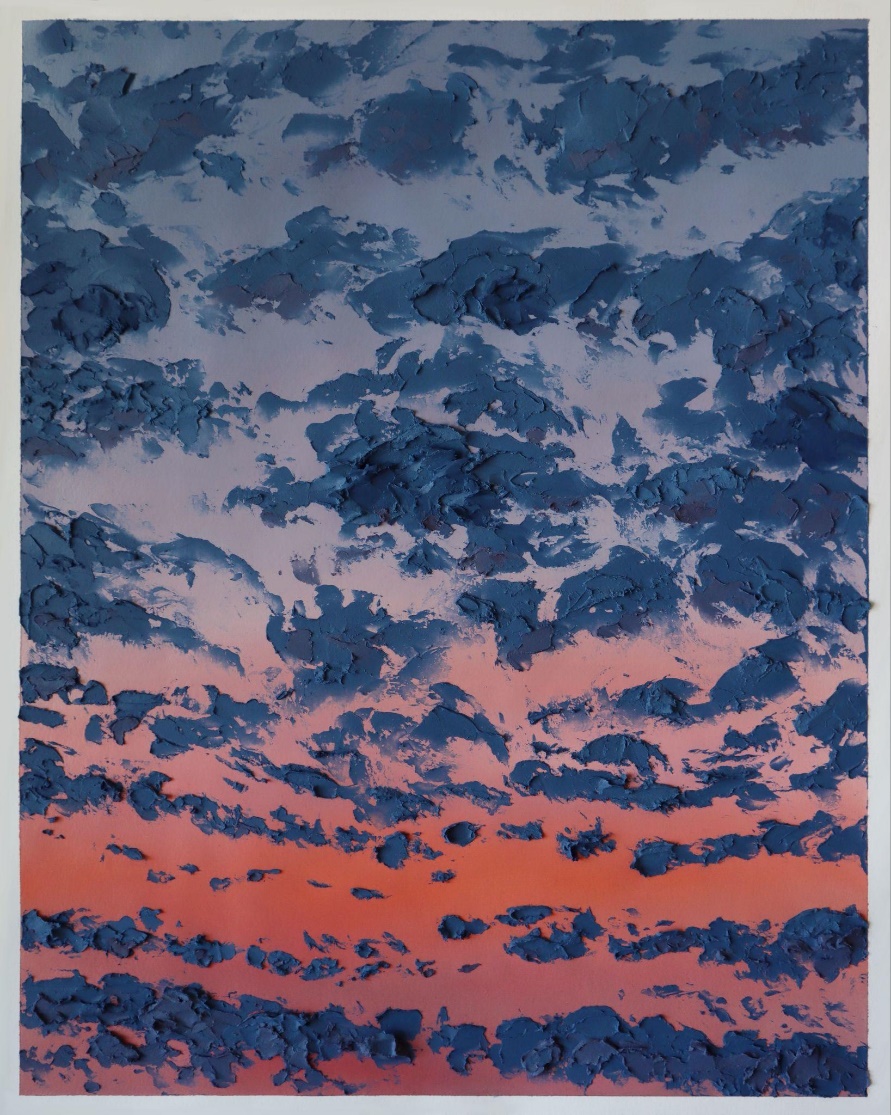
Yellow plays a subtle but decisive role in this structure. This careful orchestration of color and material has also received professional recognition. A dash was recognized in Creative Quarterly 83’s Fine Art, Theme: Yellow category, yellow does not function as a simple thematic marker or dominant color. It appears as warmth beneath the surface, a trace of sunset, and a thin layer of light that alters the atmosphere of the scene. It gathers along the edges of the cloud forms, emerges from beneath other colors, and glows through the surrounding field. It does not occupy the painting through force. Instead, it changes the temperature of the image from within.
This broader artistic direction is equally reflected in Wei’s treatment of color. In her work, color is not merely a visual component or a symbolic device. It often acts as an entry point into a state of attention. In A dash, yellow is not a fixed meaning but a passing condition: a brief light that touches the ordinary world and makes it momentarily unfamiliar. The sky remains a sky, and the cloud remains a cloud, yet they are no longer simply external scenery. They become signs of a moment when attention loosens from routine and turns toward the self.
This inward turn belongs to a larger direction in Wei’s practice. Currently living between Xiamen and Los Angeles, Wei works across oil painting, cold wax, acrylic, photography, and installation. Her works often begin with ordinary visual encounters: skies glimpsed through car windows, clouds seen from airplanes, reflections in rainwater, and fragments of light at the edge of the city. These images come from daily life, but they are not treated as casual records. Through material handling and color, Wei turns them into spaces where experience slows down and looking becomes a form of reflection.
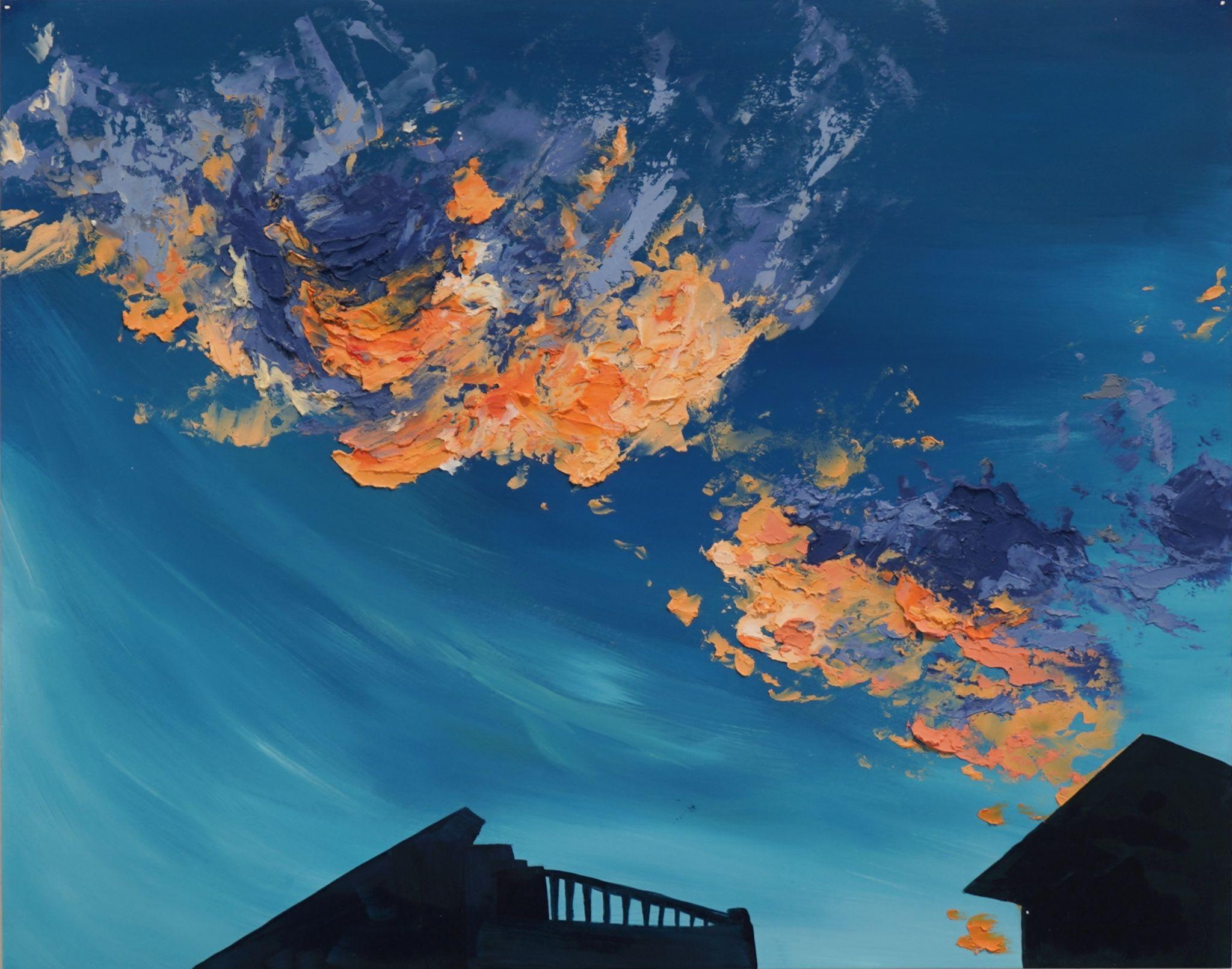
Oil painting and cold wax have become especially important to this process. The density of oil paint gives weight to images that might otherwise remain ephemeral, while cold wax creates a spatial quality that allows the surface to hold light, pressure, and movement at once. In A dash, this relationship between material and perception is particularly precise. The work does not enlarge the fleeting moment into drama. Instead, it lets the smallness of the encounter remain visible, while giving it enough material presence to stay with the viewer.
The acclaimed recognition of Wei’s practice is also reflected through its presentation across a range of exhibition and publication contexts in the United States and internationally. Over the past several years, Wei has presented her work through a growing number of solo and group exhibitions across the United States and internationally. From Small Eternities at East Gallery to A Journey Through Urban Evolution at Ginkgo Art Gallery, and through exhibitions in Milan, Portland, Pomona, and Claremont, her practice has steadily attracted broader institutional and professional visibility. Her inclusion in Annuario d’Arte Contemporanea Cina–Italia 2022 further reflects the expanding international recognition of her work.
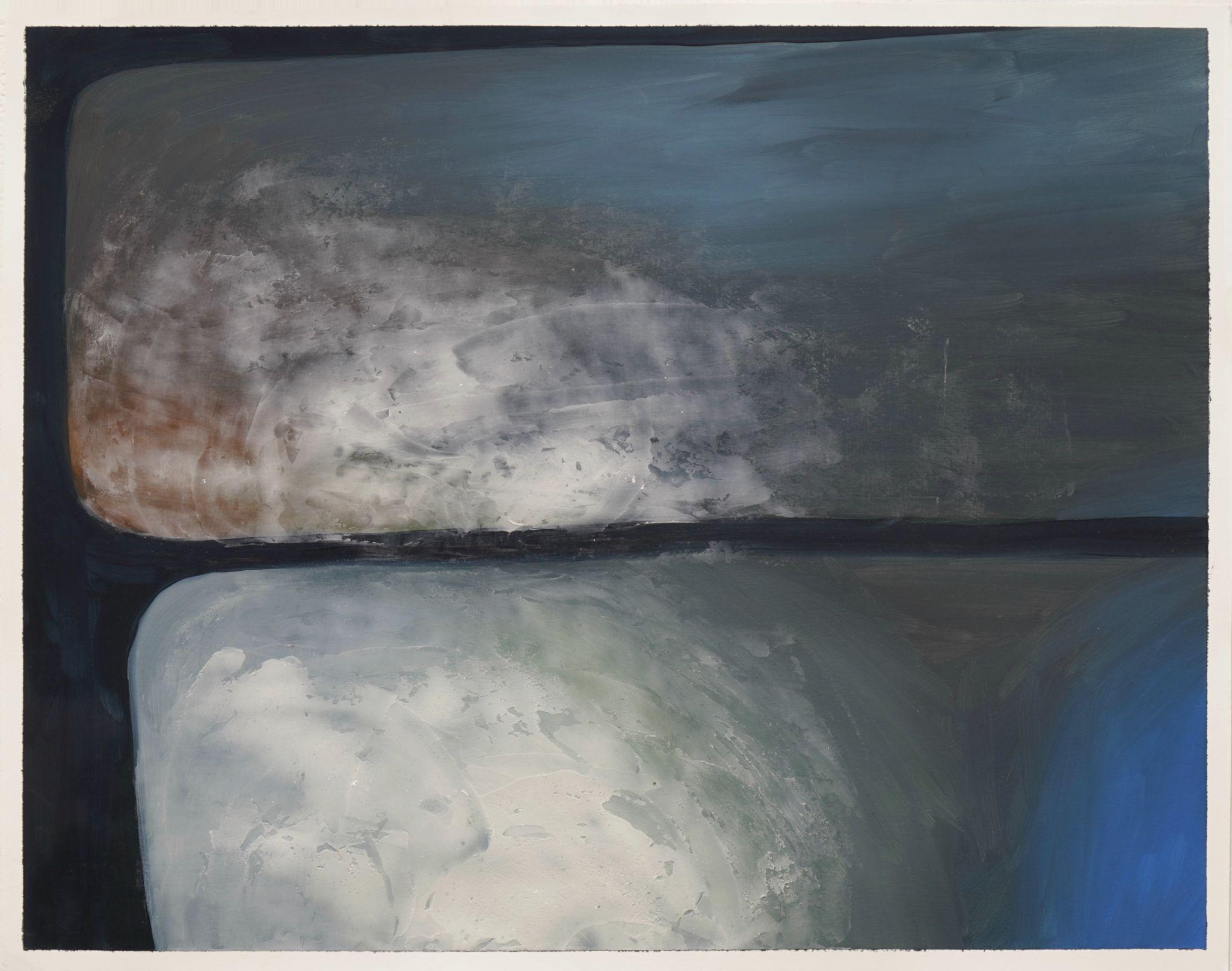
The strength of A dash lies in its refusal to overstate its subject. The work does not rely on explicit narrative, dramatic symbolism, or psychological illustration. Its meaning emerges through more subtle contrasts: smoothness and roughness, surface and depth, lightness and weight, a passing image and a materially built form. At first glance, the painting may appear immediate, almost like a quick gesture of color. Beneath that immediacy, however, is a carefully structured relationship between material, memory, and mental distance.
In this sense, A dash connects to Wei’s broader body of work without needing to explain itself through biography. Across her paintings of skies, clouds, window views, and reflected surfaces, incidental images often appear at the edge of movement. A view appears through glass. A reflection gathers in rainwater. A cloud is briefly held by dusk. These are not dramatic subjects, but they carry the quiet intensity of moments in which the visible world becomes psychologically charged.
Its recognition in Creative Quarterly 83 reinforces the professional reception of Wei’s practice while bringing broader visibility to a painting that resists spectacle in favor of sustained looking. Rather than preserving a complete landscape, A Dash transforms an ordinary visual encounter into a materially sophisticated meditation on perception. In doing so, the work exemplifies the distinctive qualities that continue to define Wei’s contribution to contemporary painting.

