

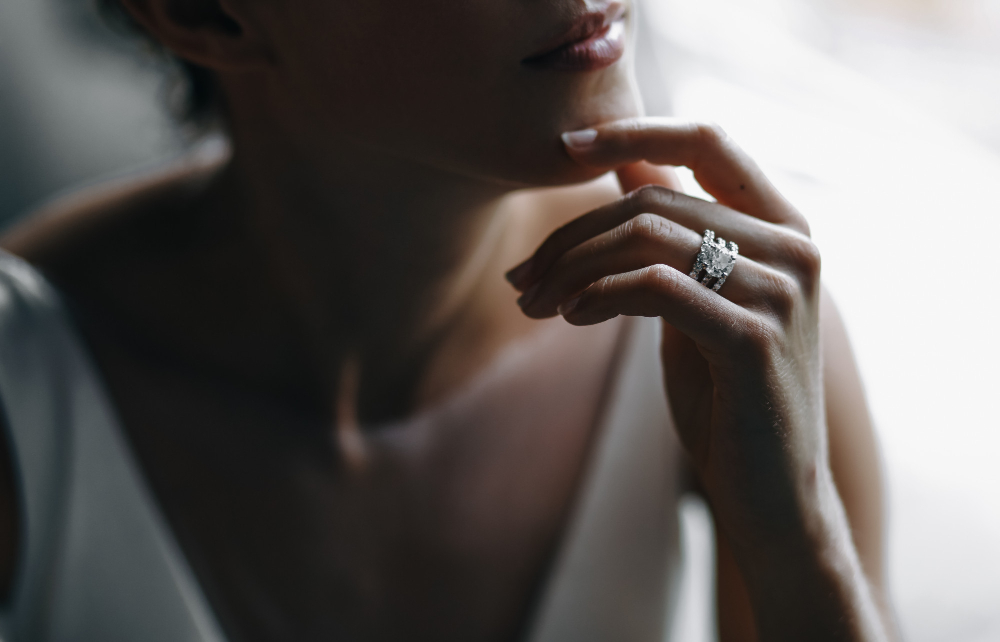
Minimalism has quietly taken over the way a lot of us dress. Neutral tones, clean lines, wardrobes pared back to the essentials, it makes sense, really, as a reaction to years of overconsumption and visual noise. But here’s the thing: the minimalist movement hasn’t killed off statement jewellery. If anything, it’s given it a more interesting role to play. When your outfit is deliberately simple, a sculptural cuff, an unusual ring, or a piece of diamond jewellery stands out not because it’s trying too hard, but because everything around it has been stripped back to let it breathe.
There’s a common misconception that statement jewellery is inherently over the top. It isn’t. Often, the impact comes entirely from balance, one well-chosen piece can shift the mood of an outfit, give structure to something soft, or introduce a flash of personality without unsettling the whole look. In a minimalist context, jewellery doesn’t compete. It anchors.
Minimalism needs a bit of contrast
The appeal of minimalist dressing is restraint, a crisp white shirt, a well-cut black dress, a cashmere knit that asks nothing of you. But taken too far, that restraint can tip into flatness. Everything is so considered that nothing stands out, and the overall effect feels a little lifeless. Jewellery is the obvious solution, because it introduces contrast without pulling the look apart.
Oversized earrings with a sleek updo. A bold necklace against a plain neckline. A chunky ring with monochrome tailoring. These combinations work because they’re controlled, there’s one thing drawing the eye, and everything else supports it. You’re not adding more for the sake of it; you’re giving the outfit a focal point. That’s a very different thing.
“Statement” doesn’t mean maximalist
The word gets misread constantly. Statement jewellery can absolutely be big, colourful and theatrical, but it doesn’t have to be. A piece makes a statement through shape, material, craftsmanship, even the way it sits on the body. A clean architectural pendant. A wide silver cuff. A pair of pearl drops with an unusual silhouette. None of these are loud, but all of them have presence.
The most quietly effective statement pieces tend to work because they use restraint intelligently. Strong silhouette, interesting texture, a distinctive finish, but still leaving room for the rest of the outfit to exist. This matters particularly for people who lean minimalist but don’t want their style to feel entirely anonymous. One intentional piece rather than five layered ones. It reads as considered, not cautious.
Jewellery as self-expression
Clothes communicate, but jewellery often communicates something more personal. It’s worn close to the body, kept for years, and frequently tied to memory or meaning in a way that a seasonal coat simply isn’t. Heritage, identity, creativity, sentiment, these things tend to live in jewellery more than anywhere else in a wardrobe.
In a minimalist era, where many people are gravitating towards the same staples, jewellery becomes one of the few genuine points of difference. Two people in identical black blazers and tailored trousers will look entirely different depending on what’s around their neck or on their wrist. One picks a vintage brooch, another a chunky gold chain, another a spare and unusual ring. Each choice says something specific.
As wardrobes have become more edited, fewer pieces, more classics, accessories have taken on more of the expressive work. Jewellery offers a way to shift your personal style without overhauling everything else. That’s a genuinely useful thing.
The influence of art and architecture
A lot of contemporary jewellery is drawing from the same visual language as modern architecture and sculpture: geometric forms, organic shapes, asymmetry, unexpected material combinations. This makes it naturally compatible with minimalist fashion, which tends to share that preoccupation with form and proportion.
A sculptural earring that echoes the curve of a neckline. A pendant with an abstract shape that creates a focal point against a simple dress. A wide cuff that mirrors the structure of a tailored sleeve. These pieces work because they’re in dialogue with the outfit rather than just decorating it. There’s a visual logic to the pairing, even if it isn’t consciously articulated.
For anyone who thinks about fashion as a kind of visual culture, jewellery offers a small but surprisingly powerful canvas. An everyday outfit can feel genuinely considered when the right piece is involved.
Getting the dressing-up problem right
Minimalist wardrobes are praised for their versatility, and mostly that’s deserved. But occasion dressing can expose their limits. A simple slip dress or a clean-lined suit works brilliantly during the day and then, come evening, needs a bit of help to shift register. Statement jewellery does exactly that job.
Dramatic earrings make a plain black dress event-appropriate. A bold bracelet changes the tone of a tailored suit. A striking ring adds interest when the rest of the look is deliberately understated. Rather than buying separate occasion pieces you’ll rarely wear, one or two good accessories can make familiar clothes work much harder. It’s a more sensible approach, and it keeps the wardrobe genuinely flexible.
Giving it space to work
The principle is simple: if the jewellery is doing something interesting, the outfit should let it. That doesn’t mean everything else has to be boring, it means the rest of the look shouldn’t compete.
Oversized earrings tend to land better when the neckline is simple and hair is off the face. A bold necklace suits an open or plain high neck. A sculptural cuff earns its moment with short or rolled sleeves. Colour and texture follow the same logic, polished metal against matte fabric, colourful stone against a neutral outfit, irregular organic shapes against clean tailoring. These aren’t rigid rules, just instincts worth developing.
Statement jewellery endures because it operates on a different rhythm to clothing trends. A distinctive piece can remain relevant across years and evolving wardrobes precisely because it isn’t tied to a season. And it lasts because it often means something, a piece chosen for its shape or its story becomes part of how someone understands their own style.
In an era of restraint, that matters. Minimalism done well is never about erasure; it’s about intention. And a single piece of jewellery, chosen carefully, proves that a simple outfit can still have real character.

