

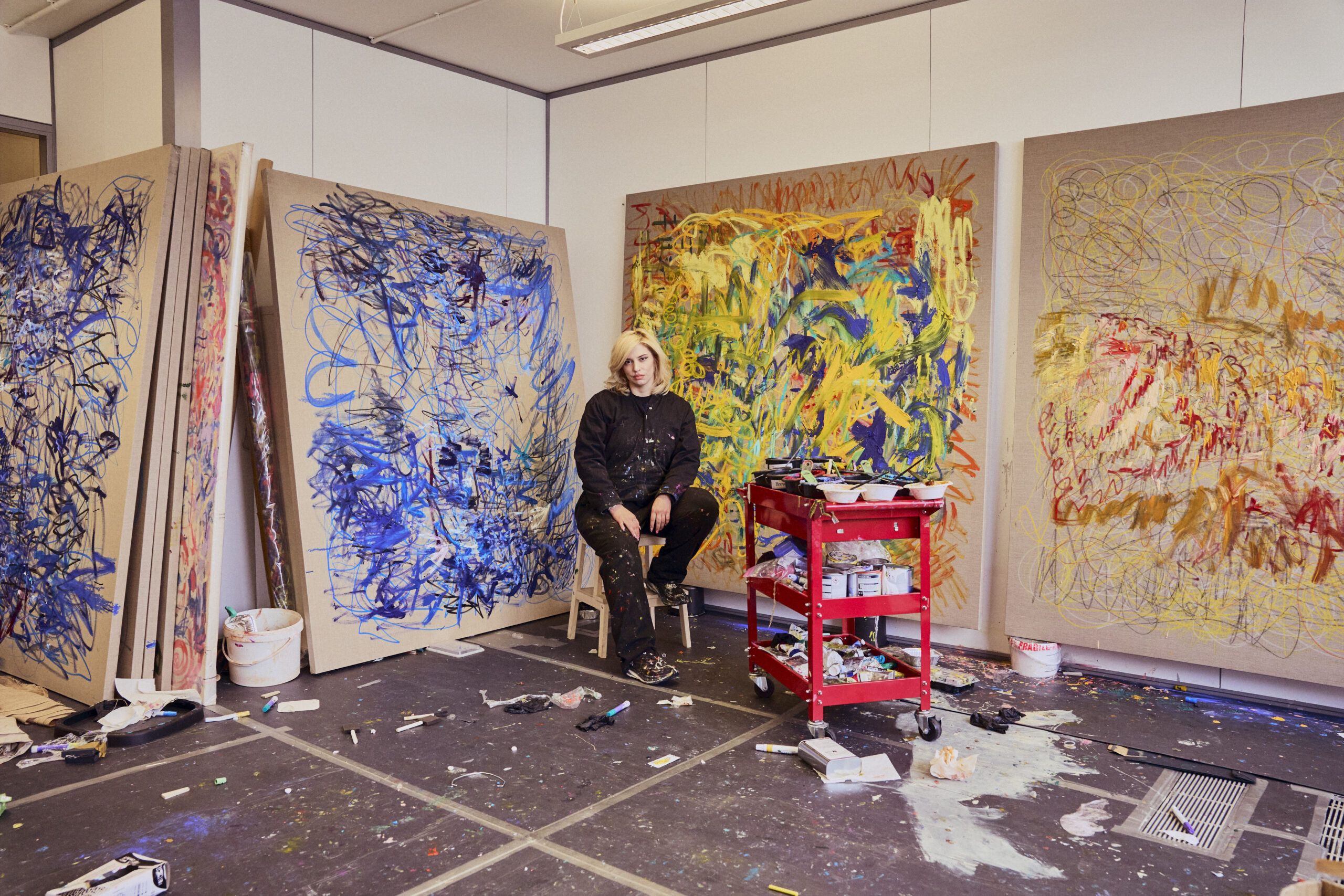
When I stand in front of one of Mariana Cordoba’s paintings, I begin to picture the body that made it. I sense the artist there, her weight shifting, her pulse, the crowd of thoughts moving through her, and then I watch all of that fall away until nothing remains but a hand and the paint it carries. The work holds that disappearance inside it. I can read the movement directly off the surface, a gesture that might be anger, might be sorrow, might be a flash of pure exhilaration. Mariana never tells me which. She lets me decide.
Followed across time, Mariana’s paintings start to behave like a record of a life. Her colours and marks seem to shift with whatever she is living through, some passages sharpened and cooled into hard blues, others softening into yellows that feel like a season turning. Winter loosens into summer on the canvas, though I suspect the weather she is describing is not the sky outside but something further in, closer to the heart. This is the power of abstraction. It refuses to fix a single meaning, so I am free to find my own, and so is everyone who stands beside me. The painting becomes a mirror as much as a window, and no two of us will see the same thing.
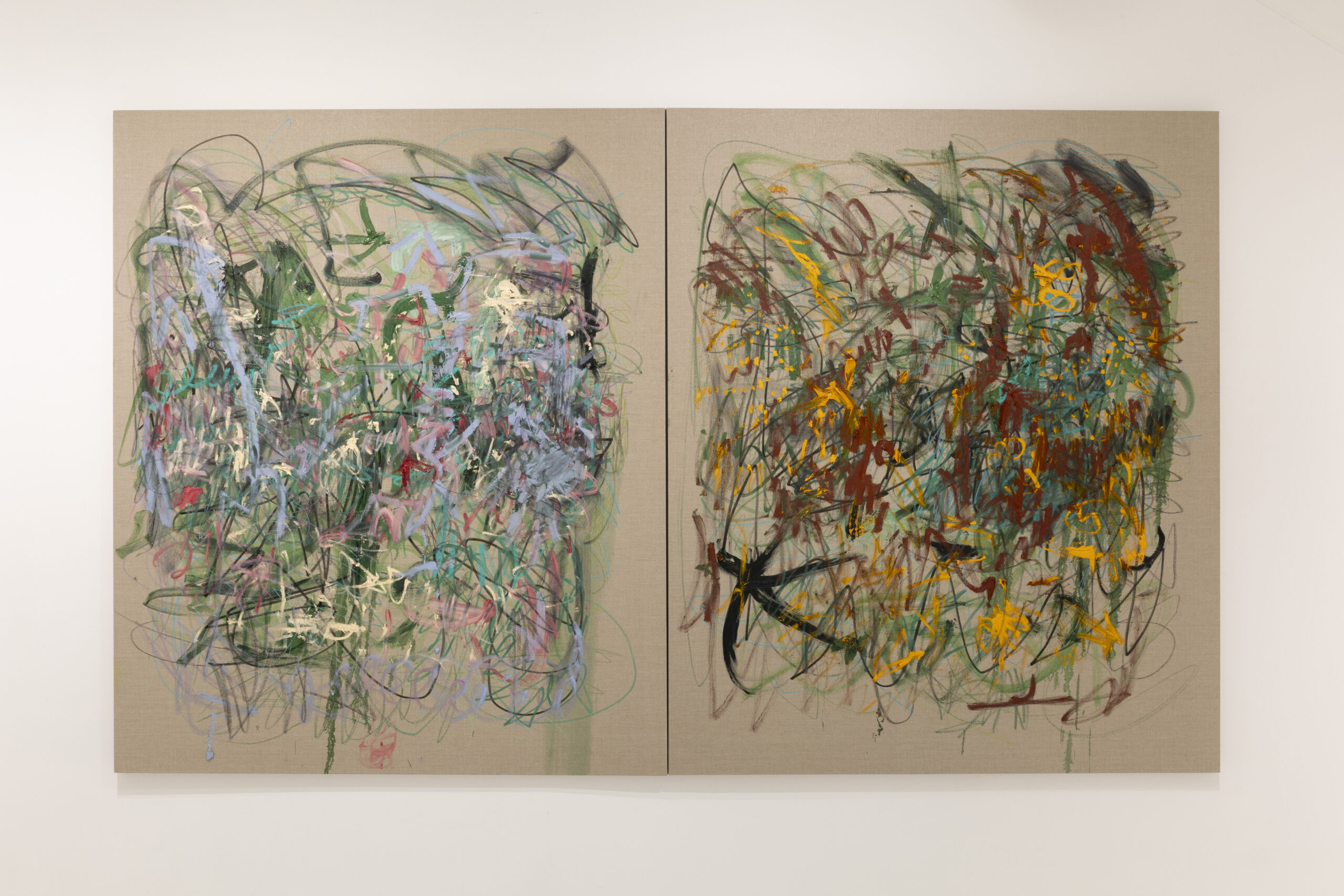
And yet, for all their force, these are not paintings that spill over. The edge of the canvas does the disciplining Mariana will not do herself. Its shape gives her emotion a beginning and an end. What first looks like chaos turns out to be controlled, held in check by the rectangle, by the rhythm of where she chooses to stop, by the empty spaces she leaves deliberately bare. Those negative spaces are as eloquent as the dense ones. They are the breath between her marks, the silence that lets the noise mean something. Mariana works on unprimed linen, refusing the smooth barrier a primer would give, so the rawness shows. Nothing is sealed off, nothing pretends to have been planned. Her emotion meets the material directly, and it keeps the evidence.
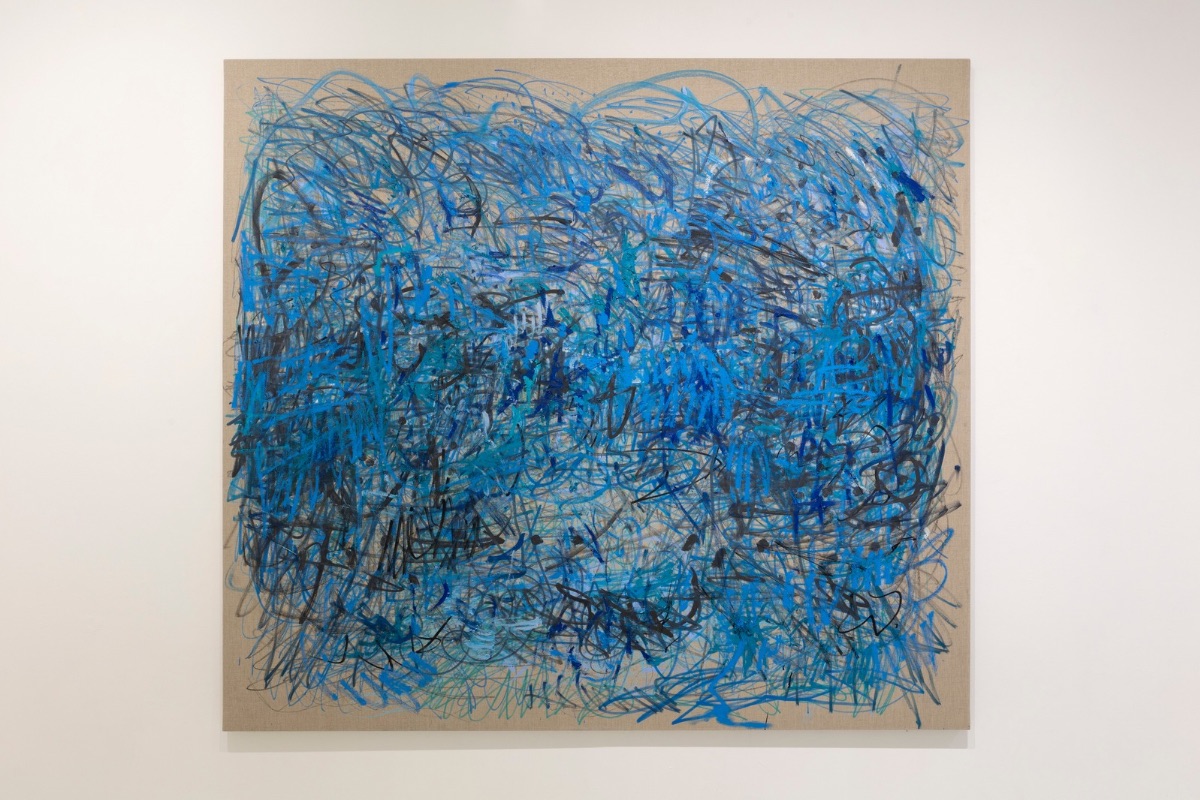
If I leave with one hope, it is to see Mariana let go even further, to watch the feeling outgrow its frame entirely. I would like to see her colour crawl past the edge, leak down onto the wall, drip across the floor and reach the ceiling. I would like to see the controlled chaos finally tip into chaos and the whole room become the painting. The discipline is already there, hard-won and plainly visible in every restrained edge and bare patch of linen. What remains is the thrilling possibility of the explosion. Mariana is an artist this attuned to her own interior weather, and I would like to see her given permission to let it flood the space around her. That is the work I most want to stand inside, and the reason her practice feels to me less finished than gathering force.
I believe London, where Mariana studied her MA in Painting at the Royal College of Art and where I came across her work for the first time, is the richer for holding that force. She brings the city something it cannot manufacture for itself: a painter who treats abstraction as confession and carries a Colombian-American inheritance into the heart of British painting. To my mind she widens what the UK art scene can hold, and I believe its conversation will be more honest, more international, and more alive for having her voice inside it.

