

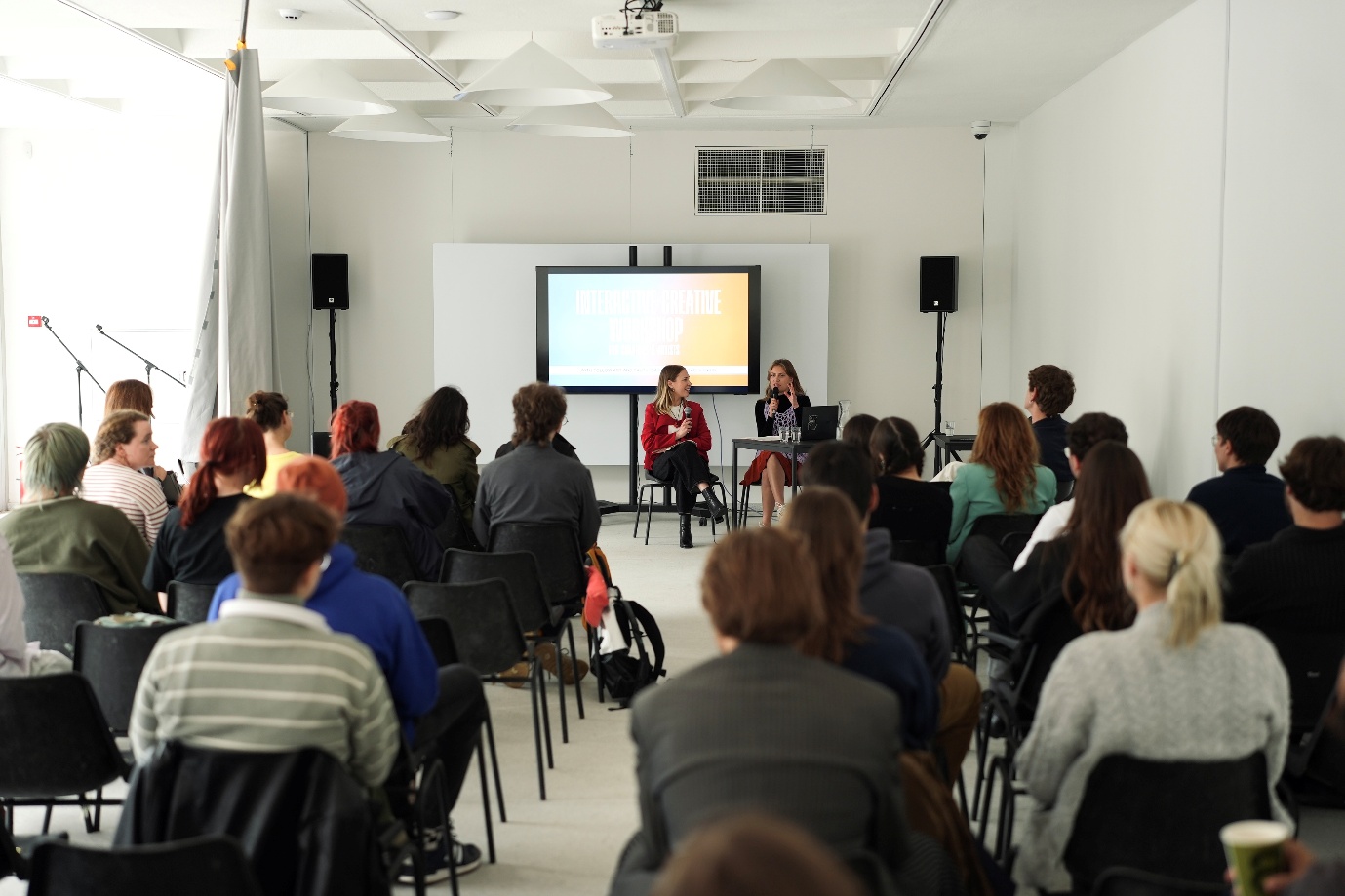
In an art world increasingly shaped by digital visibility, artists and curators are navigating a paradox: the more they are encouraged to share, the harder it becomes to sustain a meaningful and coherent presence. Beyond the pressures of constant output and algorithmic performance, a quieter shift that prioritises structure over speed is emerging, and legibility over reach.
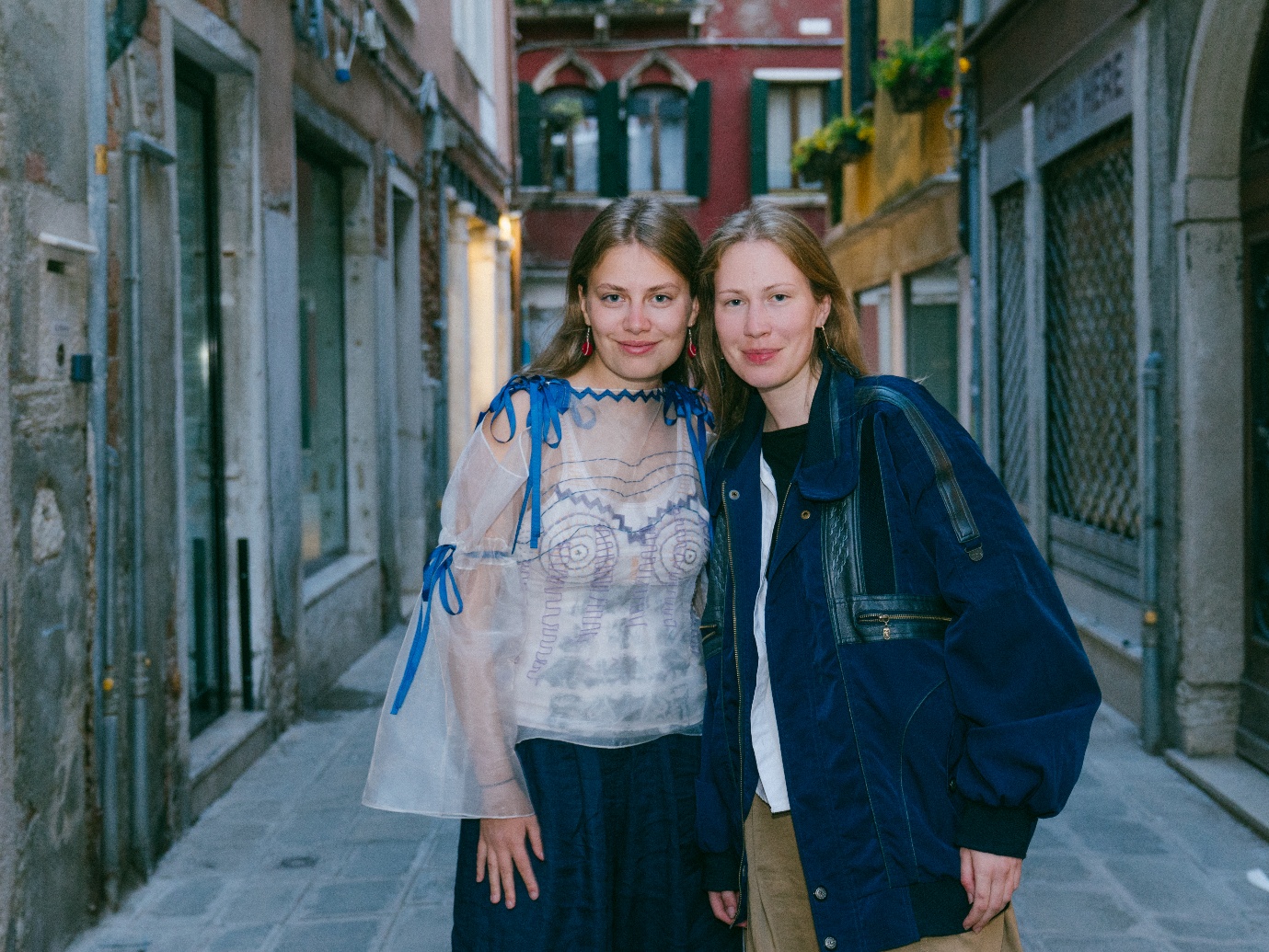
Sisters Evelīna Gorbačova, Digital Development Lead and Veronika Gorbačova, Curatorial Lead, are part of a generation rethinking how creative practices exist online. Through their work with FOLLOW.ART, they explore how artists and curators can move beyond fragmented digital identities and instead build intentional, enduring representations of their work, using data not as a metric of performance, but as a tool for reflection, connection, and long-term development.
We spoke with them about the evolving role of digital presence, the shared challenges between artistic and curatorial practices, and what it means to be truly understood, not just seen, today.
There’s a growing fatigue around algorithm-driven visibility. From your perspective, what feels fundamentally broken about how artists and curators are currently expected to exist online?
E: Perhaps nothing is “broken”, but there is a mismatch. Many platforms seem normalized to frantic speed, search for and respond to quick bursts of information and short attention spans. Artistic work tends to demand more time and may not automate well into the quick-hits.
What ends up happening then is that the artists start trying to tailor what they’re doing to the platform. And after a while that gets tiring, because they’re not actually able to do what they do because they’re working within the parameters of how they’re supposed to share.
V: Exactly! Nowadays artists are supposed to be their own social media and marketing managers (some combine it with also being art managers and curators for themselves), and juggling multiple jobs never seems to be rejuvenating for anyone, so why should it be for them? And there’s a simple truth that, in my opinion, reveals that fundamentally broken aspect of online self-presentation: algorithms prefer what they know and fear the unknown. Artists and curators tend to do the opposite.
E: And there’s the risk of artistic and curatorial work becoming flattened; you begin to focus on how it’s going to appear online, how people are going to respond to it, rather than what it actually is; and in a way you’re attempting to fit into an environment that isn’t even real. That’s why one of the core principles of FOLLOW.ART is to stay algorithm free.
Both artists and curators rely on visibility, but in very different ways. Where do you see their challenges overlapping and where do they diverge?
E: For artists, communication often occurs through their work. It’s a sensory and intuitive way of sharing that requires time and attention from the viewer. What we see online is usually fragments of it.
V: And that’s still considering that most artists can actually show what they’ve been working on through social media. Whereas curators rarely can fit the final product of their research into the rectangular IG feed. Their work is reduced to a few installation shots and some bits and pieces of an interview, if they’re lucky, but most of it is left behind the curtains, because it’s hard to translate into visual formats.
That’s why one of the top priorities for curatorial profiles at FOLLOW.ART was to have as much space for text as possible, so that each project can be described in detail.
E: It’s always worth asking yourself what kind of visibility you are actually aiming for. Do you want to reach as many people as possible, or do you want to connect with the right people who might work with you and support your practice over time? We built FOLLOW.ART exactly for intentional connections. Each artist and curator has their own profile – the Cards, a multifunctional portfolio that answers to the needs of the creative practice and is designed to be used on-site during exhibitions, art fairs, studio visits and other IRL situations in the form of a QR code. By scanning it, the visitors can save your contacts, see your last projects, book a studio visit or a meeting directly and even support creative’s practice financially in seconds. All of that without the need for the audience to register at the platform.
V: To make a quick point about visibility: artists already spend a lot of time posting about exhibition openings and inviting hundreds or even thousands of followers to come and see the work. Imagine if, the next day after the exhibition, the artist could see that visitors had supported their practice financially or reached out to arrange a studio visit to see more works. That goes beyond likes and following on social media. That is the real mutual support system that we’re building, where visibility can lead to something more concrete. Where artists and curators are not only giving, while visitors simply take in the experience. It’s a two-way street.
You often speak about moving from visibility to legibility. How would you define “legibility” in the context of a creative practice, and why does it matter now?
E: In my view, legibility is about being understood by allowing someone to spend time with your work and connect with it. Right now, artistic and curatorial work is visible, but mostly through fragmented posts, just like Veronika mentioned: an image here, a caption there.
V: I would define legibility as the ability to understand what someone’s practice is really about, not just see that they are active.
This is especially important for curators, both in their communication with colleagues and potential partners, and with the wider audience. However, the professional art circle is relatively small, so people often connect through mutual contacts and each other’s projects. Whereas the gap between art professionals and the audience is much bigger, and I think that is worth putting at the centre of the conversation, especially now.
If people cannot understand the work, it is much harder to imagine them supporting it. And audience support is exactly what curators, and the art industry as a whole, need at a time when cultural funding is under pressure and many art professionals are working in even more fragile conditions.
E: For me, the best way to understand artists’ work is to visit their studio and see the conditions where work comes to life, and hear artists talk about what they’re exploring. This is the experience that stays with you and has the power to transform your thinking. Studio visits shouldn’t be limited to professionals. Friends, acquaintances, and local communities can also provide valuable interactions, especially when so much of an artist’s work happens in isolation.
This is where support comes into play. When someone feels connected, they often want to give back. It’s a very natural exchange. Through FOLLOW.ART, artists and curators can receive tangible support in a form of micro-patronage from the audience, who are not necessarily collectors. We’ve seen this in practice across exhibitions and fairs where even small contributions, from £20 to £200, made a difference, not only financially but also in how audiences engage. It turns a passive viewer into an active participant.
V: In more practical terms, it works like this: Each of our members has their own QR code, which they place in the exhibition space or their studio. When scanned, it not only gives a direct way to support their practice financially but also gives visitors a clear overview of their practice, invites them to save contact information, arrange a meeting or studio visit. It’s about saying to the audience: “I’m open to you. Let’s have a conversation.” rather than keeping a distance.
On a monthly basis, we also host curatorial roundtable discussions with multiple members who are using micro-patronage in their exhibitions. These conversations have been really valuable because curators share what actually works in practice, often down to the smallest details, like where to place QR codes in an exhibition space so they don’t interfere with the artworks but are still visible enough for visitors. And those details matter, especially because talking about money is still uncomfortable in the art industry. So we try to keep this as an open conversation with our members, learning from them what feels natural and what could work better.
Within the team, we really believe that more people should feel invited into art, not only as visitors, but as audiences who understand what they are experiencing and have a direct way to support the practices they value.
The idea of using data within a creative practice can feel counterintuitive, even uncomfortable. How do you reframe data as something reflective rather than reductive?
E: It depends on the type of data. If we focus only on likes, views, and followers, it does feel limiting. But that’s just one type of data, mostly related to marketing.
V: One artist told us she keeps an Excel sheet for every material cost behind each work. Very unromantic, yet it proved to be very useful. For her data wasn’t about ‘making more money’, it was about sustaining her practice in the long run. Data helps you protect your future self before burnout becomes the business model.
E: Yes, that kind of data gives you a sense of control and helps you make informed decisions and sustain your practice over time.
V: Data can also be valuable when it helps artists and curators understand how people engage with their work in real situations. That is why we included statistics inside our members’ profiles, showing things like how many times their QR code was scanned. During an exhibition or event, this gives a useful sense of audience response. Did visitors notice the QR code? Did they want to learn more? Was it placed in the right spot? These are small details, but they can make a real difference in how people are invited to connect with the work.
Curatorial work has always involved structuring relationships, between artworks, ideas, and audiences. Do you see a parallel between curating exhibitions and structuring one’s own digital identity?
V: It’s an interesting thought, but before answering, I ought to rescue the word ‘curating’ from mild overuse. Today, everything is curated, from an Instagram feed and a playlist to a breakfast plate if the lighting is right. In that context, ‘curating’ often just means selecting. And we all know that curating an exhibition is much more than choosing works and placing them on walls.
But if by digital identity we imply professional online self-presentation, then its effectiveness indeed rests on three main pillars, namely your work, your idea (or message) and your audience. And the causes of imbalance are noticeable everywhere.
If you cut the audience out of the equation, your online presentation becomes a one-way street. We see this quite often with artist websites that are visually beautiful, almost artworks in themselves, but absolutely impossible to navigate. They have a clear artistic value, but if a potential buyer, curator, or sponsor gets lost in what was supposed to be your professional introduction, then the presentation is not really doing its job.
Now, if you cut your messaging short, the presentation also loses depth. This happens quite often with artists who share the practical details of their work, such as size, medium and price, which, don’t get me wrong, are absolutely important and should not be hidden somewhere in a mysterious corner of the internet. But without your personal intent, the work can easily appear too flat online, yet again leaving your audience disconnected from you.
And if you cut the work itself short, this becomes especially visible with curators. For a long time, curators had very limited online infrastructure to present what they actually do. Instagram became the default place, but it is not exactly generous to text-based or research-led practices. So complex curatorial work often gets reduced to a carousel of opening night images. It may look cool, but it again reduces the labour behind the project. This is also one of the ideas at the root of FOLLOW.ART, and it has shaped my role from the beginning, which is to provide high-quality infrastructure that curators have long been missing.
For artists, there is often pressure to continuously produce and share. How can they move toward a more sustainable, intentional form of presence?
E: I believe this shift is already underway. In the broader creator space, there is less emphasis on reaching the largest audience possible. Instead, the focus is on building a smaller group of people who genuinely care about the work.
For artists, that may mean focusing less on constant production and more on clarity. Make sure that when someone encounters your work, they can understand it, return to it and maintain a connection.
Artists and curators excel at creating communities around their work. That’s what people are seeking right now, especially in larger cities. An exhibition, a studio visit, or a small event does create shared experiences that are very important for a healthy society. The challenge is how to maintain that relationship. That’s why we made the Card in a way that when you meet someone, you can easily share your work, and people can revisit it later, stay connected or support it.
How can mapping elements like themes, collaborations, or research interests actually influence the direction of someone’s practice over time? Have you seen this shift happen?
V: This is almost fundamental for curatorial practice. Curators work through research, so mapping themes, references, and collaborations is part of how projects are created. When you start seeing those patterns more clearly, it becomes easier to develop future exhibitions and to position your work within a broader context.
At the same time, you often need to find artists or other curators who are already working with similar ideas. That’s where having access to a structured network becomes very important. Through the Connectory, this process becomes more intentional and you can actively search and reach out to people whose work aligns with your research.
E: Also, many artists reach a point where they want to explore a new medium or research direction, but might want to have more direction in navigating it. Having access to a community where you can find people who have already worked with similar materials or topics makes a significant difference. Instead of figuring everything out alone, you become part of a network where knowledge is shared more openly.
Many creatives today feel caught between intuition and optimisation. How do you balance the need for structure with the unpredictability that’s essential to artistic work?
E: I really like what the Berlin-based curator Jenia Yanes said: “Creativity is an error in a controlled environment.”
In a world that is becoming more structured and automated, creativity is one of the few areas where unpredictability still thrives.
So, structure should not replace intuition; it should support it. Structure helps you move things forward, but too much can stifle the process. There needs to be some space and flexibility. That’s also how we view the infrastructure we create. It should enhance the workflow, not dictate it. Each artist and curator should have the freedom to use them as they choose, as the infrastructure is quite multifunctional, depending on the needs of each creative.
If we think about digital presence as a kind of “living archive,” what should artists be preserving and what can they afford to let go of?
E: It comes down to what you want to preserve. What represents your work over time? There’s often pressure to document everything, especially with social media, but I see more people getting off that.
But digital presence functions as an archive whether we intend it or not. And it requires maintenance because formats change, platforms close down, links break. It’s worth keeping your materials across multiple places, backing things up on drives, and even keeping physical copies when possible. It might sound basic, but it becomes important over time.
The Card can help with this in a very practical way. It is not an archive, but it can point to the places where different parts of your practice live like your website, cloud folders, articles, catalogues or other links. And even if some links break over time, the Card still holds the essential information about your practice in one place.
V: For curators, there is too little preserved rather than too much. Exhibitions are temporary by nature, and once they are over, what remains is usually limited documentation. So preserving the thinking behind the project becomes very important. There are surprisingly few spaces where curators can share their research that are not academic research papers. There is a need to know what your peers are working on, what kind of questions they encounter, and to have documentation of the thinking process rather than only the finished work. Currently, we’re giving our Substack platform to our curatorial members to share their unfinished research or reflections on their past projects, to prolong the lifecycle of a project and encourage a more casual and accessible dialogue around the process of curatorial work.
Looking ahead, what does a healthier digital ecosystem for artists actually look like? What needs to change?
E: A healthier space would be one where artists are not constantly pressured to reshape their work for platforms. Digital tools should help them showcase what they already do instead of demanding changes. I think we’re already witnessing a shift. People are more interested in depth, process, and understanding where work originates.
V: Right now, visual and fast-moving content dominates. Research-based and process-driven work often remains invisible. So change needs to be not only technological, but also cultural. A recognition that not everything valuable can be reduced to immediate visibility. And that slower, more complex practices also need space and infrastructure to exist.
If you are an artist or curator, you can join the FOLLOW.ART movement and create your FOLLOW.ART Card

