

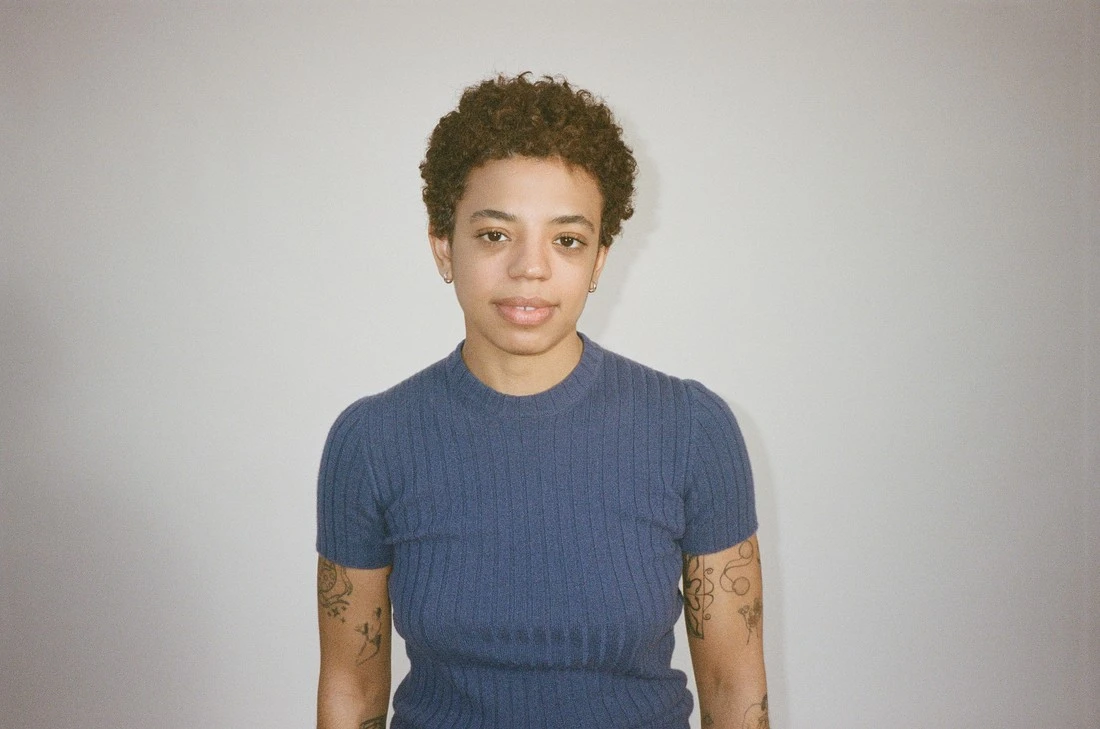
A couple of years ago, a flood of joy was visible on the horizon of Tasha’s music. All of This and So Much More was the titular refrain of her last album, which is deeply actualized on the New York-via-Chicago artist’s fourth LP, You Are Spring!, out today. The via is an important part of how it came to be: after portraying Nacna in Illinoise, the Broadway adaptation of Sufjan Stevens’ landmark album, Tasha relocated from her native Chicago to New York, where she quickly went back to working on her next album. All she knew, to start, was that she wanted it to be released in the spring or summer, because all of her past records had come out in the fall.
In fact, discussing Tell Me What You Miss the Most half a decade ago, she’d told me she rarely feels the urge to sit and write in the summer. Now, Tasha talks about being inspired by looking at the sun out the window while crafting most of You Are Spring! the same way she found comfort, back then, in “sitting alone in my room with the radiators kicking.” But the point of Tasha’s work is never linear progression, changing while moving from one place to the next, so much as the beauty orchestrating and constantly rearranging itself in between; past selves seeping through the present; via as home. “There’s life to be found now,” she sings, echoing Gwendolyn Brooks’s foundational poem ‘To the Young Who Want to Die’ while harmonizing with Brooklyn’s L’Rain and Chicago’s Jamila Woods. Halfway through beloved cities, but most of all: right here.
We caught up with Tasha to talk about cities, sunsets, the clarinet, and other inspirations behind her new album, You Are Spring!.
Cities
As much as there is a lot of nature imagery, I think this record is also really inspired by what it feels like to live in a city, as someone who grew up in a city and now is living in a new city for the first time. I’ve lived in the city where I was born for almost my entire life. Honestly, moving to New York and experiencing the seasons changing in a new place is really inspiring to me. It’s like experiencing a season change for the first time, almost. Becoming familiar with a new place, learning to love it, learning how to be comfortable in it. is so connected to thinking about time passing and the emotional rollercoaster that comes with that.
Even though I was here for one spring before when I was doing Illinois, it was different because my time was different, my life was different, and my life was really structured around that show, so I was processing things in a different way. Whereas 2025 was kind of my first real entrance into spring. I had already started recording – I went to LA in May of 2025. I hadn’t written all the songs yet, but I’d written a bunch, and I didn’t have the intro track written yet. I didn’t have the title yet. Listening to ‘Clarion’, which was a really big part of it, I just realized my relationship to spring, and what it means to sort of find one’s footing and to really feel so much possibility.
What shape did that sense of possibility take for you during that particular spring?
I think I was just really thinking about what it meant to make a life that was really mine, and that was really shaped by my own desires and dreams. Moving here was such a big decision because Chicago has shaped me so much – both that city and the people there, and my family, who are all still there. It was very dramatic to decide to leave. I think that the first few months here were very fun, but it’s completely disorienting. Anyone who moves here can tell you that. Even though, again, I’d been here for many months, my life looked really different. I think I see those months of writing songs through March, April, and May as me really reveling in this freedom.
I think sometimes about the way one record connects to another. All of my albums are really different and have been written and recorded in very different ways, from different places in my life. But I do think there’s sometimes one song from the last record that feels like the thread or the catalyst that springboards into the next one, whether I know it or not. When I think about All This and So Much More, the big theme and refrain of that whole album and the way that it ends is this idea of “you could have all this and so much more.” It was me just getting this taste of “there’s all of this goodness to come.” I think You’re Spring! is sort of the aftermath, the fruition of that. It was really important for me in that time of year to capture what that joy and excitement felt like.
Sunsets
In ‘Special’, I have this line, “The sunsets still dazzle everyone.” I feel like a lot of what I was experiencing was this sense of, “Okay, Tasha, open your eyes, see what’s around you. Look at how wondrous it is.” I have this window in my room here with a little fire escape. There’s a view where I can see a little bit of Lower Manhattan and downtown Brooklyn. It faces sort of southwest diagonally, but I get some really incredible sunset views. In this period of what was a cycle between loneliness, thrill, and self-actualization, there was a lot of reflection that happened sitting on the fire escape and watching the sunset. There were times when maybe someone else was sitting there with me, but mostly alone. A lot of reflection time happened in this little corner that I have here.
New York – everyone says this – demands so much, and it’s so oppressive to the senses when you’re out in it. [laughs] Having a shelter, a bubble of peace from it, really does wonders for one’s nervous system when living here. This was really my bubble, my shelter zone, my little fire escape sunset view. A lot of songs were written sitting in this room and looking out the window. ‘Perfect’ and ‘Porous’ were the last songs I wrote, and those were written when I went to a writing residency in Nantucket last September. I knew I wanted to finish writing the record, and I was about to go to LA right after the residency to finish recording, so I needed some more songs. ‘Quick!’ was written sitting on a blanket in the sunshine last June, and ‘Summer’ was written in the little apartment I was staying in when I was doing Illinois on Broadway. I was staying in the West Village. And then all the other songs were written in this room, so they really feel like a product of my internal processing, my place of respite, my own sort of emotional workshop zone.
Having some distance from the other songs and being in a different season, how had your perception of the record developed when you were finishing the album?
I think there’s this acknowledgement that I get to really indulge in this joy because I know that it’s temporary, just like everything else. I feel like by the time I was writing the last couple of songs, they felt a little bit like the bow that gets tied. By the time I wrote ‘Perfect’, it was September, the season was changing again, and the quality of the light was different. But like I said, the reason that I think season change in general feels important to this record – I have a line in that song that says, “I’m falling for the changing season’s light.” Dusk and sunsets are in there again, and this line, “I’m not brave, I’m not tough, I just need to see a dream come true somehow.” I feel like I am just thinking about how so much of that whole period of time was about dream-following and dream fruition – various dreams of various sorts.
Then, in ‘Porous’, the last song that was written, there’s a sunset in there, too. Looking at the lyrics, it’s funny to see how many times it comes up. [laughs] I honestly think ‘Porous’ feels like a really big representation of what that whole year was feeling like. Because there’s missing, there’s lovers that have come and gone, there’s the sunset over the city I’ll learn to love. It’s thinking about rushing toward a dream and still having fear, but having trust. A place feeling like home; so much of this is also homemaking and what home means. And this line, “My future’s all mine” – again, coming from the last record, coming from ‘Love’s Changing’, it’s really thinking about what the future looks like and what time passing looks like. ‘Porous’ does feel like this ecstatic recognition of, “Everything that I’ve wanted, I have.” So much of life, especially as an artist, makes it easy to compare what you’re doing to other people because other people’s achievements are broadcast with such proximity. Having made so many records now at this point, I think I have moved internally to a place of, “Everything that I have, I’m grateful for.”
Home
As someone who’s always explored the shifting nature of home, something that struck me about this record is how much stock you put in homemaking as almost a separate thing.
I’ve said this about ‘Clarion’ – it’s named after this town in Pennsylvania that I was driving past a lot between Chicago and New York. I went back to Chicago six times or something last year for various reasons; I just had a lot of stuff to do there. So there was a lot of thinking about this transition of home. In ‘Clarion’, I say the line, “Clarion, I’m halfway home.” Home is both Chicago and New York, and to me, in my mind, “I’m halfway home” is pointed in either direction. At that time, I wasn’t sure yet if I could call New York home, even though I lived here and had no plan to leave. There was a way where it was like, “That’s not my home, though. Chicago is my home.” But that continued to shift as I processed what making a home meant. In Chicago, home was different because it was the place I’m from, the place I grew up, and the place where my deepest and longest relationships still reside. It’s the place where I lived with a partner for the first and only time, so homemaking was very much centered around that.
Here and now, homemaking is, yes, my physical space, but it feels almost more external. It’s about finding the people here who can be my home people, relationships I can nurture and invest in. It’s about finding places, corners, and activities in the city that feel personal to me and important to who I am. And it’s music-making, too. It’s playing enough shows and being in enough rooms with people where I get to share my music, because that’s really important to me. I really had that in Chicago. I have it sort of here, but I’m kind of building it from scratch. So there are a lot more intricate puzzle pieces that I have to put together.
Recording in LA with Gregory Uhlmann
I like what you said about music-making and homemaking being intertwined. With that in mind, did recording the album in LA with Gregory Uhlmann shift the energy at all?
It’s interesting because we didn’t have that much time to record. It happened really fast, and a lot of recording happened remotely. Greg did a lot of tracking on his own and sent things to me. I recorded the vocals in New Jersey with my friend because our schedules were crazy. Greg is very busy with his many music projects, as I’m sure you’re aware, so we were squeezing it into a short amount of time. He has his own influences and musical references, and his musical imagination is just insane. So many of the projects he plays in are different, from SML to the stuff he does with Meg Duffy in their duo, or his years playing with Perfume Genius. He can take my demos, which are just guitar and vocal and really find ways to make them into entirely new universes.
Our recording process is most of the time just the two of us, and he has a really lovely little studio attached to his home that has a beautiful garden and outdoor space. It feels very LA to me – it’s very lush, sunshiny, warm. While I think that was present a little bit on the last record, it feels really present on this one, too. As far as the references, we were both listening to a lot of really lush music. We both listen to a lot of old Brazilian samba and bossa nova, like Milton Nascimento and Gal Costa. He has a bunch of nylon-string guitars, and a lot of the record was recorded on nylon-string guitar. But I feel like that sort of expansive quality of the music feels very indicative of recording in LA with Greg. He’s so great at creating these layers and layers of sparkle. I don’t think it would sound like that if it was recorded in Brooklyn. [laughs]
How did the sense of familiarity of working with him again influence the process?
The turnaround from the last record was kind of fast, and I wanted to work with him again because I knew I wouldn’t have to go through the process of becoming familiar with someone. It requires so much trust, and I’m kind of protective of my songs or feel a bit shy sometimes, to be honest. I was really counting on working with someone where I knew I could send the songs and wouldn’t have to feel nervous or shy about what they might think or if they would want to work on them. I obviously asked Greg, “I have a few songs, I think I’m gonna work on another record, do you want to do this one again with me?” He was immediately down, which I love. I really appreciate his friendship, his excitement, and his trust in me to make something like this.
Having worked together before allowed us to work a little quicker, and it allowed me to have a little bit more of a voice in the recording process. With every record I’ve made, I think I’ve learned more. I don’t really consider myself an executive producer – I haven’t cultivated and perfected those kinds of skills – but I do see myself as more of a producer than I was two or five years ago. Working with Greg for a second time really opened up that door in a bigger way, gave me more confidence, and allowed me to feel like I had more say. Also, I just know how to communicate with him. Not to say I can’t do that with a new person on the next record, but he has a real softness to his temperament that I really value and appreciate. It allowed for a very intuitive time in the studio.
The clarinet
You mentioned ‘Special’ before, where you make your clarinet debut. What inspired you to take it up and make it a part of the record?
I have clarinet on the last record – my friend Adeline Strei recorded some clarinet on All This and So Much More – and I have flute. I think it was partially meeting more musicians who play other instruments, and just becoming kind of musically intrigued and excited by that. It sounds kind of basic or naive to say, “I met other people who play other instruments.” [laughs] But it really was a part of it, and I was listening to so much more music. I was listening to a lot more jazz and classical – which I always have, but the volume was increasing. I wasn’t really playing a lot of guitar or feeling super inspired by it, actually, and I wanted to play something else that was going to shock some inspiration into me. I don’t have room for a piano in my apartment, so I’d been thinking about the clarinet and just decided to go for it. I reached out to some friends and found a place I could rent a clarinet from. I found a teacher, though, to be honest, I only took two lessons; most of my learning was just teaching myself and doing it on my own. It was immediately so fun and really inspiring.
‘Special’ was written because I wanted to write a clarinet song. I wanted a song that I could play clarinet along to, and I could only play so many notes at that time since I’d only been playing for two months. So I played these guitar chords as a vehicle for being able to play clarinet to the song. And it did what I wanted it to do. It sort of reverse-engineered this inspiration that I needed. A lot of songs have clarinet on them on the record, and I recorded all the clarinet. It’s such a cool instrument. Woodwinds are beautiful – I love the tone, and I love the texture that it can add. It actually felt, and continues to feel, intuitive to me in a way. I’m not saying this as a humble brag, like, “I just can’t help but be really good at clarinet!” But I think as a singer, there’s a way that I relate to that instrument melodically, the way that I relate to my voice, the way that I think about melody, harmony, and composition
Ross Gay’s Catalog of Unabashed Gratitude
That brings us back to Gwendolyn Brooks’ poem ‘To the Young Who Want to Die’, which gives the album its name. Did something dawn on you when you came across or revisited it? Did it complete or guide the record in some way?
It did feel like such a light bulb moment. I’ve known this poem for years, it’s been a really important poem to me. There’s a book by Ross Gay called Catalog of Unabashed Gratitude that really feels in the orbit of this whole record for me, of what it means to write about joy and gratitude. Ross Gay is so good at that and has been a real touchstone for me for many years. For this Gwendolyn Brooks poem, many people have written work in response to it, especially Black people. Ross Gay has a poem that is inspired by the Gwendolyn Brooks poem, so there’s a lineage and certainly a cadre of people – I’m not the first, is what I’m trying to say.
But having written ‘Clarion’, a few other songs, and having been thinking about spring, I think it was maybe May or June that I wrote the first track. This poem just kept coming into my brain, and I couldn’t decide if I wanted to hold on to that or if I wanted to be like, “No, that is its own thing, it’s not my place.” Eventually, I just couldn’t stop thinking about it. I was like, “I think this has to be a direct part of this work that I’m trying to make.” The line that kept returning to me was, “Green’s your color, you are spring.” It was just there in my head, so then I was thinking through all of the feeling and the sentiment of that poem. The words for my song ‘Spring’ came out, and I recorded this little voice memo of the first part of that song. I didn’t even know if it was gonna be on the record, and I didn’t know what I wanted to do with it. I knew it wasn’t a full song, and then I was like, “Wait, no, this is it—this is all it is, actually. I think it should just be voice.”
In the same way that the OG Tasha fans maybe will remember from Alone at Last, from the poem that I have at the beginning – I don’t really revisit that work so much, just because it feels very baby Tasha. But I started writing songs because of my love for poetry, because I was a poet, and because I performed poems as a teenager, in college, and after that. I grew up in the poetry scene. Another reason having Jamila’s voice on that song is so important to me is because we used to read poems at the same open mics in Chicago when we were in our teens and our twenties, because she is such a fixture of the Chicago poetry scene. The work of Black women poets is such a huge part of her work and her entire oeuvre. Having Jamila [Woods] on there is a dream come true. I mean, she’s a friend, but also I’m a fan, so that felt like a really important part of the orbit of this work.
Having this opening track feels like the overlapping of all of those pieces of my identity as a poet – even my previous life as a poet. Also, thinking about young people, thinking about my younger self, thinking about my love for poetry in general. Honestly, thinking about Alone at Last and opening that album with a poem and having this little moment of return and acknowledgement where it’s less about the production and the arrangement and more about the language and the feeling. I actually hadn’t really thought about that until just now, all of those layers of connection. But allowing myself to hold on to that as a tenet of what this record could be was a huge answer.
Future generations
It’s interesting how that ties into how the record thinks about future generations – not just calling back to your younger self, but considering young people moving through the world right now.
At the end of ‘Quick!’, there’s this outro, a little lullaby part. I do see that as being sort of an offering to both a younger self, but also a young person. I was kind of thinking about my nieces. I have two baby nieces, and this line, “Little girl asleep, tell me what you dream.” I think I am thinking about a child, and that is both me and not me. There will be a video for ‘Quick!’ that will come out in a couple of weeks, but I think we’re gonna incorporate some old VHS footage from my childhood into the video. It feels top of mind because I was just looking at some of the footage that we’re digitizing just yesterday, and it’s so insane to see. But I do think ‘Quick!’ really does tie it back to that. It’s for me, but it’s also for this sort of non-linear past me, and future child, and baby child now. I think there is a lot of kind of generational and message-passing, prayer-passing, through the circle of the record.
What inspires you about your nieces? I feel like there’s a lot of cynicism when we talk about younger generations abstractly, but not so much here.
I think this question feels connected to the song ‘Ending’, too, which is thinking about the multiplicity of this life, and the way that this joy and euphoria exists alongside terror, fear, and a real, almost impossibility of imagining a future. And then this response, I think, is really insisting on that imagination. Recognizing: How am I leaving this place? What is the impact that I am having? What choices have I made to make my presence in the world important, not just to me, but to everyone around me – to the world, to the people before and after me? And the response being this hopeful and optimistic insistence. I think the poem does this: that your life, your choices, your beauty, your joy, and your work are important.
As someone who’s not sure if I will have kids of my own, I think having my nieces and my nephew – and also, one of my best friends has two kids — there are a lot of babies kind of around me. I think it is the surest reassurance that there is so much beauty to witness, and also that it is my responsibility and our responsibility to make sure that they get that. That the world that they also get to receive and grow into. It’s sort of a duty, but not out of obligation – out of love.
This interview has been edited and condensed for clarity and length.
Tasha’s You Are Spring! is out now via Bayonet.

