

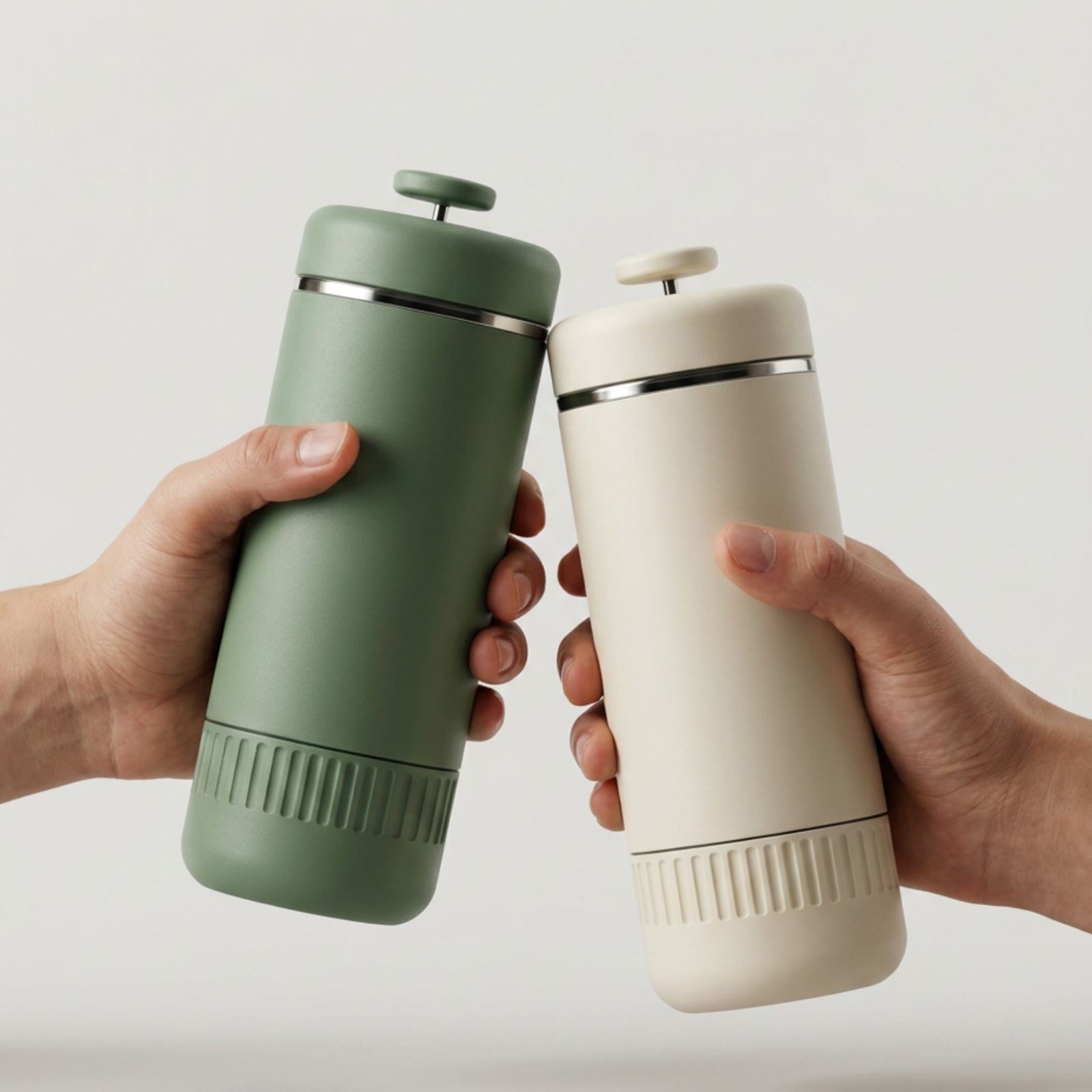
Portable coffee makers have become increasingly sophisticated over the past decade, but one problem has remained surprisingly persistent. Most travel French presses continue extracting coffee long after brewing should have ended, leaving the final sip noticeably harsher than the first. For a product designed around convenience, it is an oddly unresolved compromise.
That overlooked flaw became the starting point for LOOM, a portable French press designed by industrial designer Kyung-seo Yoo, which recently received the Platinum Award in the Cookware, Bakeware & Kitchen Tools category at the 2026 Houzee Awards, presented by Architecture Collection Magazine under the ADC Awards program.
Rather than treating portability as the primary challenge, Yoo reconsidered something more fundamental: what actually happens inside a French press once brewing is complete.
The problem with every travel French press
Most portable French presses share a flaw that shows up sip by sip: once the plunger is down, the grounds stay in direct contact with the brewed coffee for the rest of the drink. That ongoing contact keeps extracting bitter compounds, so the last mouthful tastes noticeably worse than the first — and cleanup means disassembling the whole vessel over a sink.
LOOM addresses both problems with a two-stage filtration and isolation system. A micro-filtration layer strains grounds out during the initial brew, the way a standard press does. But once brewing is finished, rotating the vessel’s top handle engages a second, silicone-sealed isolation layer that physically walls off any remaining sediment from the drinking chamber — stopping over-extraction instead of just slowing it down.
The body is insulated stainless steel, built to survive daily transport and hold temperature through a commute or a trail. A detachable bottom compartment handles both ends of the brewing cycle — loading grounds in, and clearing spent grounds out — without pulling the whole unit apart. The result merges the function of a French press with the form of a travel tumbler: brew, carry, and drink from a single object, designed for commuters, travelers, and anyone who wants fresh coffee somewhere other than a kitchen counter.
A practice built on solving problems with your hands
Although LOOM presents itself as a relatively restrained consumer product, much of its innovation is concealed within the internal mechanism rather than expressed through its appearance.
That approach aligns closely with Yoo’s design practice.
Currently a Creative Designer at J World Sports Inc., Yoo leads product development across backpacks and bags, overseeing projects from user research and concept development through manufacturing coordination and production. She earned her BFA in Industrial Design from the Rhode Island School of Design, concentrating in Computation, Technology, and Culture while also studying Design Engineering at Brown University—a background that emphasizes engineering performance as much as visual form.
Rather than treating mechanical complexity as something to showcase, LOOM hides it almost entirely. The user experiences the solution through a simple rotational gesture, while the engineering remains largely invisible.
Recognition beyond LOOM
The Houzee Awards win adds to a run of recognition Yoo has received in 2025 and 2026. She was named a Platinum Winner at the 2026 International Architecture & Design Awards in the Product Design – AI-Powered category for Solis Lamp, and a Gold Winner at the 2026 NY Product Design Awards in the pet supplies bowls category. She was also named a runner-up at the 2025–2026 A’ Design Award in the Pet Care, Toys, Supplies and Products for Animals category, and selected as a Fall 2025 winner by Design Dispatch’s Future Forward Designs feature, which spotlights emerging designers.
An approach grounded in use, not just form
Across her projects, Yoo works from the same starting point: identify where a product actually fails people in daily use, then solve that failure through form and mechanism rather than surface styling. LOOM is a direct example — the win wasn’t for how the object looks, but for a filtration and isolation system that changes how the product performs over the course of a normal use cycle, from brewing to cleanup.
That same problem-first approach runs through her broader body of work, which spans consumer electronics, furniture, home goods, sporting goods, and bags and backpacks. She describes her process as built on strategic problem-solving and close observation of how people actually use the things they own, aimed at products that are functional, visually distinctive, durable, and realistic to produce.

