

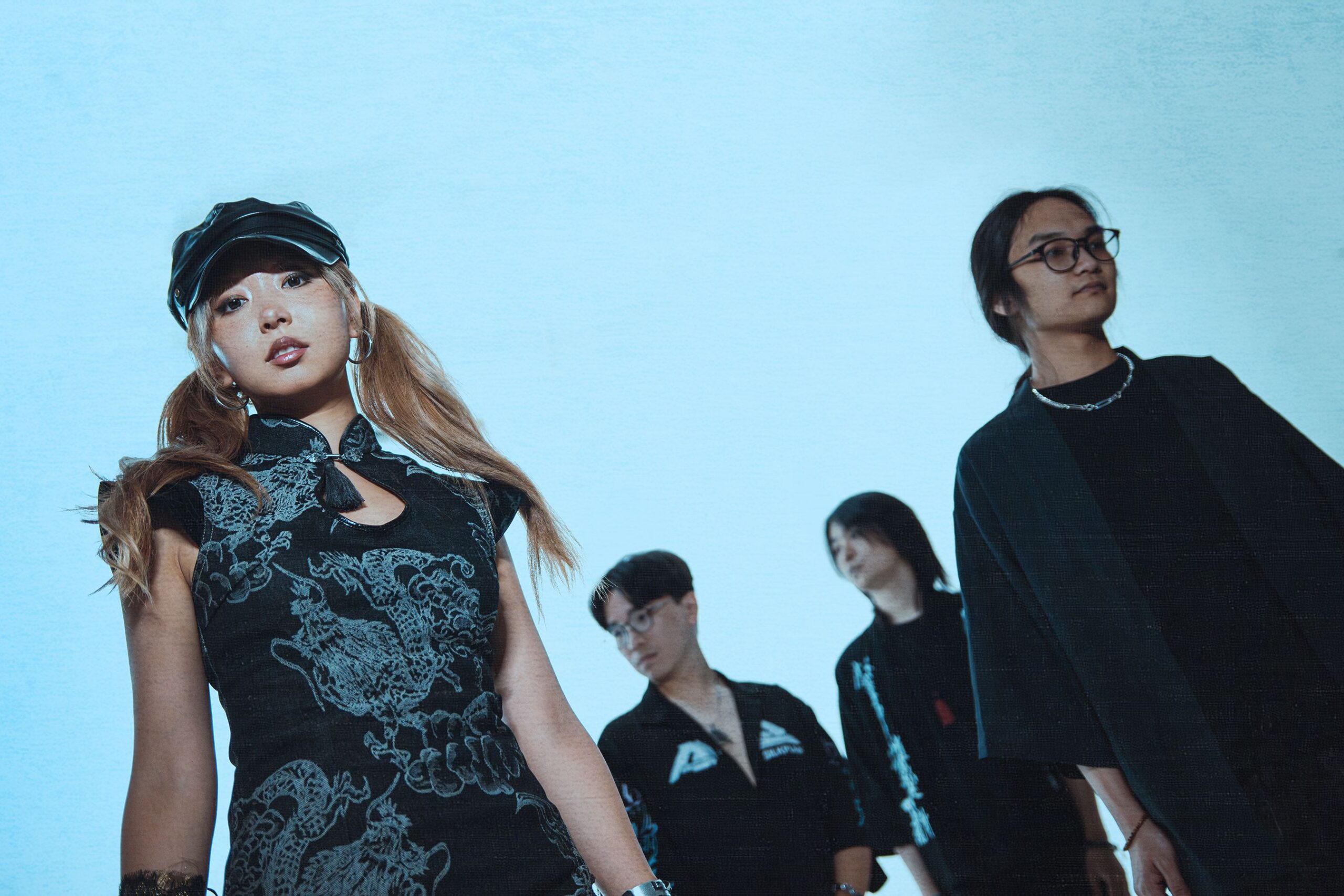
Three years after their debut album KARMA earned a Bandcamp Album of the Day nod and an NPR Tiny Desk “Top Shelf” selection, New York’s P.H.0 are back with Mantra, an EP born from personal loss, new life, and global turmoil, and the first to feature vocals from the largely instrumental band. Guitarist Jun, who also mixed the entire EP, co-founded Silkpunk Productions, and designs the band’s live sound rig, joins us to talk about the record’s themes of reflection and rebirth, the craft behind it, and what’s next after a year that included SXSW 2026, a Gramercy Theatre slot opening for VOLA, and December tour dates in Salisbury, MD and Charlotte, NC.
Q1: Jun, P.H.0 is releasing its first EP, Mantra, in three years. Can you tell us a bit about it? What is it about, and what themes or experiences run through it? Is there a story or concept connecting the tracks?
A lot has happened since KARMA. Over the past three years, we poured everything into this EP, including our reflections on both personal and systemic upheaval: losing team members to the immigration system, refreshed views on our identity, family loss, new birth, and the volatile chaos of the world at large. Mantra is both the title of the EP and its lead single, and it serves as our spiritual talisman, tempering chaos into rebirth. Reflection and rebirth are the key words, and in my opinion it’s both introspective and provocative.
It will be available on all streaming platforms upon release, with physical copies to follow. Stay tuned!
Q2: How does this record build on your debut album, KARMA? How did the response to it (Bandcamp Album of the Day, the NPR Tiny Desk “Top Shelf” selection) shape your goals this time? Is there anything you’re doing differently?
Recognition from prestigious organizations like NPR and Bandcamp means a great deal to us. It reassures us that our unique, non-mainstream approach doesn’t have to be a weakness. It also echoes the incredible welcome and love we’ve experienced back home in New York City, which we consider the crossroads of the modern Silk Road: a place where people from all corners of the world and all walks of life gather under one roof to celebrate music and humanity. We want this EP to be a firm step in the same spirit as our last record.
The most significant change is the addition of vocals. We’ve been a mostly instrumental band since our formation, but we felt the need to add vocals to our arsenal to get our messages across more effectively, and that’s what we did on this EP.
Q3: We’ve seen you collaborate with others, both inside and outside of music, in the past. What can we expect this time? You guys are also teaming up with Arson Theory as distributor this time, tell us about it!
We’ve made friends along the way, many of whom have joined the family as long-term collaborators! Piotr worked his modular synth magic and also mastered the EP. Yucheng and Zhuxin are on our visuals team, creating the artwork and directing our music videos, respectively. We appreciate their contributions a lot.
We’re also very excited to work with Arson Theory! They’ve worked with so many incredible bands in the heavy music scene, and we’re thrilled that they dig our music and share our vision.
Q4: You’re the band’s guitarist and also its mixer. Which creative decisions on this album came down to you? How do you balance being a player with being the person in charge of the final product?
Quite a lot of decisions came down to me, since I was highly involved in both the writing and the engineering. Because of my background in post-rock and math rock, I’m most interested in building textures and soundscapes, as well as writing tasty clean riffs. For example, on the EP’s second single, “Dangr,” the second half of the song, which is built on a clean guitar riff progression, was my idea. On the engineering side, I mixed the entire EP and built its drum sound, from drum library selection and sample layering to the final mix.
Since most of our members come from a music tech background and we produce ourselves, the creative and engineering processes have always been intertwined, as is the case for many modern metal bands these days. For me, it’s important to flip the switch when it’s time to mix and focus on the big picture, the vibe and the narrative, instead of falling down the rabbit hole of chasing the perfect tone for a particular instrument.
Q5: Why does P.H.0 keep production and mixing in-house rather than hiring an outside engineer? What does that control allow the band to do that a typical independent act can’t?
Engineering and mixing have become increasingly important in modern metal, to the point that even average listeners associate a band’s sound with its mixes and its mix engineer. You can’t talk about Periphery without talking about the incredible engineering work Nolly has done for them, and you can’t talk about thall without mentioning how Buster Odeholm’s approach to mixing has shaped the sound of the entire genre.
For a band like ours, which draws on everything from traditional Chinese chants and erhu to modern heavy guitars, post-rock, and electronic soundscapes, it’s important that the person mixing really understands the vision. After some trial and error, we believe that having me mix our material in-house is the best way to present it.
Q6: Speaking of mixing, you ranked 19th nationally in the 2025 Harman Cup Mixing Contest. What was that experience like?
I was so excited and honored to have the chance to mix those songs! They were engineered by the best in the business, and the raw multitracks sound amazing. I had a lot of fun working on them, and I was even more thrilled to learn that I’d ranked 19th nationally, especially since the judges were mixing legends in China like Wang Lei, dean of the School of Music Technology at the Beijing Contemporary Music Academy, and Lu Nan, who mixed my favorite Mando Pop album, Orion by Pu Shu. Being placed in the top 10 by Lu Nan is especially meaningful to me.
The songs I mixed in this contest are in the pop realm, and I learned a few new tricks for vocal treatment. They came in handy when I worked on the vocals for our new EP!
Q7: You also placed in the top 90 of 686 entrants in the Second China Arrangers Contest. How has your arranging background shaped P.H.0?
It was a fun experimental ground for me. We were free to create anything that fell under a broad genre category (rock, in my case), and I wrote a vibey, math rock– and post-rock–influenced track. That style is still a big part of my musical language today, as you can hear in P.H.0’s work.
Q8: Tell us about the band’s production house, Silkpunk Productions. When and why did you co-found it, and what does it do?
The term “silkpunk” captures our spirit of staying true to our roots and early musical influences while remaining open to incorporating anything that excites us along the way. We believe this approach applies not only to P.H.0’s music but to other people’s music as well. That desire to explore our philosophy beyond our own material gave birth to Silkpunk Productions, where we provide production, mixing, and mastering services to help other musicians create more interesting sounds. The inspiration we draw from working with clients also feeds back into the band’s creative workflow. At the end of the day, we’re doing what we love in both scenarios: creating music.
We’ve worked with artists like Dexter the Angel, Sangre, Her Dark Heaven, and Echo Wolf, and the list is growing!
Q9: You also handle live sound. How do you translate the album’s production to the stage, and what gear do you use?
I designed our live sound rig and oversee its operation. We currently use a rackmountable Midas M32C as the heart of our system and an S16 as the I/O device. We also have a DN48-16O for additional outputs, because the eight outputs on the S16 aren’t enough for our IEM needs.
For a band like ours, with so many musical elements happening at once, it’s important to do a lot of automation throughout the set so that whatever needs to stand out does so at the right moment, whether it’s an erhu solo, a guitar riff, or a soundscape. I can’t do that while I’m playing on stage, so our A1 engineer, Dong, takes care of it, and he’s been doing a fantastic job!
Q10: What comes after the New York release? Are there any tour dates coming up?
Yes, we’re bringing this EP on the road! In addition to shows in New York City, we’re planning multiple weekenders, mini weekend tours outside the city. We’re starting in December with Lurking Class Skate Shop in Salisbury, MD, and The Milestone Club in Charlotte, NC, with more on the way. Stay tuned!
Q11: The Milestone Club in Charlotte is an iconic venue that hosted legends like Nirvana and R.E.M.! How excited are you to play there?
Very excited! Not only because of its legendary status, but also because we sold out the room the last time we headlined there. We can’t wait to come back.
Q12: P.H.0 played SXSW 2026 and made the Austin Chronicle’s “40 Musical Acts to See” list. What did that moment mean for the band?
It was definitely a huge moment in our career. Being accepted from a large pool of applicants into a renowned festival like SXSW, where artists like Billie Eilish, Johnny Cash, and John Mayer have played, is very special. We played two official showcases, and SXSW’s official Instagram named us one of “your favorite musical artists this year.” It was an absolutely dreamy experience.
Q13: You opened for VOLA at the Gramercy Theatre. How did that show come about?
Huge shoutout to VOLA, who openly recruited support acts for each stop of their North American tour! We’ve been huge fans of theirs. I absolutely love their 2021 album Witness as well as their latest release, Friend of a Phantom, so we didn’t hesitate to apply. We all went nuts when VOLA handpicked us out of numerous applications to support them at the New York stop at the Gramercy Theatre!
About 500 people were standing in the Gramercy Theatre, most of whom didn’t know who we were, and we managed to start a mosh pit in the crowd. Fair to say it worked out pretty well.
Q14: You came up through China’s music scene before moving to New York. How did that path shape you?
When I was in China, I was part of two post-rock projects, Major Fifth and Space Station. We played shows extensively and shared the stage with internationally recognized bands like Zhaoze. Our work was covered by outlets like Fender China and StreetVoice, which described Space Station’s music as “spacious, but also full of emotions and dynamics, which won them a fanbase nationwide.” All of these achievements gave me the confidence that I could bring my music to even bigger stages like New York, and the musical language I’ve loved since then is still with me today in P.H.0’s music.
Q15: How has the New York heavy and experimental music community responded to the band?
We couldn’t be more grateful for the way New York City has welcomed and loved us over the years. From the fans to fellow musicians to the venues, everyone has greeted us with open arms and made us feel like we belong here. One such moment came at the Winter Madness Battle of the Bands hosted by Our Wicked Lady, where we took third place. The enthusiasm of the crowd that day and the special connection we felt with them were truly extraordinary. Even now, we occasionally meet fans who say they discovered us and fell in love with us that day.
Q16: Finally, what do you want listeners to take away from Mantra? Where do you see P.H.0, and yourself as a producer, a year from now?
It’s open to your interpretation. Make it yours! We love hearing how people perceive our music through their own lens and find meanings we never thought possible. It’s so cool. I’m really looking forward to growing with P.H.0 and Silkpunk Productions over the next year, making more music, and further establishing myself as a modern metal mixing specialist. Can’t wait!

