

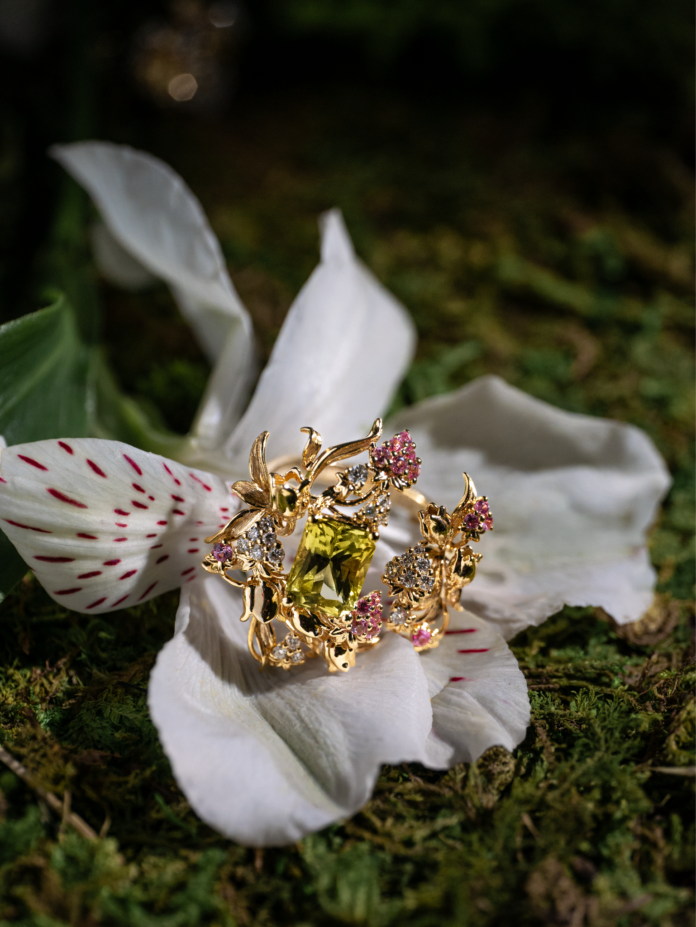
Through natural colored gemstones, sculptural growth and open composition, the New York–based designer transforms private memories into forms intended to be worn and lived with over time.
A miniature strawberry can become a vessel for memory.
In one of Yi Xiong (Aris)’s works, the motif emerged from the relationship between a mother in Beijing and a daughter in London. The syllable “Mei” in the mother’s name prompted an association with méi (莓), the Chinese character used in words for berries. Rather than illustrating the story literally, Yi Xiong concealed a tiny strawberry among lily-of-the-valley blossoms, gemstones and gold branches.
The detail offers an entry into her broader practice. Memory rarely appears in Yi Xiong’s jewelry as a complete or literal image. More often, it is distilled into a color, a gesture, a direction of growth or a detail whose full significance belongs only to the wearer. Designing from memory is not an attempt to reproduce the past. It is a way of identifying what feels most irreplaceable within it and giving that feeling a form that can endure.
Yi Xiong is a designer at Aris Fine Studio, a New York–based fine jewelry house working primarily with 18-karat gold, natural colored gemstones and bespoke commissions. The Guardian, Seasons and Lumen collections she has created draw respectively from companion animals, botanical life and the seasons, and the architecture and light of New York. Rather than relying on a single recurring motif, the collections share a consistent approach to space, movement and color.
A Private Language of Detail
Yi Xiong’s work often begins with a specific personal experience: a family member, a partner, a companion animal or a period of change. Her interest lies not in recounting an entire story, but in preserving its most precise emotional clue.
The strawberry in Lily of the Valley Ring is deliberately understated. From a distance, it reads as one detail within the larger composition. Only at closer range does its private significance begin to surface. To an outside viewer, the jewel is visually complete without explanation. For the wearer, it preserves another language entirely.
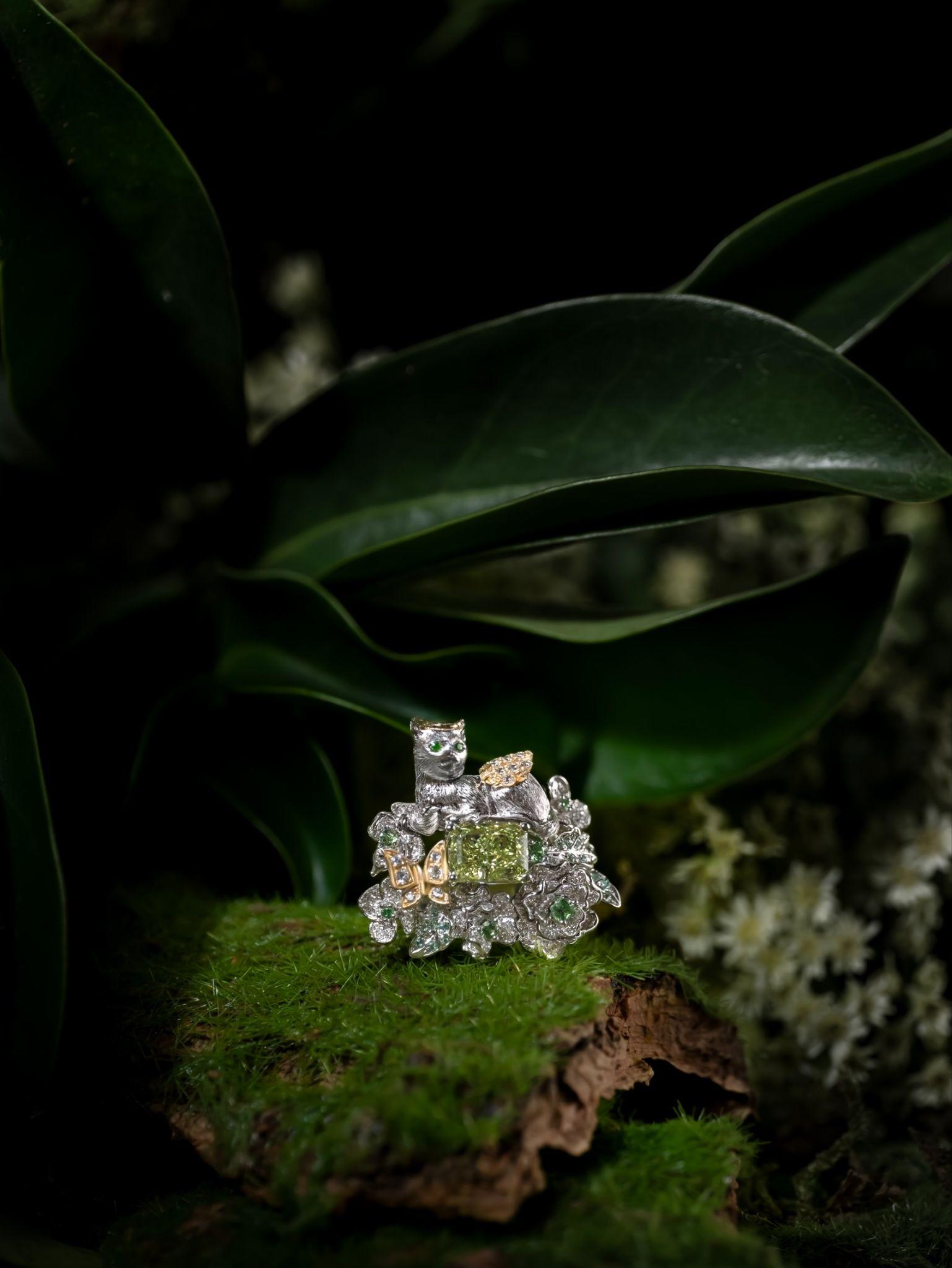
A similar process shapes the Guardian collection. Rather than reducing a photograph of a companion animal to the scale of a jewel, Yi Xiong looks for more intimate characteristics: the color of its eyes, a familiar posture, a particular expression or a small habit remembered through years of living together. These details may reappear as a natural gemstone, a movement in metal or a botanical or personal symbol concealed within the composition.
Guardian is one of the collections in which Yi Xiong addresses companionship and private memory most directly. She brings the language of botanical growth together with the recognizable gestures of a companion animal, allowing natural forms to convey protection, vitality and emotional connection rather than simply decorate a portrait. Posture, gemstone color and the outward movement of the structure come together as sculptural fine jewelry charged with personal meaning.
Between Organic Growth and Urban Order
If memory determines why a piece exists, nature and the city help determine how that memory takes form.
Nature in Yi Xiong’s work is not limited to recognizable flowers and foliage. She is drawn to the logic of growth itself: how a branch extends, how one form supports another and how opposing directions can achieve balance without symmetry.
Branches emerge from the ring shank. Gemstones occupy different elevations. Flowers and leaves rise, descend or extend outward. The resulting works maintain a stable visual center without settling into strict bilateral symmetry. Their sculptural growth makes them feel less like closed objects than forms still in the process of becoming.
This quality is particularly evident in Lily of the Valley Ring, which received a Silver A’ Design Award in Jewelry Design in 2026. Yi Xiong establishes its spatial relationships through lily-of-the-valley blossoms, wild-strawberry leaves and gemstones positioned at different heights. The downward movement of the flowers meets the outward extension of the foliage, while layered gold structures give certain elements a subtle sense of suspension. The ring has no single prescribed front and unfolds as the hand moves.
Living and working in New York has also reshaped Yi Xiong’s understanding of space. Layered façades, cantilevered structures, connections between different elevations and points of light suspended above the city have gradually entered the way she imagines jewelry.
In the Lumen collection, the softness of botanical lines begins to meet the harder order of the city. Recognizable foliage gives way to clearer geometry, architectural curves, interrupted lines and suspended gemstones, yet the vitality of Yi Xiong’s botanical works remains. Lines continue to reach outward while separate elements gather, grow and respond to one another across different elevations.
The form has changed. Organic curves become more restrained and structural, but the energy moving through them remains. Nature gives Yi Xiong’s jewelry life and motion; the city gives that movement order.
Connecting the two is her continued use of open composition. A ring may be divided at the top, two forms may approach without touching or a line may stop before reaching its expected destination. Negative space is not treated as an area left undecorated. It carries visual weight alongside gold and gemstones.
Open composition is not synonymous with the open-ring format. It can also emerge through pierced structures, interrupted outlines, suspended elements and measured distances within continuous rings, necklaces and bespoke works. These openings allow the eye to enter the jewelry and make each piece legible from multiple viewpoints.
Openness does not imply looseness. Yi Xiong rarely relies on mirrored symmetry. Instead, she balances visual weight and directional force. A descending flower may be answered by an ascending line, while an outward extension may be stabilized by a gemstone or an empty interval elsewhere.
The equilibrium is relational rather than symmetrical.
Natural Gemstones as Emotional Anchors
Color offers another way for Yi Xiong to translate emotion into material.
Having studied oil painting and color from an early age, she approaches gemstones as areas of color within a larger composition rather than as isolated precious objects. When selecting natural stones, she considers rarity and carat weight alongside their relationships to surrounding gems, metal, light and negative space.
Her palettes rarely settle into safe harmony.
Instead of relying on the familiar pairing of a colored center stone with colorless diamonds, Yi Xiong often introduces a second, less expected hue. It can redirect the eye, alter the perceived depth of the composition or create restrained tension within an otherwise cohesive palette.
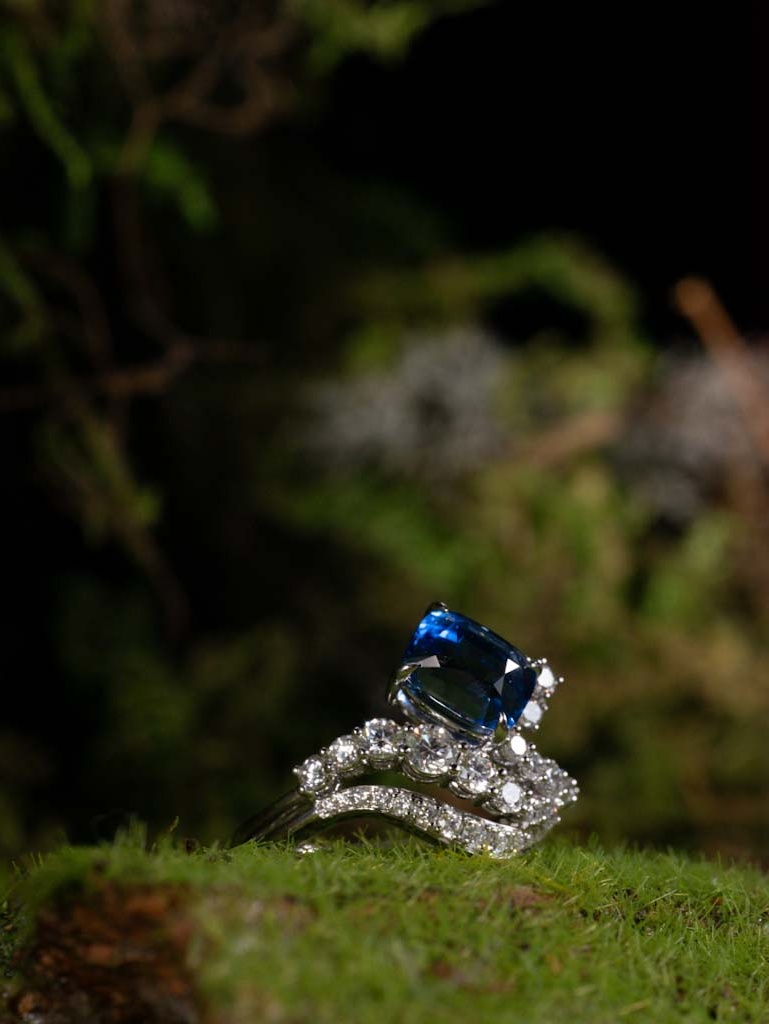
In a Guardian ring created for Milo, Yi Xiong selected a green diamond to echo the color of his eyes. Color does more than strengthen the portrait’s individual character here; it becomes a way of preserving the memory of companionship. Luna’s ring takes a royal-blue sapphire as its chromatic foundation, accented by dragonfly motifs in vivid yellow and red. These secondary colors interrupt the safer conventions of blue-sapphire jewelry and introduce a more animated, distinctly personal rhythm into the deep-blue composition.
The colors are not decorative additions to a completed design. They help determine the order of perception, the visual center and the emotional register of the piece, bringing the relationship between gemstones closer to the construction of color in painting.
The individuality of natural gemstones is equally important to Yi Xiong’s practice. Variations in hue, saturation and response to light create a starting point that cannot be entirely standardized. Each stone can redirect the palette, shift the visual center or give a piece its particular emotional character.
In Guardian, color may echo the eyes or coat of a companion animal or preserve an association known only to the wearer. In Seasons, colored gemstones register subtle changes in botanical life, season and light. In Lumen, differences in brilliance, saturation and darkness evoke the layered illumination of New York after nightfall.
Richness in Yi Xiong’s work does not become excess because each detail is carefully ordered. Silhouette, direction and dominant color register first; concealed stones, botanical elements and private symbols reveal themselves more gradually.
Modernity emerges not from eliminating detail, but from determining how and when each detail should be seen.
A Creative Language Coming into Focus
In 2026, this evolving approach received a more public form of recognition.
Yi Xiong (Aris) received two Silver A’ Design Awards in Jewelry Design for Heart in Bloom Ring and Lily of the Valley Ring. As of August 2026, the two awards give her a cumulative score of eight and place her at No. 98 in the DAC Jewelry Design Classification, bringing her into the category’s top 100.
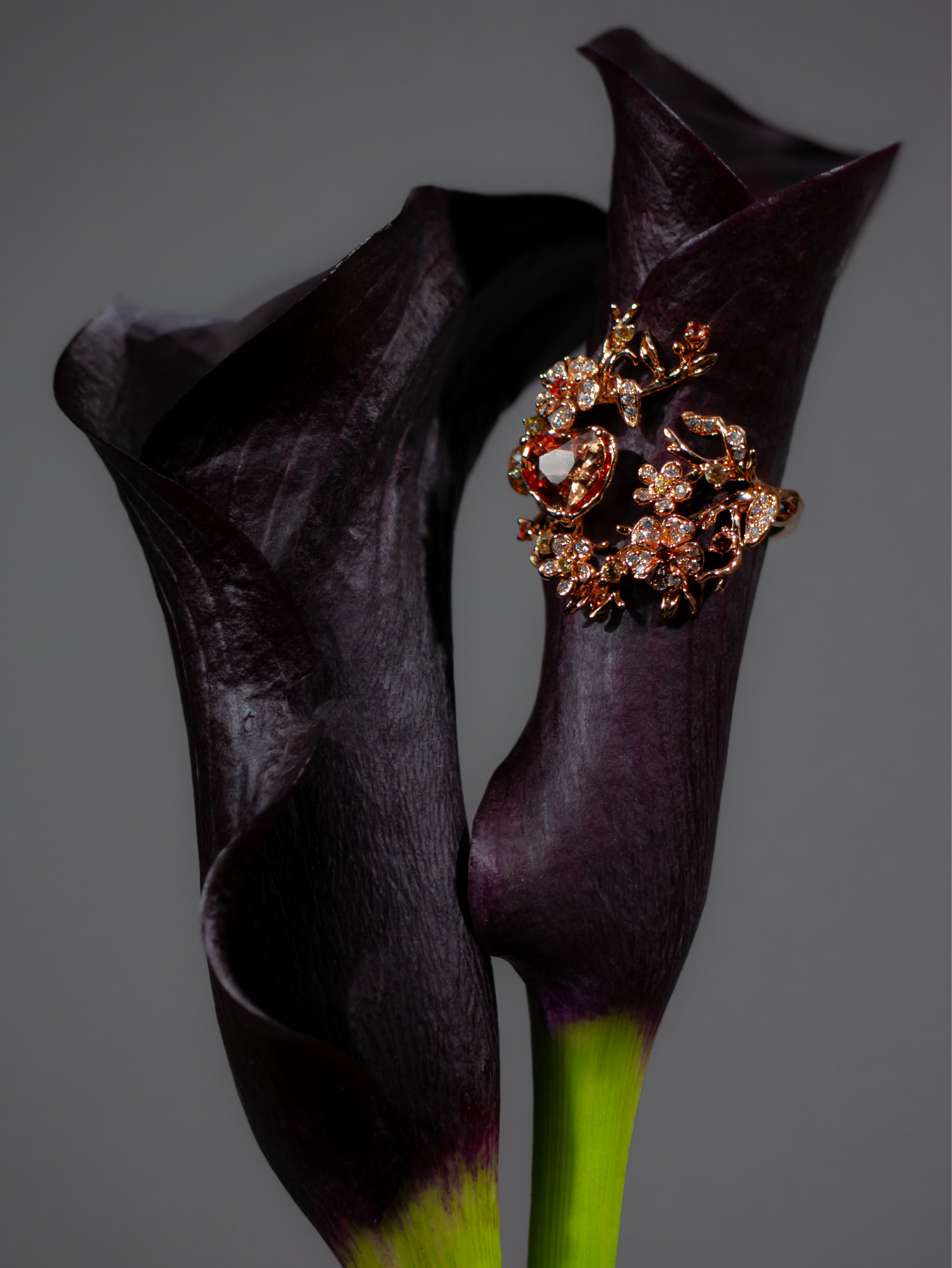
The awarded pieces do not stand apart from the rest of Yi Xiong’s practice as isolated competition works. Seen within the broader world of Aris Fine Studio, they recognize more than a particular floral vocabulary. They draw attention to an increasingly coherent creative method.
Across her collections, Yi Xiong follows a related way of making. She begins with an emotional clue, allows nature to provide life and movement, draws spatial order from the city, and uses natural gemstones and craftsmanship to give an invisible experience physical form.
“My work often begins with a memory. Natural gemstones help me locate its emotion, nature gives it a direction in which to grow, and New York shapes how I understand structure and space. In the end, all of this must return to the jewelry itself. It has to be wearable, and it has to remain with someone for a long time.”
Yi Xiong (Aris)
The heirloom, in Yi Xiong’s work, does not depend on inherited iconography. It emerges through an act of private recognition. A jewel may remain formally complete to an outside viewer while preserving an entirely different history for its wearer.
It is in this distance between public form and private memory that her practice finds its clearest identity.

